
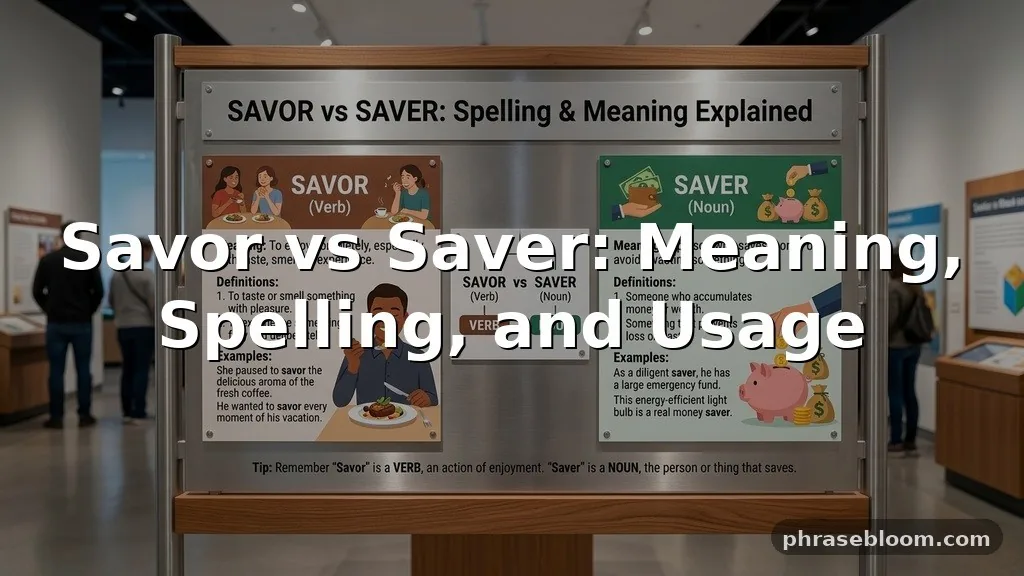
Savor vs saver is a spelling comparison between two different words, not two interchangeable versions of the same word. Savor usually means to enjoy something slowly and appreciate its flavor or quality, while saver is a person or thing that saves money, time, energy, or another resource. The words look similar, but their meanings and grammatical roles are distinct.
The difference matters in menus, reviews, personal finance advice, product descriptions, and everyday writing. Once you connect savor with careful enjoyment and saver with saving, the spelling becomes easier to remember, and you can avoid treating these non-homophones as a simple vowel variation.
Savor vs Saver: The Short Answer
Savor is a verb meaning to enjoy something fully and slowly, especially food, a drink, an experience, or a moment. It can also be a noun referring to a distinctive taste or quality, although that noun use is less common than the verb.
Saver is a noun for someone or something that saves. A person who puts money aside may be a saver, and a product that reduces household costs may be described as a money saver or time saver.
| Word | Part of speech | Core meaning | Example |
|---|---|---|---|
| Savor | Verb, sometimes noun | Enjoy slowly or appreciate deeply | She savored the final bite. |
| Saver | Noun | A person or thing that saves | The new feature is a time saver. |
| Savour | Verb, sometimes noun | British spelling of savor | He savoured the meal. |
These words are not homophones. Their vowel sounds differ in standard pronunciation, even though their written forms share the letters sav. A useful memory aid is simple: you savor a meal, but a saver saves something.
If you are writing in American English, use savor for the enjoyment word. In British English and some other varieties, savour is the usual spelling, while saver keeps its meaning related to saving.
Savor Meaning and Grammatical Use
The primary savor meaning is to enjoy something with attention and appreciation rather than rushing through it. The word often appears with food and drink, but it can describe an experience, memory, victory, conversation, or quiet period of rest.
In the sentence “They savored the dessert,” savored is a transitive verb because it takes the object the dessert. The sentence says more than “they ate the dessert.” It suggests that they paid attention to its taste and took pleasure in the experience.
Savor as a verb
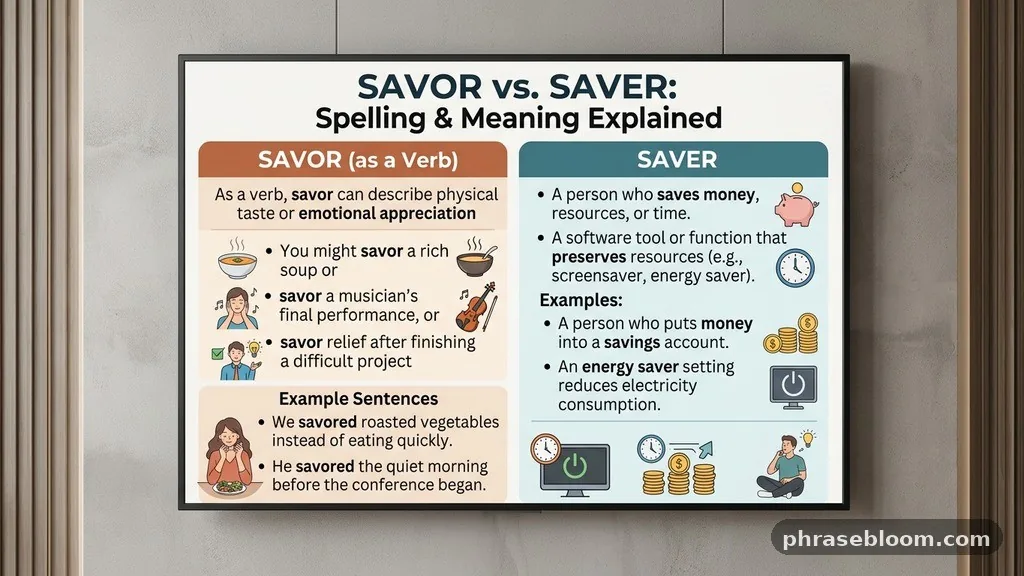
As a verb, savor can describe physical taste or emotional appreciation. You might savor a rich soup, savor a musician’s final performance, or savor the relief of finishing a difficult project.
- We savored the roasted vegetables instead of eating quickly.
- He savored the quiet morning before the conference began.
- The team savored its first winning season in several years.
- She wants to savor the opportunity before making another major decision.
The verb usually carries a positive or reflective tone. It implies deliberate attention, which is why phrases such as enjoy slowly, appreciate flavor, and relish food can sometimes explain its meaning to an English learner.
Savor can also take an abstract object. Someone may savor success, freedom, recognition, or a small victory. In those examples, the word describes a mental response rather than the act of tasting.
Savor as a noun
Savor as a noun refers to a distinctive taste, smell, quality, or characteristic. For example, “The sauce had a smoky savor” uses the noun to identify a particular quality of the sauce.
This noun sense is legitimate, but it appears less often in ordinary conversation than the verb. Writers may choose flavor, quality, character, or appeal instead, depending on the sentence.
Consider the difference between these two examples:
- Verb: The guests savored the meal.
- Noun: The meal had a savory savor that lingered after each bite.
The first sentence describes what the guests did. The second describes a quality of the meal. In many contexts, “savory flavor” would sound more natural than “savory savor,” so careful writers should choose the noun only when it adds a precise or deliberate effect.
Saver Meaning and Grammatical Use
The saver meaning centers on preservation or economy. A saver is a person, device, method, or feature that prevents waste or keeps something available for later use.
Most commonly, saver is a noun for a person who saves money. A saver may build an emergency fund, contribute to a retirement account, or set aside part of each paycheck for a future goal.
“Maya is a careful saver” describes Maya’s financial habit. It does not mean that she enjoys a meal slowly, even if the surrounding sentence mentions dinner or groceries.
Saver as a person
A saver may be cautious, disciplined, or simply focused on a particular financial objective. The word itself does not say whether the person saves a large amount or a small amount, and it does not automatically imply that the person is excessively frugal.
For instance, a college student who saves for a laptop is a saver, as is a household that maintains a long-term investment plan. The underlying action is the same: money is kept rather than immediately spent.
- She became a regular saver after creating an automatic transfer.
- The financial counselor encouraged every saver to keep a cash reserve.
- He is a patient saver who prefers steady progress to risky shortcuts.
The related phrase frugal person is not always an exact synonym. A frugal person may reduce spending through careful choices, while a saver specifically sets resources aside, but one person can be both.
Saver as a thing or feature
Saver can also describe something that reduces a cost or prevents wasted effort. A dishwasher setting may be called a water saver, a shortcut may be a time saver, and a software feature may be a labor saver.
Common compounds include money saver, time saver, space saver, and energy saver. In each case, the word identifies something that helps conserve the resource named before it.
“This template is a real time saver” means the template reduces the time required for a task. It does not mean that the template is enjoyable, although saving time may produce that result.
How Savor and Saver Are Pronounced
Savor and saver are sometimes confused because their spellings begin alike. They are not pronounced alike, however, and the difference becomes clearer when the words are spoken carefully.
In American English, savor is commonly pronounced roughly like “SAY-vur,” with the first vowel sounding like the vowel in day. Saver is commonly pronounced roughly like “SAY-vur” as well in many American accents, but the second syllable and surrounding vowel quality can vary by speaker, making the distinction subtle in connected speech.
Because regional pronunciation differs, listening alone may not always identify the word. Context remains essential. If the sentence concerns a meal, savor is likely; if it concerns money or preservation, saver is the likely choice.
Savor pronunciation and spelling
The pronunciation of savor in American English is often represented in dictionaries with an entry similar to “SAY-ver,” while the British spelling savour is pronounced the same way. The extra u changes the spelling, not the core meaning.
To savor something is to give it attention. The word is closely associated with taste because its history and common usage connect it with flavor and enjoyment, but modern usage extends well beyond food.
Saver pronunciation and spelling
The pronunciation of saver reflects its connection to the verb save. The ending -er creates a noun for someone or something that performs the action: a person who saves is a saver.
This pattern appears in many English words. A runner runs, a teacher teaches, and a saver saves. The spelling does not indicate enjoyment or flavor; it points to an agent of saving.
For a dependable reference on definitions and pronunciation, consult the Merriam-Webster dictionary. A dictionary is especially useful when you need to check whether a word is functioning as a verb, noun, adjective, or part of a compound expression.
Savor in Real Sentences
Context shows how flexible savor can be. The word works naturally in personal writing, restaurant reviews, literature, speeches, and workplace communication when the subject is an experience worth appreciating.
| Context | Example sentence | Why it works |
|---|---|---|
| Food | Take a moment to savor the citrus and herbs in the sauce. | Savor means to appreciate the taste. |
| Travel | We savored the last evening of the trip. | The object is an experience rather than food. |
| Achievement | She savored the recognition after months of work. | The verb expresses emotional enjoyment. |
| Writing | The novel invites readers to savor each carefully chosen detail. | Savor encourages slow, attentive reading. |
Restaurant writers often use savor when they want to suggest attention and pleasure rather than mere consumption. “Savor the smoky finish” sounds more deliberate than “taste the smoky finish,” although both sentences can be grammatically correct.
Marketing copy also uses savor as an invitation. A coffee brand may ask customers to savor a roast, while a travel company may encourage visitors to savor a sunset or local tradition.
The word can be effective in workplace communication too, but it should fit the tone. “Let’s savor this milestone before turning to the next deadline” sounds warm and celebratory, while “savor the quarterly figures” may sound strange unless the writer is intentionally being playful.
Savor versus relish
Relish food and savor food are close in meaning. Both can describe taking pleasure in eating, but relish often sounds more enthusiastic or energetic, while savor can suggest slower, more attentive appreciation.
“He relished the spicy noodles” emphasizes enjoyment. “He savored the spicy noodles” emphasizes the careful experience of tasting them. Neither word guarantees a particular speed or quantity of eating, so the best choice depends on the tone you want.
Saver in Financial and Workplace Writing
Saver is especially common in financial writing because saving is a central personal finance behavior. A bank may address new savers, a budgeting app may describe a money saver, and an adviser may explain how a regular saver can build reserves over time.
In these contexts, saver is concrete and easy to understand. It identifies a person or tool associated with saving without requiring a longer phrase such as “someone who regularly sets money aside.”
- Personal finance: A first-time saver may begin with an automatic weekly transfer.
- Consumer products: The insulated bottle is a money saver for commuters who bring drinks from home.
- Project management: The reusable checklist is a time saver for new team members.
- Technology: The backup feature can be a major data saver during a device failure.
The term can be positive, neutral, or descriptive depending on the surrounding language. “A disciplined saver” praises financial consistency, while “a reluctant saver” identifies someone who saves despite finding it difficult.
Be careful not to turn saver into an adjective without a reason. “Saver account” may appear in product names or specialized financial language, but in ordinary prose, “savings account” is usually the established phrase.
Likewise, do not use savor when you mean that a person has reduced spending. A sentence such as “She is trying to savor money for a down payment” is incorrect in standard business English. The correct verb is “save”: “She is trying to save money for a down payment.”
British English, American English, and the Spelling Difference
The main regional spelling difference concerns savor and savour, not savor and saver. American English generally uses savor, while British English commonly uses savour for the enjoyment word.
The noun or verb related to saving remains saver in both varieties. A British writer may say, “She savoured the meal,” and also, “She is a careful saver.” The different spellings reflect different words, not a difference between American and British meanings.
Regional usage is not completely uniform. Canadian, Australian, and other English varieties may follow patterns associated with either American or British conventions depending on the publication, institution, or audience.
Why spelling choices vary
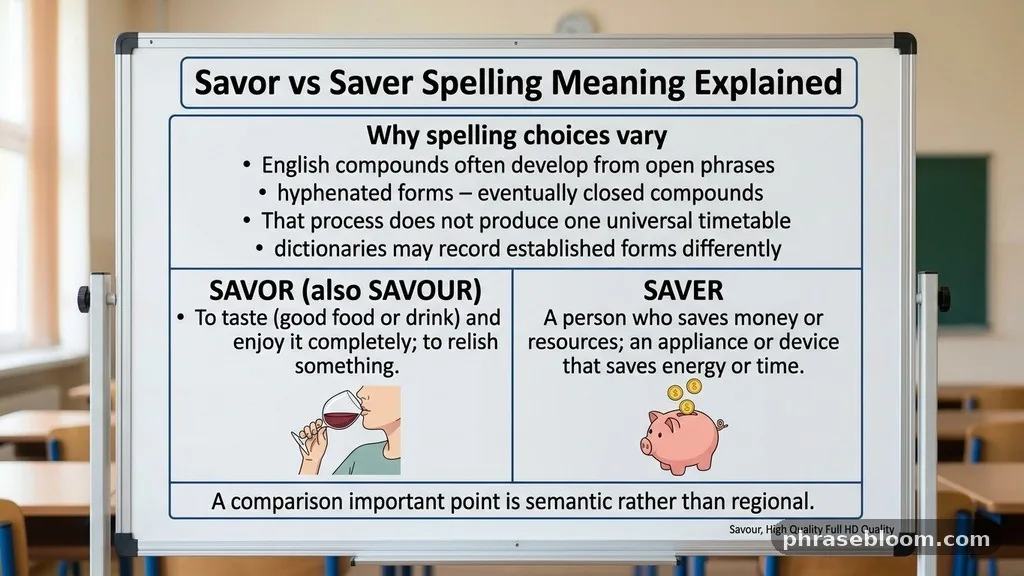
English compounds often develop from open phrases to hyphenated forms and eventually to closed compounds. That process does not produce one universal timetable, and dictionaries may record established forms differently.
For the savor versus saver comparison, the important point is semantic rather than regional. Savour means the same thing as savor in the relevant sense, while saver refers to someone or something that saves.
Writers should also distinguish pronunciation from spelling. A person may hear savor and saver as very similar, especially in a fast conversation, but the written context usually makes the intended meaning clear.
If your audience is international, choose the spelling that matches the publication’s established English variety. Do not switch between savor and savour in one document unless you are deliberately discussing regional usage.
Common Mistakes with Savor and Saver
Most mistakes happen because the words share a beginning and appear in similar-looking sentences. A quick check of the intended meaning will usually resolve the problem.
Using saver for enjoyment
“We saver the final course” is incorrect because saver is a noun, not the past-tense form of savor. The correct sentence is “We savored the final course.”
The ending helps here. Savor becomes savored in the past tense, while saver names a person or thing that saves. They belong to different grammatical categories.
Using savor for financial saving
“He wants to savor more money each month” is also incorrect. The correct wording is “He wants to save more money each month,” or “He wants to become a better saver.”
The verb save describes the action. Saver describes the person or tool connected with that action.
Confusing savour with saver
British spelling can add another layer of confusion. “Savour” is the British form of the enjoyment word, not an alternate spelling of saver.
These sentences show the distinction:
- British English: We savoured the dessert.
- American English: We savored the dessert.
- Both varieties: The automatic transfer helped her become a saver.
Assuming the words are homophones
Savor and saver are not homophones because they are not identical in sound and meaning. Even if a speaker’s accent makes the difference difficult to hear, the words remain separate entries with separate grammatical uses.
Proofreading software may not catch every substitution because both words are valid English words. Human review and context are still valuable, especially in short sentences where only one word appears.
How to Choose the Right Word
Use a simple meaning-first test. Ask whether the sentence describes enjoyment or saving.
- If the subject is appreciating taste, a memory, an experience, or an achievement, choose savor or savour.
- If the subject is a person or thing that preserves money, time, space, energy, or data, choose saver.
- If the sentence describes the act of putting money aside, use the verb save, not savor or saver.
- If the audience follows British English, consider savour for the enjoyment meaning.
- Read the completed sentence aloud and check whether the surrounding noun or verb supports the intended meaning.
Grammar provides another useful clue. Savor can be a verb: “They savor the moment.” Saver is normally a noun: “They are careful savers.” If the blank requires an action word, saver is unlikely to be correct.
Look at the word before and after the blank. An article such as a often introduces saver because it names a person or thing: “a saver,” “a time saver,” or “a money saver.” Savor often follows a subject and functions as an action: “she savors,” “they savored,” or “we will savor.”
Finally, consider whether the sentence would be clearer with a related word. “She savored the memory” is natural, while “she appreciated the memory” may be more direct in formal prose. Good writing is not only about selecting the correct spelling; it is also about selecting the most precise expression.
Professional, Academic, and Everyday Usage
In professional writing, savor is appropriate when the subject involves customer experience, food, hospitality, celebration, or reflection. A restaurant report might say that customers were encouraged to savor the tasting menu, while an internal announcement might invite employees to savor a team achievement.
Saver belongs naturally in financial, operational, and technical contexts. A benefits presentation may refer to regular savers, and a project report may describe a reusable process as a time saver.
Business communication
Business emails should use the word that matches the intended action. “Please savor the opportunity” is possible but expressive; “Please save the file before closing the program” is the practical instruction most workplace messages require.
For a celebration, however, savor can be effective. “Let’s take a moment to savor the successful launch before we begin the next phase” gives a team message a human tone without creating ambiguity.
Academic writing
Academic writers should define the intended sense through context. A paper about food culture may analyze how diners savor meals, while a paper about household finance may study the behavior of savers.
Formal writing does not require avoiding savor or saver. It requires using each word accurately and avoiding decorative language that does not support the argument. If “experience,” “taste,” or “saving behavior” is more precise, use that alternative.
Websites and marketing
Marketing copy often uses savor because it creates an invitation to experience something fully. “Savor seasonal ingredients” is a natural restaurant phrase, while “Save more with our refill program” addresses the economic benefit directly.
A product description may call an item a money saver, but the claim should be specific enough for readers to understand what is being saved. The word saver identifies the benefit category, not proof of a particular financial result.
Related Words and Better Alternatives
Sometimes a related word communicates the idea more clearly than savor or saver. Rewriting can also remove confusion when a sentence feels too dependent on a small spelling distinction.
| Intended idea | Useful word or phrase | Example |
|---|---|---|
| Enjoy slowly | Savor | Try to savor the last course. |
| Appreciate taste | Enjoy, taste, appreciate | Guests appreciated the subtle spice. |
| Person who saves money | Saver | Every saver needs a realistic goal. |
| Reduce spending | Save money | Buying in bulk can save money. |
| Something that reduces effort | Time saver, shortcut, efficiency | The new form is a major time saver. |
Use relish when you want a stronger sense of enthusiastic enjoyment. Use appreciate when the focus is recognition or understanding rather than sensory pleasure.
For saving, choose economical, cost-effective, thrifty, or frugal when you are describing a method or person rather than naming an agent. “A frugal household” describes spending habits, while “a saver” identifies someone who sets resources aside.
The clearest alternative is often a full phrase. Instead of “She is a saver,” you might write “She regularly sets aside part of her income.” Instead of “Savor the moment,” you might write “Take time to appreciate the moment.”
Examples You Can Copy and Adapt
The following examples show the words in realistic contexts. They also demonstrate that savor can be emotional or sensory, while saver generally identifies a person or practical benefit.
- Take a quiet minute to savor the first cup of coffee.
- The chef asked guests to savor the broth before adding seasoning.
- We should savor this success because the project required months of work.
- The author encourages readers to savor each scene.
- She became a saver after setting a clear emergency-fund goal.
- The reusable shipping box is a money saver for the small business.
- This keyboard shortcut is a genuine time saver.
- A patient saver can make steady progress without dramatic lifestyle changes.
- He saved money by preparing lunch at home.
- They savoured the local specialty during their visit to London.
Notice the difference between “The guests savored the meal” and “The guests were savers.” The first sentence describes an experience at the table. The second describes a financial or resource-related habit and would need additional context to make sense.
Also compare “This plan is a money saver” with “This plan helps customers save money.” The first uses saver as a noun, while the second uses save as a verb. Both can be correct, but the second may be clearer in formal explanatory writing.
If you are unsure, replace the disputed word with a plain phrase. If “enjoy slowly” fits, choose savor. If “someone or something that saves” fits, choose saver.
Frequently Asked Questions
What is the difference between savor and saver?
Savor means to enjoy or appreciate something slowly and fully. Saver is a noun for a person or thing that saves money, time, energy, space, or another resource.
Is savor a verb or a noun?
Savor is most commonly a verb, as in “They savored the meal.” It can also be a noun meaning a distinctive taste or quality, although that noun use is less common in everyday writing.
Is saver always related to money?
No. A saver can be a person who saves money, but it can also be something that saves time, energy, space, or data. Examples include time saver, energy saver, and space saver.
Are savor and saver homophones?
No. They have different meanings and are not identical in pronunciation. Their similar spelling can create confusion, especially in fast speech or proofreading.
Is savour the British spelling of savor?
Yes. British English commonly uses savour for the word meaning to enjoy or appreciate something. Saver remains the word connected with saving, regardless of whether the writer uses American or British English.
Conclusion
The practical difference in Savor vs Saver is easy to remember once you focus on meaning. Savor describes enjoying something slowly or appreciating its qualities, while saver names a person or thing that preserves a resource. In British English, the enjoyment word is commonly spelled savour, but it still differs from saver.
Before publishing, replace the word with “enjoy slowly” or “someone or something that saves.” That quick test usually reveals the correct choice. If you have a useful example of savor or saver in workplace, financial, or everyday writing, share it with other readers.
Related reading: Imbed vs Embed, Alright vs All Right, Gluing vs Glueing.
1 thought on “Savor vs Saver: Meaning, Spelling, and Usage”