
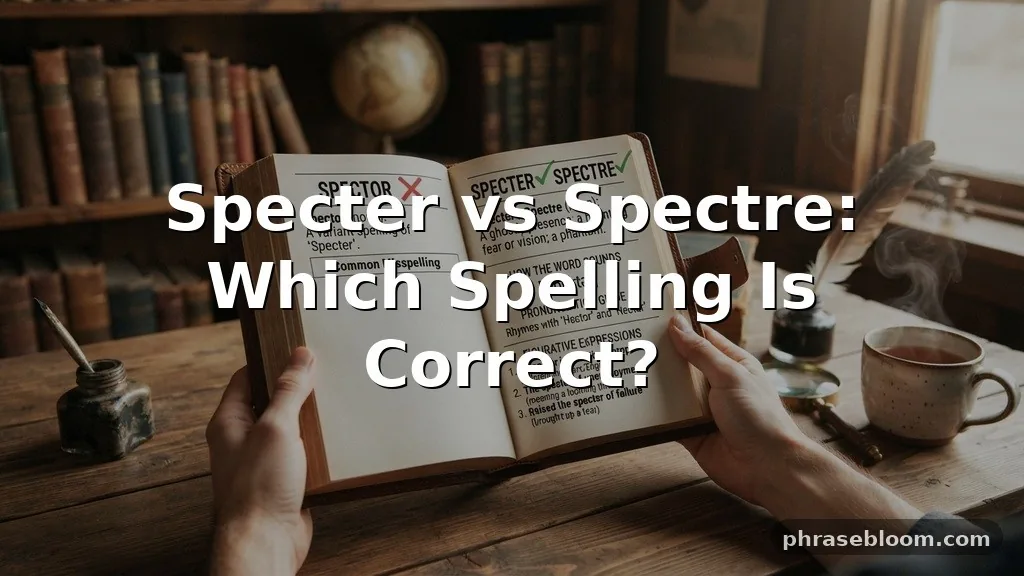
The spelling difference between specter and spectre reflects regional variation in English, not a major difference in meaning. Both words describe a ghost, apparition, phantom, or haunting presence, and both can also refer to a threatening idea or possibility.
In American English, specter is usually preferred, while British English commonly uses spectre. The pronunciation is generally the same, so the choice depends mainly on your audience, the variety of English you are using, and the style of the publication. The history behind the two forms also explains why both remain standard.
Specter vs Spectre: The Short Answer
Specter and spectre are both correct English spellings. They have the same basic definition and are pronounced in essentially the same way, usually as “SPEK-ter.”
The practical rule is simple: use specter in American English and spectre in British English unless a particular publication, organization, or quotation requires another form. Neither spelling is inherently more correct.
| Spelling | Language variety | Meaning | Typical recommendation |
|---|---|---|---|
| specter | American English | Ghost, apparition, or threatening possibility | Use for a primarily American audience |
| spectre | British English | Ghost, apparition, or threatening possibility | Use for a primarily British audience |
For example, an American newspaper might write, “The specter of recession continues to worry investors.” A British newspaper is more likely to write, “The spectre of recession continues to worry investors.” The sentence means the same thing in both versions.
The spelling should not be confused with a difference in pronunciation. In ordinary speech, listeners generally cannot tell whether the writer would spell the word with an -er or -re ending.
What Does Specter or Spectre Mean?
The literal meaning of specter or spectre is a ghostly or supernatural appearance. It can describe an apparition that seems to visit or haunt a person, place, or story.
Consider these literal uses:
- “A pale specter appeared at the end of the hallway.”
- “The novel opens with a spectre walking through the ruined house.”
- “Local legends describe the bridge as the home of a restless specter.”
In each example, the word suggests a ghost, phantom, or spirit. It often creates an atmosphere of fear, mystery, or haunting without specifying exactly what the apparition looks like.
The word also has a common figurative meaning. A specter or spectre can be an unwelcome possibility that seems to threaten the future, even though it is not a physical being.
- “The specter of war affected the government’s decisions.”
- “The spectre of unemployment remains a serious concern.”
- “The company faced the specter of a costly lawsuit.”
Here, the word does not mean that a ghost is literally present. It means that a danger, fear, or troubling possibility hangs over a situation like a ghost.
The term can therefore appear in fiction, history, politics, economics, journalism, and everyday commentary. A “specter of failure” is not a visible phantom, but it is a powerful image for an idea that causes anxiety.
Why Are There Two Spellings?
The two forms developed from the same underlying word but followed different spelling conventions. The history of specter vs spectre is tied to the movement of English between languages and regions.
The word ultimately relates to the Latin spectrum, meaning an appearance, image, or apparition. English borrowed and adapted related forms through French and Latin-influenced vocabulary. Over time, English writers used more than one ending.
The -re spelling became strongly associated with British English, as did a number of other words that end in -re, including “centre,” “metre,” and “theatre.” American English often changed or regularized these endings to -er, producing “center,” “meter,” and “theater.”
That pattern is not absolute, and the history of each word is different. Still, it helps explain why “spectre” feels familiar in British writing while “specter” is the ordinary form for many American readers.
The spelling variation does not indicate two separate supernatural beings. It is an example of how English spelling can preserve regional traditions while the spoken word remains nearly identical.
For historical background, readers can consult the Oxford English Dictionary entry for “spectre”, which traces the word’s development and recorded meanings.
American English and British English Usage
Specter is the standard spelling in American English. It appears in American books, newspapers, academic publications, business writing, and general web content.
Spectre is the usual spelling in British English. It is also common in other varieties of English that often follow British spelling conventions, although individual countries and organizations may have their own preferences.
Regional usage does not create a strict divide in every international setting. A British writer may use “specter” when quoting an American source, writing for an American audience, or following a publication’s specified style. An American writer may retain “spectre” in a quotation, a title, or a discussion of British literature.
| Context | Likely spelling | Example |
|---|---|---|
| American newspaper | specter | The specter of inflation dominated the debate. |
| British newspaper | spectre | The spectre of inflation dominated the debate. |
| American fiction | specter | A specter appeared beside the old chapel. |
| British fiction | spectre | A spectre appeared beside the old chapel. |
| International publication | Either, used consistently | Follow the publication’s house style. |
The safest choice is not always the form you personally see most often. Match the spelling to the expected variety of English, especially in formal writing, educational materials, publishing, and professional communication.
If your audience is international and no style guide gives a preference, either form will usually be understood. Consistency matters more than claiming that one regional spelling is universally superior.
Specter and Spectre Pronunciation
In most varieties of English, specter and spectre have the same pronunciation. They are generally pronounced with two syllables: “SPEK-ter.”
The first syllable carries the main stress. The final sound is similar to the ending in “better” for many American speakers, although accents vary across English-speaking regions.
Because the pronunciation is so similar, the difference usually appears only in writing. A listener may understand the word perfectly without knowing which spelling the speaker would choose.
Pronunciation can change slightly across regional accents, but there is no standard rule that assigns one pronunciation to “specter” and another to “spectre.” The distinction is primarily orthographic, meaning that it concerns written form.
Writers should therefore avoid treating the two spellings as homophones with different meanings. They are two written forms of the same word, not a pair of words that must be separated in speech.
How the Word Sounds in Figurative Expressions
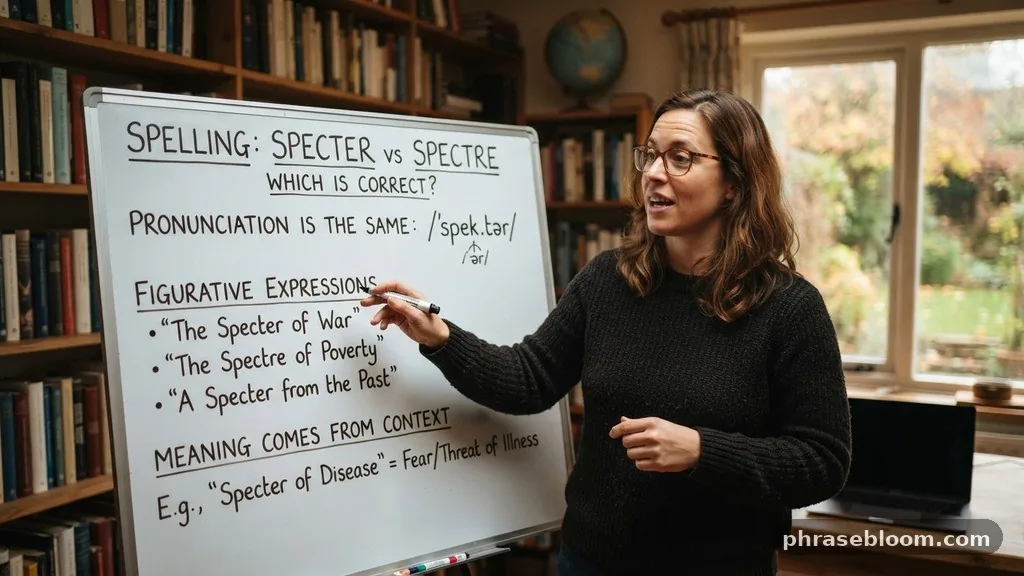
The pronunciation stays the same in expressions such as “the specter of war,” “the spectre of poverty,” and “a specter from the past.” The figurative meaning comes from context rather than from a change in sound.
For example, “the specter of disease” means the fear or possibility of disease, while “a specter in the hospital” more likely describes a literal ghostly figure. The surrounding nouns and verbs guide the reader toward the intended sense.
Specter vs Spectre in Real Sentences
Both spellings work naturally in descriptions of supernatural events. The choice depends on the English variety of the surrounding text.
- American English: “The detective found no evidence that the specter was more than a reflection.”
- British English: “The detective found no evidence that the spectre was more than a reflection.”
- American English: “A specter was said to haunt the abandoned theater.”
- British English: “A spectre was said to haunt the abandoned theatre.”
The paired examples show how spelling can change alongside other regional forms. An American writer may use “theater,” while a British writer may use “theatre,” but the sentence’s meaning remains unchanged.
The word also appears frequently in news and public affairs writing:
- “The specter of rising costs has forced the council to reconsider the project.”
- “The spectre of political instability influenced the election campaign.”
- “Investors are watching for signs that the specter of recession is returning.”
These sentences use the word figuratively. The specter represents a threat or possibility rather than a supernatural apparition.
In literary criticism, the term may describe a recurring image, an unresolved past, or a historical memory:
- “The novel is shaped by the specter of the narrator’s absent father.”
- “The play returns repeatedly to the spectre of a war that ended decades earlier.”
These examples work because the word suggests something that remains present in the imagination. It may be invisible, but it continues to affect the characters or the public discussion.
When Should You Use Specter?
Use specter when you are writing in American English or for an audience that expects American spelling. This is the standard choice in most United States schools, newspapers, corporate documents, and general publications.
American professional writing may use the word in a figurative phrase such as “the specter of litigation” or “the specter of declining demand.” The expression is formal but familiar, making it useful in reports, commentary, and analysis.
Examples include:
- “The specter of higher interest rates has changed the company’s investment plans.”
- “The report examines how communities respond to the specter of water shortages.”
- “A specter from the region’s industrial past appears throughout the documentary.”
American fiction writers also use “specter” for a ghost, phantom, or supernatural presence. The word can sound serious and atmospheric without being limited to horror writing.
If you are preparing a document for a multinational organization, check whether its editorial policy follows American English. A company may use American spelling across all offices even when employees work in countries where British English is common.
When Should You Use Spectre?
Use spectre when you are writing in British English or following a publication that uses British spelling. It is the natural choice in many British novels, newspapers, essays, government documents, and cultural discussions.
The spelling is also appropriate when the subject itself has a British setting or source. For example, a quotation from a British author may retain “spectre,” even when the surrounding article is written for an international readership.
Examples include:
- “The spectre of recession has returned to the political debate.”
- “The castle’s spectre appears only during the winter months.”
- “The historian describes empire as a spectre that continues to shape national identity.”
British English often uses “spectre” alongside spellings such as “centre,” “labour,” and “organise,” but a writer should not assume that every word follows one universal regional pattern.
Some British publications may adopt a house style that differs from traditional expectations. The publication’s own instructions should take priority over a personal preference.
Is One Spelling More Formal or Correct?
Neither spelling is automatically more formal. Specter is not a casual version of spectre, and “spectre” is not inherently more literary or sophisticated.
Readers may associate “spectre” with British literature or older texts, which can give it a particular tone. That association comes from exposure and cultural context, not from a difference in grammatical status.
Likewise, “specter” may feel more natural in American reporting or academic prose because it matches the reader’s expected spelling. A familiar form often reads more smoothly, but that does not make it more formal.
In professional writing, the most formal choice is the one that fits the document’s language standard. A report written in American English should normally use “specter,” while a British report should normally use “spectre.”
Consistency is especially important in long documents. Switching between the two forms without a reason can look like an editing error, even though both spellings are legitimate.
Common Mistakes and How to Avoid Them
The most common mistake is treating the two spellings as if they have different definitions. They do not. In ordinary usage, both can mean a ghost, an apparition, or a threatening possibility.
Mistake: “The specter means a physical ghost, but the spectre means a political threat.”
Correction: Both spellings can be used in either sense. The context determines whether the reference is literal or figurative.
Another mistake is assuming that one form is always wrong because it does not match the writer’s local convention. An American editor should not mark “spectre” as a spelling error in a British quotation, and a British editor should recognize “specter” as standard American English.
Mistake: “Spectre is incorrect because the document uses American English.”
Correction: “Specter” is the preferred American form, but “spectre” may be retained in a proper title, quotation, or source name.
Writers may also use inconsistent forms in the same document:
Inconsistent: “The specter of war appears in chapter two, while the spectre of poverty dominates chapter four.”
Better: “The specter of war appears in chapter two, while the specter of poverty dominates chapter four.”
If the document follows British English, use “spectre” in both sentences instead. The goal is not to erase regional identity but to make the chosen standard clear.
A final mistake is changing the spelling inside a fixed name or quoted work. Titles, names of organizations, and direct quotations may need to preserve their original form.
How to Choose the Right Form
Choosing between “specter” and “spectre” becomes easy if you make the decision in a sensible order. Start with the audience, then check the publication or organization’s style.
- Identify the variety of English. Use “specter” for American English and “spectre” for British English unless another rule applies.
- Check the style guide. A publisher, university, employer, or journal may specify spelling preferences.
- Look at nearby words. Spellings such as “color” or “colour” and “center” or “centre” can reveal the document’s general language standard.
- Preserve quotations and titles. Do not silently alter a source’s spelling when accuracy requires the original form.
- Stay consistent. Once you choose one form for ordinary prose, use it throughout the document.
For a personal email, either spelling may be acceptable if the audience understands it. In a formal report, consistency and regional fit matter more because the document represents an institution or professional writer.
Academic writers should follow the requirements of their instructor, department, journal, or publisher. A paper using American citation and spelling conventions will usually favor “specter,” while a British university may prefer “spectre.”
Marketing and public communication require a similar decision. A global brand may choose one spelling for its entire website, while regional campaigns may adapt the language for local readers.
Related Words and Useful Alternatives
Writers do not always need to use either spelling. Several alternatives can express a similar idea, although each carries a slightly different tone.
| Word or phrase | Typical meaning | Useful when |
|---|---|---|
| ghost | A spirit of a dead person or a supernatural figure | You want plain, direct language |
| apparition | A visible supernatural appearance | The figure appears suddenly or mysteriously |
| phantom | An insubstantial or imagined figure | You want a literary or atmospheric tone |
| spirit | A supernatural being or nonphysical presence | The context is religious, spiritual, or neutral |
| threat | A danger or harmful possibility | You mean the figurative sense directly |
| fear | An anxious expectation or concern | You want simple language for a general audience |
For example, “the specter of layoffs” sounds more figurative and polished than “the threat of layoffs,” while “the threat of layoffs” is more direct. “A ghost appeared in the attic” is clearer than “a specter appeared in the attic” if the audience includes young readers or language learners.
“Apparition” emphasizes appearance. “Phantom” can suggest something unreal or elusive. “Spirit” may carry religious or cultural associations that “specter” does not.
Choose the alternative that matches the intended tone. A plain news report may benefit from “threat,” while a historical essay or novel may deliberately choose “spectre” or “phantom.”
Using Specter and Spectre in Formal Writing
In formal writing, the word is often used in a phrase built around “the specter of” or “the spectre of.” This construction introduces a danger, memory, or possibility that influences a discussion.
- “The report considers the specter of long-term unemployment.”
- “The essay examines the spectre of colonial violence.”
- “The board discussed the specter of regulatory action.”
- “The novel presents the spectre of a family secret.”
These phrases are grammatically straightforward. “Specter” or “spectre” is a noun, and “of” introduces the thing that the ghostly or figurative presence represents.
The word can also appear as a direct object:
- “The policy was designed to prevent the specter of widespread shortages.”
- “The character confronts a spectre from her childhood.”
In both sentences, the noun names something that the subject faces or addresses. The spelling choice remains regional rather than grammatical.
Writers should avoid using the word merely to sound sophisticated. If “risk,” “concern,” “threat,” or “possibility” communicates the point more clearly, one of those words may be better.
Copy-and-Adapt Usage Examples
The following sentences show practical ways to use both forms. Replace the surrounding details as needed, but keep the spelling consistent with your chosen English variety.
Literal supernatural meaning
“Witnesses reported seeing a specter near the closed railway station.”
This sentence uses “specter” to describe a possible ghostly figure. In British English, replace it with “spectre.”
Political and social writing
“The specter of political violence shaped the campaign’s central message.”
The word is figurative here. It represents a serious possibility that influences public behavior.
Business and economic writing
“The specter of falling demand has led the company to delay the expansion.”
This usage suits business reports because it presents a risk as a looming presence. “Risk of falling demand” would be plainer and more direct.
Literary analysis
“The spectre of the missing brother appears in every major decision the narrator makes.”
The British spelling may fit a British literary context, but the American spelling “specter” would have the same meaning.
Historical writing
“The museum’s exhibition explores the specter of famine in nineteenth-century communities.”
This sentence uses the word to frame a historical danger. It does not claim that an actual ghost appeared.
These examples demonstrate an important point: the word’s meaning changes with context, but its spelling does not need to change within one regional style.
Frequently Asked Questions
Is specter or spectre correct?
Both are correct. “Specter” is usually preferred in American English, while “spectre” is usually preferred in British English.
Do specter and spectre mean different things?
No. Both can mean a ghost, apparition, phantom, or supernatural presence. Both can also describe a feared or threatening possibility in a figurative sense.
Is specter the American spelling?
Yes. “Specter” is the standard American English spelling in most ordinary contexts.
Is spectre the British spelling?
Yes. “Spectre” is the standard spelling in British English and is common in writing that follows British conventions.
Are specter and spectre pronounced differently?
Usually not. Both are generally pronounced “SPEK-ter,” although accents may produce small differences in sound.
Which spelling should I use in professional writing?
Use the spelling that matches your audience and the document’s style guide. If you are writing American English, choose “specter”; if you are writing British English, choose “spectre.”
Can I use both spellings in one document?
Usually, you should choose one form and use it consistently. Preserve a different spelling when it appears in a quotation, title, proper name, or source that must remain unchanged.
Conclusion
The choice in Specter vs Spectre is mainly a matter of regional English spelling. Use specter for American English and spectre for British English, while remembering that both forms mean the same thing and usually share the same pronunciation.
For polished writing, follow the relevant dictionary, publication style guide, or organizational convention. If no rule applies, choose the form that fits your audience and use it consistently. That simple habit keeps your writing clear without treating a normal spelling difference as a difference in meaning.
Explore more on PhraseBloom.