
Gluing vs Glueing: Which Spelling Is Correct?
Gluing vs glueing often creates doubt because both spellings appear in English writing. The standard modern spelling is usually gluing, especially in American English, while glueing exists as a variant spelling and may appear in British English or older sources.
The difference does not normally change the meaning. Both forms refer to using glue or joining something with glue, but gluing is the safest choice for most professional, academic, and everyday writing. The spelling follows the usual rule for adding the suffix -ing to a verb ending in silent e: drop the final e before adding -ing.
The Short Answer: Gluing Is Usually Correct
Gluing is the preferred spelling in most current English contexts. It is the present participle and gerund form of the verb glue, as in “She is gluing the broken handle” or “Gluing the pieces together requires patience.”
Glueing is not an invented word, and readers will understand it. However, it is less common in contemporary edited writing and may look unusual to readers who expect the standard silent e rule. If you need one form for a report, email, instruction sheet, school assignment, or website, choose gluing.
The spelling question is mainly about English usage, not a difference in meaning. Both words describe the same action, and neither form changes the pronunciation in ordinary speech.
| Form | Status | Meaning | Best practical use |
|---|---|---|---|
| gluing | Preferred standard spelling | Using glue or joining with glue | Professional, academic, and general writing |
| glueing | Variant spelling | The same basic meaning | Acceptable where a source or house style uses it |
| glue wide | Not relevant to this verb form | Not a standard spelling of the action | Do not use as a substitute for gluing |
For a quick decision, write gluing unless an employer, school, publisher, or established reference specifically requires another spelling. Consistency matters more than making a dramatic distinction between the two forms.
What Gluing Means
Gluing means applying glue to something or joining two or more things with glue. It can describe a physical activity, a manufacturing process, a craft technique, or a figurative action in informal language.
In “The technician is gluing the panel,” gluing is a present participle because it helps form the continuous verb phrase “is gluing.” In “Gluing the label evenly takes practice,” the same form acts as a gerund, meaning it functions like a noun and names an activity.
The word can appear in several grammatical positions:
- “They are gluing the cardboard pieces together.”
- “Careful gluing prevents excess adhesive from spreading.”
- “The machine is designed for gluing wood joints.”
- “She spent the afternoon gluing photographs into the album.”
- “The instructor demonstrated gluing before the students began.”
In each sentence, gluing relates to the verb glue. It is not a noun naming the adhesive itself. The adhesive is glue, while the action is gluing.
The spelling also makes the word easy to connect with related forms such as glued, glue, glues, and gluing. The final e disappears before the -ing ending, but it remains in the base form because glue is the dictionary form of the verb.
That distinction is useful in instructions. “Apply glue before gluing the pieces” correctly uses glue as a noun and gluing as the action. “Apply gluing” would usually be incorrect unless a specialized context treats gluing as the name of a process or operation.
Why Gluing Follows the Silent E Rule
The spelling of gluing follows a familiar English pattern. When a verb ends in a silent e, the final e is often dropped before the suffix -ing is added.
Examples include:
- make becomes making
- write becomes writing
- drive becomes driving
- use becomes using
- move becomes moving
- save becomes saving
- glue becomes gluing
The rule helps avoid awkward spellings and reflects established English spelling patterns. In the case of glue, the final e is not pronounced as a separate sound, so the form gluing does not require the extra letter.
Still, English spelling rules contain exceptions and competing traditions. Some verbs retain an e before -ing to protect pronunciation or distinguish the word from another form. For example, seeing retains both e letters because removing one would produce a confusing or visually misleading result.
The word glue has an unusual letter sequence at the end, and that may explain why some writers produce glueing. They see the base spelling and add -ing without applying the usual deletion rule. The resulting form is understandable, but gluing is the more widely accepted modern spelling.
The spelling is not pronounced “gloo-ing” with a break between two syllables in careful standard speech. It is generally pronounced with two syllables, commonly represented as “GLOO-ing.” The extra e in glueing does not create a different pronunciation.
Gluing vs Glueing in Dictionaries and Usage
Major dictionaries and established English usage references recognize gluing as the standard form derived from glue. The Merriam-Webster entry for glue presents the verb and its inflected forms within the normal spelling system for English verbs.
Glueing may still appear in dictionaries, historical records, regional writing, technical documents, or personal usage. Its presence does not mean that it has a completely different definition. It is generally treated as a spelling variant rather than as a separate verb.
Dictionary treatment can vary because dictionaries record usage rather than create a single worldwide spelling law. A reference work may include a less common variant to help readers recognize it, while an editorial guide may recommend the shorter form for new writing.
The Oxford English Dictionary, Cambridge Dictionary, Collins Dictionary, and Merriam-Webster serve different purposes and cover different varieties or histories of English. Their entries should be read as evidence of usage and standardization, not as proof that every English-speaking community must make the same choice.
For most readers, the practical lesson is simple: gluing is the normal default. Glueing is recognizable, but it is less likely to be preferred by a modern editor who expects the silent e rule.
In formal writing, a writer should avoid presenting glueing as the only correct form. It is more accurate to call it a variant spelling. Likewise, it would be too strong to claim that every appearance of glueing is an error, especially when quoting an older text or preserving an organization’s existing terminology.
American English and British English Usage
American English generally favors gluing. The same spelling is also widely used in British English, so gluing should not be treated as an exclusively American form.
British English contains many spelling differences from American English, such as colour and color, organise and organize, and centre and center. Gluing versus glueing does not fit neatly into that familiar pattern. The choice is influenced more by spelling convention, dictionary preference, editorial practice, and individual or institutional style than by a strict national divide.
A British writer may use glueing, particularly in older material or within a house style that preserves the variant. Another British writer may use gluing without considering it an Americanism. Both situations are possible.
The same applies to international business English. Companies with offices in several countries often need to choose one spelling for manuals, software instructions, training materials, and product documentation. In that setting, gluing is usually the less distracting option because it follows the widely taught rule of dropping the final silent e.
Regional usage can also be affected by education and exposure. A reader who learned the word through craft instructions may have encountered gluing, while someone reading older technical documents may have seen glueing. Neither spelling necessarily identifies the writer’s nationality.
Pronunciation provides little help because both forms are normally pronounced alike. The difference appears on the page, not in ordinary conversation.
If you are writing for a British publisher, American university, international company, or government agency, check the applicable style guide rather than guessing from geography. House style is usually more important than a broad assumption about American English or British English.
How to Use Gluing in Real Sentences
The easiest way to understand the correct spelling is to see gluing in realistic sentences. In each example below, the word describes an action or process involving adhesive.
Craft and classroom instructions

“Begin gluing the paper strips from the center of the design.” Here, gluing follows the instruction “begin” and names the activity the reader should start.
“The children practiced gluing fabric to the cardboard frame.” The form appears after the verb practiced and functions as the activity being practiced.
Manufacturing and technical writing
“The assembly line uses a robot for gluing the protective seal.” Gluing identifies a manufacturing stage, while the surrounding sentence explains the equipment used.
“Workers must clean the surface before gluing the replacement panel.” This sentence is suitable for a repair manual because it places the preparation step before the adhesive step.
Workplace communication
“The design team is gluing sample materials to the presentation board.” This is a straightforward present continuous construction.
“Please allow additional drying time after gluing the labels.” Here, gluing follows a preposition and describes the action that occurs before the drying period.
Figurative or informal use
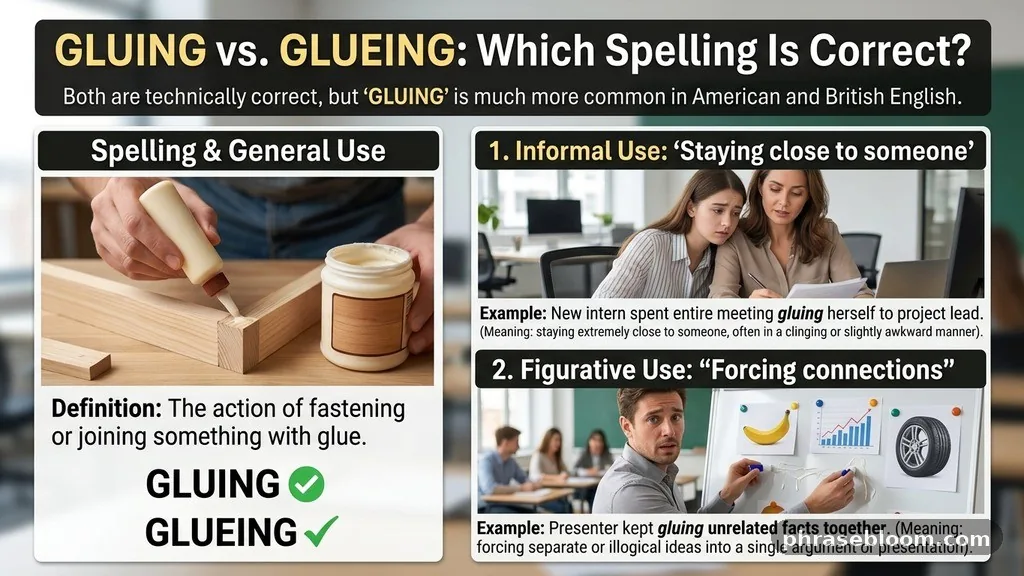
“The new intern spent the entire meeting gluing herself to the project lead.” This informal use means staying extremely close to someone, although the tone may sound critical or humorous.
“The presenter kept gluing unrelated facts together.” In this figurative sentence, gluing means forcing separate ideas into a single connection. The spelling remains the same even though no physical adhesive is involved.
These examples show why grammar matters more than visual habit. Gluing can act as a present participle, a gerund, or part of a larger noun phrase, but its spelling remains stable across those functions.
When Glueing Appears and How to Handle It
Glueing appears because English spelling is not perfectly regular. Some writers retain the final e from glue when adding -ing, creating a transparent form that looks like the base word plus the suffix.
That spelling may also survive through institutional documents. A repair company could have years of manuals containing glueing, or a publisher could preserve an author’s variant spelling. Changing every instance may not be necessary if the document already follows a consistent internal convention.
In a new document, however, gluing is generally the stronger choice. It is shorter, follows the common silent e rule, and will look familiar to most readers.
Glueing can be retained in several situations:
- When you are quoting a historical or archival source.
- When a client or organization has an established spelling policy.
- When preserving the original wording of a document matters.
- When editing a text in which the form appears consistently and causes no confusion.
- When a regional publication specifically prefers the variant.
Even in those cases, consistency is important. Switching from glueing to gluing within the same instruction manual can make the document look careless, especially if both forms appear close together.
Do not use glueing simply because you believe it has a different meaning. It does not normally refer to a different type of adhesive, a special industrial process, or a separate grammatical category.
For learners, the most useful memory aid is this: glue plus -ing usually becomes gluing. The variant exists, but it should not be your automatic first choice.
Common Spelling and Grammar Mistakes
The most common mistake is writing glueing in a document that otherwise follows standard modern spelling. The word is understandable, but an editor may change it to gluing for consistency with other verbs such as making, writing, and using.
A second mistake is treating gluing as the name of the adhesive. For example, “Apply gluing to the seam” is usually incorrect because the material is glue or adhesive, while gluing is the act of applying it.
Another error is using an unnecessary hyphen. Gluing is one word, not a compound expression that needs a hyphen. Write “gluing the parts together,” not “glue-ing the parts together.”
Writers sometimes create the form glueding by trying to preserve the past-tense ending before adding -ing. That is incorrect. The present participle is formed from the base verb glue, so the correct form is gluing.
Some people also assume that the final e must always be preserved when a verb ends in a vowel sound. That is not how the spelling rule works. The relevant issue is the written form and the established inflection, not simply the way the word sounds.
Watch for these corrections:
| Less suitable form | Preferred form | Reason |
|---|---|---|
| We are glueing the tiles. | We are gluing the tiles. | Gluing is the standard modern spelling. |
| Apply gluing to the joint. | Apply glue to the joint. | Glue names the adhesive; gluing names the action. |
| They are glue-ing the model. | They are gluing the model. | The suffix does not require a hyphen. |
| After glueding the parts, wait. | After gluing the parts, wait. | Use the base verb before adding -ing. |
Grammar tools may flag glueing, but automated suggestions are not always complete. A dictionary, publisher’s style guide, or knowledgeable editor can provide better context than a red underline alone.
Choosing the Right Form for Professional Writing
In professional writing, use gluing unless your organization has a documented reason to use glueing. The shorter form is clear in business emails, technical instructions, project reports, and workplace communication.
Technical writers should be especially consistent because repeated process descriptions make spelling patterns visible. A manual that uses gluing in one section and glueing in another may appear to describe two different operations, even though the meaning is the same.
Academic writers should follow the style guide required by their institution or publisher. A formal paper does not become more scholarly by using glueing, and there is no need to avoid gluing because it looks conversational.
Marketing writers have slightly more flexibility. A craft brand may choose a familiar or traditional spelling in a product name, but ordinary supporting copy should normally use gluing unless the brand has made another choice deliberately.
Editors should distinguish between correction and preference. If a manuscript consistently uses glueing and the publisher permits the variant, changing it may be unnecessary. If the publisher’s style sheet specifies gluing, then replacing the variant is a reasonable copyediting decision.
When preparing a document, make the decision early:
- Check the organization’s house style or editorial guide.
- Search the document for both gluing and glueing.
- Choose one form for ordinary prose.
- Preserve a different spelling only in quotations or proper names.
- Review headings, captions, labels, and instructions for the same choice.
This approach prevents the spelling difference from becoming a distraction. Readers care more about clear instructions than about a theoretical argument over a variant that has the same basic meaning.
Alternatives That Avoid the Spelling Question
Sometimes the best solution is to rewrite the sentence. This is useful when a document serves an international audience or when the writer wants to avoid a spelling choice that could attract unnecessary editing.
For example, “Gluing the trim requires a clean surface” can become “A clean surface is required before the trim is attached.” The meaning remains clear, but the sentence no longer depends on the present participle.
Other alternatives include:
- “Attach the pieces with adhesive.”
- “Apply glue to the joint.”
- “Join the panels with glue.”
- “The parts are bonded with adhesive.”
- “Secure the label to the box.”
- “The technician attached the seal.”
These alternatives are not always interchangeable. Glue is a specific substance, adhesive is a broader technical term, and attach may describe fastening without saying how the connection was made.
In a safety manual, “Apply adhesive to the marked area” may be more precise than “Begin gluing.” In a children’s craft instruction, “Glue the shapes onto the card” is shorter and easier to follow than a noun phrase built around gluing.
Rewriting should improve clarity, not hide uncertainty. If gluing is the most natural word, use it. There is no need to avoid an accurate and standard form merely because glueing also appears in some sources.
Alternatives can also reduce repetition. A paragraph that uses gluing four times may read more smoothly if one sentence says “apply adhesive,” another says “attach the pieces,” and a third uses “gluing” where the action itself is the focus.
A Practical Decision Rule for Gluing or Glueing
Use a simple three-step process whenever you hesitate between gluing and glueing.
First, identify the base verb
The base verb is glue. You are not forming a word from glued, and you do not need to preserve every letter in the dictionary form. The relevant ending is -ing.
Next, apply the standard spelling pattern
Drop the final silent e and add -ing. That produces gluing, which is the normal modern form in most writing.
Finally, check the document’s style
If a style guide, client, publisher, or organization specifically uses glueing, follow that preference consistently. If no such preference exists, gluing is the safest default.
The decision can be summarized like this:
- New general writing: choose gluing.
- Formal or professional writing: choose gluing unless house style says otherwise.
- Quotations: preserve the original spelling.
- Existing documents: maintain the established form or edit consistently.
- International writing: choose gluing and define the process clearly if needed.
Do not make the choice based on the assumption that glueing is always wrong or that gluing is always mandatory in every variety of English. The better distinction is standard preference versus accepted variant.
Once you choose, use the same form in the title, body text, captions, diagrams, and file labels. Consistency supports credibility, especially in workplace communication and technical documentation.
Quick Reference for Gluing Usage
| Question | Practical answer | Example |
|---|---|---|
| What is the standard spelling? | Gluing | “She is gluing the pieces.” |
| Is glueing recognizable? | Yes, as a variant spelling | “The older guide refers to glueing.” |
| Is gluing one word? | Yes | “Gluing requires a steady hand.” |
| Does gluing need a hyphen? | No | Write gluing, not glue-ing. |
| Does the form change in British English? | Not by a strict national rule | Both varieties use gluing, while glueing may also appear. |
| What is the safest professional choice? | Gluing | “The team is gluing the protective layer.” |
The table reflects practical usage rather than an absolute ban on the variant. English contains many spelling variations that remain understandable even when one form is preferred by current editorial practice.
Frequently Asked Questions
Is gluing or glueing correct?
Both forms are encountered in English, but gluing is generally the preferred modern spelling. Glueing is a recognized variant with the same basic meaning.
Is gluing more formal than glueing?
Gluing is not necessarily more formal, but it is more widely accepted as the standard spelling in contemporary professional and academic writing. Use it unless a house style requires glueing.
Is gluing one word?
Yes. Gluing is one word formed from the verb glue and the suffix -ing. It does not need a space or hyphen.
Why does glue become gluing?
The final silent e is dropped before -ing is added. This follows the common spelling pattern seen in making, writing, using, and moving.
Does British English prefer glueing?
There is no strict rule that makes glueing exclusively British or gluing exclusively American. Both forms may appear in British and American writing, although gluing is usually the safer general choice.
Can I use glueing in a professional document?
Yes, if your organization or publication uses it consistently. For a new professional document with no established style, gluing will usually be the clearer and more conventional choice.
Should I use the same spelling throughout a document?
Yes. Choose gluing or glueing and apply that choice consistently across paragraphs, heading, captions, instructions, and labels. Consistency prevents readers from wondering whether the two forms describe different processes.
Final Recommendation
The practical answer to gluing vs glueing is straightforward: use gluing in most new writing. It follows the standard silent e rule, appears naturally in American English and British English, and is the form most likely to satisfy a professional editor or general reader.
Glueing remains understandable and can be retained as a variant when a source, publisher, or house style uses it. If you are unsure, choose gluing, check the relevant style guide, and keep the spelling consistent from beginning to end. That approach handles the English spelling question without turning a small usage difference into a larger writing problem.
You may also like: Separate or Seperate: Which Spelling Is Correct? A Simple Guide · Pajamas vs Pyjamas: Which Spelling Is Correct?
1 thought on “Gluing vs Glueing: Which Spelling Is Correct?”