
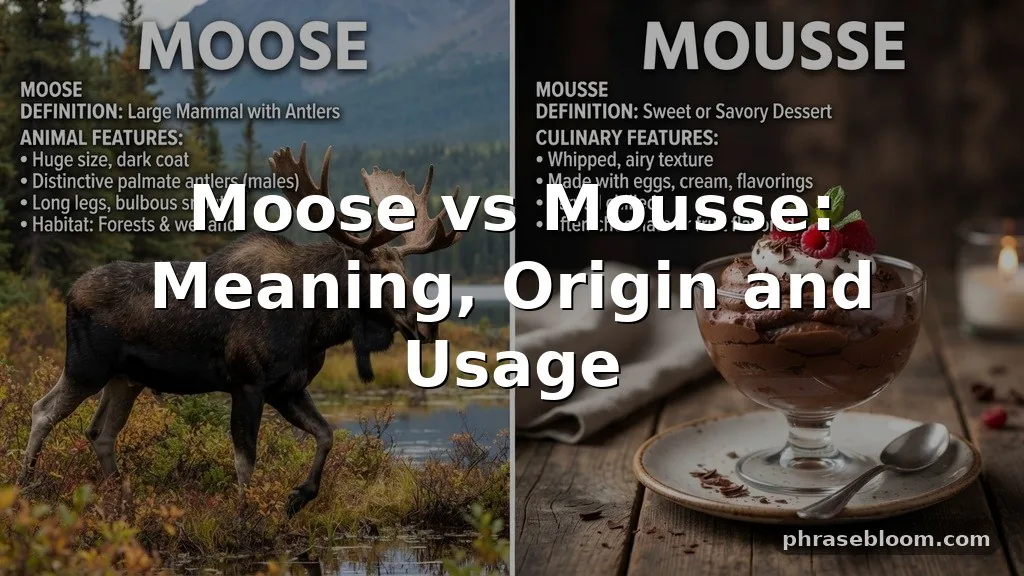
Moose vs Mousse: Meaning, Origin and Usage
The difference between moose and mousse is simple once you connect each spelling to its meaning. A moose is a large North American animal, while mousse is usually a light, foamy food or a styling product for hair. Their pronunciation is often identical in English, which makes them commonly confused words.
Understanding the moose vs mousse distinction helps you avoid amusing spelling mistakes in emails, menus, schoolwork, travel writing, and everyday conversation. The key is context: one word belongs to wildlife, and the other usually describes something with a soft, airy texture.
Moose vs Mousse: The Quick Answer
Moose is a noun meaning a large herbivorous mammal with broad antlers, especially the animal known scientifically as Alces alces. Mousse is a noun for a light, foamy dish or a product used to style hair.
In most varieties of English, the two words are pronounced the same way: “moos.” They are homophones, meaning they sound alike but have different spellings and meanings.
| Word | Spelling | Meaning | Typical context |
|---|---|---|---|
| moose | m-o-o-s-e | A large deer family animal | Wildlife, forests, hunting, nature |
| mousse | m-o-u-s-s-e | A light food or foamy styling product | Cooking, desserts, cosmetics, hair care |
A useful memory aid is to associate the extra “u” and “s” in mousse with its French origin. The French word mousse means “foam,” which fits both dessert mousse and hair mousse. Moose, by contrast, refers only to the animal.
What Does Moose Mean?
A moose is a very large member of the deer family. The North American moose is recognized by its long legs, heavy body, broad muzzle, and, in males, wide palmate antlers that grow and shed each year.
In scientific classification, the moose belongs to the species Alces alces. In North America, the common name is moose, while some speakers in parts of Europe use “elk” for the same animal. That difference can create another vocabulary problem because “elk” usually refers to a different animal in North American English.
The animal is a herbivorous mammal. It eats vegetation such as leaves, twigs, aquatic plants, and other available plant material, and it commonly lives in forests, wetlands, and cold northern regions.
Moose Definition and Animal Features
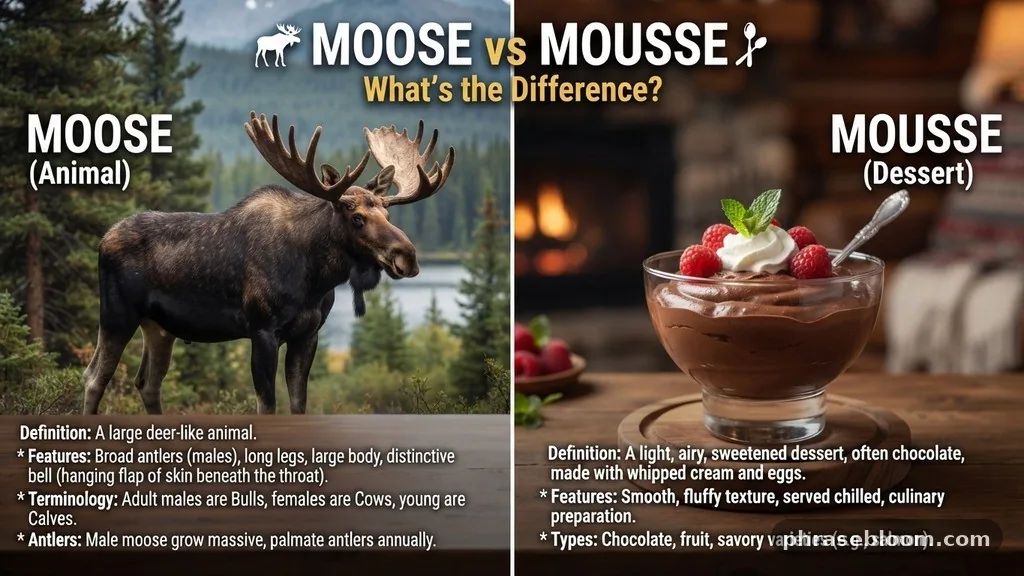
The simplest moose definition is “a large deer-like animal with broad antlers.” Adult males are called bulls, adult females are called cows, and young moose are called calves.
- Appearance: Moose have long legs, a large body, and a distinctive hanging flap of skin beneath the throat called a bell.
- Antlers: Male moose grow broad, flattened antlers rather than the narrow branching antlers associated with many other deer.
- Habitat: They are strongly associated with boreal forests, lakes, marshes, and other cool northern environments.
- Diet: Moose browse on woody plants and consume aquatic vegetation, making them plant-eating mammals.
- Grammar: The plural of moose is usually still moose, not “mooses.”
For example, you can write, “We saw three moose near the lake.” The word does not need an added plural ending in standard English.
Moose in a Sentence
Here are natural examples of the animal word:
- “A moose crossed the road just after sunrise.”
- “The wildlife photographer captured a bull moose beside the river.”
- “Visitors should keep their distance from moose in the national park.”
- “The guide explained how moose use wetlands during the warmer months.”
Each sentence describes an animal, so moose is the correct spelling. If you are discussing antlers, forests, wildlife, or a large deer family mammal, you almost certainly need moose rather than mousse.
What Does Mousse Mean?
Mousse is a noun borrowed from French. Its basic idea is something light, airy, and foamy, although its exact meaning depends on the subject being discussed.
The word most commonly refers to a dessert, a savor dish, or a hair styling product. In each case, the texture or consistency is important. Mousse is generally lighter and more aerated than a dense pudding, cream, gel, or sauce.
Food and Dessert Mousse
In cooking, mousse is a soft preparation made light by incorporating air. A chocolate mousse may contain melted chocolate, cream, egg, or other ingredients, depending on the recipe. A fruit mousse may use fruit purée, whipped cream, gelatin, or a similar combination.
Examples include:
- “The restaurant served chocolate mousse with fresh berries.”
- “She prepared a lemon mousse for the dinner party.”
- “The savory salmon mousse was spread on toasted bread.”
These examples use mousse because they describe food. The word does not refer to an animal, even though “mousse” and “moose” sound alike when spoken.
Hair Mousse
Hair mousse is a foamy styling product applied to the hair. It can add volume, shape curls, reduce the appearance of limp hair, or help hold a hairstyle, depending on the formulation.
For example, “Apply a small amount of hair mousse before blow-drying” uses the word correctly. The context is cosmetics and hair care, so mousse is the only appropriate spelling.
The phrase “moose for your hair” would describe the animal rather than the styling product. It changes the meaning completely and would sound like an obvious spelling mistake.
Moose vs Mousse Meaning and Pronunciation
The moose vs mousse meaning difference is mainly a spelling and context issue. In standard English pronunciation, both words are generally pronounced /muːs/, which sounds like “moos.” That shared pronunciation explains why people often confuse them in writing.
Because the words are homophones, hearing one aloud does not tell you which spelling to use. You need to identify the subject of the sentence first.
| If the sentence discusses… | Use… | Example |
|---|---|---|
| Wild animals or forests | moose | “The moose stood near the trail.” |
| Antlers or wildlife photography | moose | “The guide photographed a moose.” |
| Chocolate or fruit desserts | mousse | “We ordered chocolate mousse.” |
| Hair styling | mousse | “This mousse gives the hair more volume.” |
| Light, airy food texture | mousse | “The chef made a savory mousse.” |
Pronunciation can vary slightly by accent, but the words are treated as homophones in mainstream American English and in much British English. Their sounds do not carry the spelling distinction.
Why the Spelling Difference Matters
Spelling communicates meaning when two words sound the same. Writing “The chef prepared a moose” suggests that the chef prepared an animal, while “The ranger found a mousse” suggests that a dessert or cosmetic product appeared in the wilderness.
Most readers will understand the intended meaning from context, but the error can still look careless. In a menu, product label, school assignment, or professional message, choosing the right spelling makes the sentence precise.
Moose and Mousse Origins
The word moose entered English from an Indigenous language of the northeastern region of North America, commonly identified with the language family associated with the Algonquian peoples. Its early history reflects the fact that European settlers needed a name for an animal unfamiliar to them.
The word mousse comes from French, where it means “foam.” French mousse is related to the idea of froth or a light, bubbly texture, which explains its use in culinary and cosmetic language.
The two words therefore have unrelated origins. Their similarity in English is accidental, and it is mainly their pronunciation that brings them together.
Mousse as a French Loanword
English contains many words borrowed from French, especially in cooking, fashion, art, and personal care. Mousse kept its French spelling because the form became established in English usage.
The culinary sense appeared before the hair-care sense became common. Over time, manufacturers and stylists adopted mousse to describe a foamy product that could be distributed through the hair.
The dictionary entry for mousse provides a useful reference for its food, foam, and styling-product meanings. The important point is that all of these meanings connect to lightness or froth.
Moose and the Elk Comparison
Moose are sometimes confused with elk because naming conventions differ by region. In North American English, an elk is usually Cervus canadensis, a large deer with branched antlers, while a moose is Alces alces, a heavier animal with broad, flattened antlers.
In parts of Europe, the animal North Americans call a moose may be called an elk. This regional difference does not affect the moose versus mousse spelling question, but it helps explain why wildlife vocabulary can vary across English-speaking regions.
Common Uses of Moose in English
Moose appears in writing about nature, geography, conservation, outdoor recreation, transportation safety, and wildlife management. It can function as a singular noun or as a plural noun when the context requires more than one animal.
Consider these examples:
- Nature writing: “The moose moved slowly through the birch trees.”
- Public safety: “Drivers should watch for moose along the highway.”
- Tourism: “The lodge offers guided moose-watching trips.”
- Education: “Students compared the moose with other members of the deer family.”
- Conservation: “Researchers are monitoring moose populations in the northern forest.”
These sentences all point to a living animal. The surrounding nouns provide strong clues: highway, forest, population, wildlife, and deer family all support the spelling moose.
One common grammatical detail is the plural. “Two moose” is standard, just as “two sheep” is standard. “Two mooses” may appear informally, but it is not the usual form in edited English.
Common Uses of Mousse in English
Mousse is used across food writing, restaurant menus, beauty advertising, product packaging, and everyday conversation. The word can describe something served on a plate or something dispensed from a can or bottle.
| Context | Natural phrase | What it describes |
|---|---|---|
| Dessert | chocolate mousse | A light chocolate dessert |
| Fruit dessert | raspberry mousse | An airy fruit-based preparation |
| Savory food | chicken liver mousse | A smooth, light savory spread |
| Hair care | volumizing hair mousse | A foamy styling product |
| Beauty instructions | apply mousse to damp hair | Using a styling product before drying |
Food-related mousse often appears with a flavor or ingredient before it. “Chocolate mousse,” “mango mousse,” and “cheese mousse” are immediately recognizable combinations.
Hair mousse is usually identified by words such as styling, volume, curls, damp hair, blow-drying, or hold. Those clues distinguish it from dessert mousse without requiring a long explanation.
Examples of Moose vs Mousse in a Sentence
Seeing the words in complete sentences is one of the fastest ways to remember the spelling difference. The following examples are written in ordinary contexts where the surrounding vocabulary makes the meaning clear.
Wildlife Examples
“A moose wanderd into the clearing before the hikers arrived.” The word is moose because the sentence describes an animal in a natural setting.
“The museum displayed a detailed model of a moose skeleton.” Again, the subject is wildlife, so mousse would be incorrect.
“The park sign warns visitors not to approach a moose or feed it.” Words such as park, approach, and feed point to the animal meaning.
Food Examples
“The bakery added dark chocolate mousse to its seasonal menu.” The word is mousse because the sentence describes a dessert.
“The lemon mousse was chilled overnight and topped with whipped cream.” Ingredients, preparation, and refrigeration make the culinary meaning unmistakable.
“The chef served a smoked trout mousse with crackers.” This example uses mousse for a savory preparation rather than a sweet dessert.
Hair and Beauty Examples
“Work the hair mousse through the roots to create more volume.” The phrase refers to a styling product, not food or wildlife.
“She switched to a lightweight mousse for defining her curls.” Words such as curls and lightweight identify the cosmetic meaning.
“The stylist recommended mousse instead of a heavy gel.” The comparison with another hair product confirms the intended spelling.
Common Mistakes and How to Fix Them
The most frequent mistake is choosing the spelling based on sound alone. Since moose and mousse are homophones, writers must use meaning and context rather than pronunciation.
Using Moose for Food
Incorrect: “The restaurant serves a rich chocolate moose.”
Correct: “The restaurant serves a rich chocolate mousse.” Chocolate mousse is a dessert, so it needs the French-derived spelling.
Using Mousse for an Animal
Incorrect: “We saw a mousse near the lake.”
Correct: “We saw a moose near the lake.” A large deer family animal is always a moose in standard North American English.
Adding an Unnecessary Plural Ending
Incorrect: “Several mooses gathered near the water.”
Correct: “Several moose gathered near the water.” Moose usually has the same singular and plural form.
Assuming Mousse Always Means Dessert
Mousse can refer to food, but it can also mean a hair styling product. “Apply the mousse to damp hair” is perfectly correct, even though no dessert is involved.
Context determines the sense. If the sentence mentions a salon, curls, volume, or styling, mousse is being used in its cosmetic meaning.
Confusing Sound with Spelling
Because both words are usually pronounced “moos,” spell-checking by sound does not work. A useful editing habit is to ask, “Am I describing an animal, or something light and foamy?”
If the answer is animal, choose moose. If the answer is dessert, savory food, or hair product, choose mousse.
How to Remember the Difference
A visual memory aid can make the distinction easier. Imagine the two extra letters in mousse, especially the “u” and second “s,” as part of a soft, foamy texture. The more elaborate spelling belongs to the French-derived word.
For moose, picture the animal’s large antlers. The shorter spelling is connected to the creature, while the longer spelling is connected to food and styling products.
- Moose: animal, antlers, forest, wildlife.
- Mousse: foam, dessert, hair product, French word.
- Both: usually pronounced “moos.”
- Neither: should be selected solely by sound.
You can also use a sentence substitution test. Replace the word with “large deer” or “foamy dessert.” If “large deer” fits, write moose. If “foamy dessert” or “hair product” fits, write mousse.
Moose vs Mousse in Professional and Academic Writing
Professional writers encounter both words in different fields. A wildlife organization may discuss moose habitat, while a restaurant business may promote chocolate mousse. A cosmetics company may describe hair mousse in product instructions or marketing copy.
Accuracy matters because a spelling error can affect credibility. In a scientific report, “moose population” must refer to an animal population, while “mousse texture” in a food report describes a culinary quality.
Academic writing may use moose in biology, ecology, geography, or environmental studies. Mousse is more likely to appear in culinary arts, nutrition, food science, hospitality, fashion, or cosmetic-product research.
Professional Editing Checklist
- Identify the subject before choosing the spelling.
- Check whether the sentence refers to wildlife, food, or hair care.
- Search the surrounding paragraph for context clues.
- Use a dictionary if the word appears in a specialized passage.
- Check repeated uses for consistency, especially in menus and product descriptions.
For public-facing writing, a final read-aloud review is not enough because the two words sound the same. Visual proofreading is essential. Search the document for both spellings and verify each occurrence individually.
Related Words and Clear Alternatives
There is no perfect synonym for every use of moose or mousse, but related terms can clarify the intended meaning. For moose, writers may use “large deer,” “wildlife,” or “North American moose,” depending on the level of detail needed.
For mousse, alternatives depend on whether the subject is food or hair care. A writer might use “foamy dessert,” “light cream dessert,” “hair styling foam,” or “volumizing foam.” These alternatives are useful when the audience may not recognize the French-derived term.
| Original term | Possible alternative | Best use |
|---|---|---|
| moose | large deer | Simple explanation for general readers |
| North American moose | Alces alces | Scientific or regional clarification |
| chocolate mousse | light chocolate dessert | Plain-language menu explanation |
| hair mousse | hair styling foam | Product instructions or accessible copy |
Still, replacing the original word is not always necessary. Moose is the standard name for the animal, and mousse is the established term for both the dish and the styling product.
Frequently Asked Questions
What is the difference between moose and mousse?
Moose is a large deer family animal. Mousse is a light, foamy food or a hair styling product. They usually sound alike but have different spellings and meanings.
Are moose and mousse pronounced the same?
Usually, yes. In common American English pronunciation, both are pronounced “moos.” This makes them homophones.
Is mousse only a dessert?
No. Mousse can describe a sweet dessert, a savory food preparation, or a foamy hair styling product. The surrounding context shows which meaning is intended.
Is the plural of moose “mooses”?
Usually not. The standard plural is “moose,” as in “two moose crossed the road.”
What is the easiest way to remember moose versus mousse?
Use moose for the animal with antlers. Use mousse for something light and foamy, such as chocolate mousse or hair mousse.
Conclusion
The moose vs mousse distinction comes down to meaning, not pronunciation. A moose is the large animal associated with northern forests and broad antlers, while mousse describes a light food preparation or a foamy styling product.
When writing, check the context before choosing the spelling: wildlife calls for moose, while desserts and hair products call for mousse. Remembering that both words sound alike but belong to different subjects will help you avoid one of English’s most recognizable spelling mix-ups.
You may also like: Wonder vs Wander: Meaning, Difference and Usage
Explore more on PhraseBloom.