
How to Use “My Question Is” Correctly
Using “My Question Is” correctly is mostly a matter of punctuation, sentence structure, and purpose. The phrase is grammatical when it introduces a question, but it usually needs a question mark only when the entire sentence is a direct question. In formal English, “My question is, why did the policy change?” is possible, while “My question is why the policy changed” is an indirect question and normally ends with a period.
The wording also affects tone. It can sound focused in a meeting, email, or interview, yet a shorter opening such as “Why did the policy change?” is often cleaner. The examples below show how to use the phrase naturally, how to place a colon or comma, and how to avoid fragments and confusing punctuation.
What “My Question Is” Means
“My question is” is an introductory expression that identifies the question a speaker or writer wants to ask. It tells the listener that the next words contain the main point, usually a request for information, clarification, or explanation.
In its simplest form, the phrase contains a possessive pronoun, a noun, and a linking verb: “My” identifies the speaker, “question” names the subject, and “is” connects that subject to what follows. The phrase itself is not usually the complete question. It is a lead-in.
For example, “My question is, how will the new schedule affect contractors?” contains the introductory phrase plus a direct question. The speaker is asking for a specific answer about the schedule’s effect.
The expression can also introduce an embedded or indirect question. In “My question is why the deadline moved,” the words “why the deadline moved” function as a noun clause that completes the sentence. The sentence reports the question rather than presenting it in its original direct form.
That distinction matters because direct and indirect questions follow different grammar rules. A direct question generally uses question word order and a question mark, while an indirect question usually uses statement word order and a period.
- Direct question: “Why did the deadline move?”
- Direct question with an introduction: “My question is, why did the deadline move?”
- Indirect question: “My question is why the deadline moved.”
In spoken English, the difference is often signaled by intonation. A speaker’s voice may rise at the end of a direct question. In written English, punctuation and sentence structure must carry that information.
Direct Questions and Indirect Questions
A direct question asks something openly and preserves the usual interrogative structure. With a question word such as “why,” “when,” or “how,” the auxiliary verb often comes before the subject: “Why did the supplier cancel?”
When “My question is” introduces that direct question, writers have two common options. They may use a comma to separate the introductory phrase from the question, or they may use a colon when the following question is presented as a clearly stated item.
Examples include:
- “My question is, what happens after the trial period ends?”
- “My question is this: What happens after the trial period ends?”
- “My question is: What happens after the trial period ends?”
The first example is common in conversational writing and transcripts. The second is especially clear because “this” creates a complete introductory clause before the colon. The third appears in some formal or business contexts, although style preferences differ on whether a colon should follow a linking verb in this pattern.
An indirect question has a different sentence structure. It does not ask the question in its direct form; instead, it describes or identifies the information being sought.
- “My question is whether the contract covers repairs.”
- “My question is how the figures were calculated.”
- “My question is why the committee rejected the proposal.”
Notice the word order. A direct question says, “Why did the committee reject the proposal?” The indirect version says, “My question is why the committee rejected the proposal,” not “My question is why did the committee reject the proposal.”
The second version incorrectly carries direct-question word order into an indirect question. In casual speech, people sometimes produce that structure, but formal writing generally benefits from the standard indirect pattern.
A useful test is to remove “My question is.” If the remaining words stand alone as a direct question, use direct-question punctuation and word order. If they function as information attached to the main clause, treat them as an indirect question.
Punctuation: Comma, Colon, or Question Mark?
Punctuation depends on whether the complete sentence is asking a question. The presence of the word “question” does not automatically require a question mark.
| Pattern | Example | Ending punctuation | Why it works |
|---|---|---|---|
| Direct question | My question is, when will the service resume? | Question mark | The full sentence asks for an answer. |
| Indirect question | My question is when the service will resume. | Period | The sentence states what the question concerns. |
| Colon introduction | My question is this: When will the service resume? | Question mark | The colon introduces a complete direct question. |
| Reported concern | She explained that her question was why the service had stopped. | Period | The sentence reports a question indirectly. |
“My question is, why was the invoice rejected?” uses a comma to set off the introductory phrase. This form is understandable and common, especially in dialogue, but some editors prefer a colon or a rewritten sentence because the comma can create a loose connection between two structures.
“My question is this: Why was the invoice rejected?” is often the clearest formal version. The word “this” gives the first clause a complete grammatical shape, and the colon signals that the precise question follows.
Another clean option is to remove the introduction entirely: “Why was the invoice rejected?” That direct version is concise and avoids any debate about colon punctuation.
The final question mark belongs to the whole sentence, not merely to the words after the comma or colon. If the sentence reports a question, use a period: “The manager asked why the invoice was rejected.”
When a Colon Helps
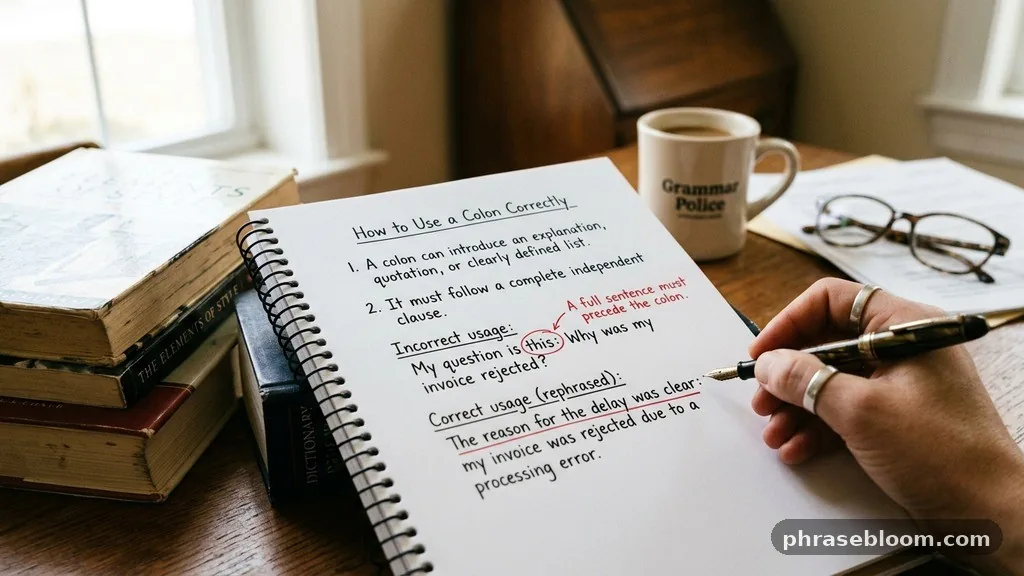
A colon can introduce an explanation, quotation, list, or clearly defined question. In formal writing, “My question is this: Why was the invoice rejected?” has a strong logical connection between the setup and the question.
Still, a colon is not a universal repair tool. “My question is: why was the invoice rejected?” may be accepted by a house style, but some editors consider the construction less elegant because the words before the colon already form a linking structure. If clarity matters more than preserving the original wording, write “I have one question: Why was the invoice rejected?”
“My Question Is” in a Complete Sentence
A complete sentence normally contains an independent clause, meaning a group of words that can stand on its own. “My question is why the figures changed” is complete because “My question is” forms a main clause and “why the figures changed” completes its meaning.
By contrast, “My question is why the figures changed because” is unfinished. The final “because” creates the expectation of a reason that never arrives, leaving a sentence fragment or incomplete thought.
The phrase can also be followed by a noun phrase rather than a full question clause. For example, “My question is the timeline” is grammatically possible, but its meaning is not immediately clear. It could mean the speaker is identifying the timeline as the question, or it could be a poorly phrased request for information about the timeline.
Clearer alternatives would be “My question concerns the timeline” or “My question is about the timeline.” If the writer wants an actual answer, “When will the timeline be finalized?” is more direct.
Some writers use “My question is” as a sentence fragment in notes or presentation slides:
- “My question is: Who approves the final design?”
- “My question is…”
- “My question is about the renewal clause.”
Fragments can work in deliberately informal settings, such as a slide heading or a spoken pause. In a formal report, however, a complete sentence usually creates a more polished result.
The phrase also works inside a longer sentence. For example, “The committee understood that my question was whether the proposed change had been tested.” Here, “whether the proposed change had been tested” is an indirect question serving as the complement of “was.”
Using the Phrase in Formal and Professional Writing
In professional writing, the main concern is precision. “My question is” can be useful when a meeting, email, or review contains several issues and the writer needs to identify one specific request.
For example, an employee might write, “My question is whether the revised benefits policy applies to part-time staff.” The sentence is formal, complete, and specific. It does not require a question mark because it states the subject of the question indirectly.
A direct version would be shorter: “Does the revised benefits policy apply to part-time staff?” Both sentences are grammatical, but they perform slightly different rhetorical jobs. The first emphasizes the speaker’s concern; the second moves immediately to the requested information.
Business Emails

In an email, the phrase can help distinguish a question from background information. A useful pattern is: “Thank you for sending the draft. My question is whether the payment schedule includes the final inspection.”
For a more concise message, write: “Could you confirm whether the payment schedule includes the final inspection?” This version sounds courteous without adding an unnecessary announcement that a question is coming.
When several questions follow, avoid repeating the phrase before every item. Introduce the subject once, then use a numbered list or separate headings. Repetition can make a short email feel heavier than necessary.
Reports and Policy Documents
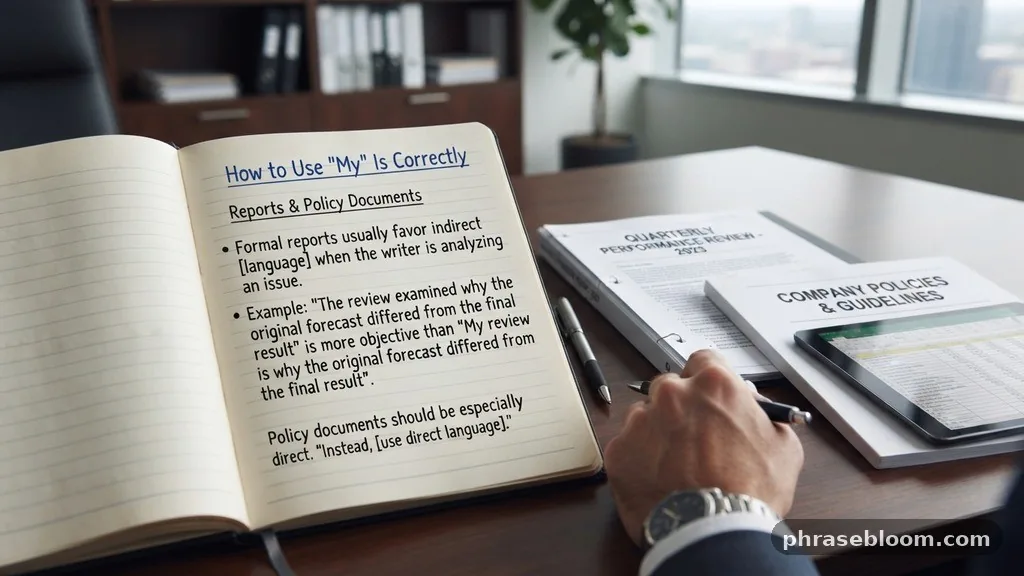
Formal reports usually favor indirect questions when the writer is analyzing an issue. “The review examined why the original forecast differed from the final result” is more objective than “My question is why the original forecast differed from the final result.”
Policy documents should be especially direct. Instead of writing “My question is whether employees must submit the form,” write “Employees must submit the form by Friday” if the policy is stating a requirement. Use the question form only when the document genuinely asks for information.
In legal or compliance writing, small changes in sentence structure can affect interpretation. A writer should not rely on a rhetorical question when a clear rule, condition, or request is intended.
Spoken English, Meetings, and Rhetorical Questions
In spoken English, “My question is” often serves as a conversational signal. It gives the speaker a moment to organize the question and tells others that the next sentence is the central request.
A participant might say, “My question is, how will this affect the regional offices?” The speaker is not necessarily being formal. The phrase can sound natural in a meeting, interview, classroom, or public discussion.
It can also be used to sharpen a follow-up question. After receiving a general answer, someone may say, “I understand the overall plan. My question is whether the launch date has changed.” That wording politely narrows the discussion.
The expression sometimes introduces a rhetorical question, which is asked for effect rather than to obtain a literal answer. “My question is, what kind of example does that set?” may communicate criticism or concern rather than request factual information.
Context supplies the intended tone. In spoken communication, voice stress and pauses help listeners distinguish a sincere request from a challenge. In written communication, the surrounding sentences need to provide that context.
Writers should be careful with rhetorical questions in workplace communication. A sentence such as “My question is, who approved this?” may sound accusatory, even if the writer intended a neutral request for information.
A calmer version would be “Could you clarify who approved this?” or “Please confirm which team approved the change.” These alternatives make the purpose explicit and reduce the risk of sounding confrontational.
Common Errors and Better Revisions
The most frequent error is confusing direct and indirect question word order. “My question is why did the price increase?” combines two patterns incorrectly in formal written English.
Use one of these revisions instead:
- Direct: “Why did the price increase?”
- Indirect: “My question is why the price increased.”
- Polite request: “Could you explain why the price increased?”
Another issue is using a question mark after an indirect question. The sentence “My question is whether the shipment has arrived.” is a statement about the subject of the question, so it normally ends with a period.
Writers also sometimes create a sentence fragment by stopping after the introductory phrase: “My question is…” In a transcript, that may accurately represent hesitation. In edited prose, complete the thought or replace the fragment with a direct question.
Unnecessary repetition can weaken a paragraph. Compare “My question is whether the plan is affordable. My question is whether the deadline is realistic.” A smoother version is “I have two questions: Is the plan affordable, and is the deadline realistic?”
Another mistake involves using “my question” when the writer means “my concern.” “My question is that the figures seem inconsistent” is not a natural construction because “that the figures seem inconsistent” expresses a concern or observation, not a question.
Better choices include “My concern is that the figures seem inconsistent” or “My question is why the figures seem inconsistent.” The noun must match the function of the clause that follows it.
Choosing the Clearest Sentence Structure
There is no requirement to use “My question is” every time you need to ask something. The best wording depends on whether you want to emphasize the question, request clarification, report uncertainty, or move directly to the point.
| Purpose | Preferred wording | Effect |
|---|---|---|
| Ask directly | Why did the schedule change? | Concise and immediate |
| Identify a concern | My question is why the schedule changed. | Focused and explanatory |
| Ask politely | Could you explain why the schedule changed? | Professional and collaborative |
| Request confirmation | Could you confirm whether the schedule changed? | Specific and practical |
| Introduce a formal question | My question is this: Why did the schedule change? | Structured and emphatic |
For emails, the direct form often saves space. For meetings, the introductory form may help listeners follow the speaker’s reasoning. For academic or analytical prose, an indirect construction may fit better because it integrates the question into a larger argument.
Consider the difference between these sentences:
- “My question is whether the survey included international respondents.”
- “The analysis must establish whether the survey included international respondents.”
- “Did the survey include international respondents?”
The first identifies the writer’s question. The second presents a research requirement.
The third asks for a fact. None is automatically superior; each has a different communicative purpose.
If the phrase adds no useful emphasis, remove it. “My question is, where can I find the revised form?” is usually less efficient than “Where can I find the revised form?” Clear writing does not require announcing every question as a question.
Examples You Can Copy and Adapt
The following examples show how the phrase behaves in workplace communication, academic writing, customer service, and everyday conversation.
- “My question is whether the training is required for contractors.”
- “My question is, when will the updated software be available?”
- “My question is this: Who has authority to approve the exception?”
- “The central question is why the original estimate was inaccurate.”
- “Could you clarify whether the refund includes the delivery charge?”
- “My question concerns the final paragraph of the agreement.”
- “I have one follow-up question: How were the results verified?”
- “My question is not about the cost but about the implementation schedule.”
- “The reviewer asked why the supporting documents were incomplete.”
- “My question is whether the proposed approach meets the stated requirements.”
In the first example, “whether the training is required for contractors” is an indirect question. It uses statement word order and ends the sentence with a period.
The second example contains a direct question introduced by “My question is.” The question mark is appropriate because the complete sentence asks when the software will be available.
The third example uses “this” before a colon. That structure is particularly useful in presentations, formal correspondence, and discussions where the writer wants to frame one question as the main issue.
“My question concerns the final paragraph of the agreement” does not ask for an answer by itself. It identifies a topic. The writer would need to add a second sentence, such as “Does that paragraph apply to renewals?”
For academic writing, “The central question is why the results differ across regions” may be more objective than “My question is why the results differ across regions.” The choice depends on whether the writer is describing a personal inquiry or stating the research problem.
Reference Points for Grammar and Usage
Grammar references generally distinguish direct questions from indirect questions because their word order and punctuation differ. A direct question can stand alone, while an indirect question is embedded within another sentence.
For an accessible reference on question forms and punctuation, consult the Cambridge Dictionary guidance on questions and negative sentences. A reputable dictionary or style reference can help confirm a construction when a sentence feels uncertain.
“My question is” is not a special exception to ordinary grammar. The phrase follows the same principles that apply to other introductory expressions. What matters is whether the words that follow form a direct question, an indirect question, a noun phrase, or an incomplete clause.
Formal English often favors clarity over conversational repetition. Spoken English allows pauses, restarts, and fragments that would look untidy in a report. Written English gives readers punctuation and sentence structure instead of tone of voice, so the relationship between clauses needs to be visible.
American English and British English use the phrase in broadly similar ways. Differences may appear in punctuation preferences, editorial conventions, and the treatment of certain constructions, but “My question is” is not limited to one regional variety.
Individual publishers, universities, and employers may follow different style guides. One organization may prefer “My question is: Why did the result change?” while another may favor “My question is why the result changed.” Consistency within the document is usually more important than claiming that one punctuation choice is the only possible form.
Frequently Asked Questions
Is “My question is” grammatically correct?
Yes. “My question is” is a grammatical introductory phrase, but it needs a suitable completion. You can follow it with a direct question, an indirect question, or a noun phrase that clearly identifies the subject.
Should I write “My question is, why…” or “My question is why…”?
Use “My question is, why…” when the rest is a direct question and you want the sentence to end with a question mark. Use “My question is why…” when the rest is an indirect question, in which case the sentence normally ends with a period.
Is “My question is this: Why…” formal English?
Yes. “My question is this: Why did the figures change?” is a clear formal construction. The colon introduces the direct question, and the question mark belongs at the end of the complete sentence.
Can “My question is” introduce an indirect question?
Yes. For example, “My question is whether the contract has expired” contains an indirect question. Do not use direct-question word order inside it, so write “whether the contract has expired,” not “whether has the contract expired.”
Should I always use “My question is” in professional writing?
No. It is acceptable in professional writing, but a direct question or a polite request is often more concise. Choose the form that best expresses your purpose, then keep the punctuation and sentence structure consistent.
Final Guidance on Using “My Question Is” Correctly
The safest rule for using “My Question Is” correctly is simple: identify whether you are asking a direct question or describing an indirect one. Write “My question is, why did the figures change?” for a direct question, or “My question is why the figures changed” for an indirect question.
Use a colon when it genuinely clarifies the introduction, and remove the phrase when it adds unnecessary length. In formal English, careful question wording, correct word order, and a complete sentence matter more than forcing one punctuation pattern into every situation.
Related: Any Problem or Any Problems · Is Summer Capitalized? Grammar Rules Explained? · A Chip Off the Old Block
Explore more on PhraseBloom.
1 thought on “How to Use “My Question Is” Correctly”