
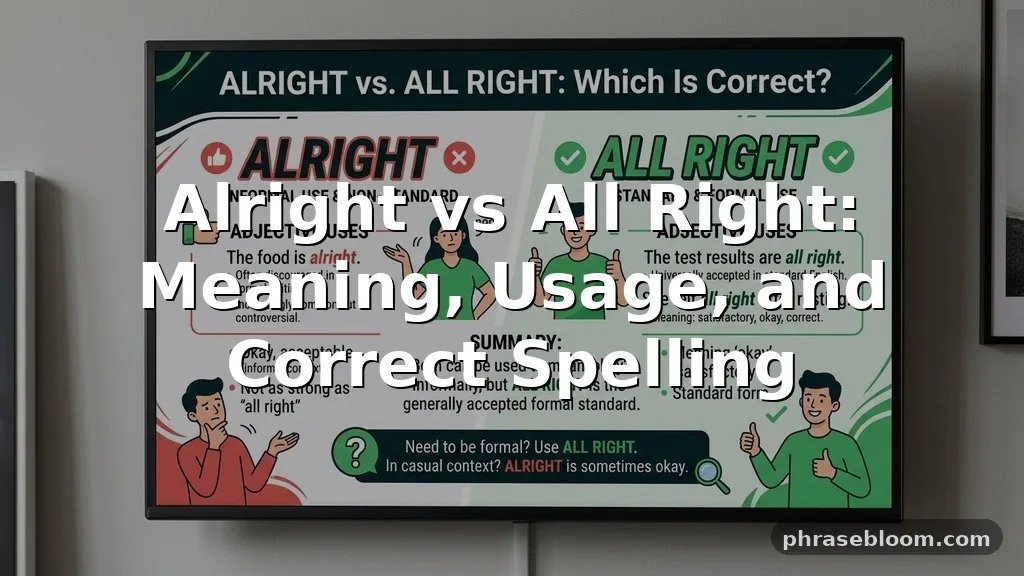
The choice between alright vs all right depends on context, tone, and the level of formality you need. Both forms are widely understood, and both can express agreement, acceptance, or a satisfactory condition, but they do not carry exactly the same stylistic weight.
All right is the safest choice in formal writing, academic work, business communication, and careful editing. Alright is common in informal English and appears frequently in modern published writing, but some style guides and readers still regard it as less formal or less traditionally established. Knowing that distinction helps you choose the spelling without treating language preference as a simple right-or-wrong rule.
Alright vs All Right: The Direct Answer
All right is the traditional and generally safest spelling in standard English. It works in formal writing, professional correspondence, academic essays, reports, and edited publications.
Alright is a widely used closed form, especially in informal writing, dialogue, popular media, and conversational American English. It normally has the same basic meaning as all right, so the difference is usually one of spelling, register, and editorial preference rather than meaning.
If you need one dependable rule, use all right unless your organization, publication, or style guide specifically prefers alright. That choice avoids criticism from readers who follow prescriptive grammar traditions and remains clear to readers in both American English and British English.
| Form | Basic meaning | Typical tone | Practical recommendation |
|---|---|---|---|
| all right | Fine, acceptable, correct, or agreed | Neutral to formal | Use as the default in professional and academic writing |
| alright | Usually the same as all right | Informal to neutral | Use when house style or conversational tone supports it |
| allright | Not the standard spelling | Incorrect or accidental | Avoid it |
The two-word form also makes certain grammatical relationships easier to see. In a sentence such as “The figures are all right,” the words can be read as separate elements, while “Are you alright?” functions as a familiar conversational expression.
What “All Right” Means
The all right spelling has several related uses. It can mean satisfactory, safe, acceptable, correct, or willing, depending on the sentence around it.
- Satisfactory: “The revised schedule looks all right to me.”
- Safe or well: “Call me when you know that everyone is all right.”
- Permission or agreement: “All right, we’ll begin the meeting at nine.”
- Correct or acceptable: “Your answer is all right, although the explanation needs more detail.”
- Transition or acceptance: “All right, let’s review the final paragraph.”
In each example, all right may function as an adjective, an adverbial expression, or a conversational response. The exact grammatical label matters less than recognizing how the phrase operates in context.
Adjective uses
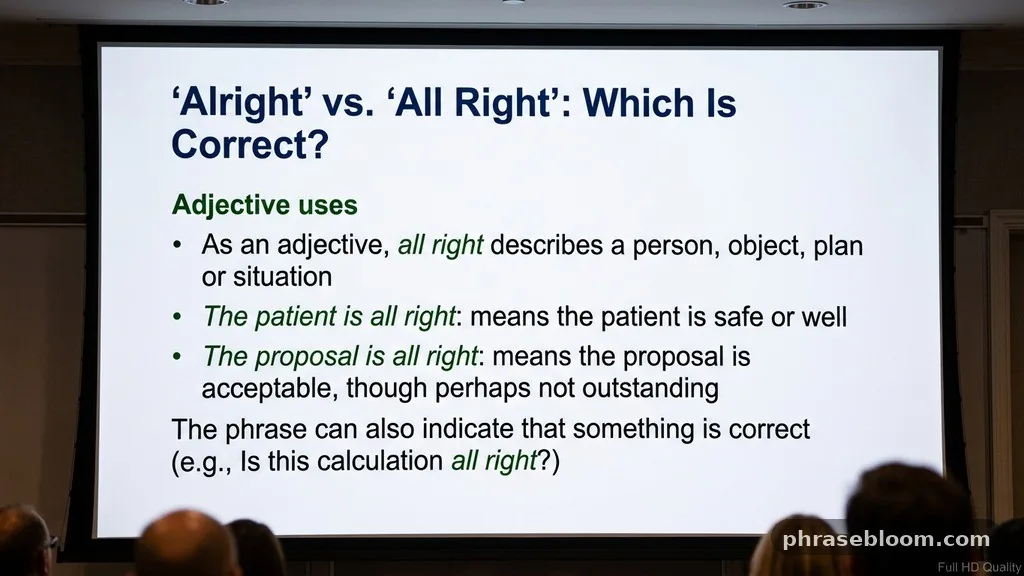
As an adjective, all right describes a person, object, plan, or situation. In “The patient is all right,” it means the patient is safe or well. In “The proposal is all right,” it means the proposal is acceptable, though perhaps not outstanding.
The phrase can also indicate that something is correct. “Is this calculation all right?” asks whether the calculation is accurate or acceptable. That meaning is different from enthusiastic praise, so “all right” often sounds moderate rather than strongly positive.
Conversation and agreement
At the beginning of a sentence, all right can signal agreement, acceptance, or a move to the next point. “All right, I’ll send the revised contract this afternoon” means the speaker accepts the plan.
This conversational use is one reason alright has become so familiar. The closed spelling often appears in dialogue because it reflects the compact rhythm of everyday speech, although formal editors may still prefer the traditional form.
What “Alright” Means
Alright is a closed compound, meaning the two elements have joined to form one written word. Its meaning is generally the same as all right: satisfactory, safe, acceptable, or agreed.
The alright meaning can be seen in sentences such as “Are you alright?” and “The presentation went alright.” These sentences are easy for most readers to understand, and the form appears regularly in informal communication, fiction, journalism, song lyrics, and online writing.
That widespread use does not mean every editor treats alright and all right as interchangeable in every setting. Some style guides accept the closed form, while others recommend retaining the traditional two-word spelling, particularly in formal prose.
Why the closed form exists
English often turns frequently used word combinations into closed compounds. Examples include “already,” “always,” and “altogether,” although the history of each word is different. Frequent use can encourage writers and readers to treat a phrase as a single unit.
The alright spelling follows that general pattern of language evolution. It has gained recognition through repeated use, but acceptance can vary by dictionary, editor, region, and audience. The Oxford English Dictionary entry for “alright” is useful for readers who want to examine its historical development and recorded usage.
Is “alright” one word?
Yes. Alright is written as one word. It is not spelled “allright,” and it should not be confused with the separate words in “all right.”
Calling alright a closed compound explains its spelling, not its level of formality. A word can be written as one unit and still be considered informal, disputed, or unsuitable for a particular publication. That is why the question “Is alright one word?” has a simple answer, while the question “Should I use it?” requires context.
Is “Alright” Correct?
Whether alright is correct depends on what “correct” means in the situation. It is an established form used by many fluent English speakers, but some readers and editors prefer all right because it has a longer history in edited standard English.
In informal writing, a text message, a personal email, or realistic dialogue, alright is usually clear and natural. A sentence such as “I’m alright now” sounds ordinary in conversation.
In formal writing, the safer choice is “I am all right now.” That version avoids a spelling debate and matches the preference of traditional style authorities without changing the meaning.
Correctness and prescriptive grammar
Prescriptive grammar focuses on rules that writers are expected to follow in a particular form of standard English. Under a strict traditional approach, all right is often preferred because it is the older and more established spelling.
Descriptive approaches focus on how speakers and writers actually use language. From that perspective, the widespread appearance of alright is evidence that the form has a real place in English, even if it remains less acceptable to some editors.
These approaches do not produce a single universal verdict. A professional writer should ask what the audience expects, what the applicable style guide says, and whether the document needs a conservative or conversational tone.
Is “all right” always more formal?
Not always. The phrase all right can appear in casual speech, while alright can appear in edited publications. Still, all right is the more conservative choice when the writer wants to signal formal, careful, or traditional usage.
Formality also depends on the sentence itself. “All right, team, let’s get started” is conversational even though it uses the traditional spelling. “The results were alright” may sound less formal even though the surrounding report uses technical vocabulary.
How to Use Each Form in a Sentence
The best way to understand alright vs all right is to examine the grammatical position of the expression. Both forms can occur in similar positions, but the two-word version is usually more suitable for formal prose.
Before or after a verb
In “The client is all right,” the phrase follows a linking verb and describes the client’s condition. This is a predicate adjective use. The sentence means that the client is safe, well, or not in serious difficulty.
The closed form can also appear in the same position: “The client is alright.” The grammar is understandable, but the style is more conversational. A formal report would usually choose “The client is all right.”
As an adverbial expression
In “The software performed all right during testing,” the phrase describes how the software performed. It functions adverbially, meaning it modifies the verb “performed.” The sentence suggests an acceptable result, not necessarily an excellent one.
Many writers would choose “The software performed adequately” in a technical report because that wording is more precise. In a less formal update, “The software performed alright” may sound natural, but it still carries the style concerns associated with the closed form.
As a response or discourse marker
“All right, let’s move to the next item” uses the phrase as a response or transition. It can show agreement, acceptance, readiness, or a change in topic.
“Alright, let’s move to the next item” is also common in speech-based writing. The choice depends on the intended voice. A corporate policy may use “All right” in quoted dialogue, while a screenplay, personal message, or informal blog may use “alright.”
Alright vs All Right in Formal and Professional Writing
Professional writing rewards clarity and consistency, not unnecessary spelling debates. If you are preparing a business report, employee handbook, legal notice, academic paper, or formal email, all right is usually the least controversial option.
That recommendation is practical rather than absolute. Some organizations use alright in their internal communications, product language, or brand voice. If an established house style has chosen the closed form, switching every instance to all right may create inconsistency with existing documents.
Business emails
Use “all right” in a formal email when you mean acceptable or agreed. “All right, I’ll approve the purchase order once the final figures arrive” is clear and professional.
For a friendly internal message, “Alright, I’ll take care of that this afternoon” is understandable. If the email may be forwarded to clients, executives, or external partners, the traditional spelling gives you a more conservative default.
Policies and employee handbooks
Policy documents should normally use all right if the expression is needed at all. These documents often serve as long-term references, so a spelling that is accepted across more editorial traditions can reduce distraction.
Even better, replace a vague phrase with a precise one where appropriate. Instead of “It is all right to access the system remotely,” write “Employees may access the system remotely.” The revised sentence states the rule directly.
Reports and formal analysis
In a business report, “The first-quarter results were all right” may sound too casual because it gives little information. “The first-quarter results met the forecast” communicates a measurable conclusion.
This is an important distinction. Choosing all right solves the spelling question, but it does not automatically make a sentence precise or professional. Strong business writing uses specific descriptions wherever the facts allow.
Websites and marketing copy
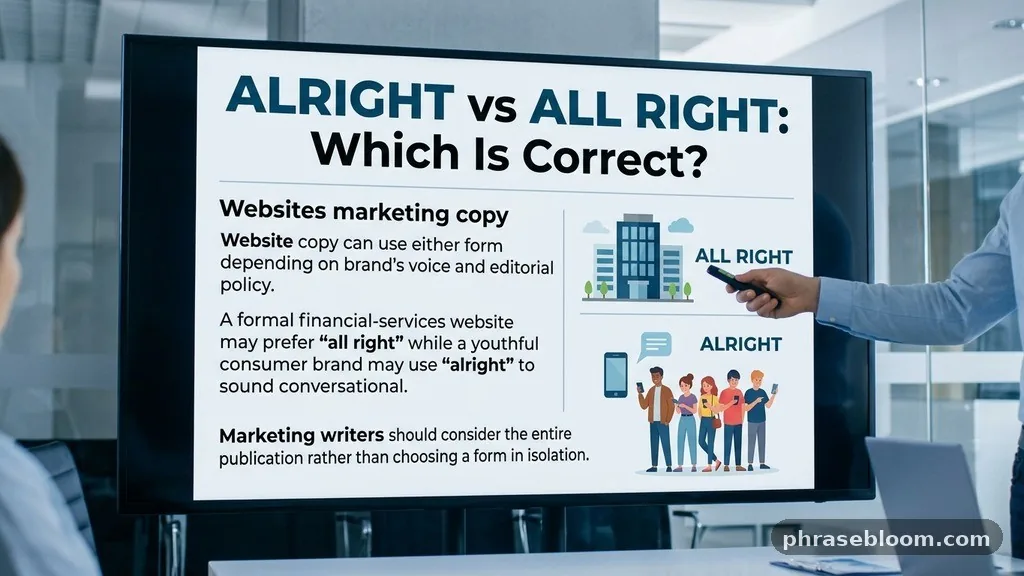
Website copy can use either form, depending on the brand’s voice and editorial policy. A formal financial-services website may prefer “all right,” while a youthful consumer brand may use “alright” to sound conversational.
Marketing writers should consider the entire publication rather than choosing a form in isolation. If one page uses “alright” and another uses “all right” without a reason, visitors may interpret the variation as an editing error.
American English, British English, and Style Guides
There is no simple rule that assigns alright exclusively to American English or all right exclusively to British English. Both forms appear across varieties of English, and regional usage overlaps.
American English often favors compact compounds in many contexts, but that broad tendency does not settle this particular spelling. British English also includes examples of alright, while British editors may still prefer all right in formal prose.
Dictionary treatment and style-guide recommendations can differ. Merriam-Webster records contemporary usage, while editorial manuals may set stricter preferences for a specific publication. The Associated Press Stylebook, an organization’s internal manual, or an academic department’s guidelines may each influence what a writer should submit.
Audience matters more than assumptions
An international audience is unlikely to misunderstand either form, but readers may notice a spelling that conflicts with their expectations. That is a style issue, not proof that one form is incomprehensible or universally incorrect.
If you are writing for a publication based in the United States, check its current house style rather than relying on a general assumption about American usage. The same advice applies to British publishers, universities, multinational companies, and public-sector organizations.
Formal versus informal writing
For formal writing, all right remains the safest recommendation. For informal writing, alright is often acceptable, especially when the goal is to reproduce natural speech or maintain a relaxed tone.
The distinction is similar to other language choices that are widely understood but differently judged by editors. A writer who knows the audience can make an intentional choice instead of treating language evolution as a list of permanent errors.
Alternatives That Avoid the Spelling Question
Sometimes the best solution is not to choose between alright and all right. Rewriting can make a sentence more precise, more concise, or more appropriate for the intended audience.
- Acceptable: “The revised terms are acceptable to both departments.”
- Fine: “The equipment is fine after the inspection.”
- Approved: “The proposed schedule has been approved.”
- Safe: “All passengers are safe.”
- Permitted: “Remote access is permitted for authorized staff.”
- Adequate: “The test results were adequate for the next phase.”
- Agreed: “The departments agreed to the revised deadline.”
These alternatives are not exact substitutes in every sentence. “All right” can signal agreement or begin a transition, while “acceptable” usually describes a judgment. Still, replacing a vague phrase can improve professional writing when the intended meaning is specific.
Choosing a clearer expression
Compare “The figures look all right” with “The figures match the approved forecast.” The second sentence tells the reader what standard the figures meet.
Likewise, “It’s alright to proceed” can become “You may proceed” or “The review team has authorized the next step.” The revised version removes conversational softness and identifies the source of permission.
When the familiar phrase is better
There are times when all right or alright is exactly what the writer needs. In dialogue, “Are you all right?” expresses concern naturally, while “Are you safe and well?” may sound stiff.
The expression also works well when the writer wants a brief transition. “All right, let’s examine the evidence” has a different rhythm from “We will now examine the evidence.” Good writing depends on matching the wording to the situation.
Common Mistakes and How to Fix Them
The most common error is writing allright. That spelling combines the two forms incorrectly and should be avoided in standard English.
Another frequent problem is treating alright as automatically wrong or all right as automatically superior in every context. The real issue is often audience, tone, and editorial policy rather than basic comprehension.
Inconsistent spelling
A document should not switch randomly between “alright” and “all right.” Readers may assume the inconsistency reflects multiple authors, careless editing, or an unresolved style decision.
Choose a default before editing. Search the document for both forms, decide which one fits the intended register, and revise the exceptions unless a quotation or deliberate voice requires the alternative.
Using “alright” in a formal rule
“It is alright for employees to share passwords” is not only stylistically questionable; it also communicates a poor security rule. A clearer revision is “Employees must not share passwords.”
Formal documents should avoid using a conversational expression where a direct instruction is needed. The choice of spelling matters less than the precision of the policy.
Inventing “alrightly”
Alrightly is not a standard replacement for “in an acceptable way.” Writers should not form it simply because “alright” exists as a closed compound.
Use “adequately,” “satisfactorily,” “correctly,” or another adverb that expresses the intended meaning. For example, “The process was completed correctly” is clearer than an invented form.
Confusing spelling with meaning
In most ordinary sentences, “alright” and “all right” do not represent different levels of safety, quality, or approval. The spelling does not turn an acceptable result into an excellent one.
Meaning comes from context. “The draft is all right” may mean merely adequate, while “All right, I agree” signals acceptance. The same spelling can serve different functions.
How to Choose the Right Form
A short decision process can settle the question quickly. Start with the audience, then consider the sentence and the document’s existing style.
- Identify the meaning. Decide whether you mean safe, acceptable, correct, agreed, or ready to proceed.
- Check the level of formality. Use all right as the conservative choice in formal, academic, legal, and professional writing.
- Check the house style. Follow the organization, publication, client, or school guidelines if they specify alright or all right.
- Review nearby usage. Match the spelling already used consistently in the document unless it is clearly an error.
- Consider rewriting. Replace the phrase with “approved,” “permitted,” “safe,” or another precise word if that improves clarity.
- Proofread the final version. Confirm that you have not used “allright” or switched forms without a reason.
For most writers, the practical default is simple: choose all right in formal writing and allow alright in informal writing when it suits the voice. Neither form should be used merely because it seems shorter or more modern.
If your audience includes editors, teachers, regulators, or international business readers, the traditional spelling is especially useful. It does not guarantee that every sentence is well written, but it removes one avoidable point of disagreement.
Examples You Can Copy and Adapt
The following examples show how the two forms work in realistic settings. The forms are usually interchangeable in meaning, but the tone may change slightly.
- “Are you all right after the evacuation?”
- “Are you alright after the evacuation?”
- “All right, I’ll send the signed agreement before noon.”
- “Alright, I’ll send the signed agreement before noon.”
- “The revised figures look all right, but finance must verify them.”
- “The revised figures look alright, but finance must verify them.”
- “The customer confirmed that the replacement unit was all right.”
- “The customer confirmed that the replacement unit was alright.”
- “The first draft was acceptable, but the second draft was stronger.”
- “Employees may proceed once the supervisor has approved the request.”
The first four pairs are suitable for dialogue or internal communication, with all right carrying the more conservative editorial style. The final two examples show how a precise alternative can improve a formal report.
Examples for workplace communication
“All right, everyone, the training session will begin at 2 p.m.” works in a spoken announcement or meeting transcript. “The training session will begin at 2 p.m.” is better for a formal calendar notice because it removes a conversational transition.
“The new process is all right for small teams” expresses a general judgment. “The new process is approved for teams of fewer than ten employees” gives the reader a clearer operational rule.
Examples for academic writing
Academic writers should normally choose all right if the phrase appears in an essay or research discussion. Even then, a more exact word may be preferable: “The result was statistically acceptable” says more than “The result was all right.”
In quoted interview material, retain the speaker’s original form if the spelling reflects the intended voice and the publication’s quotation policy permits it. Edited prose and quoted speech do not always need identical language choices.
Frequently Asked Questions
Is “alright” or “all right” correct?
Both forms are used in English and usually have the same basic meaning. All right is the safer choice for formal writing, while alright is widely used in informal and conversational writing.
Is “alright” one word?
Yes. Alright is written as one word. Do not write “allright,” which is not the standard spelling.
Should I use “all right” in formal writing?
Usually, yes. Use all right in academic work, business reports, formal emails, legal documents, and other edited contexts unless an applicable style guide or house style directs you to use alright.
Is “all right” more formal than “alright”?
Generally, all right is treated as the more traditional and formal option. The difference is a matter of register and editorial preference, not a major difference in meaning.
Is there an American English and British English difference?
There is no strict regional division. Both spellings occur in American English and British English, so writers should check the audience’s style expectations rather than assume that one form belongs exclusively to one variety.
Can I use “alright” after a verb?
Yes. “She is alright” and “The project went alright” are understandable examples. In formal writing, however, “She is all right” or “The project went satisfactorily” may be the safer or clearer choices.
What is a good alternative to “all right”?
Choose a word that states the intended meaning, such as “acceptable,” “safe,” “approved,” “permitted,” “adequate,” or “correct.” The best alternative depends on whether you are describing a condition, granting permission, or evaluating a result.
Should I use one spelling consistently?
Yes. Select a form that fits your audience and document, then use it consistently. Exceptions may be appropriate in quotations, dialogue, or material that deliberately preserves a speaker’s original style.
Final Recommendation for Alright vs All Right
The practical choice in alright vs all right is straightforward: use all right when you want the most broadly conservative option, especially in formal, academic, legal, and professional writing. Use alright when the setting is informal or when a publication’s house style accepts the closed form.
Neither spelling changes the core meaning, and neither should replace a more precise word when the sentence needs one. Check your organization’s style guide, consider your audience, and keep the chosen form consistent. That approach makes your writing clear without pretending that language evolution has produced only one acceptable usage.
5 thoughts on “Alright vs All Right: Meaning, Usage, and Correct Spelling”