
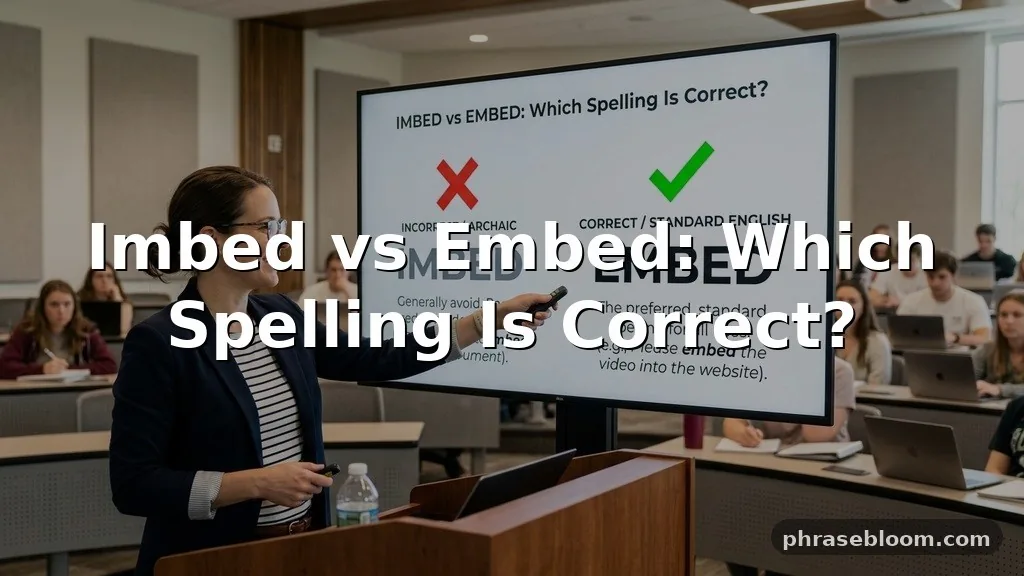
The choice between imbed vs embed is usually a spelling and usage question, not a difference in meaning. Both verbs can mean to fix something firmly inside another thing, and both appear in dictionaries and published English. In most modern writing, however, embed is the more widely recognized form and the safest choice for business, academic, technical, and general communication.
Imbed is not automatically wrong, but it is less common in many contexts. This article explains the spelling difference, the verb forms, the history behind both words, and the situations in which embed, imbed, embedded, or imbedded may appear.
Imbed vs Embed: The Short Answer
Embed is generally the preferred spelling in contemporary English. It is especially common in technology, journalism, education, publishing, and professional writing.
Imbed is also an established spelling with the same basic meaning. It can be found in dictionaries and edited texts, but many readers encounter it less often. If you have no relevant style guide or house style to follow, embed is usually the clearest default.
| Form | Meaning | Typical use | Practical recommendation |
|---|---|---|---|
| embed | To fix, place, or insert something firmly within another thing | General, technical, academic, and professional writing | Use this as the default spelling |
| imbed | The same basic meaning as embed | Established but less common variant usage | Use it if a house style or source specifically prefers it |
| embedded | Past tense or past participle of embed | Technology, writing, research, and physical descriptions | Usually preferred over imbedded |
| imbedded | Past tense or past participle of imbed | Variant formal and literary usage | Acceptable when consistent with the chosen verb |
The simple rule is this: choose embed unless there is a clear reason to use imbed. The difference is primarily one of spelling preference, frequency, and editorial style rather than a sharp difference in definition.
What Does Embed Mean?
Embed is a transitive verb. That means it normally takes a direct object, such as an image, message, device, idea, or person.
In its physical sense, embed means to place something firmly into a surrounding material. A construction crew might embed steel supports in concrete, while a researcher might embed a specimen in wax before examining it under a microscope.
The word also has several important figurative meanings. An idea can become embedded in a culture, a habit can become embedded in a routine, and a journalist can be embedded with a military unit or other organized group.
- The manufacturer embedded a sensor in the handle.
- The report embeds historical data in each chapter.
- Years of practice embedded the procedure in the team’s daily routine.
- The website lets visitors embed a video on another page.
In digital communication, embed often means to place media or code directly into a webpage, document, or application. An embedded video, for example, plays within a webpage instead of requiring the reader to visit a separate location.
That technology meaning has made embed particularly familiar to modern readers. People now regularly see phrases such as “embed a video,” “embedded content,” “embedded link,” and “embedded software.”
What Does Imbed Mean?
Imbed has the same central meaning as embed: to place something deeply or firmly inside another thing. Its dictionary definition is not generally a separate concept with a completely different action.
The spelling with im- may look unusual because embed is more familiar in current usage. Still, imbed has a long history in English and remains recognizable as a variant spelling.
Examples of imbed include:
- The technician imbedded the small magnet inside the casing.
- The roots imbed themselves in the surrounding soil.
- The author imbedded a subtle reference in the final paragraph.
- The panel was designed to imbed securely into the frame.
Many editors would revise these sentences to use embed and embedded, particularly in a technical manual or public-facing document. That revision reflects current preference and consistency, not necessarily a claim that imbed is impossible or meaningless.
The practical issue is audience recognition. Since embed is more familiar to many readers, it tends to look more natural and creates less hesitation in professional writing.
Why Do Both Spellings Exist?
The spelling difference comes partly from the history of English prefixes and partly from variation in how borrowed words developed. Embed is connected to the idea of placing something in or into a surrounding substance, while imbed developed as a spelling variant rather than as a wholly separate verb.
English frequently permits spelling variation when a word has been used for a long time in different forms. Some variants become dominant, while others remain in dictionaries but gradually become less common in ordinary writing.
The prefix in embed is not functioning as a simple modern instruction to add the letter e. Its history involves older forms and influences from French and Latin. That etymology helps explain why the two spellings can coexist, but it does not require modern writers to treat them as equally common.
Dictionaries such as Merriam-Webster’s entry for embed can help confirm meanings, verb forms, and related usage. A dictionary records established language use, while a workplace style guide may still recommend one spelling for consistency.
The important point is that dictionary inclusion and editorial preference are not identical. A word may be valid in English while still being a poor choice for a particular audience, publication, or document.
Embed and Imbed in Real Sentences
Both spellings can describe a physical object placed within another material. The following examples use embed, the form most writers would choose today.
The engineer embedded copper wiring inside the wall panels.
The fossil was embedded in a layer of sedimentary rock.
Those sentences use embedded as a past participle. It describes the condition of the wiring and fossil after someone or something placed them inside another substance.
The verb also works in organizational and cultural writing. A company may embed a new process in its workflow, or a community may have values embedded in its traditions.
The revised training program embeds safety checks into every stage of production.
The principle of public access is embedded in the organization’s mission.
Technology creates another major group of usage examples. In that context, embed often refers to content that appears within a different digital environment.
- Use the platform’s code to embed the presentation on your intranet.
- The application has an embedded reporting tool.
- The editor embedded a chart directly in the annual report.
- Readers can view the embedded map without leaving the page.
The spelling imbed can replace embed in many of these sentences without changing the basic meaning. For example, “The application has an imbedded reporting tool” is understandable, but many readers will find “embedded reporting tool” more familiar and polished.
Do not switch randomly between the forms in one document. If a report uses embed in one section and imbed in another, readers may assume the difference is meaningful even when it is not.
Which Spelling Is More Common?
Embed is generally more common in current general, academic, technical, and business English. The rise of online publishing has reinforced that preference because digital products frequently use terms such as embedded media, embedded content, and embedded systems.
Frequency alone does not make imbed ungrammatical. It simply means that embed is likely to be the form most readers expect.
Professional writers should separate three questions:
- Is the spelling recognized in English?
- Will the intended audience understand it immediately?
- Does the chosen form match the relevant style guide or house style?
Imbed can pass the first test. It may pass the second as well, although some readers may pause over it. In many settings, embed passes all three without creating a style issue.
Frequency can also vary by field. A literary text may preserve an older or less common variant, while a software manual is more likely to use the terminology familiar to developers and users.
That is why claims such as “imbed is always wrong” or “both forms are equally preferred everywhere” are too broad. The accurate answer depends on usage, audience, and editorial policy.
Embedded or Imbedded?
The past tense and past participle forms follow the spelling of the selected verb. If you use embed, the usual form is embedded. If you use imbed, the corresponding variant is imbedded.
In contemporary writing, embedded is usually the safer choice. It appears naturally in descriptions of software, journalism, research, electronics, culture, and physical objects.
- The embedded image loaded correctly in the report.
- The researcher examined the embedded sample.
- An embedded journalist provided firsthand observations.
- The device contains an embedded security feature.
Imbedded follows a valid spelling pattern, but it may appear less familiar. Some readers may even wonder whether it is a typographical error, especially in a document that otherwise uses modern technical vocabulary.
The same consistency principle applies to related forms. Avoid writing “embed” in one paragraph, “imbedded” in the next, and “embedded” later unless the difference is deliberate and explained.
If your organization has already standardized on imbedded, changing every instance may not be necessary. The best editorial choice is usually the one that preserves consistency across the document and matches the publication’s established practice.
American English and British English
The choice between embed and imbed is not a simple American-versus-British distinction. Neither spelling belongs exclusively to one national variety, and neither can be assigned reliably to only American English or only British English.
American English and British English both contain examples of spelling variation, and individual dictionaries may differ in which form they list first or how they describe the alternative. Publishers, universities, newspapers, software companies, and government organizations can also maintain their own preferences.
Formal writing should therefore follow the relevant publication standard rather than relying on assumptions about geography. A British academic department may prefer embed, while an American organization may retain imbed in an established technical vocabulary.
Audience expectations still matter. If a document is intended for an international audience, embed may be the most immediately recognizable option because it is common in digital and professional terminology across regions.
Other regional spelling differences, such as colour and color, have well-known patterns. The relationship between embed and imbed is less neatly divided by national variety.
Use the form required by a named style guide, institutional policy, client specification, or editorial team. If no such authority applies, choose embed and use it consistently.
Choosing the Right Form in Professional Writing
In a business email, embed is usually the natural choice. You might write, “Please embed the updated chart in the client presentation,” or “The new process is embedded in the team’s review schedule.”
Employee handbooks and company policies should favor clarity over unnecessary variation. “The handbook includes embedded links to the required forms” is direct, familiar, and easy to maintain across future revisions.
Technical documentation may use embed as a specialized term. Software instructions often explain how to embed video, code, fonts, widgets, or reports inside another product.
Academic writing requires a slightly more careful approach. If you are describing a physical process, a social pattern, or a research method, embedded will normally be understood without explanation. Your institution’s style guide remains the final authority if it specifies a different form.
Marketing copy has more flexibility, but familiar language is still valuable. A sentence such as “Create a page with embedded video and interactive charts” is clearer to most readers than one using the less common imbedded.
Legal and policy documents deserve special attention because consistency can affect interpretation. The spelling itself rarely changes the legal meaning, but inconsistent terminology can make a document look poorly controlled.
Before finalizing professional writing, check these points:
- Look for an organizational style guide or editorial manual.
- Search the entire document for both spellings.
- Use the same form in headings, examples, captions, and body text.
- Choose embed if no established preference exists.
- Ask whether a less technical alternative would be clearer for the audience.
Alternatives That Avoid the Spelling Question
Sometimes the best revision is not choosing between embed and imbed. You can rewrite the sentence with a phrase such as “insert into,” “place within,” or “include in.”
For example, “Embed the chart in the report” could become “Include the chart in the report.” “The values are embedded in the culture” could become “The values are deeply rooted in the culture.”
These alternatives are not always exact substitutes. Embed can imply firm placement, integration, or technical insertion, while include may express only presence.
| Original idea | Possible alternative | Best use |
|---|---|---|
| Embed the video in the webpage. | Place the video on the webpage. | Plain-language instructions |
| The feature is embedded in the software. | The feature is built into the software. | User-facing technical communication |
| The idea is embedded in the policy. | The idea is included in the policy. | When “firmly integrated” is not important |
| The sensor is embedded in the device. | The sensor is installed inside the device. | Physical or engineering explanations |
Rewriting can improve accessibility for English learners and readers outside a specialist field. Still, do not replace a precise technical term merely to avoid a familiar spelling choice.
Common Mistakes With Imbed and Embed
Assuming imbed is always incorrect
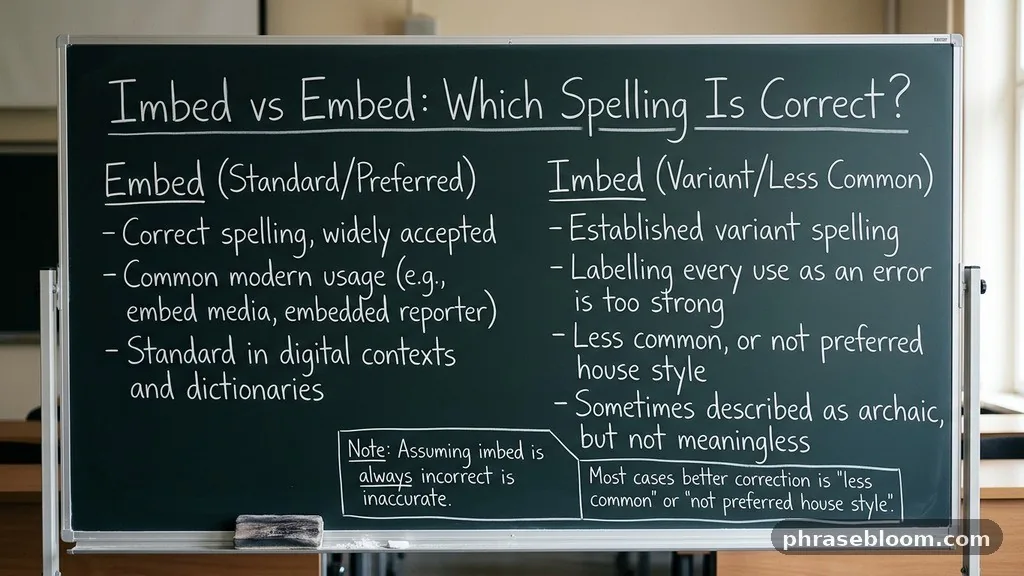
Imbed is an established variant, so labeling every use as an error is too strong. In most cases, the better correction is “less common” or “not the preferred house style,” not “meaningless.”
Changing spellings without changing the related form
Writers sometimes use imbed but write embedded, or use embed but write imbedded. Although readers will usually understand the sentence, the mixed forms create an avoidable inconsistency.
Using embed when include is more accurate
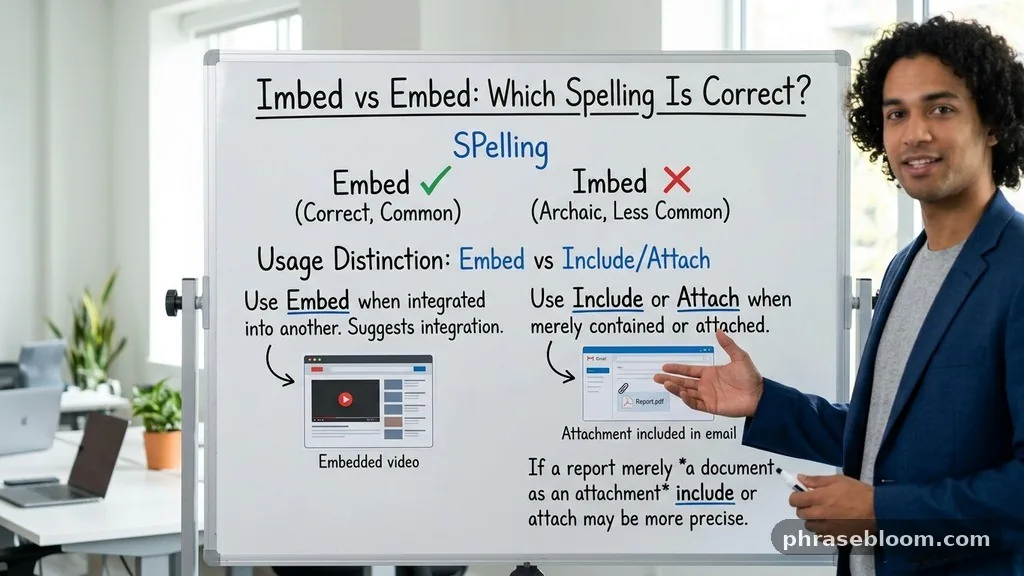
“Embed” suggests that one thing is placed within or integrated into another. If a report merely lists a document as an attachment, “include” or “attach” may be more precise.
Treating embed as only a technology word
Digital usage is highly visible, but the verb also applies to physical objects, social ideas, habits, research methods, and journalism. Its meaning depends on the object and context.
Ignoring the document’s existing style
An organization may have years of manuals, templates, or product documentation using one spelling. A writer should check those materials before introducing a variant that creates unnecessary inconsistency.
A Practical Decision Rule
When you need to choose between imbed and embed, start with the audience and document type. A public webpage, business report, academic paper, or software instruction will usually benefit from the familiar form embed.
Next, check for an applicable authority. That may be a university style guide, a publisher’s editorial policy, a client’s terminology list, or an internal documentation standard.
If no authority exists, apply this short decision process:
- Ask whether you mean “place firmly inside,” “integrate,” or “insert.”
- Use embed as the default modern spelling.
- Use embedded for the past tense and past participle.
- Search for inconsistent forms before submitting the document.
- Replace the word with a clearer alternative if the audience may not know the technical sense.
This method avoids two opposite errors. It does not treat imbed as impossible, and it does not pretend that every spelling choice is equally useful in every context.
Consistency is especially important in long documents. A reader may not consciously notice the difference between embed and imbed, but inconsistent terminology can still reduce confidence in the editing.
Examples You Can Copy and Adapt
The following examples show common professional uses of embed. They can be adapted for workplace communication, reports, websites, and technical documentation.
- Please embed the updated form in the employee portal.
- The report includes an embedded chart showing quarterly results.
- Managers should embed the new approval step in their regular workflow.
- The training video is embedded below the written instructions.
- The device uses an embedded processor to manage temperature control.
- The survey embedded three quality checks in the questionnaire.
- The policy is designed to embed accessibility into every stage of planning.
- The journalist was embedded with the emergency response team during the operation.
Here are equivalent examples using imbed or imbedded. They are understandable, but many editors would choose the embed forms in a current professional document.
- The technician imbedded the component beneath the protective layer.
- The historical reference was imbedded in the author’s description.
- The device contains an imbedded monitoring function.
- The roots became imbedded in the compacted soil.
If you use the less common variant, use it deliberately. A consistent document that follows an established house style is stronger than one that alternates between forms without explanation.
Frequently Asked Questions
Is embed or imbed the correct spelling?
Both are established spellings, but embed is generally the preferred and more familiar form in modern English. Use imbed when a trusted dictionary, publication, or house style specifically supports it.
Is imbed a misspelling of embed?
No. Imbed is a recognized variant spelling. It is less common in many forms of contemporary writing, which is why some readers may mistake it for an error.
Is embedded or imbedded more common?
Embedded is usually more common, especially in technology, business, academic, and public-facing writing. Imbedded is the corresponding form of imbed and remains acceptable in contexts that use that variant.
Should I use embed in formal writing?
Usually, yes. Embed is a safe default for formal writing unless your organization, publisher, or academic style guide has a different preference.
Does embed have a different meaning from imbed?
In ordinary usage, the two verbs have the same basic meaning. The difference is mainly spelling, frequency, and editorial preference.
Conclusion
The practical answer to Imbed vs Embed is straightforward: both forms are recognized, but embed is usually the better default. It is familiar across professional writing, academic prose, digital communication, and technical documentation, while imbed remains a valid but less common variant.
Check your style guide when one applies, then use the selected spelling consistently in every related form, including embedded or imbedded. If you still have doubts, choose embed, or rewrite the sentence with “place,” “include,” or “build into” when that wording is more precise.
Related reading: Alright vs All Right, Gluing vs Glueing, Hastle or Hassle.