
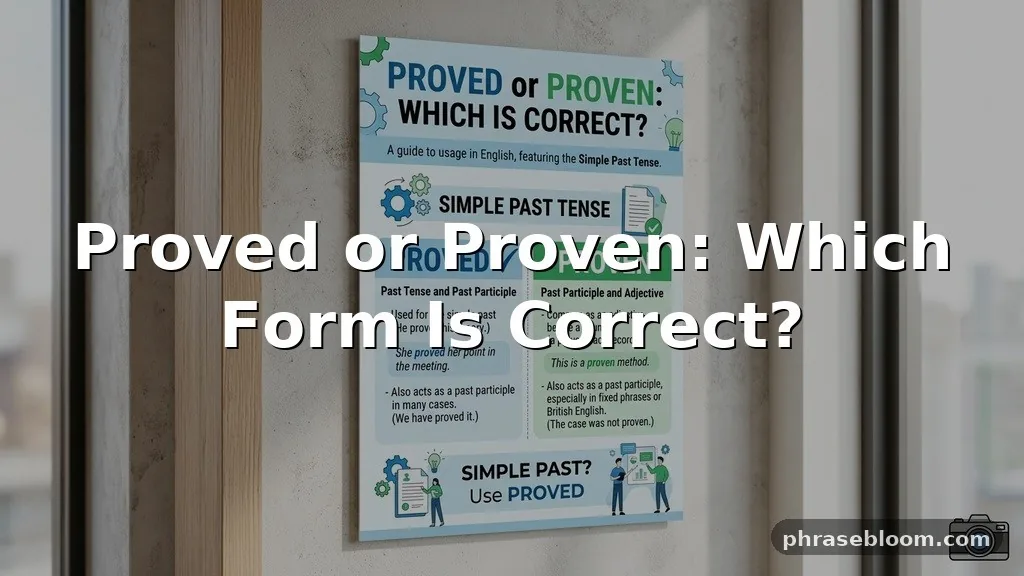
Proved or Proven: Which Form Is Correct?
“Proved or proven” is a genuine choice in modern English, not a simple case of one form being right and the other wrong. Proved is the regular past tense and past participle of prove, while proven is an established alternative past participle, especially common before a noun and in phrases such as “a proven method.” Both forms appear in standard English.
The safest choice depends on grammatical function, regional preference, tone, and the style of the document. This article explains the difference between proved vs proven, shows how each form works in real sentences, and gives you a practical rule for formal writing, business English, academic work, and everyday usage.
The Short Answer: Both Forms Are Correct
Proved and proven come from the verb prove. The form proved can serve as the simple past tense, as in “The test proved the theory,” and it can also function as a past participle, as in “The theory has been proved.”
Proven is an alternative past participle. It is particularly familiar when it acts as an adjective before a noun, as in “a proven strategy,” “a proven fact,” or “a proven safety record.” In these examples, proven describes something that has already been shown to be reliable, true, or effective.
The basic pattern is straightforward:
- Use proved as the simple past tense: “The evidence proved his claim.”
- Use proved or proven as a past participle: “The evidence has proved useful” or “The evidence has proven useful.”
- Prefer proven in many established adjective phrases: “a proven method.”
- Follow your organization’s style guide if it has a stated preference.
There is no universal rule that makes proven incorrect or requires proved in every sentence. The most useful question is not “Which word is always right?” but “What grammatical job is the word doing here?”
What “Proved” Means and How It Works
Proved is the ordinary past-tense form of prove. If an action happened in the past, you can use proved to describe it: “The laboratory test proved the material was durable.” The sentence presents the proof as a completed past event.
As the simple past tense, proved does not need an auxiliary verb such as has, had, or was. Compare “The audit proved the figures were accurate” with “The audit has proved the figures were accurate.” The first sentence places the proof at a finished point in the past, while the second connects the result with the present.
Proved also works as a past participle. A past participle is a verb form used with helping verbs or in passive constructions. For example, “The claim was proved by the records” uses proved after was in the passive voice.
In formal writing, proved may sound especially natural when the sentence emphasizes an action or process. Consider these examples:
- “The witness’s account proved consistent with the available records.”
- “The revised procedure proved more efficient than the original process.”
- “The researchers proved that the two samples came from the same source.”
- “The prediction proved correct after the final measurements were reviewed.”
In each sentence, proved describes what happened or what became clear. It does not necessarily suggest that someone deliberately completed a formal proof in the mathematical sense. The verb can mean demonstrated, showed, turned out to be, or established as true, depending on context.
What “Proven” Means
Proven is an established past participle of prove. It is also widely used as an adjective, particularly in front of a noun. “A proven technique” means a technique that has demonstrated its value or reliability through experience, evidence, or repeated use.
The word often appears in professional, commercial, technical, and academic writing because it efficiently signals prior success. A manager might recommend “a proven hiring process,” while an engineer might refer to “a proven design.” The word does not automatically prove that the claim is true, however, so the surrounding evidence still matters.
Examples of adjectival proven include:
- “The company adopted a proven approach to data security.”
- “Her proven leadership skills helped stabilize the department.”
- “The device uses a proven method for reducing heat loss.”
- “The report identifies a proven link between the two events.”
In these sentences, proven modifies a noun. It behaves like an adjective rather than a simple past-tense verb. That distinction explains why “proven method” feels more natural to many speakers than “proved method,” even though proved can sometimes appear in similar positions.
Proven can also occur in perfect tenses and passive structures. “The approach has proven effective” uses proven after has, while “The approach has been proven effective” uses it in a passive construction. The corresponding versions with proved are also grammatical: “The approach has proved effective” and “The approach has been proved effective.”
Proved vs. Proven in Real Sentences
The difference becomes clearer when the two forms appear in complete sentences. The following examples cover common uses in workplace communication, academic writing, reports, and everyday speech.
| Sentence | Form | Function | Comment |
|---|---|---|---|
| The evidence proved the allegation. | Proved | Simple past verb | The evidence established something in the past. |
| The evidence has proved useful. | Proved | Past participle | A common formal and regional choice. |
| The evidence has proven useful. | Proven | Past participle | Also standard and widely used. |
| The team used a proven process. | Proven | Adjective | Describes a process already shown to work. |
| The prediction proved correct. | Proved | Linking verb | Means that the prediction turned out to be correct. |
| The prediction was proven correct. | Proven | Passive construction | Acceptable, though some editors prefer “proved.” |
“The trial proved successful” and “The trial proved to be successful” are both natural. Here, proved connects the subject with a description of the result, so it functions as a linking verb.
“The new software has proven reliable” is also natural, especially in American English. “The new software has proved reliable” is equally defensible and may be preferred by a particular editor, institution, or regional tradition.
The adjective proven often carries a slightly more settled or promotional tone. A business may describe “a proven solution,” while a research report may choose “the method proved effective” to focus on the observed result rather than present the method as a general product claim.
Past Tense, Past Participle, and Adjective
The grammar behind proved and proven involves three related but different roles. Understanding them prevents most mistakes.
Simple past tense
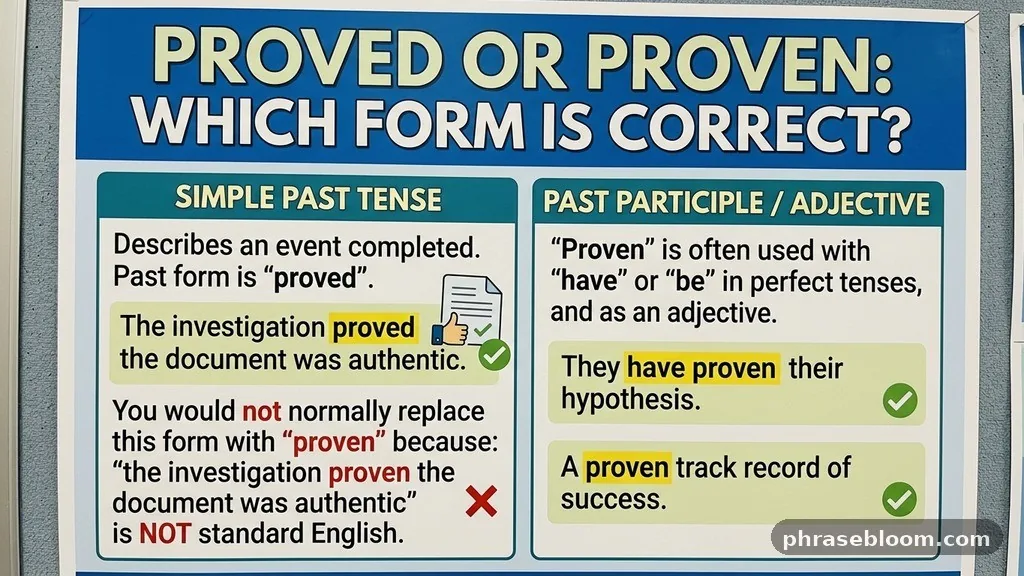
The simple past describes an event completed in the past. The form is proved: “The investigation proved the document was authentic.” You would not normally replace this form with proven, because “The investigation proven the document was authentic” is not standard English.
Past participle
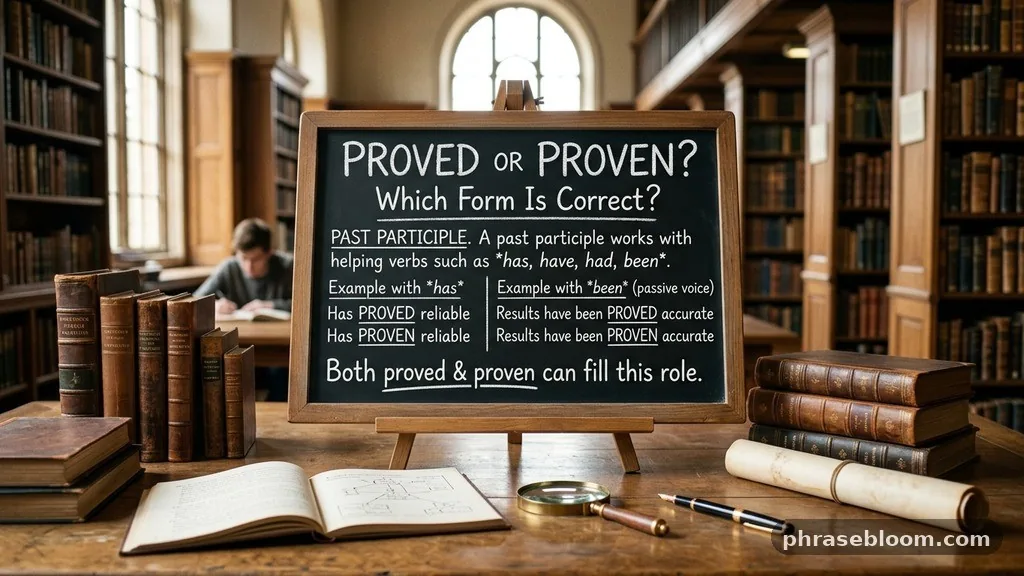
A past participle works with helping verbs such as has, have, had, or been. Both proved and proven can fill this role: “The method has proved reliable” and “The method has proven reliable.”
The same choice appears in passive voice. “The results have been proved accurate” and “The results have been proven accurate” are both found in standard usage, although the second may sound more familiar to many readers.
Adjective
An adjective modifies a noun or describes a subject after a linking verb. Proven is particularly common as an adjective before a noun: “a proven solution.” It can also appear after a linking verb, as in “The solution is proven,” although “The solution has been proven” may be clearer when the sentence refers to an act of demonstration.
Context still matters. “The prediction proved correct” uses proved as a linking verb, while “a proven prediction” uses proven as an adjective. These patterns are conventional rather than absolute, which is why a rigid rule creates more confusion than clarity.
Has Proved or Has Proven?
Both “has proved” and “has proven” are correct in standard English. They use the present perfect tense, which connects a past event or development with the present. “The policy has proved effective” and “The policy has proven effective” communicate the same central idea.
Regional and stylistic preferences can influence the choice. Many American English writers use has proven frequently, while has proved remains common in British English and in formal writing influenced by older editorial traditions. Neither form should be treated as exclusively American or exclusively British.
Choose has proved when it fits the rhythm and tone of the surrounding prose:
- “The partnership has proved valuable over several reporting periods.”
- “The initial estimate has proved accurate.”
- “The training program has proved difficult to scale.”
Choose has proven in equally standard sentences:
- “The partnership has proven valuable to both organizations.”
- “The updated forecast has proven accurate.”
- “The training program has proven difficult to scale.”
Some writers believe proven sounds stronger or more modern, but that is a matter of perception rather than a reliable grammatical distinction. The sentence should be judged by its meaning, audience, and consistency with the rest of the document.
American English and British English Usage
American English and British English do show differences in how often speakers choose proved or proven, but the boundary is not absolute. Both varieties recognize the verb prove, and both use proved as the simple past form.
The main variation concerns the past participle. American writing often uses proven in expressions such as “has proven effective” and “a proven strategy.” British writing also uses these forms, while has proved may appear more often in some formal or edited contexts.
Readers should avoid assuming that one form identifies a writer’s nationality. A multinational company may use proven in its American office, proved in a British report, and a single corporate preference across both offices. House style can be more influential than geography.
For reference, writers can consult an established dictionary such as the Merriam-Webster Dictionary entry for “prove” when checking the verb’s forms and meanings. A dictionary confirms what is accepted, but it may not settle which version best fits your publication or organization.
Formal writing benefits from consistency rather than exaggerated claims about regional correctness. If a university department, legal team, or publisher follows a specific style guide, that guidance should normally take priority over personal preference.
When “Proven” Is the Better Choice
Proven is often the most natural choice when it appears directly before a noun and describes an established quality. Common phrases include “a proven method,” “a proven record,” “a proven technology,” and “a proven approach.” These expressions are familiar because proven has developed a strong adjectival role.
For example, a project manager might write, “We selected a proven scheduling system rather than an untested platform.” The word describes the system’s prior record, not an action that occurred at a particular moment.
In marketing and business writing, proven can sound confident, but writers should use it carefully. Calling a product “a proven solution” implies evidence or experience that supports the claim. If the product is new or has only been tested in limited conditions, a more precise phrase such as “a promising solution” may be more honest.
Proven also works well when the sentence emphasizes an enduring result:
- “The department follows a proven process for reviewing applications.”
- “Her proven expertise made her a strong choice for the assignment.”
- “The report recommends a proven technique with a clear audit trail.”
- “The equipment is based on proven engineering principles.”
These examples do not mean that proved would always be impossible in a similar position. They show the form most commonly chosen when the word has become part of a descriptive phrase.
When “Proved” Is the Better Choice
Proved is the clearest choice for the simple past tense. Write “The review proved the figures were incomplete,” not “The review proven the figures were incomplete.” The verb is describing an action completed by the review.
Proved is also useful when a sentence describes an outcome or change in judgment. “The concern proved unfounded” means that later events showed the concern was not justified. “The estimate proved too low” means the estimate turned out to be lower than reality.
Formal reports often use this construction because it is concise:
- “The proposed timetable proved unrealistic.”
- “The first design proved easier to maintain.”
- “The customer’s warning proved accurate.”
- “The assumption proved incorrect after the data were rechecked.”
In each case, proved links the subject to a later-discovered result. Replacing it with proven may be possible in some passive or participial structures, but it can make the sentence less direct. “The assumption proved incorrect” is generally more economical than “The assumption was proven to be incorrect.”
Use the shorter construction when it preserves the intended meaning. Good editing is not only about choosing a correct verb form; it is also about avoiding unnecessary words.
Common Mistakes With Proved and Proven
The most serious mistake is using proven as the simple past tense. “The experiment proven the hypothesis” is not standard English. The correction is “The experiment proved the hypothesis.”
Another mistake is treating proved and proven as if they always represented different meanings. Usually, the difference concerns grammatical role, established phrase, regional preference, or style. It does not normally indicate two separate kinds of proof.
Writers also sometimes overuse proven in promotional language. A claim such as “our proven system guarantees success” contains two separate issues: proven may be grammatically fine, but “guarantees success” may be too strong unless the evidence truly supports it.
Watch for these practical problems:
- Wrong simple past: Write “The evidence proved the claim,” not “The evidence proven the claim.”
- Unnecessary passive voice: Prefer “The results proved the method effective” when the active construction is clear.
- Unsupported adjective: Use “proven” only when the record or evidence justifies the description.
- Inconsistent style: Do not alternate randomly between “has proved” and “has proven” in one report.
- Confusing verb forms: Remember that proved is the simple past, while both proved and proven can be past participles.
A careful writer checks both grammar and meaning. The correct form should fit the sentence, and the claim should accurately describe what the evidence shows.
Choosing the Right Form in Professional Writing
Business emails usually allow either form, provided the grammar is correct and the organization has no house preference. “The new process has proven effective” sounds natural in a short internal message, while “The new process has proved effective” is equally professional.
Employee handbooks, policy documents, and legal materials deserve closer attention. These documents are often reused, reviewed by several departments, and interpreted across regions. Choose one form, record the decision in the document’s style guidance, and apply it consistently.
Academic writing requires precision about evidence. A researcher might write, “The results proved consistent with the initial model,” when describing a specific finding. The same researcher could refer to “a proven measurement technique” when describing a method with an established record.
Websites and marketing materials often favor proven in phrases such as “proven results” or “proven expertise.” That wording is acceptable when supported by verifiable information, but a precise claim is stronger than an inflated one. “Used successfully in three departments” tells readers more than an unsupported assertion that a product is proven.
Editors working with American and international audiences should focus on clarity and institutional consistency. If a document already uses “has proved” several times, changing one sentence to “has proven” simply for variety may create an unnecessary inconsistency.
A Practical Decision Method
You can resolve most proved-or-proven questions with a short decision process. Start by identifying the verb form required by the sentence, then consider the audience and the document’s style.
- Ask whether the action is simple past. If the sentence says what happened, use proved: “The test proved the material safe.”
- Check for a helping verb. After has, have, had, or been, both proved and proven may be possible.
- Look for an adjective phrase. Before a noun, proven is often the most natural choice: “a proven technique.”
- Consider the sentence’s emphasis. Use proved to focus on what an event showed or how something turned out.
- Check the style guide. A publisher, university, or employer may prefer one past participle.
- Keep the choice consistent. Do not switch forms without a grammatical or stylistic reason.
If the sentence still feels awkward, rewrite it. “The approach has demonstrated its value” avoids the choice entirely and may provide a more specific meaning. Other alternatives include “the evidence established,” “the method was effective,” and “the results confirmed.”
Rewriting should clarify the idea, not hide uncertainty. Use an alternative only when it accurately expresses what happened.
Useful Alternatives to Proved and Proven
Several verbs can replace proved or proven, but each carries a slightly different emphasis. Demonstrated suggests that evidence or performance made something clear. Confirmed suggests that new information supported an existing belief or expectation.
Established often suits formal reports, legal writing, and academic prose. “The records established the date of the transaction” is more specific than “The records proved the date,” particularly when the evidence creates an official basis for the conclusion.
Showed is plain and accessible. It works well in general workplace communication: “The survey showed that employees wanted more training.” There is no need to use proved if showed expresses the point accurately.
| Alternative | Best used when you mean | Example |
|---|---|---|
| Demonstrated | Evidence or performance made a quality clear | The pilot demonstrated the system’s reliability. |
| Confirmed | New evidence supported an existing view | The review confirmed the earlier estimate. |
| Established | A fact was formally or firmly supported | The records established the company’s ownership. |
| Showed | You want simple, direct wording | The survey showed strong customer approval. |
| Verified | A claim was checked against evidence | The analyst verified the reported totals. |
These alternatives do not make proved or proven inferior. They give you more control over precision, tone, and repetition in a longer document.
Examples You Can Copy and Adapt
The following sentences show natural patterns for workplace, academic, technical, and everyday writing.
- “The revised schedule proved easier for both teams to follow.”
- “The revised schedule has proven effective during the first quarter.”
- “We recommend the proven procedure for all new installations.”
- “The audit proved that several invoices had been entered twice.”
- “The audit has proved useful in identifying weaknesses in the approval process.”
- “The audit has proven useful in identifying weaknesses in the approval process.”
- “Her prediction proved correct after the final figures were released.”
- “The team adopted a proven framework for managing research data.”
- “The initial concern proved unfounded once the equipment was inspected.”
- “The software has proven reliable under heavy demand.”
- “The software has proved reliable under heavy demand.”
- “The paper evaluates a proven method rather than proposing an untested one.”
Notice that the simple past examples use proved. The examples with has or has been can use either participle, while the examples before a noun commonly use proven as an adjective.
When editing your own sentence, read it aloud. If “has proved” sounds natural in the surrounding paragraph, use it. If your organization normally writes “has proven,” follow that established pattern instead of changing forms for no reason.
Frequently Asked Questions
Is “proved” or “proven” correct?
Both are correct, but they do not perform exactly the same grammatical role in every sentence. Proved is the simple past tense, while both proved and proven can be past participles. Proven is especially common as an adjective before a noun.
Is “proven” a proper word?
Yes. Proven is an established past participle and adjective in standard English. “A proven fact,” “a proven method,” and “has proven effective” are all widely accepted constructions.
Should I write “has proved” or “has proven”?
Either form can be correct. Use the version preferred by your audience, publisher, or house style, and apply it consistently. If no preference exists, choose the form that sounds most natural in the sentence.
Is “proved” the only correct past tense?
Yes, proved is the standard simple past form: “The experiment proved the theory.” Proven should not replace it in a sentence such as “The experiment proven the theory.”
Is “proven” more formal than “proved”?
Not necessarily. Proven may sound polished in phrases such as “a proven approach,” but proved is fully suitable for formal writing. Grammar, context, evidence, and consistency matter more than an assumed level of formality.
Final Takeaway on Proved or Proven
The practical answer to the proved or proven question is simple: use proved for the simple past, and use either proved or proven as a past participle when the sentence allows both. Choose proven naturally in many adjective phrases, such as “a proven method,” but do not treat it as the only acceptable formal option.
For professional and academic writing, check your organization’s style guide, consider your audience, and keep the choice consistent. If a sentence remains awkward, rewrite it with a precise alternative such as “demonstrated,” “confirmed,” or “established.” Once you distinguish grammatical function from personal or regional preference, choosing between proved and proven becomes much easier.
You may also like: Hassle vs Hastle: Understanding the Difference and Correct Usage · Invision or Envision: Understanding the Difference and Correct Usage Today · Soo vs So: Understanding the Difference and Correct English Usage