
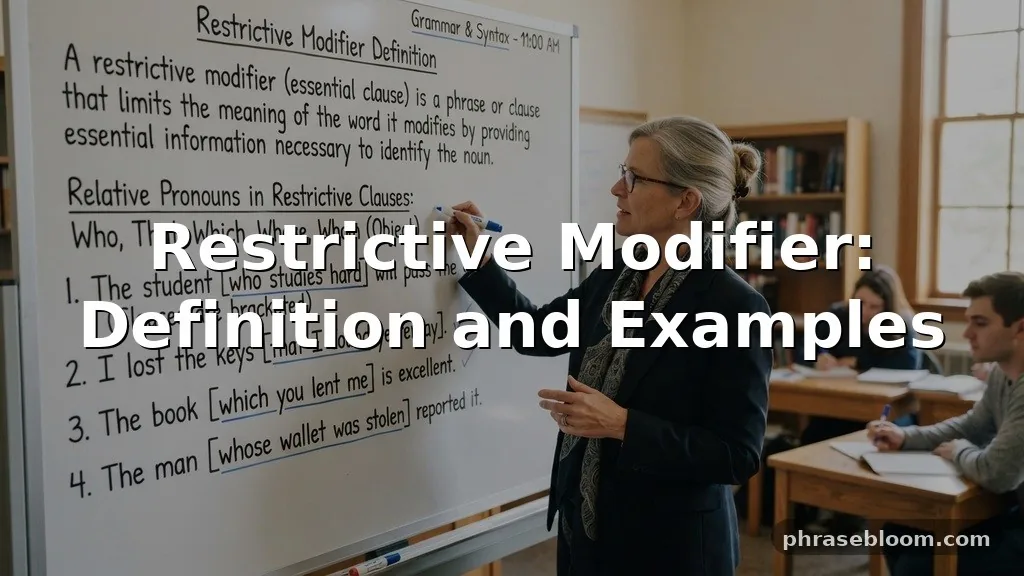
Restrictive Modifier: Definition and Examples
A restrictive modifier adds essential information that identifies exactly which person, thing, or idea a sentence means. In “The employees who completed training received certificates,” the phrase “who completed training” narrows the meaning of “employees.” A restrictive modifier can be a single adjective, a prepositional phrase, a participial phrase, or a restrictive clause.
Understanding this distinction helps you choose commas correctly and avoid changing a sentence’s meaning by accident. The examples below explain restrictive modifiers in plain English, compare them with nonrestrictive modifiers, and show how relative pronouns such as that and which work in professional and everyday writing.
What Is a Restrictive Modifier?
A restrictive modifier is a word or group of words that limits or identifies the meaning of a noun. It gives information the reader needs in order to know which noun the sentence refers to.
Consider this sentence: “The report on quarterly sales is on my desk.” The prepositional phrase “on quarterly sales” modifies “report,” and it may help identify one report from several possible reports. The phrase is restrictive if the writer means a particular report rather than every report.
The modifier can appear before or after the noun. In “The revised contract requires approval,” the adjective “revised” limits which contract is meant. The sentence does not refer to every contract, only the revised one.
In “Students enrolled in the evening course should arrive at six,” the phrase “enrolled in the evening course” identifies the students being addressed. Without it, “students” could refer to a much larger group.
The key idea is selection. A restrictive modifier selects a smaller group from a broader noun category.
- “The files in the locked cabinet are confidential.”
- “The manager responsible for compliance approved the form.”
- “Applicants who submit complete documents will receive a confirmation.”
- “The proposal approved by the board enters the next phase.”
Each bold phrase provides essential information. Removing it would make the noun less specific or could change which people or things the sentence describes.
Restrictive and Nonrestrictive Modifiers
A nonrestrictive modifier adds information about a noun that is already clearly identified. It does not select one item from a larger group. Because the information is extra, writers usually set it off with commas.
Compare these sentences:
“My sister who lives in Denver is a doctor.”
“My sister, who lives in Denver, is a doctor.”
The first sentence may suggest that the speaker has more than one sister and is identifying the one who lives in Denver. The second sentence presents “my sister” as already identified and adds Denver as additional information.
The difference is not merely visual. The commas signal a difference in meaning.
In the first sentence, living in Denver is essential to identifying the sister. In the second, it is background information.
A restrictive modifier is sometimes called an essential modifier. A nonrestrictive modifier may be called a nonessential modifier. Many grammar references also use “defining” for restrictive information and “nondefining” for nonrestrictive information.
| Modifier type | Role | Punctuation | Example |
|---|---|---|---|
| Restrictive modifier | Identifies or limits the noun | Usually no commas | The files stored off-site are archived. |
| Nonrestrictive modifier | Adds extra information | Usually commas | The files, stored off-site, are archived. |
| Restrictive relative clause | Defines which noun is meant | Usually no commas | The analyst who prepared the report is available. |
| Nonrestrictive relative clause | Adds a side detail | Usually commas | The analyst, who prepared the report, is available. |
That table shows a general pattern, not an automatic formula. Meaning comes first. Writers should decide whether the modifier is needed to identify the noun before adding or removing commas.
Restrictive Relative Clauses
A restrictive relative clause is a dependent clause that modifies a noun and identifies which person or thing the writer means. It often begins with that, who, which, or another relative pronoun.
In “The software that tracks inventory needs an update,” the clause “that tracks inventory” identifies the software. The sentence may refer to one application among several used by the company.
In “Employees who work remotely must complete the security course,” the clause “who work remotely” limits the noun “employees.” The sentence does not necessarily apply to every employee.
Because the clause is restrictive, it normally appears without commas. Adding commas can change the intended meaning:
“The clients who renewed their contracts received a discount.”
“The clients, who renewed their contracts, received a discount.”
The first sentence says that only clients who renewed received the discount. The second sentence suggests that all the clients renewed and that the renewal detail is additional information.
Relative pronouns in restrictive clauses
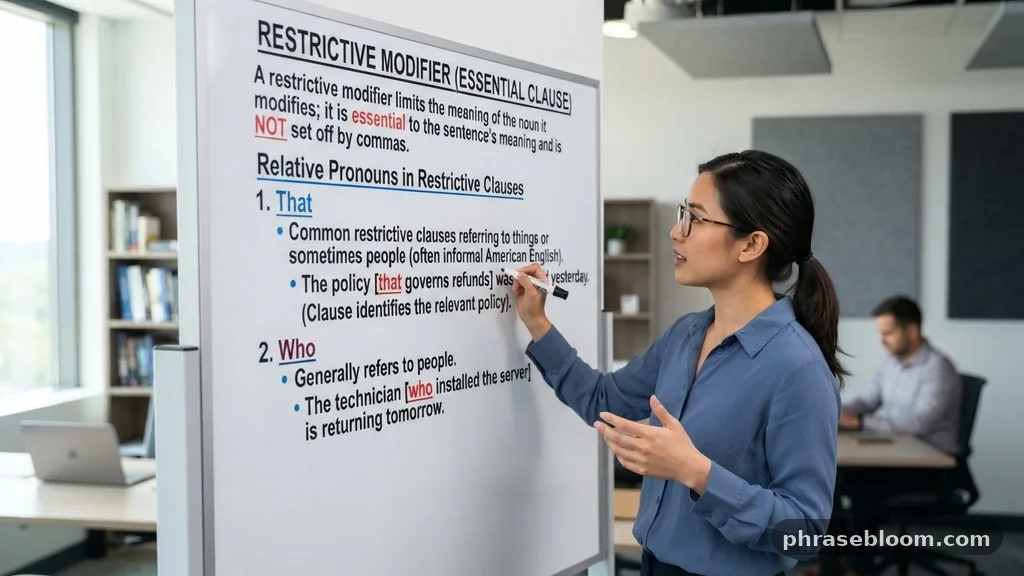
That is common in restrictive clauses referring to things or sometimes people in informal American English. For example, “The policy that governs refunds was updated yesterday.” The clause identifies the relevant policy.
Who generally refers to people: “The technician who installed the server is returning tomorrow.” In formal writing, whom may appear as the object of a verb or preposition, although many writers use who in ordinary business communication.
Which can introduce a restrictive clause in many varieties of English, particularly British English and formal styles influenced by traditional grammar rules. Some American style systems prefer that for restrictive clauses and which for nonrestrictive clauses, but actual usage is not completely uniform.
The safest approach is to follow the style guide used by your organization or publication. The major issue is usually whether the clause is restrictive, not simply which relative pronoun appears.
Restrictive Modifiers and Commas
Restrictive modifiers generally do not take commas because the information belongs closely to the noun. Separating the modifier with commas can suggest that the information is optional.
Compare “The files stored on the server are encrypted” with “The files, stored on the server, are encrypted.” The first sentence may distinguish server files from files stored elsewhere. The second suggests that the files are already known and adds their location as a side detail.
The same principle applies to appositive phrases. An appositive renames or explains a noun.
In “Author Toni Morrison won the Nobel Prize,” the name “Toni Morrison” identifies the author. In “Toni Morrison, the celebrated novelist, won the Nobel Prize,” the phrase “the celebrated novelist” is nonrestrictive because the name already identifies the person.
Participial phrases can also be restrictive:
- “Customers requesting a refund must provide a receipt.”
- “The equipment damaged during shipping will be replaced.”
- “Applicants selected for interviews will receive an email.”
In the first example, “requesting a refund” identifies which customers must provide receipts. In the second, “damaged during shipping” identifies which equipment will be replaced. In the third, “selected for interviews” identifies the applicants who will receive messages.
Do not add commas simply because a modifier is long. Length does not determine whether a modifier is restrictive. Its relationship to the noun and its importance to the sentence determine the punctuation.
Types of Restrictive Modifiers
Restrictive modifiers appear in several grammatical forms. Learning the forms helps you recognize them in complex sentences and revise them for clarity.
Adjectives and adjective phrases
A single adjective can restrict a noun: “The damaged package was returned.” The adjective “damaged” distinguishes this package from packages that are not damaged.
An adjective phrase can perform the same job: “The package ready for shipment is by the loading dock.” The phrase “ready for shipment” identifies the package the sentence concerns.
Prepositional phrases
A prepositional phrase begins with a preposition such as in, on, with, or from. It can restrict a noun by describing location, ownership, purpose, or another relationship.
“The candidates with technical experience advanced to the next round.” The phrase “with technical experience” identifies the candidates who advanced.
“The invoice from the London office contains an error.” The phrase “from the London office” distinguishes one invoice from others.
Participial phrases
A participial phrase begins with a present participle ending in -ing or a past participle such as approved, completed, or broken. It can provide compact descriptive information.
“The team managing the migration meets on Friday.” The phrase “managing the migration” identifies the team. “The records requested by the auditor are ready” uses a past-participial phrase to identify the relevant records.
Relative clauses
A restrictive relative clause contains a subject and a verb: “The vendor that supplies our uniforms changed its delivery schedule.” The clause identifies the vendor and therefore functions as a detailed modifier.
Relative clauses are useful when a shorter adjective or phrase would not express the relationship clearly. They can also prevent ambiguity by stating exactly what the noun does or receives.
How Meaning Changes in Sentence Examples
Small punctuation choices can affect legal, workplace, and academic writing. A restrictive modifier can determine who receives a benefit, which document applies, or what group a policy covers.
Consider a benefits announcement: “Employees who enroll by Friday will receive the contribution.” This sentence limits the benefit to employees who meet the deadline. If the writer adds commas around the clause, the sentence could imply that all employees enroll by Friday and that the deadline is merely an additional fact.
In a company policy, “Vehicles used for client visits must be inspected” applies to a particular category of vehicles. The modifier “used for client visits” defines the scope of the requirement.
In a report, “The figures included in the appendix were excluded from the summary” identifies the figures in question. A reader should not have to guess whether the sentence concerns every figure or only those in the appendix.
Here are additional workplace examples:
- Training: “Employees assigned to customer support must complete the new service module.” The modifier limits the requirement to a specific group.
- Internal communication: “The offices affected by the power outage will close at noon.” The phrase identifies which offices will close.
- Technology: “Users who access the legacy system must reset their passwords.” The clause identifies the users affected by the instruction.
- Organizational change: “Departments reporting to the new division will follow the revised approval process.” The phrase defines the departments covered.
- Public communication: “Customers purchasing annual plans receive priority support.” The modifier identifies the customers who receive the benefit.
Each sentence avoids unnecessary commas because the modifier supplies essential information. If the writer intended to describe every employee, office, user, department, or customer, the wording would need to change.
Restrictive Modifier Versus Restrictive Clause
The terms are related but not identical. A restrictive modifier can be any essential description, while a restrictive clause is a complete dependent clause that modifies a noun.
“The blue folder is missing” contains a restrictive adjective. “The folder on the desk is missing” contains a restrictive prepositional phrase. “The folder that contains the invoices is missing” contains a restrictive relative clause.
All three modifiers narrow the noun, but only the last one has its own subject and verb relationship. The clause contains “contains,” which makes it more structurally complete than the adjective “blue” or the prepositional phrase “on the desk.”
Some grammar discussions use “defining relative clause” instead of “restrictive relative clause.” These terms generally describe the same function: the clause defines which noun is meant.
A nonrestrictive clause, by contrast, adds information about a noun that is already identified. It usually requires commas:
“The marketing director, who joined the company in May, will lead the presentation.”
The name or role may already identify the person. The clause about joining in May provides background rather than selection.
Writers should also watch for misplaced modifiers. In “The company sent a notice to employees working remotely,” the phrase “working remotely” most naturally modifies “employees.” In “Working remotely, the company sent a notice,” the phrase incorrectly appears to describe the company’s action or state. Position matters.
Restrictive Modifiers in Formal and Professional Writing
Professional writing depends on precise scope. A restrictive modifier often tells readers who must act, which items are covered, or what condition applies.
Policy writers should place essential modifiers close to the nouns they describe. “Managers approving expenses must retain the receipts” is clearer than a sentence that separates “managers” from “approving expenses” with unrelated material.
Legal and compliance documents require extra care because punctuation can affect interpretation. A sentence such as “Employees using personal devices must install the security application” clearly identifies the covered employees. If the organization means every employee, it should say so directly rather than relying on a potentially confusing modifier.
Academic writers use restrictive modifiers to define terms and groups. For example, “Studies published after 2020 show a different pattern” limits the evidence to studies published after a particular date. The phrase is not decorative; it establishes the boundaries of the claim.
Business reports also benefit from direct wording. “Revenue generated by subscription services increased” identifies the source of the revenue. If the writer means total revenue, “Total revenue increased” is more accurate.
When to rewrite instead of punctuate
Sometimes the best solution is not choosing between commas and no commas. Rewrite the sentence if the intended meaning remains uncertain.
“The employees who attended the meeting received materials” may be correct, but “Only employees who attended the meeting received materials” makes the restriction unmistakable.
Likewise, “The documents submitted before noon were reviewed first” can become “Documents submitted before noon were reviewed first.” Removing “the” can make the general rule easier to read.
Clear alternatives include:
- “Only customers with active accounts qualify.”
- “All users of the legacy platform must migrate by June.”
- “The report covers sales in the western region.”
- “Staff members assigned to the project will receive access.”
These revisions make the scope explicit and reduce the chance that a reader will misinterpret the modifier.
Common Mistakes with Restrictive Modifiers
One common mistake is adding commas around information that identifies the noun. “The employees, who work night shifts, receive a premium” suggests that all the employees work night shifts. If only night-shift employees receive the premium, write “The employees who work night shifts receive a premium.”
Another mistake is assuming every phrase after a noun is nonrestrictive. “The contract with the supplier expires in July” may identify one contract among several. No commas are needed if the supplier phrase is essential.
Writers also create ambiguity by using a modifier that could attach to more than one noun. In “We reviewed the proposal from the consultant for the new system,” the phrase “for the new system” could describe the proposal or the consultant. A revision such as “We reviewed the consultant’s proposal for the new system” makes the relationships clearer.
Dangling modifiers are another problem. A dangling modifier does not logically describe the noun placed next to it. “After reviewing the figures, the error was obvious” suggests that the error reviewed the figures. Write “After reviewing the figures, we identified the error.”
Writers sometimes use a restrictive modifier when a direct statement would be clearer. “The forms required for travel must be submitted” works, but “Submit the forms required for travel” gives the reader a clearer instruction.
Watch for these practical errors:
- Incorrect implication: “The employees, who completed training, received badges.” Use no commas if only trained employees received badges.
- Unclear attachment: “The manager emailed the schedule to the assistant in the revised format.” Clarify whether the assistant or the schedule is revised.
- Dangling phrase: “After being approved, the director announced the budget.” Revise to “After the board approved the budget, the director announced it.”
- Overloaded sentence: Break a sentence containing several nested modifiers into two sentences.
Good punctuation cannot rescue unclear logic. First decide what the modifier describes and what meaning the sentence should communicate.
A Practical Method for Choosing the Right Form
When you encounter a possible restrictive modifier, begin by identifying the noun it describes. Ask, “Which person, thing, or group does this sentence mean?” If the modifier helps answer that question, it is probably restrictive.
Next, remove the modifier temporarily. If the sentence becomes broader, misleading, or incomplete in meaning, the information is likely essential. If the noun remains clearly identified and the detail merely adds background, the modifier may be nonrestrictive.
Use this five-step check:
- Find the noun being described.
- Underline the words that provide additional information about it.
- Ask whether those words select the noun from a larger group.
- Use no commas for essential information and commas for extra information.
- Read the sentence again to check whether the punctuation matches the intended meaning.
Style guides can help with difficult cases, especially the use of that versus which, but they do not remove the need to understand meaning. A house style may prefer a particular form, yet a clear rewrite is often better than forcing a complicated sentence to fit a rule.
Audience matters too. An internal message may tolerate a conversational structure, while a policy, contract, academic paper, or public notice needs especially precise modifiers. International readers may benefit from shorter sentences and explicit words such as only, all, or those.
For a broader reference on punctuation and sentence structure, consult the Purdue Online Writing Lab’s punctuation resources. Use any reference alongside the intended meaning of your sentence rather than treating punctuation as a mechanical exercise.
Restrictive Modifier Sentence Examples to Adapt
The following examples show common patterns in business English, academic writing, and everyday communication.
Company and workplace examples
“The company policy that covers remote work was revised.” The relative clause identifies which policy was revised.
“The company policy, which covers remote work, was revised.” Here, the writer presents the policy as already identified and adds its subject as background information.
“Employees eligible for tuition assistance should contact Human Resources.” The participial adjective “eligible” limits the employees being addressed.
“The announcement about the schedule change will go out this afternoon.” The prepositional phrase identifies which announcement is meant.
Academic and technical examples
“The experiment using recycled materials produced different results.” The phrase “using recycled materials” distinguishes this experiment from others.
“The data collected during the second trial support the hypothesis.” The past-participial phrase identifies the relevant data.
“Researchers who examine long-term effects often use a larger sample.” The restrictive relative clause limits the researchers described.
Everyday examples
“The keys on the kitchen counter belong to Jordan.” The location phrase identifies which keys.
“People interested in the workshop should register online.” The phrase “interested in the workshop” identifies the intended group.
“My car, which is parked outside, needs fuel.” The clause adds information about an already identified car, so commas are appropriate.
These examples demonstrate that restrictive modifiers are not limited to formal grammar exercises. They appear whenever a writer needs to define a noun precisely.
Frequently Asked Questions
What is a restrictive modifier?
A restrictive modifier is a word, phrase, or clause that provides essential information about a noun. It narrows the noun’s meaning and usually appears without commas.
What is the difference between a restrictive and nonrestrictive modifier?
A restrictive modifier identifies which noun the writer means. A nonrestrictive modifier adds extra information about a noun that is already identified, and it is usually separated with commas.
Should a restrictive modifier have commas?
Usually not. If the modifier is necessary to identify the noun, omit the commas. Use commas when the modifier is additional information rather than identifying information.
What is a restrictive relative clause?
It is a dependent clause that identifies or limits a noun, often beginning with that, who, or which. For example, “The reports that arrived today need review” refers to a specific group of reports.
Can a restrictive modifier appear before a noun?
Yes. Adjectives, participial phrases, and some other modifiers can appear before a noun, as in “the revised policy” or “the requested documents.” Their position does not change the central principle: the modifier is restrictive when it identifies which noun is meant.
Conclusion: Using Restrictive Modifiers Clearly
A restrictive modifier supplies essential information that narrows a noun’s meaning. It may be an adjective, prepositional phrase, participial phrase, appositive phrase, or restrictive relative clause, and it usually appears without commas.
Before punctuating, ask whether the modifier identifies the noun or merely adds a side detail. That simple test will resolve many sentence examples, but clarity should remain the final goal. If a sentence still feels ambiguous, rewrite it with direct wording, explicit terms such as only or all, and a clear relationship between the modifier and its antecedent.
Related: Who to Contact or Whom to Contact · Some of Whom vs Some of Who · Any Problem or Any Problems
Explore more on PhraseBloom.