
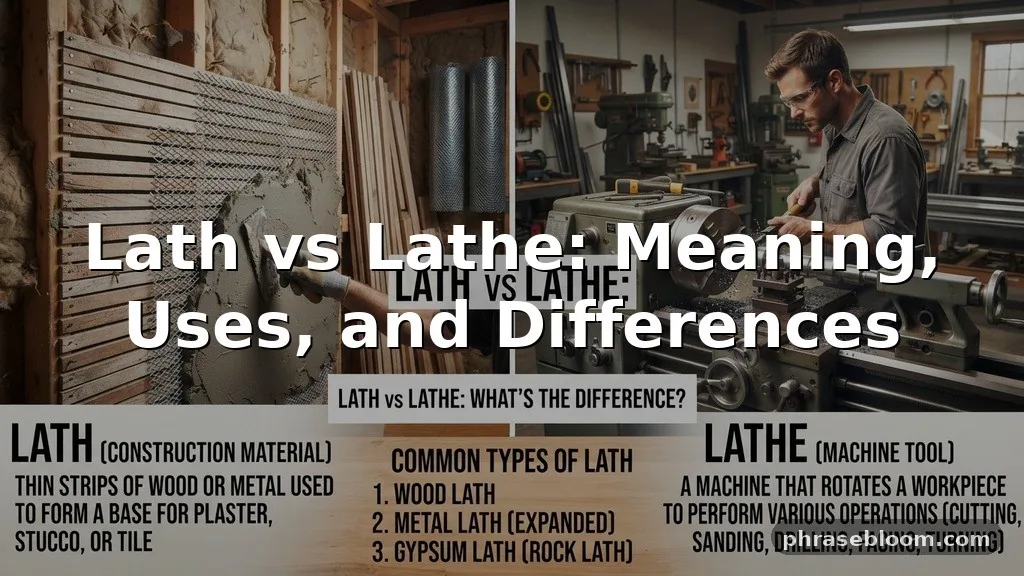
The difference between lath vs lathe is simple once you connect each word to its subject. A lath is a narrow strip or framework used in construction, plastering, or other building work, while a lathe is a machine tool that rotates a workpiece so it can be shaped with a cutting tool.
The words sound similar, but they describe completely different things. This distinction matters in woodworking, metalworking, construction, home repair, technical writing, and everyday conversation. The examples below show the lath meaning and lathe meaning clearly, including how to recognize each word in a sentence.
Lath vs Lathe: The Direct Answer
Lath usually means a thin strip of wood, metal, or another material used to support plaster, shingles, tiles, or a similar surface. Traditional plaster walls often used narrow wood strips called plaster lath, while modern construction may use metal lath or expanded metal lath as a reinforcing base.
Lathe means a machine that holds and rotates a workpiece while a cutting tool shapes it. A woodworking lathe can turn a block of wood into a bowl, spindle, or table leg, while a metalworking lathe can produce accurately shaped metal components.
| Word | Basic meaning | Typical field | Example |
|---|---|---|---|
| lath | A strip or framework supporting a surface | Construction and plastering | The contractor replaced the damaged lath behind the plaster. |
| lathe | A machine that rotates material for shaping | Woodworking and machining | She used a lathe to turn the wooden blank. |
For a quick memory aid, think of lath as a building material and lathe as a machine. The extra “e” in lathe does not signal a different pronunciation rule in a useful everyday way, so the surrounding sentence is often the best clue.
What Does Lath Mean?
The noun lath refers to a narrow strip, rod, or mesh used as a base for another material. In older buildings, wood strips were nailed across wall studs or ceiling joists before wet plaster was applied. The plaster pressed around the strips and formed a mechanical grip as it dried.
That traditional system is often called wood lath and plaster. A wall may contain several layers of plaster over closely spaced strips, and the lath can help explain why renovation work in an older house produces long, thin pieces of wood along with chunks of plaster.
Lath is not limited to wood. Metal lath is used as a reinforcement and attachment surface for stucco, plaster, mortar, and some masonry applications. Expanded metal lath has slits cut into a sheet and then stretched to create a diamond-shaped mesh that can hold coating material.
Common types of lath
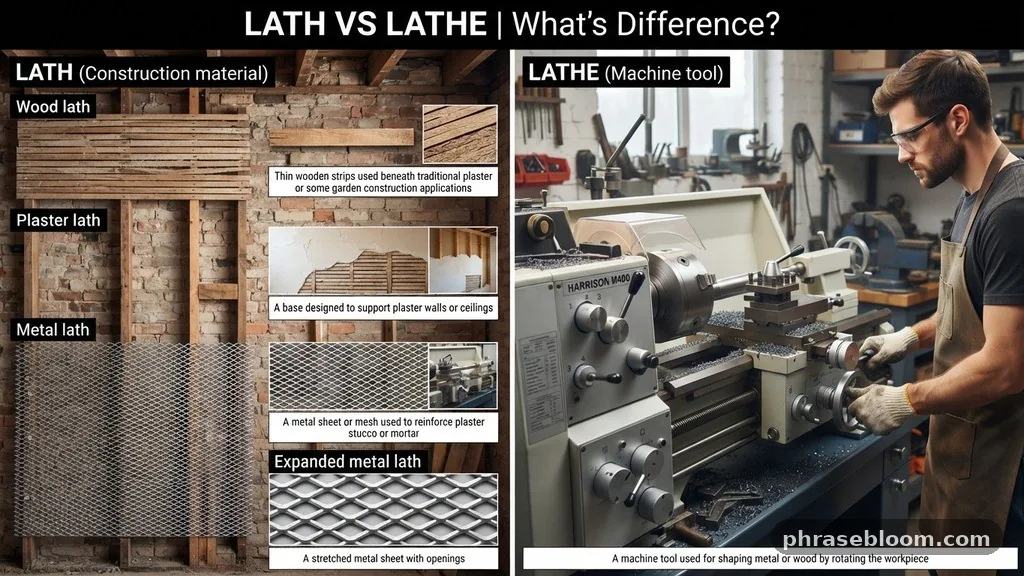
- Wood lath: Thin wooden strips used beneath traditional plaster or in some garden and construction applications.
- Plaster lath: A base designed to support plaster on walls or ceilings.
- Metal lath: A metal sheet or mesh used to reinforce plaster, stucco, or mortar.
- Expanded metal lath: A stretched metal sheet with openings that help a coating bond to the surface.
- Drywall lath: A term that may describe a support or backing material used with wall systems, although modern drywall construction usually relies on gypsum panels rather than traditional lath.
The lath meaning can therefore vary slightly by trade, but the central idea remains the same: it is a support material, not a machine. A construction specification might identify the thickness, material, spacing, or fastening method required for the lath.
What Does Lathe Mean?
A lathe is a machine tool used for turning operations. The machine rotates a workpiece around a central axis while a cutting tool moves against it. This arrangement allows the operator to remove material and create cylindrical, tapered, threaded, or carefully shaped surfaces.
In a typical lathe, the material is held by a chuck, collet, faceplate, or another gripping device. The rotating assembly is connected to the spindle, which transfers motion from the motor to the workpiece. A carriage or tool rest supports the cutting tool as it moves along or across the material.
A woodworking lathe is commonly used for woodturning. The operator may begin with a square or rough piece of stock, secure it between centers or in a chuck, and then shape it into a bowl, handle, vase, spindle, or decorative object.
A metalworking lathe is generally built for greater precision and may include powered feeds, change gears, a lead screw, and accessories for threading. It can cut steel, aluminum, brass, and other materials, depending on the machine’s capacity and the selected cutting tool.
How a lathe shapes a workpiece
The defining action is rotation. Instead of moving a handheld tool around a stationary object, the lathe turns the workpiece while the tool makes controlled contact with it.
- The workpiece is secured to the machine.
- The spindle rotates the workpiece at an appropriate speed.
- The cutting tool is positioned against the material.
- Material is removed through a controlled feed.
- The operator checks the shape, diameter, surface, or thread.
These steps explain why “lathe” belongs in a workshop or manufacturing context. If a sentence mentions a chuck, spindle, tool rest, turning, or machining, lathe is almost certainly the intended word.
Lath Meaning and Lathe Meaning in Context
Dictionary definitions help, but context makes the distinction easier to remember. A sentence about a wall, ceiling, stucco surface, or plaster repair is likely discussing lath. A sentence about a workshop, rotating stock, machining, or woodturning is likely discussing a lathe.
| Context clue | Likely word | Natural example |
|---|---|---|
| Plaster or wall repair | lath | The damaged plaster exposed the wood lath underneath. |
| Stucco reinforcement | lath | The installer fastened metal lath to the wall before applying stucco. |
| Woodturning | lathe | The bowl blank was mounted on the woodworking lathe. |
| Precision machining | lathe | The machinist used a metalworking lathe to cut the shoulder. |
| Construction materials | lath | The estimate includes the removal of old plaster lath. |
| Workshop equipment | lathe | The new machine shop added a computer-controlled lathe. |
Consider the objects around the word. Lath is installed, nailed, fastened, covered, or repaired. A lathe is operated, adjusted, powered, cleaned, or used to cut a workpiece.
The distinction also appears in compound terms. Plaster lath and metal lath describe construction products, while woodworking lathe and metalworking lathe describe machines used to shape materials.
For readers learning English, these are what linguists might call context clues. You do not need specialized grammar to use them. Identify the field first, then choose the word associated with that field.
Pronunciation and Spelling Differences
Lath is usually pronounced with the short “a” sound followed by the “th” sound, as in “bath” for many speakers. Lathe is usually pronounced like “layth,” with a long “a” sound and a voiced “th” sound similar to the one in “breathe.” Regional accents can affect the exact pronunciation.
The spelling difference is small but meaningful. Lath has four letters and ends in “th,” while lathe adds a final “e.” That final “e” helps signal the long vowel in the standard pronunciation, much as it does in words such as “bake” or “shape.”
Neither word is normally used as the other. Writing “The technician repaired the lathe behind the plaster” changes the sentence from a construction statement into one about a machine, even if the writer intended to describe lath.
The words are also different parts of a technical vocabulary. Someone working in historic preservation may discuss lathing, lath strips, or lath-and-plaster walls. Someone working in a machine shop may discuss lathe capacity, spindle speed, cutting tools, or turning operations.
For pronunciation practice, say the words in short pairs: “wood lath” and “wood lathe,” then “metal lath” and “metal lathe.” The contrast becomes easier to hear when the same material word precedes each one.
How Lath Is Used in Construction
Lath has played an important role in wall and ceiling construction for centuries. In a traditional lath-and-plaster system, installers attached narrow strips to a structural frame and spread plaster over them. The plaster pushed into the gaps between the strips, creating keys that helped hold the hardened coating in place.
Older wood lath was often installed horizontally, although details varied according to the building, region, period, and construction method. When a historic wall is opened, the condition of the lath can reveal whether the damage is limited to the plaster or extends into the wall support.
Metal lath serves a related purpose but behaves differently. It can provide a stable base for stucco, cement coatings, and other materials, especially where a reinforced surface is required. Expanded metal lath is formed from sheet metal, so it has openings without relying on woven wires.
Construction workers may use “lathing” to describe the process of installing lath. The word can refer to preparing a surface, attaching the backing, or creating a framework for plaster and similar coatings.
Examples from building work
- The preservation team documented the original wood lath before removing loose plaster.
- The stucco contractor installed expanded metal lath over the prepared wall surface.
- The inspection report noted corrosion on the metal lath near the foundation.
- The repair crew replaced broken lath before applying a new plaster coat.
- The architect specified a compatible lath system for the curved exterior surface.
In each sentence, lath is a physical material or support system. It is not something that spins, cuts, or powers a machine.
Modern building methods often use drywall panels, cement boards, membranes, or other systems instead of traditional lath. Even so, the term remains important in renovation, historic building work, stucco installation, plaster repair, and construction documentation.
How a Lathe Is Used in Woodworking and Metalworking
Lathes are used to create shapes that are symmetrical around a central axis. In woodturning, the machine can transform a rough blank into a smooth, rounded form through a series of controlled cuts. The operator uses tools such as gouges, scrapers, parting tools, and skew chisels while supporting the work with a tool rest.
A woodworking lathe may be used to make table legs, chair spindles, rolling pins, pens, bowls, platters, and other turned objects. The required setup depends on the object’s size, the grain direction, the mounting method, and the desired finish.
Metalworking lathes handle a broader range of precision operations. A machinist may perform facing, turning, boring, drilling, threading, grooving, or parting. The cutting tool is usually held in a tool post, and the operator controls the feed and depth of cut according to the material and the required dimensions.
The chuck is especially important because it holds the workpiece securely. Some workpieces are supported at the opposite end by a tailstock, while long or flexible pieces may need additional support to reduce vibration.
Safety is central to lathe work. Loose clothing, jewelry, long hair, and unsecured material can create serious hazards around rotating equipment, so operators follow the machine manufacturer’s instructions and workplace safety procedures.
Useful lathe-related terms
- Workpiece: The material being shaped on the machine.
- Chuck: A gripping device that holds the workpiece.
- Spindle: The rotating shaft that drives the work or tooling.
- Tool rest: A support used by a woodturner to steady a hand tool.
- Cutting tool: An implement that removes material from the workpiece.
- Turning operations: Machining processes performed as the workpiece rotates.
If the sentence includes any of these terms, lathe is the correct spelling. A lathe is equipment, while lath is material used in a building or surface system.
Common Mistakes and Easy Corrections
The most common mistake is choosing the word based only on sound. Because lath and lathe are visually similar and can be difficult to distinguish in speech, writers sometimes use “lathe” for construction material or “lath” for workshop equipment.
| Incorrect or unclear usage | Better version | Why |
|---|---|---|
| The plaster was attached to the lathe. | The plaster was attached to the lath. | The sentence refers to a construction backing material. |
| He shaped the bowl on a lath. | He shaped the bowl on a lathe. | The sentence refers to a rotating machine. |
| The machinist adjusted the lath. | The machinist adjusted the lathe. | Workshop equipment is a lathe. |
| The contractor installed wood lathe. | The contractor installed wood lath. | Wood strips used under plaster are lath. |
Another mistake is assuming that “lath” and “lathe” are alternate spellings of one word. They are separate nouns with separate meanings, not regional versions of the same term.
Writers can also confuse the plural forms. The plural of lath is commonly laths, while the plural of lathe is lathes. For example, “The wall contains several layers of laths” refers to construction strips, while “The shop has three lathes” refers to machines.
Technical documents deserve particular care because a spelling error can affect purchasing, repair, or safety instructions. A request for “replacement lath” should not be interpreted as a request for a replacement lathe, which is a much larger piece of equipment.
When proofreading, check the verbs and nearby nouns. Words such as plaster, stucco, wall, ceiling, mesh, and strips point toward lath. Words such as spindle, chuck, bowl, machining, turning, and cutting point toward lathe.
Examples You Can Copy and Adapt
Seeing the words in realistic sentences is one of the fastest ways to learn the difference. The following examples cover construction, restoration, woodworking, machining, and ordinary workplace communication.
Examples with lath
- The contractor found damaged wood lath beneath the cracked plaster.
- The restoration plan calls for preserving as much of the original lath as possible.
- Workers installed metal lath before applying the first coat of stucco.
- The inspection revealed moisture damage in the plaster and lath system.
- The building’s historic walls contain narrow wood strips behind the finish.
These examples use lath as a material or structural support. The words around it describe walls, plaster, stucco, inspection, and restoration, so the construction meaning is clear.
Examples with lathe
- She mounted the maple blank on the woodworking lathe.
- The machinist used a metalworking lathe to cut a new threaded section.
- Always secure the workpiece before starting the lathe.
- The school workshop purchased a smaller lathe for introductory woodturning.
- The operator reduced the spindle speed before using the larger cutting tool.
Here, lathe refers to a machine tool. The associated vocabulary includes mounting, workpieces, threading, spindle speed, and cutting tools.
One sentence can contain both terms if the subject changes. For example, “The restoration shop repaired the plaster lath, then used a lathe to reproduce a missing wooden spindle.” The first word describes building material, and the second names the machine used to make a replacement part.
How to Remember the Difference
A useful memory trick is to associate the “e” in lathe with equipment. This is not a formal spelling rule, but it gives you a quick way to recall that a lathe is a machine. The shorter word, lath, can be connected with a strip or layer in a wall.
You can also ask one practical question: Is the object installed, or does it rotate? If it is installed behind plaster or stucco, choose lath. If it rotates a workpiece for shaping, choose lathe.
- Wall, plaster, stucco, mesh: Choose lath.
- Workshop, spindle, chuck, turning: Choose lathe.
- Strips or reinforcement: Choose lath.
- Shaping or machining: Choose lathe.
- Construction material: Choose lath.
- Machine tool: Choose lathe.
Visual learners may remember the spelling by imagining a wall made from lath and a machine with a lathe. The “e” in lathe can look like the extra element that turns the word into a more specialized machine term.
If you are editing a technical document, do not rely on memory alone. Read the full sentence and identify the object being named. Definitions become much easier to apply when you first identify the trade or activity.
Why the Difference Matters in Technical Writing
Precision matters in construction specifications, equipment manuals, work orders, inspection reports, and educational materials. A reader may understand a casual typo from context, but a wrong word can still create confusion in a technical setting.
Imagine a renovation document that says, “Remove the damaged lathe and replace it with compatible material.” A contractor may infer that the document means lath, but the sentence literally identifies a machine. Replacing the wording with “Remove the damaged plaster lath” eliminates that ambiguity.
The same issue appears in a workshop manual. “Inspect the lath before operating the machine” is unclear if the manual is discussing a lathe. A better sentence would be “Inspect the lathe and secure the workpiece before operation.”
These distinctions also matter in searches, catalogs, and inventory systems. A person looking for expanded metal lath needs a construction product, while someone searching for a metalworking lathe needs industrial equipment. One letter can lead to entirely different results.
Technical writers should favor the exact noun rather than relying on a reader to repair the meaning mentally. The Merriam-Webster definition of lath is a useful reference when checking the construction term, while equipment documentation can confirm the machine-specific terminology for lathe.
Clear word choice supports safety as well as readability. Instructions involving rotating machinery should identify the lathe, chuck, spindle, and cutting tool accurately, while construction instructions should specify the type and placement of lath.
Frequently Asked Questions
What is the difference between lath and lathe?
Lath is a strip, mesh, or framework used to support plaster, stucco, shingles, or another surface. A lathe is a machine that rotates a workpiece while a tool shapes it.
Is lath used in construction?
Yes. Wood lath, plaster lath, metal lath, and expanded metal lath can all be used as backing or reinforcement in wall, ceiling, plaster, stucco, or masonry systems.
Is a lathe only used for wood?
No. A woodworking lathe is used for woodturning, but a metalworking lathe can shape steel, aluminum, brass, and other materials. Lathes can also be adapted for different turning operations.
What is a simple way to remember lath versus lathe?
Remember that lath is installed in a wall, while a lathe spins material in a workshop. Construction terms point to lath, and machining terms point to lathe.
Are lath and lathe pronounced the same way?
Usually not. Lath commonly has a short “a” sound, while lathe usually has a long “a” sound, as in “layth.” Accent differences may change the exact sound, but the words remain distinct in meaning.
Conclusion
The key to lath vs lathe is the object each word names. Lath is a construction strip, mesh, or backing material used with plaster, stucco, and related surfaces. Lathe is a machine tool that rotates a workpiece for woodworking, metalworking, and other turning operations.
Use the surrounding context as your final check: walls and plaster call for lath, while chucks, spindles, cutting tools, and workshops call for lathe. Once you connect each spelling to its field, the difference becomes easy to recognize and apply.
Related reading: Unselect vs Deselect, Hassle vs Hastle, Continuous vs Continous.