

The phrase Born With a Silver Spoon describes someone raised with wealth, comfort, and advantages from birth. It usually suggests that a person grew up in a wealthy family with access to financial security, strong connections, excellent education, or opportunities that many others had to work hard to obtain.
The expression can be neutral, descriptive, or critical depending on context. It may point to inherited wealth and an affluent upbringing, but it can also highlight the social privilege and unearned advantages attached to an upper-class background. Understanding the idiom helps you recognize both its literal imagery and its wider comments about socioeconomic status.
What “Born With a Silver Spoon” Means
“Born with a silver spoon in one’s mouth” is an idiom for being born into prosperity. A person described this way usually begins life with material comfort, family resources, and forms of support that create a significant financial advantage.
The phrase does not necessarily mean that the person literally received a silver spoon as a baby. The spoon is symbolic. It represents access to food, safety, good healthcare, quality schooling, social networks, and other benefits associated with a wealthy or financially secure household.
Someone born into a family fortune may inherit money directly, but inherited wealth is only one part of the idea. The family might also own valuable property, operate a successful business, hold influential positions, or provide family connections that make education and employment easier to obtain.
For example, consider this sentence:
“She was born with a silver spoon, so she never had to worry about paying for college.”
Here, the expression emphasizes financial support from her family. It does not prove that she has done nothing independently, and it does not tell us whether she is talented or hardworking. It identifies the circumstances into which she was born.
The idiom can also describe a broader pattern of privilege rather than a specific bank balance. A child from an affluent upbringing may have private tutoring, unpaid internship opportunities, travel experience, professional introductions, and a safety net that allows them to take risks.
- Basic meaning: born into wealth or substantial comfort.
- Broader meaning: raised with social, educational, and financial advantages.
- Common implication: the person had opportunities unavailable to many others.
- Typical tone: neutral, admiring, skeptical, or critical depending on context.
Why the Silver Spoon Represents Privilege
Silver has long been associated with value, refinement, and status. A silver spoon is not as extravagant as a gold one, but it suggests that the household can afford attractive, durable tableware rather than relying only on basic necessities.
The image becomes powerful because a spoon is connected to feeding a child. To be born with one already in your mouth suggests that comfort and provision were present from the beginning. The person did not first have to earn access to food, security, education, or social standing.
In modern use, the phrase often points to economic privilege. Economic privilege means that a person benefits from financial conditions that reduce certain risks and expand available choices. A wealthy family may pay for housing, healthcare, education, transportation, or a failed business venture.
Social privilege can operate alongside money. Children from an upper-class background may grow up around adults who understand professional institutions, know how to approach influential people, and can explain systems that are unfamiliar to families without those connections.
That does not make every advantage visible. A graduate whose parents paid rent during an unpaid internship may appear to have reached the same position as a classmate who worked nights to cover living expenses. The two people may have shown equal determination, but their financial conditions were not equal.
The expression therefore often invites readers to ask a second question: what support existed before the person’s public success became visible? A founder may be praised for taking a risk, yet the risk looks different if family money guaranteed housing and covered early losses.
Silver Spoon Idiom: Origin and Historical Sense
The silver spoon idiom has a long association with wealth and birth, although its exact history is more complicated than a single confirmed origin story. Silver spoons were valuable household objects, and giving one to a child could symbolize prosperity, family status, or a wish for a comfortable future.
The expression is related to older ideas about wealthy children being born into advantage. In some historical settings, silver utensils also carried practical value because silver was durable and could be sold or exchanged. A child who possessed silver objects had a form of material security.
English has used spoon imagery in expressions about birth, feeding, and social rank for centuries. The exact wording has changed over time, and versions involving gold or silver have appeared in different contexts. It is safest to treat the phrase as a long-established metaphor rather than attach it to one certain anecdote.
The dictionary explanation of “born with a silver spoon in one’s mouth” reflects the modern sense: being born into a wealthy or privileged family. That definition captures the core meaning without claiming that every person described by the idiom has identical experiences.
The phrase became especially useful as societies increasingly discussed class, inherited status, and economic mobility. It contrasts naturally with stories about people who begin with few resources and build financial stability later in life.
That contrast is sometimes called a rags-to-riches contrast. A rags-to-riches story emphasizes movement from poverty or hardship toward success, while a silver-spoon description emphasizes the advantages present before the person’s own choices and achievements.
Born With a Silver Spoon in Everyday Sentences
The idiom can appear in conversations about celebrities, business leaders, politicians, students, athletes, and fictional characters. Its meaning depends heavily on the surrounding words and the speaker’s attitude.
Neutral use
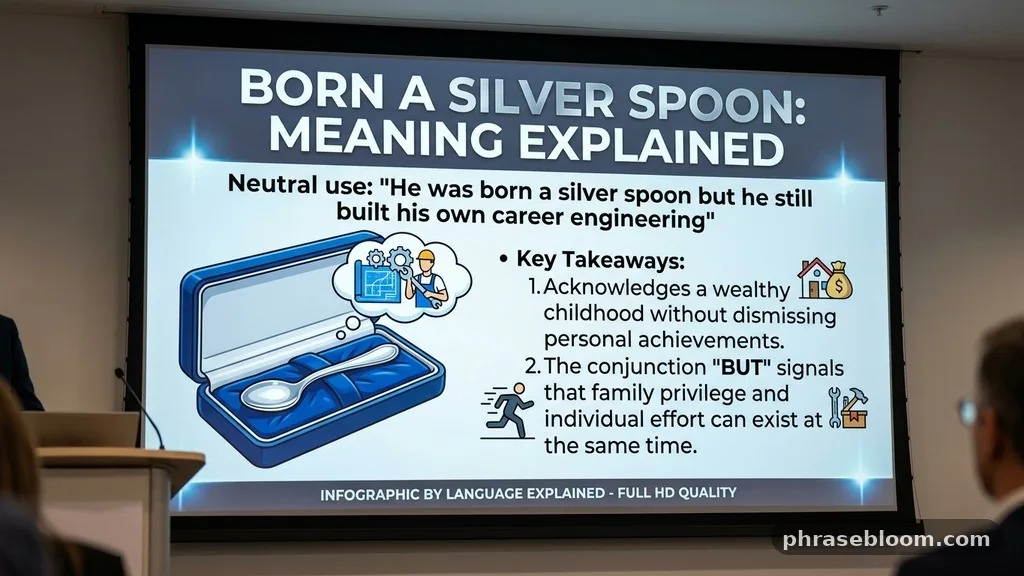
“He was born with a silver spoon, but he still built his own career in engineering.”
This sentence acknowledges a wealthy childhood without claiming that the person has no personal accomplishments. The conjunction “but” signals that family privilege and individual effort can exist at the same time.
Critical use
“Her comments about working hard sounded different after people learned she had been born with a silver spoon.”
Here, the phrase questions whether the speaker understands the role of financial advantage. It does not necessarily accuse her of dishonesty, but it suggests that her account of success may leave out important support.
Descriptive use
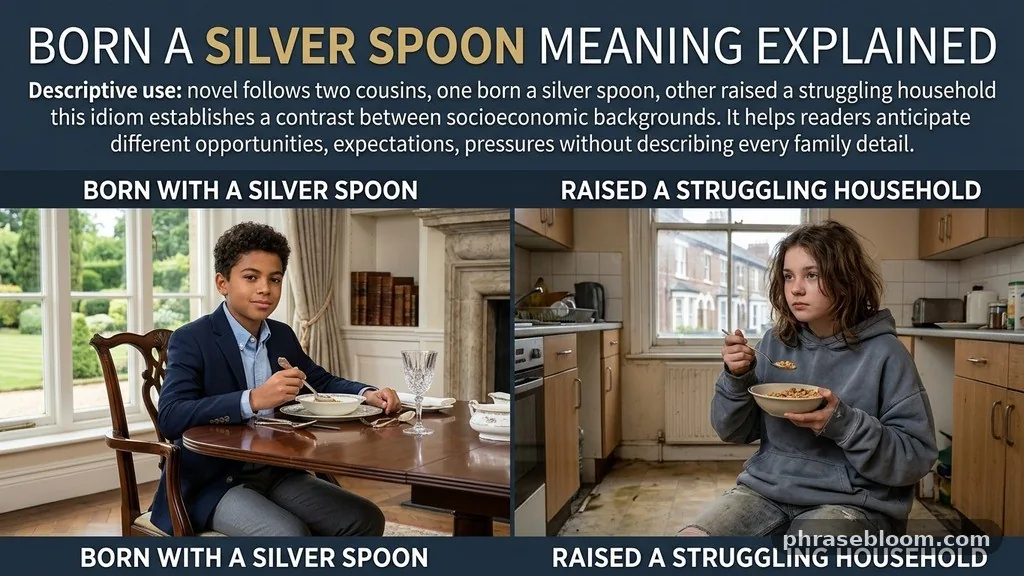
“The novel follows two cousins, one born with a silver spoon and the other raised in a struggling household.”
In this example, the idiom establishes a contrast between socioeconomic backgrounds. It helps readers anticipate different opportunities, expectations, and pressures without describing every family detail.
Informal conversation
“He grew up with a silver spoon, so buying his first home was much easier.”
This is common business English and everyday speech, although it is informal enough that a formal report may benefit from more precise wording. A professional alternative might be “He received substantial financial support from his family when purchasing his first home.”
The phrase can sound judgmental if it is used as a shortcut for a person’s entire character. Wealth at birth does not establish that someone is lazy, arrogant, incapable, or undeserving. Strong writing separates a person’s background from assumptions about personality.
Privilege, Inherited Wealth, and Access to Opportunity
Being born into a wealthy family can provide advantages that continue even when no large inheritance is transferred. Parents may fund a child’s education, pay for professional training, offer a place to live, or provide emergency money during unemployment.
A trust fund is one familiar example of inherited or family-managed wealth. However, many forms of advantage are less direct. A parent may introduce a child to a hiring manager, recommend a private school, provide business advice, or make it possible to accept an unpaid position.
These forms of support can create access to opportunities. Two people may apply for the same position, but only one may have been able to build a portfolio through unpaid work, attend industry events, or move to an expensive city without immediate income.
Generational wealth also affects long-term financial security. A family-owned home can reduce housing costs, while inherited property can create rental income or collateral for a loan. Even if the child never describes themselves as wealthy, those assets may shape their choices.
| Source of advantage | How it may help | Connection to the idiom |
|---|---|---|
| Inherited wealth | Provides assets, savings, or investment income | Directly reflects financial privilege |
| Family housing | Reduces rent, mortgage, or relocation pressure | Creates a practical safety net |
| Private education | May provide specialized instruction and networks | Represents an affluent upbringing |
| Family connections | Opens doors to internships, clients, or employers | Shows social privilege beyond money |
| Business support | Allows a person to start or sustain a company | Can make risk easier to absorb |
Privilege does not guarantee success. It changes the starting conditions. Someone with a trust fund can still make poor decisions, face illness, or experience personal loss, but they may have resources that soften the consequences.
That distinction matters in discussions about merit. A person can work hard and still benefit from inherited wealth. Acknowledging the advantage is not the same as denying every achievement that followed.
How the Phrase Relates to Nepotism and Family Connections
The silver spoon idiom and the word nepotism are related, but they are not synonyms. The idiom describes a person’s privileged background, while nepotism refers to favoring relatives, especially in employment or advancement.
A person born into a family fortune may never receive a job through a relative. Conversely, someone from a modest household might obtain a position through family connections later in life. The concepts can overlap, but they describe different mechanisms of advantage.
For example, this sentence focuses on background:
“He was born with a silver spoon and attended schools that prepared him for international business.”
This sentence focuses on nepotism:
“The company faced criticism after the director hired her inexperienced nephew.”
A third sentence combines both ideas:
“Born into a wealthy family, she also benefited from family connections when she entered the industry.”
Careful language is important because accusations of nepotism can affect reputations. If the evidence only shows that someone grew up wealthy, it is inaccurate to claim that they obtained every opportunity through favoritism.
Business reporting should distinguish among inherited ownership, family investment, personal achievement, and preferential hiring. Saying that an entrepreneur “came from a wealthy family” is different from saying that the family financed the company or gave the entrepreneur a leadership role.
This precision also helps avoid lazy class stereotypes. A silver-spoon background can explain access to resources without providing a complete explanation for an individual’s decisions, talents, or conduct.
Does the Phrase Always Sound Negative?
No. The tone of born with a silver spoon ranges from admiring to dismissive.
In a family history, it may simply describe a prosperous upbringing. In a political argument, it may criticize a candidate for presenting inherited privilege as self-made success.
Context creates the emotional meaning. Words such as “despite,” “although,” or “never had to” often make the phrase sound critical, while words such as “grateful,” “responsible,” or “used the opportunity” may produce a more balanced impression.
Compare these examples:
- “She was born with a silver spoon, yet she devoted her career to public service.”
- “He was born with a silver spoon and has never understood the cost of housing.”
- “The biography describes the silver spoon that shaped his early education.”
The first sentence acknowledges privilege while presenting a positive judgment about service. The second challenges the person’s awareness. The third is more detached and suitable for explanatory writing.
Writers should avoid using the idiom as an insult when the point can be expressed more accurately. If the relevant fact is that parents paid tuition, say that. If the issue is inherited property, name the property or financial support when the information is publicly established.
Specific wording is especially important in journalism, academic writing, and workplace communication. The idiom is vivid, but it can oversimplify a complicated family history if used without supporting detail.
Silver Spoon Versus Self-Made Success
The phrase often appears in debates about whether someone is self-made. A person who grows up with inherited wealth may still build a profitable company or achieve professional distinction. The question is how much of the starting platform came from family resources.
Self-made is not a single, universally defined category. One person may receive tuition and housing but earn their own income afterward.
Another may inherit a company, receive seed funding, and rely on family introductions. Both may work hard, but their paths contain different levels of financial advantage.
Recognizing this difference improves public discussion. A person can be talented and privileged. They can also face genuine obstacles while benefiting from a safety net that others do not have.
The phrase “born with a silver spoon” is therefore most useful when it describes conditions rather than ending the argument. It can prompt questions such as:
- Who paid for the person’s early education?
- Could the person take professional risks without immediate income?
- Did family connections influence access to mentors or employers?
- Was a business supported by inherited capital or family property?
- Did the person have financial security during setbacks?
These questions do not diminish every achievement. They make the account more complete. A fair description can recognize discipline and talent while also acknowledging economic privilege.
The opposite mistake is to assume that anyone from a wealthy background has had an effortless life. Wealth can coexist with family conflict, health problems, public pressure, or personal failure. The idiom identifies class advantage, not a complete biography.
When to Use the Expression in Formal and Informal Writing
In casual conversation, “born with a silver spoon” is natural and widely understood. It works well in interviews, opinion writing, personal essays, novels, and explanatory articles where an idiomatic tone is appropriate.
Formal writing may require more precise wording. A policy report, academic paper, or financial profile might replace the idiom with “raised in a high-income household,” “born into inherited wealth,” or “benefited from substantial family resources.”
The best choice depends on the purpose of the sentence. Use the idiom when you want a concise image of privilege; use a descriptive phrase when the exact source or type of advantage matters.
| Writing context | Suitable wording | Why it works |
|---|---|---|
| Casual conversation | “He was born with a silver spoon.” | Natural, vivid, and easy to understand |
| Opinion article | “Her silver-spoon upbringing shaped her view of work.” | Expresses interpretation and attitude |
| Academic writing | “She was raised in a high-income household.” | More neutral and precise |
| Business profile | “His family provided early financing.” | Identifies a concrete advantage |
| Biography | “He grew up with substantial inherited wealth.” | Clarifies the financial source |
Professional writers should also consider whether the expression sounds fair. Calling someone “silver-spoon born” without evidence may appear speculative or insulting. If the person’s background is publicly documented, explain the relevant fact rather than relying only on a colorful label.
In formal writing, the phrase can work when it is clearly attributed or supported. For example, “Critics describe the candidate as born with a silver spoon because her family owned several companies” gives readers the basis for the description.
Common Misunderstandings About the Idiom
One common misunderstanding is that the phrase refers only to extremely rich people. In practice, speakers may use it for anyone raised with noticeably greater comfort or opportunity than average. The threshold is subjective, so context matters.
Another mistake is treating “silver spoon” as proof that a person has never faced hardship. Someone may have grown up wealthy and still experienced grief, illness, discrimination, or professional failure. Financial privilege is real, but it is not the only factor shaping a life.
Some people also assume that the idiom means a person inherited a specific trust fund. It does not. The expression may refer to family support, elite schooling, property, social status, or a combination of advantages rather than a documented inheritance.
A further misunderstanding comes from confusing privilege with lack of effort. The phrase does not grammatically mean “lazy” or “unskilled.” Those judgments may be implied by a speaker, but they are separate claims that require separate evidence.
Writers should also avoid saying that every successful person from a wealthy family is a fraud. A more accurate sentence might be, “Her family’s resources reduced the financial risk of starting the company.” That statement identifies a concrete advantage without deciding whether her later work had value.
Alternatives to “Born With a Silver Spoon”
Several alternatives can communicate a similar idea with different levels of formality and precision. The best choice depends on whether you want to emphasize money, social position, family support, or opportunity.
- Born into wealth: direct and concise, with a clear focus on money.
- Raised in an affluent household: relatively neutral and suitable for formal writing.
- Born into privilege: broader, including social and educational advantages.
- From a wealthy family: plain and conversational.
- Benefited from generational wealth: emphasizes assets passed across generations.
- Had substantial family support: useful when the specific assistance is known.
- Raised in an upper-class environment: focuses on social position as well as income.
- Started with significant financial security: highlights reduced economic risk.
“Born into privilege” is broader than “born with a silver spoon.” It may include racial, social, educational, political, or cultural advantages that are not directly tied to family money.
“Benefited from generational wealth” is more specific but should be used carefully. It implies that assets or financial resources passed between generations, so it may be inaccurate if the only known fact is that the family had a comfortable income.
Rewriting the sentence can also make the point more concrete. Instead of “He was born with a silver spoon,” write “His parents paid for private school and financed his first business.” The second version gives readers information rather than leaving them to interpret a broad idiom.
Frequently Asked Questions
What does “born with a silver spoon” mean?
It means being born into a wealthy or privileged family. The expression usually suggests access to money, security, education, connections, or other advantages from an early age.
Is “born with a silver spoon” always an insult?
No. It can be neutral, complimentary, or critical. The tone depends on whether the speaker is simply describing a prosperous upbringing or questioning how much family privilege contributed to a person’s success.
Does the phrase mean someone inherited a trust fund?
Not necessarily. A trust fund is one possible source of financial advantage, but the idiom can also refer to family property, paid education, business connections, housing support, or a broader affluent upbringing.
What is the difference between privilege and wealth in this expression?
Wealth refers mainly to financial resources and assets. Privilege is broader and can include social status, family connections, education, safety, and access to opportunities. The silver spoon idiom often suggests both.
What is a formal alternative to “born with a silver spoon”?
Depending on the facts, you could write “born into a wealthy family,” “raised in a high-income household,” “born into privilege,” or “raised with substantial family resources.” Choose the phrase that states the known advantage most precisely.
Conclusion
The phrase Born With a Silver Spoon describes a person who begins life with wealth, comfort, or significant social advantages. It commonly refers to inherited wealth, an affluent upbringing, family connections, and the financial security that makes education, risk-taking, and professional access easier.
Use the idiom when its vivid, conversational tone fits, but use precise language in academic, legal, or professional writing when the source of the advantage matters. The clearest interpretation recognizes both sides: a privileged background can provide unearned advantages, while it does not automatically erase a person’s effort or individual achievements.