
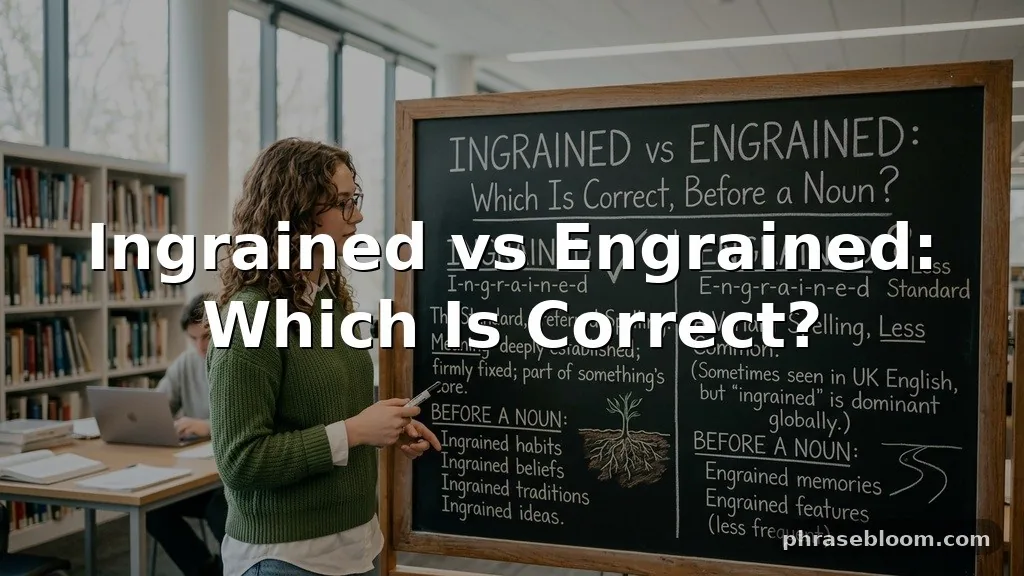
Ingrained vs engrained is a spelling question with a mostly clear answer: ingrained is the standard and safest form in modern English. It describes something deeply fixed in a person, group, system, or culture, such as an ingrained habit or an ingrained belief.
Engrained does appear in dictionaries and real-world writing as a spelling variant, and it is connected to the verb engrain. Still, it is much less familiar to many readers. Understanding the distinction helps you choose the correct spelling for formal writing, recognize the alternative in older or regional texts, and avoid treating a genuine variant as though it had a completely different meaning.
Ingrained vs Engrained: The Short Answer
Use ingrained when you mean deeply embedded, firmly established, or difficult to change. It is the usual spelling in phrases such as ingrained behavior, ingrained prejudice, ingrained habits, and ingrained beliefs.
Engrained is not simply a meaningless error in every context. It is an established spelling variant related to engrain, but it is less common and may look unfamiliar or incorrect to a general audience. For most contemporary American English and international professional writing, ingrained is the better choice.
| Form | Basic meaning | Typical status | Practical recommendation |
|---|---|---|---|
| ingrained | Deeply fixed or embedded | Standard and widely recognized | Use this form by default |
| engrained | Generally the same basic idea | Attested spelling variant, less familiar | Use only when a source or house style supports it |
| ingrain | To establish deeply | Standard verb | Preferred in most formal writing |
| engrain | Variant of “ingrain” | Less common verb form | Use cautiously for a broad audience |
The safest rule is simple: choose ingrained unless you are quoting a source, following a specific dictionary or editorial tradition, or discussing the spelling variant itself.
What Does Ingrained Mean?
The ingrained definition is “deeply fixed” or “firmly established.” The word usually refers to a habit, attitude, belief, custom, response, or pattern that has become so established that changing it takes sustained effort.
For example, a person may have an ingrained habit of checking email before breakfast. A workplace may have an ingrained culture of working late.
In both cases, the word suggests more than something that happened once or twice. It points to a pattern repeated over time.
Ingrained is an adjective. It modifies a noun by describing the condition of that noun, as in the following examples:
- ingrained assumptions
- ingrained social customs
- ingrained fear
- ingrained loyalty
- ingrained workplace behavior
- ingrained beliefs and attitudes
The word can describe positive, negative, or neutral patterns. An ingrained commitment to safety may be praised, while ingrained prejudice identifies a harmful attitude. The adjective itself does not tell you whether the pattern is desirable.
In ordinary English, ingrained often carries a sense of persistence. If a behavior is ingrained, simply explaining a new rule may not be enough to change it. The behavior has become part of how a person, team, or institution routinely responds.
Where the Word Ingrained Comes From
The history of ingrained is tied to the word grain. In older usage, something could be dyed or marked so deeply that the color became fixed in the material. That physical image later developed into the figurative meaning of an idea, habit, or quality being deeply embedded.
The related verb ingrain means to fix or establish something deeply. For example, repeated practice can ingrain a technical skill, while years of experience can ingrain a particular way of solving problems.
That origin helps explain why the spelling contains grain, not grain as a reference to engraving. The word is not primarily about carving lines into a surface. Its central image is closer to color or substance becoming fixed within a material.
English spelling has never developed in a perfectly uniform way. Prefixes such as in- and en- have sometimes produced related forms, especially as words moved between dialects, historical periods, and specialized uses.
For readers interested in historical evidence, the Merriam-Webster entry for “ingrained” shows how the word is treated in a major modern reference source. Other dictionaries, including the Oxford English Dictionary and Cambridge Dictionary, may provide additional information about related forms, pronunciation, and historical usage.
The important practical point is that etymology does not always tell you which spelling a modern reader expects. In current general writing, ingrained is the established form most readers will recognize immediately.
What Does Engrained Mean?
Engrained can function as a spelling variant of ingrained. Its related verb is engrain, which can mean to impress, fix, or establish deeply. In that sense, the engrained definition overlaps with the ingrained definition.
The spelling does not normally create a major difference in meaning. A phrase such as engrained assumptions generally communicates the same idea as ingrained assumptions: the assumptions are deeply established and not easily changed.
The difference is mainly one of frequency, familiarity, and editorial preference. Many readers know ingrained as the standard form but have rarely encountered engrained. As a result, using the less common spelling can distract readers, particularly in business reports, academic papers, public websites, and application materials.
That does not mean every appearance of engrained should be marked as impossible. A dictionary may record it as a variant, and a historical text or regional publication may use it consistently. An editor should distinguish between a genuine spelling variant and a simple typographical mistake.
For a writer making an independent choice, however, the practical answer remains straightforward. Use ingrained unless you have a specific reason to use engrained.
Is Ingrained or Engrained the Correct Spelling?
If the question is asking which spelling is most reliable for present-day standard English, the answer is ingrained. It is the form most likely to appear in familiar expressions and the form least likely to prompt a correction from an editor, teacher, client, or reader.
Examples of conventional usage include:
- The team has an ingrained habit of reviewing every safety report.
- Her ingrained confidence came from years of public speaking.
- The training challenged several ingrained assumptions about leadership.
- Courtesy was an ingrained part of the organization’s customer service culture.
Engrained may be defensible when a particular dictionary, publication, or regional tradition accepts it. It can also appear in writing produced by people who have learned the variant from family, community, or professional sources.
Still, acceptability and suitability are not always the same thing. A spelling may be recorded somewhere and yet remain a poor default for a document intended for a wide audience. Writers should consider not only whether a form exists, but also whether readers will recognize it without interruption.
That is why “correct spelling” needs a little context. Ingrained is the normal recommendation. Engrained is an attested but less common alternative.
How Ingrained Works in a Sentence
Most uses of ingrained are adjectival. The word appears before a noun as a descriptive modifier or after a linking verb as a subject complement.
Before a noun
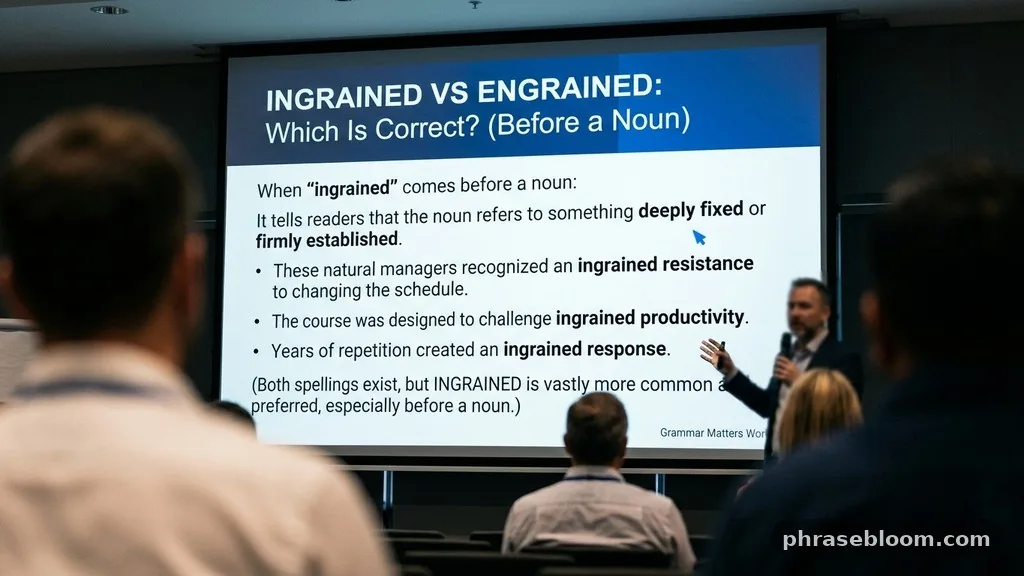
When ingrained comes before a noun, it tells readers that the noun refers to something deeply fixed. These are natural examples:
- The manager recognized an ingrained resistance to changing the schedule.
- The course was designed to challenge ingrained ideas about productivity.
- Years of repetition created an ingrained response to emergency warnings.
- The survey examined ingrained attitudes toward remote work.
In these sentences, ingrained is a straightforward adjective. It modifies resistance, ideas, response, and attitudes.
After a linking verb
Ingrained can also appear after verbs such as become, seem, and remain. For example, the practice became ingrained means that the practice gradually became deeply established.
Consider these examples:
- By the end of the season, the routine had become ingrained.
- That expectation remains ingrained in the department’s decision-making.
- The response seemed ingrained rather than carefully considered.
Because the word is not directly before a noun in these sentences, no special punctuation is needed. It remains the same adjective.
With the verb ingrain
The verb ingrain describes the process of establishing something deeply. Its object is the thing being fixed in someone’s mind, behavior, or system.
- Daily practice ingrained the correct pronunciation.
- The onboarding program ingrained the company’s safety procedures.
- Repeated reminders helped ingrain the new reporting process.
The past participle of the verb is also ingrained, which explains why the adjective and verb forms look alike in many sentences.
Ingrained in American and British English
The choice between ingrained and engrained is not a simple division between American English and British English. Both varieties use ingrained, and neither spelling should automatically be labeled exclusively American or exclusively British.
Regional English can influence spelling preferences, but dictionaries, publishers, schools, professions, and individual organizations also shape usage. A British publication may use ingrained throughout, while a writer in the United States may encounter or choose engrained in a specialized context.
Historical spelling variants often survive unevenly. One form may remain common in ordinary conversation while another appears in older books, local publications, or a particular editorial tradition. This does not necessarily mean that modern readers assign different meanings to the two forms.
For international communication, ingrained is usually the clearest option. It is familiar across major varieties of English and appears naturally in both formal and informal writing.
Writers should also follow the spelling conventions of the publication or organization they are writing for. A company handbook, academic journal, or government office may have an established house style that resolves questions like this before the writer begins drafting.
Ingrained vs Engrained in Formal and Professional Writing
Professional writing places a premium on quick recognition. Readers often scan reports, policies, proposals, and emails under time pressure, so a familiar spelling reduces unnecessary friction.
For that reason, ingrained is generally the best choice in business English. It works naturally in descriptions of workplace culture, customer expectations, risk management, training, organizational behavior, and leadership.
Business reports
A report might state that ingrained approval processes delayed the product launch. The sentence identifies a long-established process rather than blaming a single employee or isolated decision.
Academic writing
An academic writer may refer to ingrained social attitudes or ingrained assumptions within the research community. The spelling is clear, conventional, and suitable for readers from different English-speaking backgrounds.
Workplace communication
An internal email could say, The workshop is intended to question ingrained habits that limit collaboration. The word is appropriate because it describes repeated behavior rather than a temporary preference.
Public-facing content

Websites and marketing materials should usually favor ingrained because visitors may come from many regions and language backgrounds. A familiar form helps the message stay focused on its subject instead of inviting a spelling question.
Engrained can still appear in a quotation, a historical discussion, or a document following a particular editorial convention. If you use it, consistency and context matter. Do not alternate between ingrained and engrained as though they represented different concepts unless you explain that distinction.
Common Mistakes and Better Corrections
The most common problem is not misunderstanding the meaning. It is choosing a form that looks unusual in the sentence or switching between forms without a reason.
Using engrained as an automatic default
Some writers choose engrained because they associate the word with something being “engraved” into the mind. That association is understandable, but it does not make engrained the preferred spelling for general modern usage.
Preferred: The belief was ingrained from childhood.
Assuming engrained is always wrong
The opposite mistake is declaring that engrained can never be correct. It is better described as a less common variant related to engrain. An editor should check the relevant dictionary or house style before changing it automatically.
Confusing the adjective with a noun
Ingrained is normally an adjective or a participial form of the verb ingrain. It is not generally used as a noun.
Less natural: The ingrained of the company was difficult to change.
Better: The company’s ingrained habits were difficult to change.
Using an unnecessary verb form
The form ingrainedly is technically imaginable but rarely sounds natural. Writers usually communicate the idea more clearly with a phrase such as in an ingrained way, though even that may be less direct than rewriting the sentence.
Awkward: The team ingrainedly followed the old procedure.
Better: The team followed the old procedure out of ingrained habit.
Changing spellings without a purpose
A document that uses ingrained in one section and engrained in another may look poorly edited. Unless the difference is relevant to a quotation or historical source, select one form and use it consistently.
Alternatives to Ingrained
Sometimes the best solution is not choosing between two spellings. A rewrite can make the meaning more direct and may fit the tone of the sentence better.
- deeply rooted: useful for beliefs, traditions, and cultural attitudes
- firmly established: suitable for processes, systems, and institutional practices
- deeply embedded: effective in technical, organizational, and analytical writing
- habitual: useful when the focus is repeated personal behavior
- long-standing: suitable for practices or relationships that have continued over time
- entrenched: stronger and often more critical, especially for difficult systems or attitudes
- deep-seated: common for emotions, convictions, fears, and resentment
These alternatives are not perfect substitutes in every sentence. Habitual emphasizes repetition, while deep-seated often emphasizes emotional or psychological depth. Entrenched may suggest that a pattern is resistant to reform and has negative consequences.
Compare the following examples:
- The company has an ingrained preference for face-to-face meetings.
- The company has a long-standing preference for face-to-face meetings.
- The company has a deeply rooted preference for face-to-face meetings.
The first highlights the strength of the preference. The second emphasizes duration. The third suggests that the preference is tied to the organization’s deeper culture or identity.
Rewriting can also help when a reader might mistake the intended meaning. Instead of an ingrained resistance to feedback, you could write a long-established reluctance to accept feedback. The revised version is longer, but it may be more precise in a sensitive report.
How to Choose the Right Form
A practical decision process makes the ingrained vs engrained question easy in most situations. Start by asking what meaning you intend, then consider what your audience is most likely to recognize.
- Check the meaning. If you mean deeply fixed, established, or embedded, both related forms may point toward the same concept.
- Choose the familiar default. In most modern general writing, select ingrained.
- Check the house style. Follow the preferred dictionary, publication guide, employer policy, or instructor’s requirements if one exists.
- Consider the audience. International readers and general audiences will usually recognize ingrained more readily.
- Review the surrounding sentence. Make sure the word clearly describes a habit, belief, quality, process, or pattern.
- Stay consistent. Once you choose a form, use it throughout the document unless a quotation requires another spelling.
This method separates three issues that are often confused: meaning, spelling, and style. Meaning asks what you want to say.
Spelling asks which written form communicates it. Style asks which accepted form best fits the audience and document.
For most writers, the decision will take only a moment. Write ingrained, check the document for consistency, and move on.
Usage Examples You Can Copy
The following sentences show how ingrained works in common settings. They also demonstrate the range of nouns the adjective can modify.
- The department’s ingrained preference for paper records slowed the transition to digital files.
- Years of practice made accurate formatting an ingrained part of her workflow.
- The training addressed ingrained assumptions about who should lead technical projects.
- His ingrained caution helped the team identify the security risk early.
- The organization is trying to replace ingrained habits with a more flexible process.
- Respect for patient privacy must become ingrained in every clinical procedure.
- The survey revealed deeply ingrained beliefs about promotion and seniority.
- By the third month, the morning review had become ingrained in the team’s routine.
- The policy was designed to challenge an ingrained culture of unnecessary overtime.
- Her response was so ingrained that she answered before considering the new evidence.
In each example, ingrained describes something established through repetition, experience, culture, or long-held belief. It does not mean merely “present” or “common.” The word adds the idea of depth and persistence.
If you want to use the variant, a sentence such as The community’s engrained customs shaped the annual ceremony may be understandable. Even so, many editors would prefer ingrained customs for a general audience.
Do not use the word simply to make a sentence sound formal. If you mean “regular,” write regular.
If you mean “old,” write long-standing. Precise vocabulary is more valuable than a dramatic adjective.
Frequently Asked Questions
Is ingrained or engrained correct?
Ingrained is the standard and safest choice in most contemporary English. Engrained is an attested variant connected with engrain, but it is less common and may look unfamiliar to many readers.
Is ingrained more formal than engrained?
Ingrained is not necessarily more formal, but it is more widely recognized in formal and professional writing. Its familiarity makes it the stronger default for reports, academic work, workplace communication, and public-facing content.
Is engrained a misspelling?
Not always. Some dictionaries and usage traditions recognize engrained as a variant, although many readers encounter ingrained far more often. If you are writing for a broad audience, ingrained is usually the clearer option.
What does ingrained mean?
Ingrained means deeply fixed, firmly established, or difficult to change. It commonly describes habits, beliefs, attitudes, customs, responses, and organizational practices.
Can I use ingrained for a positive quality?
Yes. Ingrained can describe a positive quality, such as an ingrained commitment to safety, an ingrained respect for accuracy, or an ingrained sense of responsibility. It can also describe neutral or harmful patterns.
Final Guidance on Ingrained vs Engrained
The practical answer to Ingrained vs Engrained is to use ingrained when you mean deeply established or embedded. It is the familiar modern form, works naturally in formal and informal English, and is unlikely to distract readers.
Engrained has a legitimate history as a variant, but it is less common. If a dictionary, quotation, regional tradition, or house style calls for it, the spelling can be understood in context. Otherwise, choose ingrained, check the surrounding sentence for precise meaning, and use the same form consistently throughout your writing.
Related reading: Unselect vs Deselect, Hassle vs Hastle, Continuous vs Continous.