
Spatter vs Splatter: Meaning, Origin and Usage
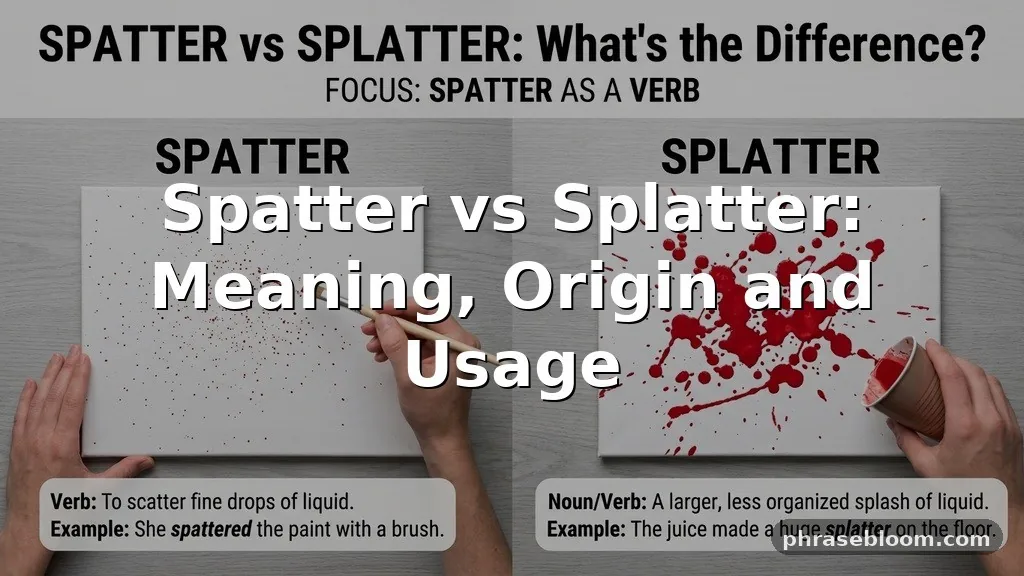
Spatter vs splatter is usually a question of degree, context, and tone rather than a strict difference in meaning. Both words describe liquid or another substance scattered into drops or small pieces, and everyday speakers often use them interchangeably.
In general, spatter suggests smaller, lighter, or more scattered droplets, while splatter often suggests larger, messier, or more forcefully scattered drops. That distinction is useful, but it is not an unbreakable rule.
The difference between spatter and splatter becomes clearer in particular settings such as painting, cooking, weather, and forensic science. This article explains the spatter definition and splatter definition, shows how the words work as nouns and verbs, and gives practical guidance for choosing between them without pretending that English has a sharper boundary than it really does.
The Short Answer: Spatter and Splatter Overlap
Spatter means to scatter small drops or particles over a surface, or the scattered material itself. Splatter means to splash or scatter liquid, mud, paint, blood, grease, or another substance in drops, often with an impression of greater force, mess, or size.
That is the central distinction, but many dictionaries treat the words as overlapping synonyms. A useful reference such as the Merriam-Webster Dictionary entry for spatter reflects how broad the ordinary usage can be.
Writers should therefore avoid claiming that one word is always correct and the other always wrong. A sentence such as “The pan sent grease splatter across the stove” sounds natural because the image is messy and forceful, while “The spray left a fine spatter on the glass” emphasizes tiny scattered droplets.
The words can also be used as nouns, verbs, and modifiers. You can write about paint spatter, paint splatter, a shirt “spattered with mud,” or a wall “splattered with ink.” The best choice depends on the material, the pattern, the force involved, and the tone you want.
- Use spatter for fine droplets, light scattering, or a more technical description.
- Use splatter for larger drops, a vigorous splash, or a conspicuously messy result.
- Use either word when the distinction does not matter and normal usage allows both.
- Follow established terminology in specialist fields, especially forensic science and technical documentation.
Spatter Definition and Core Meaning
The verb spatter describes the action of scattering small drops or particles onto something. For example, “The artist spattered blue paint across the paper” presents the paint as a collection of separate droplets rather than one continuous coating.
As a noun, spatter refers to the material or pattern created by that action. “The window was covered with paint spatter” identifies scattered spots on the window, while “The technician examined the spatter” may refer to a pattern that requires careful observation.
Spatter often carries an image of distribution. The drops may be fine, numerous, and dispersed across a surface. The word does not necessarily tell you exactly how hard the liquid moved, but it commonly fits situations involving spray, droplets, or small particles.
Spatter as a verb
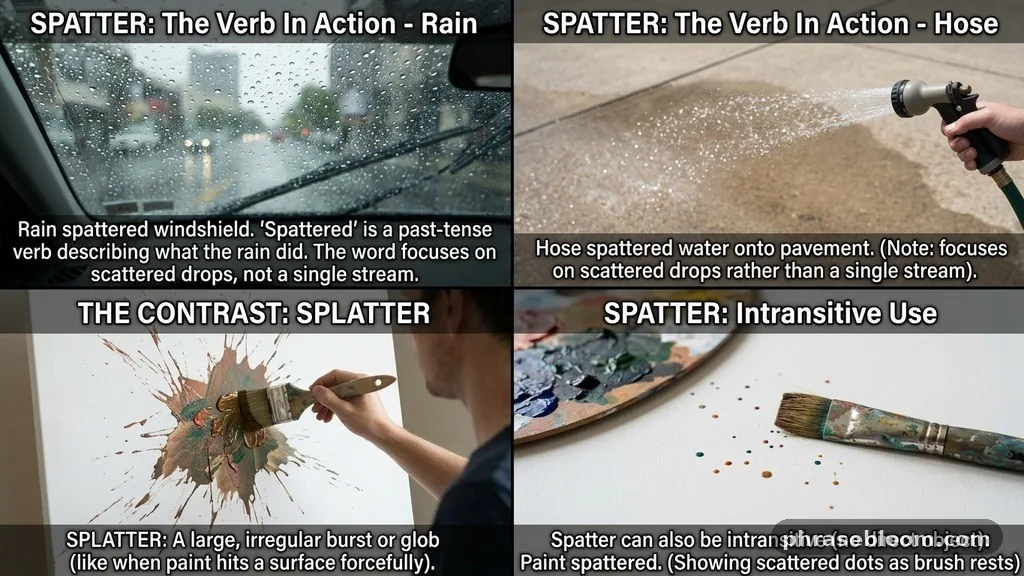
In “Rain spattered the windshield,” spattered is the past-tense verb describing what the rain did. In “The hose spattered water onto the pavement,” the word focuses on scattered drops rather than a single stream.
Spatter can also be intransitive, meaning it does not take a direct object. “The paint spattered as the brush moved” describes the droplets appearing without saying exactly what surface received them.
Spatter as a noun
The noun can identify either an amount of scattered material or the overall pattern. “There was spatter on the countertop” is broad, while “The report documented a fine spatter pattern” gives a more precise description.
In technical writing, spatter may sound more neutral than splatter. That does not make it automatically more accurate, but it can be preferable when the writer wants to describe liquid distribution without suggesting a dramatic or unpleasant scene.
Splatter Definition and Core Meaning
The verb splatter means to splash or scatter liquid, mud, paint, food, or another substance in drops. It often suggests an energetic event: a tire hits a puddle, a tomato bursts under pressure, or hot oil jumps from a frying pan.
As a noun, splatter refers to the scattered substance or the resulting mess. “Mud splatter covered the lower half of the truck” suggests visible, irregular marks that may be larger or heavier than a fine spray.
Splatter can also imply an emotional or visual effect. A thriller might use “blood splatter” in a dramatic description, while a cook might complain about “grease splatter” after frying bacon. The word is often more vivid and less restrained than spatter.
Why splatter sounds more forceful
The beginning of splatter resembles words such as splash and slosh. That sound pattern may help explain why it feels more energetic or messy, although sound alone does not determine a word’s definition.
The term is also common in phrases connected with visual mess. Paint splatter, mud splatter, and grease splatter immediately suggest noticeable spots or blobs rather than an almost invisible mist.
Splatter can still describe small drops
There is no rule stating that splatter must involve large droplets. A fine spray can be described as splatter if the speaker is focusing on the mess, the action, or the way the substance struck a surface.
That overlap matters. If a technical report uses splatter for a pattern that another writer calls spatter, the difference may be stylistic rather than factual unless the relevant field has defined the terms more narrowly.
The Difference Between Spatter and Splatter
The most practical difference is one of emphasis. Spatter tends to emphasize scattered droplets and distribution, while splatter tends to emphasize impact, mess, or force. Neither word guarantees a particular droplet size or pattern.
| Word | Typical emphasis | Common examples | Practical effect |
|---|---|---|---|
| Spatter | Fine droplets, scattered marks, spray-like distribution | Ink spatter, paint spatter, blood spatter | More neutral or technical |
| Splatter | Mess, impact, splash, larger or more noticeable drops | Grease splatter, mud splatter, paint splatter | More vivid or forceful |
| Either word | General scattering of liquid or particles | Water spatter, water splatter | Meaning depends on context |
Consider two descriptions of a wall. “A fine spatter of white paint covered the panel” sounds like a pattern of small, separate droplets. “White paint splattered across the panel” makes the action more prominent and suggests a livelier, less controlled application.
The same principle applies to food. “The sauce spattered onto the counter” is a relatively neutral observation, while “The sauce splattered all over the counter” highlights the extent of the mess.
Fine droplets and large droplets
Writers sometimes use spatter for fine droplets and splatter for large droplets. This is a useful working distinction, especially in descriptive prose, but it should not be treated as a universal scientific definition.
Droplet size can depend on viscosity, speed, surface tension, height, pressure, and the surface that receives the liquid. A single event may produce both fine droplets and larger drops, so the surrounding description should carry the technical meaning when precision matters.
Scattered liquid and spray pattern
Spatter often works well when you are describing a spray pattern or liquid distribution. “The nozzle produced a narrow spatter pattern” directs attention to where the droplets landed and how they were arranged.
Splatter works well when the reader needs to imagine an abrupt splash. “The truck sent mud splatter onto the doors” describes an event and its visible consequence, not merely a measured pattern.
How the Words Work in Real Situations
Both terms appear in ordinary workplace, household, artistic, and scientific writing. The surrounding noun often guides the choice more strongly than a dictionary definition does.
Paint and art
Paint spatter usually suggests small dots created intentionally or incidentally by a brush, tool, or spray device. An artist might write, “The final layer uses black paint spatter to soften the sharp geometric shapes.”
Paint splatter is also completely natural, especially when the process is energetic or deliberately messy. “The mural includes orange paint splatter around the central figure” emphasizes visible marks and a lively surface.
Cooking and household tasks
Grease is frequently associated with splatter because hot oil can jump suddenly from a pan. “Use a screen to reduce grease splatter” sounds idiomatic and practical.
Spatter is possible when the writer wants a neutral description: “Small droplets of oil spattered the backsplash.” The sentence focuses on the droplets rather than the unpleasant mess.
Weather, roads, and outdoor scenes
Rain can spatter a window, particularly when the writer is describing individual drops. Mud often splats or splatters against a vehicle, where the impact and mess matter more.
Both choices can work in “Water spattered the sidewalk” and “Water splattered the sidewalk.” The first sounds lighter and more dispersed; the second suggests a more noticeable or irregular splash.
Workplace and technical descriptions
In a maintenance report, “The seal failed and caused oil spatter near the valve” may sound more controlled than “caused oil splatter near the valve.” If the report concerns a safety hazard, the writer should add measurable details such as the affected area, the source, and the cleanup required.
Neither word replaces evidence. A technical document should not rely on spatter or splatter alone to communicate volume, distance, or risk.
Ink and printing
Ink spatter often fits printing, calligraphy, and visual descriptions involving tiny drops. “The scanner detected ink spatter along the lower margin” sounds observational and precise.
Ink splatter may be better in a design brief or artistic description. “The album cover uses white ink splatter over a dark background” has a more expressive tone.
Spatter and Splatter in Forensic Science
Forensic writing requires special care because everyday language and technical terminology do not always align. People commonly say blood spatter and blood splatter, but a professional report should follow the terminology used by the relevant laboratory, agency, jurisdiction, or current scientific practice.
Bloodstain pattern analysis examines the size, shape, distribution, and location of bloodstains, along with possible mechanisms that produced them. A broad description such as “blood spatter was present on the wall” may be understandable, but it does not by itself establish how the stains formed.
The expression blood splatter is common in popular media and general conversation. It often sounds more dramatic. In forensic science, however, the preferred terminology may be more specific, and the writer should not infer a cause from the word alone.
Why technical context matters
A pattern of fine droplets does not automatically prove a particular event. Surface texture, fluid properties, distance, movement, and documentation methods can affect the appearance of stains.
For that reason, a careful report separates observation from interpretation. “The examiner observed a group of small stains on the door” records a visual fact, while a conclusion about the mechanism requires validated methods and supporting evidence.
General readers versus specialists
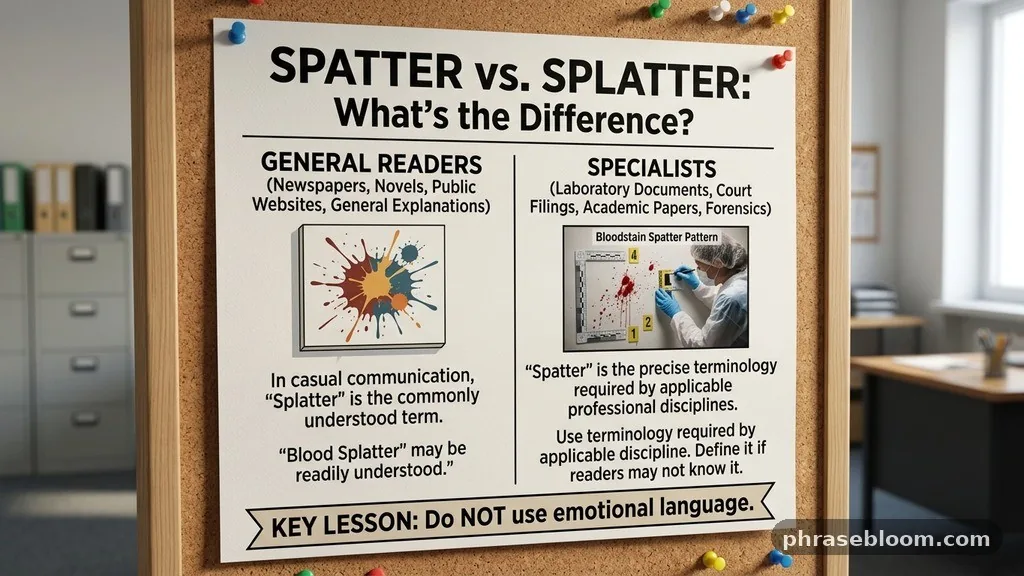
For a newspaper, novel, public website, or general explanation, blood splatter may be readily understood. For a laboratory document, court filing, or academic paper, use the terminology required by the applicable discipline and define it if readers may not know it.
The key lesson is simple: do not use the emotional force of splatter as a substitute for forensic precision. The choice of word is only one small part of a scientifically sound description.
Origin, Sound, and Tone
Spatter and splatter belong to a group of English words whose sounds help suggest movement or physical action. Linguists often call such sound-related formations onomatopoeia or sound symbolism, although the words are not literal imitations in the same way that buzz imitates an insect sound.
The added l in splatter gives the word a heavier, more emphatic rhythm. That may be one reason it fits scenes involving splashes, messes, and sudden impact. The association is about tone and usage, not a strict rule about the quantity of liquid.
Both words have long-standing use in English, and their meanings overlap. They are not a neat pair in which one refers only to tiny drops and the other refers only to large ones.
Neutral versus vivid wording
Choose spatter when you want a restrained or observational tone. “The sample showed paint spatter near the edge” sounds suitable for a report, catalog, or description of a controlled process.
Choose splatter when you want the reader to notice activity or mess. “The brush sent paint splatter across the studio floor” creates a more energetic image.
That tonal difference can matter in headlines, marketing copy, fiction, and museum labels. A horror film title may favor splatter, while a product manual may prefer spatter or simply “droplets.”
Grammar: Nouns, Verbs, and Modifiers
Spatter and splatter can both function as verbs and nouns. They can also appear as modifiers before another noun, as in spatter pattern, splatter effect, blood spatter, and paint splatter art.
As a verb, the word describes an action: “The wheel splattered mud onto the fender.” As a noun, it identifies the result: “Mud splatter covered the fender.” The spelling does not change because of that grammatical difference.
Common verb patterns
These sentences use spatter as a verb:
- “Fine rain spattered the greenhouse roof.”
- “The faulty nozzle spattered coolant across the guard.”
- “The brush spattered red ink onto the test sheet.”
These sentences use splatter as a verb:
- “The tire splattered mud across the license plate.”
- “Hot sauce splattered the cooktop.”
- “The drummer’s sticks splattered paint onto the backdrop.”
The objects and circumstances make the intended image clear. If the exact distinction matters, add a phrase such as “in fine droplets,” “in several large drops,” or “across a narrow area.”
Compound modifiers
When two words work together before a noun, writers may use a compound modifier such as fine-spatter pattern or paint-splatter design. In many contexts, the hyphen helps the reader see that the words belong together.
Hyphenation is especially useful when leaving the words open could create uncertainty. Still, established phrases, dictionaries, publication style, and the surrounding sentence can affect whether a hyphen appears.
Choosing the Right Word in Professional Writing
Professional writing rewards clarity more than theatrical wording. In a safety notice, “Prevent oil splatter by lowering the heat” is direct and familiar. In an engineering report, “The inspection found fine oil spatter around the coupling” may sound more measured.
Business writers should consider what the reader needs to understand. If the substance, source, or risk matters, identify it directly instead of assuming that spatter or splatter will carry all the necessary information.
Reports and technical documents
Use the terminology preferred by your department, laboratory, publisher, or client. Once the document uses spatter, do not switch casually to splatter unless you intend a meaningful change in tone or pattern.
A report might say, “The coating process produced fine droplets along the upper edge.” That wording avoids an unnecessary vocabulary dispute and gives the reader a concrete observation.
Marketing and creative writing
Marketing copy can use splatter for energy and visual impact. A description such as “a bold splatter finish” sounds more expressive than “a scattered-droplet finish.”
Creative writers have even more freedom, but the chosen word should fit the scene. Spatter can make an image feel delicate or clinical, while splatter can make it feel chaotic, comic, or violent.
Academic writing
Academic writers should define specialized usage and rely on evidence. If a paper discusses a specific spray pattern, say how the pattern was measured or identified rather than depending on a general dictionary distinction.
In literature, art history, or cultural studies, either word may be appropriate if the writer explains the visual effect being discussed. The important issue is consistency and a clear relationship between the term and the evidence.
Alternatives That Remove the Ambiguity
Sometimes the easiest way to avoid a word-choice problem is to rewrite the sentence. Alternatives can be clearer, especially for readers learning English or for documents that require precise physical descriptions.
- droplets: “Small droplets covered the lens.”
- spray: “A fine spray reached the adjacent panel.”
- splash: “A splash of water hit the floor.”
- scattered liquid: “Scattered liquid appeared near the drain.”
- spots: “Dark spots marked the lower section of the wall.”
- spray pattern: “The nozzle produced an uneven spray pattern.”
- liquid distribution: “The test measured liquid distribution across the surface.”
These alternatives do not always carry the same tone. “Splatter” may imply a messy action, while “droplets” simply identifies the form of the material. Choose the replacement that preserves the detail your reader actually needs.
When a plain phrase is better
“Paint landed on the floor in small drops” is longer than “paint spattered onto the floor,” but it may be easier for a beginner to understand. “Oil escaped from the valve and reached the surrounding panel” may be better than either “oil spatter” or “oil splatter” in a formal incident record.
Plain language is not weaker language. It is often the most reliable choice when the audience includes people from different language backgrounds or professional fields.
Common Mistakes and Better Corrections
The most common error is treating the words as if they have a fixed technical boundary in every context. English usage is more flexible than that, so a writer should look at the sentence, audience, and purpose before correcting someone automatically.
Assuming one word is always correct
It is inaccurate to say that spatter always means tiny drops and splatter always means large drops. That distinction can guide style, but context can override it.
Better approach: use the distinction as a practical tendency, then add a physical description if precision matters.
Using dramatic language in a technical report
“The machine splattered fluid everywhere” may be vivid but not very useful in an incident report. It does not identify the fluid, source, affected area, or severity.
Better correction: “The failed fitting released fluid droplets onto the guard and adjacent floor.”
Using a vague noun without context
“There was spatter” tells the reader almost nothing about color, material, location, or pattern. Even a technically acceptable term needs supporting detail.
Better correction: “Fine blue paint spatter appeared within 10 centimeters of the panel’s upper edge.” Only include measurements that have actually been observed.
Confusing noun and verb use
“The wall was spatter” is incorrect because the sentence needs a past participle or an adjective. Write “The wall was spattered with paint” or “Paint spatter covered the wall.”
Likewise, “The pan caused grease” is incomplete if you mean scattered grease. Write “The pan caused grease splatter” or “Grease splattered from the pan.”
Ignoring house style
An organization may prefer one term for consistency, especially across product instructions, safety documents, and training materials. A writer who changes between spatter and splatter without purpose can make the document seem less controlled.
Check the organization’s glossary or editorial guidance first. If none exists, choose the word that fits the context and use it consistently.
A Practical Decision Guide
You can make the choice quickly by asking what the sentence needs to emphasize. The following method works for most general and professional writing.
- Identify the substance. Is it paint, rain, grease, mud, ink, blood, or something else?
- Picture the movement. Was the material sprayed lightly, scattered gradually, or thrown by a forceful impact?
- Consider the tone. Use spatter for a more neutral or pattern-focused description and splatter for a more vivid or messy one.
- Check specialist usage. A laboratory, safety team, or technical publisher may have an established preference.
- Add physical detail. Describe fine droplets, larger drops, distance, location, or coverage when the distinction matters.
- Stay consistent. Do not alternate terms merely to avoid repetition if both refer to the same pattern.
For example, suppose you are describing a paint tool. “The roller created paint spatter along the trim” sounds like a small, scattered effect. “The roller created paint splatter across the floor” suggests a more obvious mess and may be the better choice if cleanup is the focus.
If you still hesitate, rewrite the sentence with droplets, spray, or scattered paint. A clear alternative is usually better than a forced distinction.
Examples You Can Copy and Adapt
The following examples show how context changes the natural choice. They are not rigid templates, but they demonstrate the usual difference in emphasis.
- “The artist added fine paint spatter to the background.”
- “A burst of paint splatter reached the studio floor.”
- “Rain spattered the office windows throughout the morning.”
- “The passing truck sent mud splatter onto the side of the car.”
- “The technician found ink spatter near the printer’s output tray.”
- “The poster uses bright ink splatter as a decorative effect.”
- “Place the lid over the pan to reduce grease splatter.”
- “The inspection recorded oil spatter around the loose connector.”
- “The report describes a fine spray pattern on the upper panel.”
- “The documentary discusses blood spatter in general terms.”
- “The crime novel uses the phrase blood splatter for dramatic effect.”
- “The hose spattered water across the concrete.”
- “The wave splattered seawater over the railing.”
- “A protective screen limits paint spatter during sanding.”
- “The new design features a black-and-gold splatter finish.”
Notice that several pairs could be reversed without creating a grammatical error. The reversal changes the image or tone more often than it changes the basic proposition.
Frequently Asked Questions
What is the difference between spatter and splatter?
Spatter usually suggests scattered, often fine droplets, while splatter often suggests a more forceful, messy, or noticeable splash. The meanings overlap, so this is a tendency rather than an absolute rule.
Is spatter more formal than splatter?
Spatter can sound more neutral or technical, particularly in descriptions of patterns and droplets. Splatter is often more vivid, but it is not inherently incorrect or informal.
Should I use blood spatter or blood splatter?
Both expressions appear in general English. In forensic or academic writing, follow the terminology used by the relevant institution or discipline, and describe the observed pattern precisely instead of relying on the word alone.
Is paint spatter or paint splatter correct?
Both are correct in suitable contexts. Use paint spatter for a fine or scattered pattern and paint splatter for a more energetic, decorative, or messy effect.
Can I use either word as a verb?
Yes. You can write “Rain spattered the glass” or “Mud splattered the car.” The first commonly sounds lighter or more dispersed, while the second usually emphasizes impact or mess.
Final Takeaway
Spatter vs splatter is mainly a question of emphasis, not a rigid split in meaning. Use spatter when you want to highlight fine droplets, a scattered pattern, or a neutral description; use splatter when force, mess, or visual energy is central.
For exact writing, add the detail that matters: droplet size, material, location, direction, or cause. In professional and technical work, follow the applicable terminology and keep your usage consistent. Once that principle is clear, choosing between spatter and splatter becomes a matter of fit rather than guesswork.
Related: Alright vs All Right · Team That, Team Who, or Team Which · Who Else vs Whom Else