
If you have ever paused while writing and wondered whether the word is separate or seperate, you are not alone. This is one of the most common spelling mistakes in English.
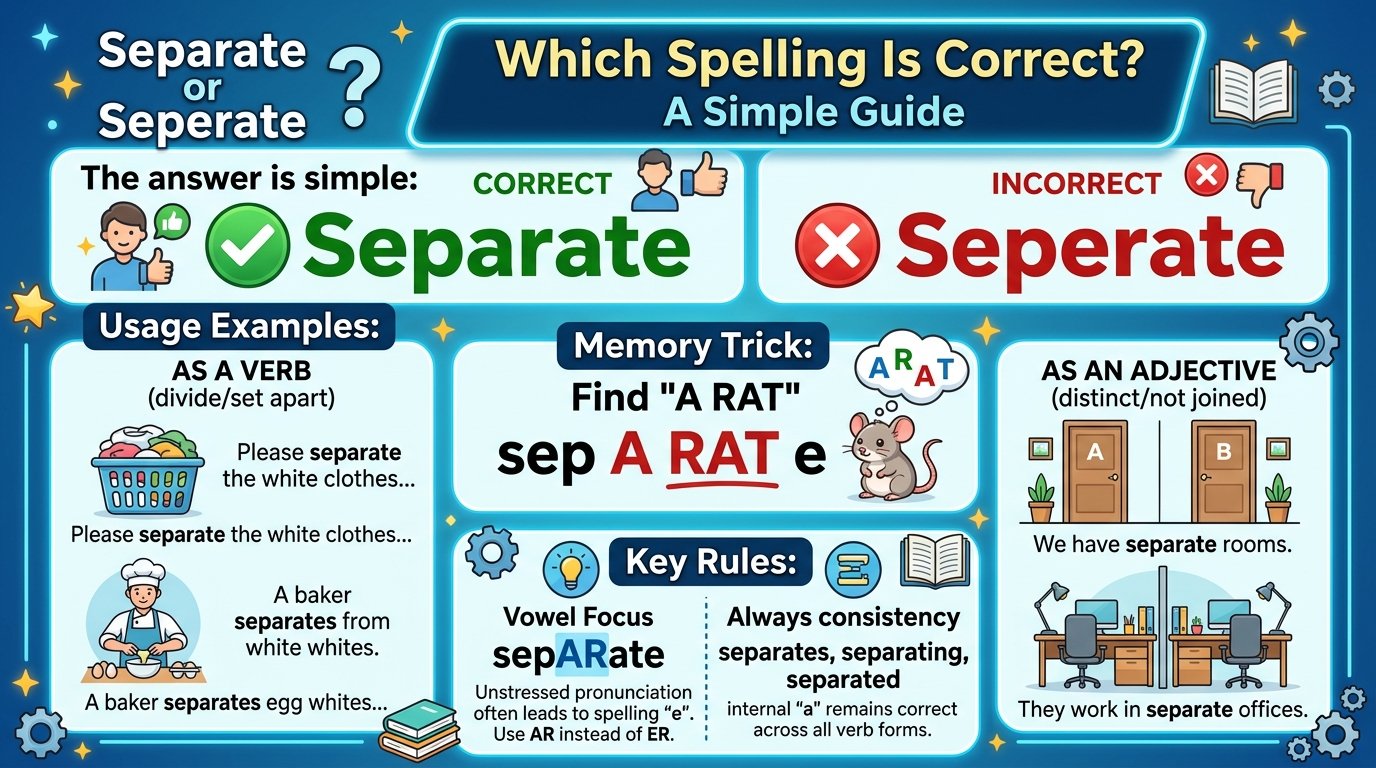
The correct spelling is separate. The form seperate is a misspelling and is not accepted as a standard spelling in English.
The confusion usually happens because the middle vowel is not strongly pronounced in everyday speech. As a result, writers may hear an unstressed sound and choose “e” instead of “a.”
Understanding the difference is simple once you connect the spelling with the word’s meaning, pronunciation, and spelling pattern.
The word separate can work as both a verb and an adjective. As a verb, it means to divide or set things apart. As an adjective, it means different, distinct, or not joined.
For example:
- Please separate the white clothes from the colored clothes.
- We have separate rooms.
- The two groups were separated after the discussion.
- Separating recyclable materials makes sorting easier.
So, whenever you are deciding between separate or seperate, choose separate.
Why It Matters in Professional Settings
Correct spelling becomes especially important in formal writing, business communication, academic work, legal texts, reports, manuals, and professional emails.
A small spelling error can make otherwise good writing look careless. Although readers usually understand what “seperate” means, it can reduce confidence in the writer’s attention to detail.
Professional writing depends on accuracy and clarity. Using the correct form, therefore, helps your message look polished and trustworthy.
This is also why spell check, proofreading, and a reliable dictionary are useful. However, learning the spelling yourself is better than depending completely on software.
Read Also: Bespeckled or Bespectacled: Understanding the Difference Clearly Today
Separate or Seperate: Which One Is Correct?
The answer is straightforward: separate is correct, while seperate is incorrect.
Separate is the standard spelling recognized in English dictionaries. Seperate is simply a common spelling error.
| Form | Correct? | Meaning/Use | Example |
|---|---|---|---|
| separate | Yes | Verb or adjective | Please separate the files. |
| seperate | No | Misspelling | Please do not use this spelling. |
| separates | Yes | Present-tense verb | The wall separates the rooms. |
| separating | Yes | Present participle/gerund | Separating the items takes time. |
| separated | Yes | Past form/past participle | They separated the documents. |
The base word remains separate in its standard word formation.
One useful point is that adding an ending does not change the correct internal vowel. You write separating, not “seperateing,” and separated, not “seperated.”
What Does “Separate” Mean? Origins, Definition, and Usage
The word separate has several connected meanings, but they all involve the idea of things being apart.
It can describe physical objects, people, groups, ideas, responsibilities, or categories.
As a verb, separate means to divide something or move things apart.
As an adjective, separate means distinct, independent, or not connected.
For example, “Separate the documents” describes an action. In contrast, “The documents are separate” describes their condition.
Definition of Separate
As a verb, separate means to divide, disconnect, sort, or set apart.
For example:
“Please separate the recyclable materials.”
Here, the speaker asks someone to divide materials into appropriate groups.
As an adjective, separate means not joined or existing independently.
For example:
“They work in separate offices.”
Here, separate describes the offices.
Common related meanings include divide, split, distinguish, set apart, and keep apart.
Origins of the Word “Separate”
The word comes from Latin separatus, which is related to the idea of making something distinct or apart.
Its historical development helps explain why the spelling has remained associated with the Latin-based form.
English contains many words whose spelling reflects their historical roots rather than exactly matching modern pronunciation. That is one reason spelling cannot always be predicted simply by sound.
The ending -ate also appears in many English words. However, learners should not assume that pronunciation alone will always tell them which vowel belongs in the written word.
Why Separate Is a Common Misspelling
The biggest reason is pronunciation.
The middle vowel can sound weak in normal speech. Because that syllable is often unstressed, writers may remember the sound incorrectly and write “seperate.”
Another reason is visual similarity. The incorrect form looks natural because English contains many words with “e” in similar positions.
This makes seperate a classic common spelling error rather than a different English word.
A useful visual memory trick is to focus on the “a” in the middle of separate.
Think of the word as containing a before r. You can also remember the phrase “a rat” as a simple mnemonic for the middle letters.
Exploring the Significance of “Separate” in the Culinary World
Although separate is not a special culinary term, it is frequently used in cooking instructions because ingredients, utensils, portions, and food categories often need to be kept apart.
For example, a recipe may instruct a cook to keep raw meat separate from vegetables.
A baker may separate egg whites from yolks. A chef may divide ingredients into separate bowls before cooking.
Therefore, the word has practical value in kitchen instructions because precise language helps prevent mistakes.
See Also: Is It Correct to Say Well Wishes? A Clear Guide to Proper Usage
Role of a “Separate” in a Professional Kitchen
In a professional kitchen, clear instructions are essential. Workers may need to separate ingredients, tools, or prepared foods according to their purpose.
For example:
“Keep raw chicken separate from ready-to-eat food.”
Here, separate functions as an adjective.
In another instruction:
“Separate the egg whites from the yolks.”
Here, separate functions as a verb.
The distinction demonstrates why understanding parts of speech matters even when the spelling itself does not change.
Common Reasons for the “Separate” Misspelling
Several factors contribute to confusion between separate and seperate.
First, pronunciation can be misleading. English spelling does not always represent sounds in a simple one-to-one way.
Second, the unstressed vowel may be difficult to hear clearly. Writers may remember the sound but not the exact vowel order.
Third, people often type quickly. A familiar-looking spelling such as “seperate” can slip through during casual writing.
Finally, some writers may have seen the incorrect form repeatedly online. Repeated exposure can make a misspelling look familiar, even though familiarity does not make it correct.
When proofreading, pay special attention to this word. A spell-checker will usually flag “seperate,” but manual checking is still valuable.
Side-by-Side Comparison: “Separate” and “Seperate”
The easiest comparison is simple:
Separate = correct spelling.
Seperate = incorrect spelling.
| Feature | Separate | Seperate |
|---|---|---|
| Standard English | Correct | Incorrect |
| Dictionary form | Yes | No |
| Can be a verb | Yes | No |
| Can be an adjective | Yes | No |
| Common in professional writing | Yes | No |
| Used in derived forms | Yes | No |
| Recommended spelling | Yes | No |
Consider these examples:
“Please keep the files separate.”
“The teacher separates the students into groups.”
“They are separating the recyclable materials.”
“The documents were separated by category.”
In each case, the correct base spelling is maintained.
Everyday Examples of “Separate” in Language
The word appears in ordinary conversations and writing every day.
You might say:
“Keep your work and personal accounts separate.”
“The two buildings are separate.”
“Please separate the red cards from the blue cards.”
“Each child has a separate locker.”
These examples show how flexible the word is.
Several prepositional collocations are also common. You can separate A from B, separate something into parts, or separate items by category.
For example:
“We separated the useful information from the unnecessary details.”
“She separated the documents into three folders.”
“The students were separated by age.”
The phrase separate from is particularly common when showing that two things are distinct.
You may also encounter the phrasal verb separate out, especially in conversational or workplace English.
For example:
“Separate out the damaged products.”
The phrase separate off exists as well, although it is less common.
How to Spell “Separate or Seperate”: Remember the Correct Spelling
If you often forget how to spell “Separate or Seperate”, use a visual memory trick instead of relying only on pronunciation.
Remember that the correct word contains an a before the r:
sepARate
Another helpful method is to mentally divide the word into smaller parts. This makes the internal “a” easier to notice.
You can also connect the word with “a rat” as a simple memory device. The goal is not to pronounce the word differently, but to create a visual reminder of the correct spelling.
When uncertain, look the word up in a reliable dictionary. Most digital spell checkers will also identify “seperate” as an error.
Practice Sentences
Practice makes the correct spelling more automatic.
“Please keep the documents separate.”
“The teacher separates the class into smaller groups.”
“We are separating the recyclable materials.”
“The two departments have separate responsibilities.”
“The children were separated into different teams.”
“The files should remain separate from the main folder.”
“The mixture was separated into several containers.”
These examples also demonstrate different verb forms, including the base form, present-tense form, present participle, and past tense form.
Remember:
separate → separates → separating → separated
Not:
“seperate → seperates → seperateing → seperated”
Literature and Media Mentions: Correct Usage of “Separate”
The word separate is common in literature, journalism, education, television, film, and everyday media because the idea of being apart appears in many contexts.
Writers may describe separate worlds, separate lives, separate groups, or separate opinions.
The phrase separate but equal is another well-known expression. It has a significant historical context and should be understood carefully when used in discussions of American history and racial segregation.
Another familiar idiom is separate the wheat from the chaff, meaning to distinguish what is valuable from what is worthless.
These expressions demonstrate that correct spelling matters beyond simple grammar exercises. A misspelled word can appear in an otherwise meaningful phrase and still weaken the quality of the writing.
The same principle applies to American English and British English. Both varieties use separate as the standard spelling. The spelling does not change to “seperate” in either variety.
Usage can vary slightly by region or context, but the correct spelling remains the same.
Frequently Asked Questions about Separate or Seperate
What’s the correct way to spell “separate”?
The correct spelling is separate. “Seperate” is a common misspelling and should be avoided in standard English, academic writing, and professional communication.
Is “separate” a French word?
No. Separate ultimately comes from Latin separatus. English adopted the word through historical language development, rather than directly treating it as a modern French word.
Why is spelling “separate” correctly important?
Correct spelling improves clarity, professionalism, credibility, and readability. Using separate correctly also prevents a common spelling mistake from weakening otherwise accurate writing.
Is “seperate” ever acceptable?
No. Seperate is not the standard spelling. Although readers may understand it, use separate in formal, academic, professional, and everyday English.
What are the verb forms of “separate”?
The main forms are separate, separates, separating, and separated. The spelling of the base word remains consistent throughout these forms.
Conclusion: Why It’s Important to Spell “Separate” Correctly
Separate is the correct spelling, while seperate is a common misspelling. The word can function as both a verb and an adjective, making it useful in everyday and professional English. Remember its middle a, especially when pronunciation makes the vowel unclear. You can also use a visual mnemonic, dictionary, or spell checker whenever you are unsure. Related forms such as separates, separating, and separated follow the correct base spelling. Whether you are writing an email, report, recipe, academic assignment, or casual message, choosing separate keeps your writing accurate, clear, and professional.
You may also like: Is It Correct to Say Well Wishes? A Clear Guide to Proper Usage · Pajamas vs Pyjamas: Which Spelling Is Correct? · Gluing vs Glueing: Which Spelling Is Correct?
5 thoughts on “Separate or Seperate: Which Spelling Is Correct? A Simple Guide”