
If you have ever wondered whether the correct word is emascuate or demasculate, you are not alone. These two forms look similar, which makes the spelling surprisingly confusing.
However, there is an important distinction. Emasculate is the established English word used in dictionaries and standard writing. Demasculate, on the other hand, is generally treated as a nonstandard or incorrect formation in modern English.
The confusion usually comes from the common English prefix “de-.” Because words such as deactivate, defrost, and devalue are common, it can feel natural to create “demasculate.” Yet English does not always work that way.
This guide explains the difference between emasculate and demasculate, their meanings, origins, correct usage, and common spelling mistakes. By the end, you will know exactly how to spell emasculate or demasculate and which form belongs in your writing.
Emasculate or Demasculate: Why Does the Confusion Exist?
At first glance, emasculate or demasculate may appear to be two variations of the same word. The extra “de-” in demasculate makes it look like a normal English construction.
That assumption, however, is misleading.
The word emasculate already carries the idea of depriving something of strength, power, effectiveness, or traditionally masculine vigor. Adding “de-” does not create a recognized standard English word.
Another reason for the confusion is pronunciation. When people hear the word rather than see it written, they may mentally construct “demasculate” because it resembles other words beginning with “de-.”
Spelling patterns can also influence memory. English contains thousands of words formed with prefixes, but not every seemingly logical combination becomes an accepted word.
Why It Matters in Professional Settings
Using the correct terminology becomes particularly important in formal English, academic writing, workplace communication, and published content.
A spelling error can distract readers from your actual point. In professional writing, terms such as standard English usage, correct terminology, and proper English matter because they affect clarity and credibility.
For example:
The new regulations emasculated the department’s ability to respond quickly.
Using “demasculated” instead could make the sentence look careless or unfamiliar to readers.
Therefore, if you are preparing a report, article, academic paper, presentation, or business document, use emasculate rather than the nonstandard “demasculate.”
See Also: Conform With or Conform To: Understanding the Difference Clearly
Emasculate or Demasculate: Which One Is Correct?
The correct form is emasculate.
If you are choosing between emasculate vs demasculate, remember that emasculate is the established word in modern standard English.
Demasculate is not generally recognized as a standard modern English term. Although unusual historical or obscure word lists may contain related forms, that does not make the word appropriate for ordinary contemporary writing.
Here is the simplest comparison:
| Word | Standard modern English? | Recommended? | Meaning |
|---|---|---|---|
| Emasculate | Yes | Yes | To weaken, deprive of power, or castrate |
| Demasculate | No | No | Nonstandard formation |
So, if you are asking is demasculate a word, the safest answer is: it is not a standard English word that you should use in normal formal writing.
Use:
The constant criticism emasculated his confidence.
Avoid:
The constant criticism demasculated his confidence.
The first sentence uses the established English verb.
What Does “Emasculate” Mean? Origins, Definition, and Usage
The word emasculate has both a literal and a figurative meaning.
Its literal sense refers to removing the male reproductive organs or depriving a male of reproductive capcity. This meaning can appear in medical, biological, veterinary, or historical contexts.
The figurative sense is much more common in everyday and professional language. It means to weaken, undermine, or deprive someone or something of power, authority, effectiveness, or confidence.
For example:
The budget cuts emasculated the organization.
Here, the sentence does not suggest anything physical. Instead, it means the budget cuts significantly weakened the organization’s capabilities.
Definition of Emasculate
The simplest emasculate meaning is “to weaken or deprive of strength or power.”
Depending on the context, the verb can describe:
- A person losing confidence
- An organization losing authority
- A policy becoming less effective
- A government losing power
- A creative project losing its original force
In psychological contexts, emasculate can describe something that makes a person feel powerless, humiliated, or less confident.
In organizational contexts, it can describe something that reduces a group’s ability to act effectively.
The figurative meaning therefore extends far beyond gender. It can describe people, institutions, ideas, policies, careers, and organizations.
Origins of the Word “Emasculate”
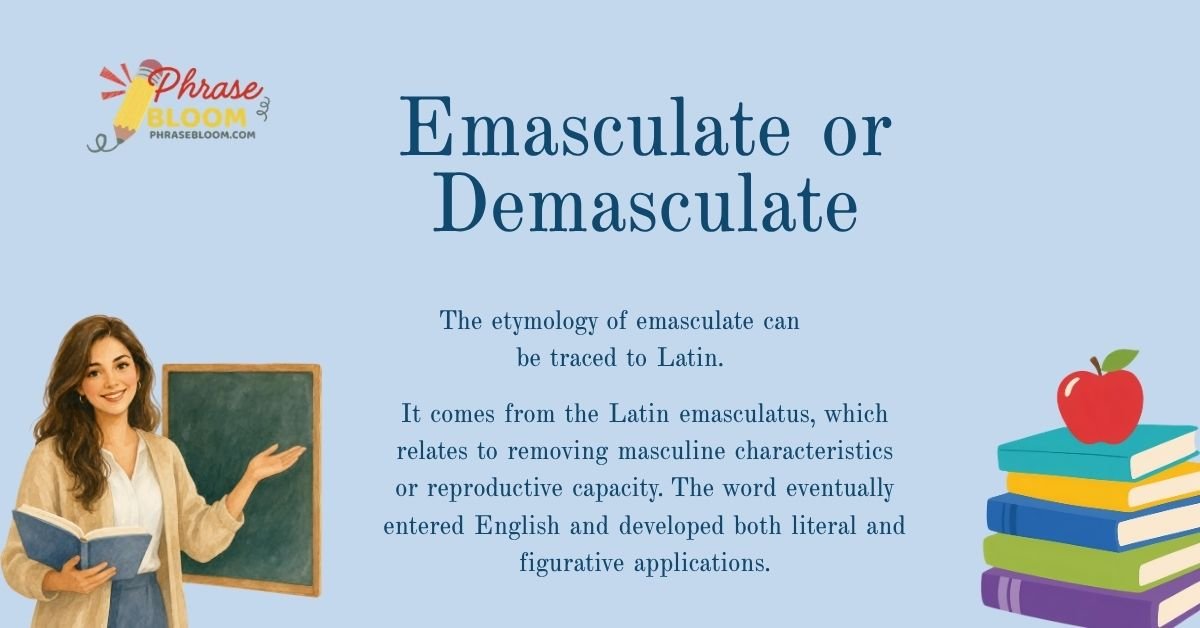
The etymology of emasculate can be traced to Latin.
It comes from the Latin emasculatus, which relates to removing masculine characteristics or reproductive capacity. The word eventually entered English and developed both literal and figurative applications.
Understanding its Latin root also helps explain why adding the prefix “de-” is unnecessary.
The word already developed as a complete English verb. It does not need to be reconstructed into “demasculate” to express weakening or removal.
Why Emasculate Is a Common Misspelling
One major reason emasculate becomes confused with “demasculate” is the way English prefixes work.
Consider words such as deactivate, deconstruct, defrost, and deactivate. These examples can make speakers assume that “de-” can simply be attached to any word when they want to express reversal or removal.
That assumption creates a common spelling mistake.
Another problem is the relationship between spelling and meaning. Someone may understand that emasculate means “to weaken” and incorrectly assume that “de-” must be added to emphasize the idea of removal.
However, correct English depends on established usage, not simply on whether a word appears logically constructed.
See Also: Alright vs All Right: Learn the Correct Spelling and Usage
The Significance of Emasculate in Psychological and Social Contexts
Although emasculate has a literal historical meaning, modern writers often use it figuratively.
The word can describe the emotional experience of losing confidence, influence, authority, or personal power.
For example:
Constant public criticism can emasculate someone’s confidence.
In this context, the word describes a psychological effect rather than a physical one.
The term can also appear in discussions of societal power dynamics, relationships, leadership, and workplace culture.
Because of its historical association with masculinity, the word can sometimes carry a strong emotional tone. Writers should therefore consider their audience and context before using it.
Role of Emasculate in Professional Communication
In business and professional writing, emasculate can describe something that significantly reduces an organization’s effectiveness.
Consider this example:
Excessive regulations emasculated the agency’s ability to respond quickly.
Here, the word communicates more than simply “reduced.” It suggests that the agency lost a meaningful degree of strength or authority.
Similarly:
Budget restrictions emasculated the department’s capabilities.
The sentence indicates that the department still exists, but its ability to perform its role has been seriously weakened.
This makes emasculate useful in analytical writing, political commentary, business reports, and discussions about organizational effectiveness.
Common Reasons for the Emasculate Misspelling
Several patterns can lead writers toward the incorrect form “demasculate.”
The first is the mistaken belief that every word meaning removal should begin with “de-.” English has many exceptions, so this rule cannot be applied universally.
The second is sound-based confusion. When someone hears “emasculate” quickly, the first vowel can be unclear, especially in casual speech.
The third is familiarity. People may encounter a nonstandard spelling online and assume it is legitimate simply because someone else has used it.
Finally, writers sometimes create words based on logic rather than established vocabulary. Language does not always follow perfect mathematical rules.
If a word looks plausible, that does not automatically make it standard English.
Side-by-Side Comparison: Emasculate vs Demasculate
A direct comparison makes the distinction easier to remember.
| Feature | Emasculate | Demasculate |
|---|---|---|
| Standard English word | Yes | No |
| Commonly accepted spelling | Yes | No |
| Used in formal writing | Yes | Avoid |
| Figurative meaning | Weaken or deprive of power | Not established |
| Literal meaning | Castrate or deprive of masculine characteristics | Not standard |
| Suitable for academic writing | Yes | No |
| Suitable for professional writing | Yes | No |
The key difference between emasculate and demasculate is therefore simple: one is an established English word, while the other is a nonstandard formation.
Everyday Examples of Emasculate in Language
Seeing the word in different contexts can make its meaning much easier to understand.
Personal confidence:
Constant insults can emasculate a person’s self-esteem.
Here, the meaning is to weaken confidence or personal strength.
Workplace authority:
Micromanagement can emasculate a manager’s authority.
The manager still has the job title, but their practical authority has been weakened.
Government power:
The amendment emasculated the local government’s authority.
The policy reduced the government’s ability to act independently.
Creative work:
Studio interference emasculated the director’s original vision.
The original creative power or character was significantly weakened.
Business innovation:
Excessive regulations can emasculate small-business innovation.
The regulations make it harder for businesses to experiment, grow, or respond creatively.
These examples show why emasculate meaning depends partly on context. The central idea remains the same: something has been weakened or deprived of power.
“How to Spell Emasculate or Demasculate”: Remember the Correct Spelling
If you keep asking how to spell “Emasculate or Demasculate”, use a simple memory trick.
Remember:
Emasculate = correct
Demasculate = avoid
You can connect “emasculate” with words beginning with “e,” such as “eliminate,” when thinking about removal or reduction. The comparison is not an etymological rule, but it can work as a practical memory aid.
Another useful strategy is to remember the noun emasculation.
Once you know:
emasculate → emasculated → emasculating → emasculation
the correct spelling becomes easier to recognize.
Practice Sentences
Try these examples:
The criticism emasculated his confidence.
The policy emasculated the agency’s authority.
Constant interference can be emasculating for creative professionals.
Budget cuts emasculated the team’s capabilities.
Fear of failure can emasculate creative risk-taking.
Notice that none of these sentences requires “demasculate.”
Literature and Media Mentions: Correct Usage of Emasculate
Emasculate has a long history in English literature and formal writing.
Writers have used it both literally and figuratively to describe the loss of masculine vigor, personal power, authority, influence, or effectiveness.
Modern journalism and commentary can also use the figurative sense when discussing politics, organizations, leadership, or social relationships.
However, the word can sound stronger than simple alternatives such as “weaken” or “reduce.” Therefore, context matters.
If you simply mean that something became less effective, “weaken” may be clearer.
If you want to emphasize a substantial loss of power, authority, or effectiveness, emasculate can be more precise.
This distinction is particularly useful for writers who want to avoid repetitive vocabulary while maintaining an accurate meaning.
Frequently Asked Questions About Emasculate or Demasculate
What’s the correct way to spell “emasculate or demasculate”?
The correct standard English spelling is emasculate. “Demasculate” is generally considered nonstandard and should be avoided in formal, academic, and professional writing.
Is “emasculate” a French word?
No. Emasculate ultimately comes from Latin roots and entered English through historical linguistic development. Its modern usage is established in English.
Why is spelling “emasculate” correctly important?
Correct spelling improves clarity, credibility, and readability. Using emasculate also prevents readers from interpreting “demasculate” as an unfamiliar or incorrect term.
Is demasculate a word?
“Demasculate” is not generally recognized as a standard modern English word. For formal writing, use emasculate, which is the established and widely accepted form.
What is the opposite of emasculate?
Depending on context, useful opposites include empower, strengthen, fortify, invigorate, reinforce, bolster, and restore confidence.
Conclusion: Why It’s Important to Spell Emasculate Correctly
When choosing between emasculate or demasculate, the answer is straightforward: use emasculate. It is the established English word with both literal and figurative meanings. Demasculate may look logical, but it is not the standard form used in modern formal English. Remembering the correct spelling helps you write with greater clarity and confidence. Whether you are discussing weakened authority, reduced effectiveness, personal confidence, workplace power, or the literal meaning of the term, emasculate is the appropriate choice. Once you recognize its spelling and meaning, the confusion between these two forms becomes much easier to avoid.
You may also like: Eaten vs Ate: What’s the Difference? · City vs Town vs Village: What’s the Difference?
1 thought on “Emasculate or Demasculate: Understanding the Difference Clearly”