
Appal vs Appall: Meaning, Spelling and Usage
The difference in Appal vs Appall is mainly a spelling preference, not a difference in meaning. Both forms are verbs meaning to shock, horrify, distress, or deeply dismay someone, but appall is the standard spelling in American English, while appal is a recognized British English variant.
If you are writing for an international or American audience, appall is usually the safest choice. British publications may use either form, although appal follows a common British preference for a single final “l” in some verbs. The pronunciation and grammatical use remain essentially the same, so the key is choosing one correct spelling and using it consistently.
Appal vs Appall: The Short Answer
Appal and appall are both correct spellings of the same verb. They describe causing someone to feel intense shock, horror, distress, or disapproval.
For most professional writing, use the following practical rule:
- Choose appall for American English and for audiences that expect the doubled final consonant.
- Choose appal if you are following a British English style or an established house style that prefers it.
- Do not treat appal and appall as different words with different meanings.
- Use the related forms appalled and appalling with two “l” letters in standard spelling.
- Avoid switching between the two forms within the same document unless you are discussing the spelling difference itself.
The spelling appall is often the clearest default because it is widely recognized across varieties of English. However, calling appal incorrect would be inaccurate. It is an established variant, especially in British English.
What Does Appal Mean?
Appal is a verb meaning to cause someone to feel shocked, horrified, deeply troubled, or strongly disapproving. If an event appals you, it affects you emotionally in a serious and unpleasant way.
For example, “The cruelty of the attack appalled the community” means that the community reacted with intense horror or distress. The word describes a powerful reaction, not merely mild surprise or ordinary disappointment.
In grammatical terms, appal is usually a transitive verb. That means it commonly takes a direct object, which is the person or group experiencing the emotional reaction.
| Sentence | Role of “appal” | Meaning |
|---|---|---|
| The report appalled the committee. | Transitive verb | The report caused the committee to feel horror or shock. |
| Her remarks appalled many listeners. | Transitive verb | Her remarks caused strong distress or disapproval. |
| The level of waste appalled him. | Transitive verb | The waste deeply disturbed him. |
The word can refer to moral outrage, physical horror, emotional distress, or profound dismay. Context determines the exact shade of meaning.
For instance, a journalist might write that a company’s treatment of workers “appalled its customers.” A doctor might say that the extent of an injury “appalled the family.” In both cases, the verb indicates an intense emotional response.
What Does Appall Mean?
Appall has the same basic meaning as appal. It means to shock, horrify, or distress someone so deeply that the person reacts with strong emotional discomfort or disapproval.
The main difference is the spelling. Appall is the usual form in American English and is also used in British English. It is not a separate word with a stronger meaning, a different pronunciation, or a different grammatical function.
Consider these examples:
- The condition of the building appalled the inspectors.
- She was appalled by the lack of safety equipment.
- The manager’s decision appalled the staff.
- The report revealed an appalling failure of oversight.
Each sentence expresses a reaction of shock, horror, or deep disapproval. Replacing appall with appal would generally preserve the meaning, although the result might look more British or more consistent with a particular editorial style.
The doubled “l” also appears in the inflected forms. Writers normally use appalled for the past tense and past participle, and appalling for the present participle or adjective. The spelling does not become “appaled” or “appaling.”
Is Appal or Appall the Correct Spelling?
Both appal and appall are correct spellings. The appropriate choice depends on regional convention, the publication’s style guide, and the consistency expected in the document.
American English generally favors doubled consonants in words such as appall. British English often permits or favors a single final “l” in certain verbs, including forms such as appal. That distinction is a spelling convention rather than a difference in pronunciation or meaning.
British usage is not completely uniform. A British writer may use appall, particularly if the writer follows an international corporate style, a publisher’s preference, or a dictionary that lists the doubled form prominently. Similarly, an international organization may select appal for all of its materials even when many readers use American English.
When a style guide gives no specific instruction, appall is a practical default. It is familiar to American readers and remains understandable to British readers. If your document is clearly British in spelling and vocabulary, however, appal may fit more naturally.
Reference works can help confirm the options. The Merriam-Webster entry for appall records the word’s meaning and standard American usage, while British dictionaries and the Oxford English Dictionary provide broader historical and regional context.
Appal and Appall in Real Sentences
The easiest way to understand the spelling difference is to see both forms in realistic sentences. In each pair below, the meaning remains the same.
Workplace and business writing
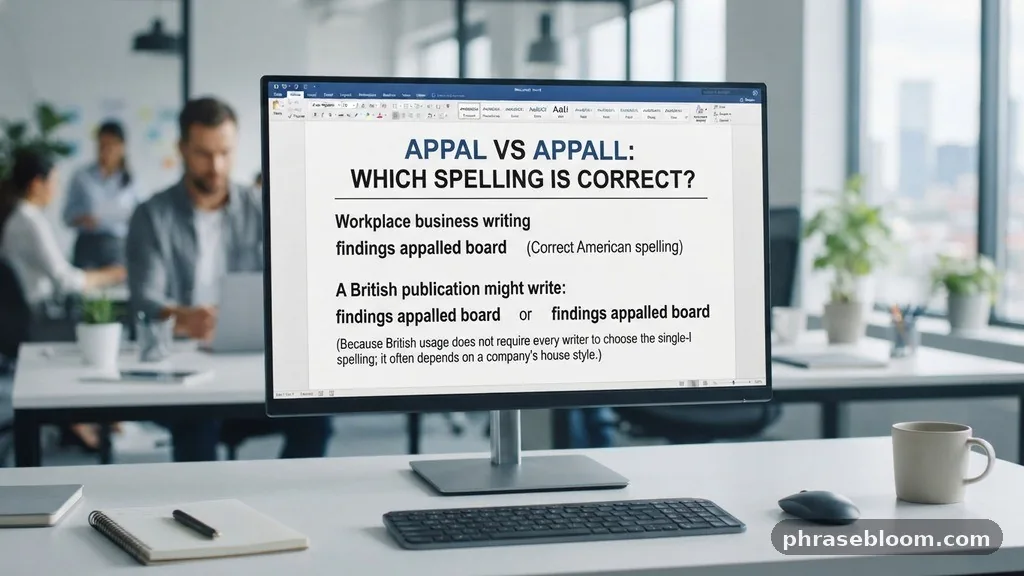
“The findings appalled the board” is appropriate in American business writing. A British publication might write, “The findings appalled the board” or “The findings appalled the board,” because British usage does not require every writer to choose the single-l spelling.
To show the alternative clearly, a house style could use “The findings appalled the board” in American materials and “The findings appalled the board” in a British text. The sentence’s grammar does not change. Only the selected spelling convention changes.
Public statements
“The mayor said she was appalled by the attack” is a natural public statement. Here, appalled is an adjective or past participle describing the mayor’s emotional state.
“The images appalled viewers around the world” uses the verb directly. The images are the cause, and viewers are the people who experience the reaction.
Reports and formal writing
“The committee was appalled by the repeated violations” is suitable for a formal report. It states the committee’s response without implying that the committee merely disliked the situation.
“The committee found the repeated violations appalling” uses appalling as an adjective. This form describes the violations themselves as shocking or horrifying.
Everyday communication
“I was appalled by the price of the repair” is common conversational English. It may express genuine shock, but speakers sometimes use it more loosely to indicate strong surprise or annoyance.
“The appalling delay caused several passengers to miss their connections” uses the adjective to describe an event or condition. The context tells readers whether the delay was morally disturbing, unusually serious, or simply unacceptable.
When Should Appal Be Hyphenated?
It should not be hyphenated. Appal is a single verb, and appall is also a single verb. The spelling difference concerns the number of “l” letters, not the use of a hyphen.
That point matters because writers sometimes confuse the terms appal, appall, and appalled with compound expressions that do require hyphenation. For example, “high-impact” and “long-term” may be hyphenated in particular grammatical positions, but appall is never written as “app-all.”
The correct forms are:
- appal
- appall
- appalled
- appalling
The pronunciation also does not change because of the spelling. In many varieties of English, the vowel sound resembles the sound in “call” or “fall,” although accent differ. The final consonant is pronounced once, not twice.
In other words, the question “Is appal hyphenated?” has a simple answer: no. It is a closed word in either accepted spelling.
British English and American English Usage
The distinction between appal and appall fits a wider pattern in English spelling. British English often retains or permits forms with one final “l” where American English commonly uses two, especially when a suffix is added or a verb ends in a stressed vowel followed by “l.”
Examples from the broader spelling system include differences such as “travelling” and “traveling,” or “labelled” and “labeled.” Those patterns can help explain why British readers may encounter appal, but they do not mean that every British writer must use it.
American English normally uses appall. A US company’s handbook, press release, or legal document would usually select that form unless it follows an international or inherited house style.
British English accepts appal and also encounters appall. The doubled spelling may appear in newspapers, academic work, corporate documents, and online writing. It is therefore misleading to label appall exclusively American or appal exclusively British.
International English creates another layer of variation. A multinational company may use American spelling across all offices, while a British organization may preserve British spelling in its local publications. The best choice is the one that matches the intended audience and the document’s existing style.
Pronunciation does not provide a reliable way to choose between the spellings. In ordinary speech, the two forms are pronounced alike or nearly alike. A reader normally identifies the intended word from context, not from the number of written “l” letters.
Appal, Appalled, and Appalling
Understanding the related forms prevents many spelling errors. Appal and appall are base forms, appalled is the past tense and past participle, and appalling is the present participle or an adjective.
| Form | Grammar | Example |
|---|---|---|
| appal | Verb, British variant | The evidence may appal the jury. |
| appall | Verb, common American form | The evidence may appall the jury. |
| appalled | Past tense or adjective | The jury was appalled by the evidence. |
| appalling | Present participle or adjective | The evidence revealed an appalling situation. |
The doubled “l” remains in the standard forms appalled and appalling. This is true even when the base word selected is the British form appal. A sentence such as “She was appalled” is standard; “She was appaled” is not.
The adjective appalled describes the person who experiences the reaction. The adjective appalling describes the thing that causes it.
Compare these two sentences: “The witnesses were appalled by the appalling conditions.” The witnesses feel the emotion, while the conditions produce it.
The same distinction applies to other pairs such as “confused” and “confusing” or “shocked” and “shocking.” Keeping the roles separate makes the sentence clearer and prevents a common grammar mistake.
Meaning, Origin, and Strength of the Word
The verb appal has historical links to the idea of becoming pale with fear or shock. Its development is associated with Anglo-French forms related to becoming pale, which helps explain why the modern word conveys a severe emotional reaction rather than ordinary surprise.
Modern dictionaries define the word through related ideas such as horrify, dismay, shock, and deeply distress. These near-synonyms overlap, but they are not identical in every sentence.
- Shock can describe sudden surprise, whether pleasant or unpleasant.
- Horrify usually suggests intense fear, disgust, or moral horror.
- Dismay emphasizes distress, discouragement, or loss of confidence.
- Appal or appall often combines shock with horror or strong disapproval.
For example, a sudden announcement may shock employees without appalling them. By contrast, evidence of deliberate cruelty may appall them because it produces both emotional distress and moral revulsion.
The word can also be used rhetorically. A restaurant review might call an extremely poor meal “appalling,” while a formal investigation may use the same adjective for serious misconduct. The surrounding context determines whether the tone is conversational, dramatic, formal, or moralizing.
Because the word is strong, writers should not use it automatically for every inconvenience. A delayed package may be annoying or frustrating. Describing it as “appalling” suggests a much more intense reaction and may sound exaggerated unless the delay caused serious consequences.
Common Spelling and Grammar Mistakes
The most common error is treating appal as a misspelling of appall or treating appall as an error in British writing. Both assumptions ignore the regional and editorial nature of the difference.
Using appaled
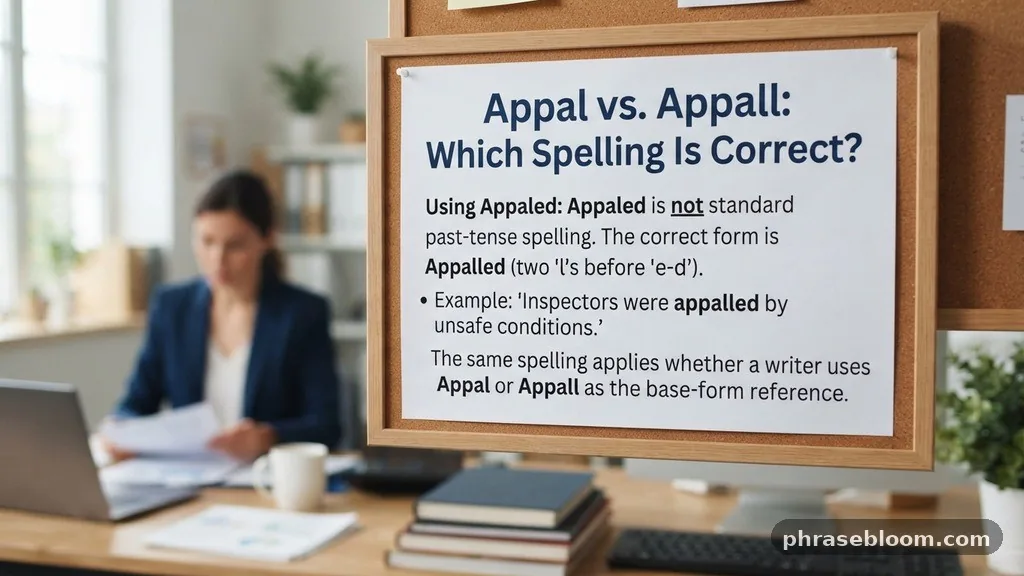
“Appaled” is not the standard past-tense spelling. The correct form is appalled, with two “l” letters before the “e” and “d.”
Example: “The inspectors were appalled by the unsafe conditions.” The same spelling applies whether the writer uses appal or appall as the base-form reference.
Using appaling
“Appaling” is also incorrect in standard English. The adjective is appalling, with two “l” letters.
Example: “The report described an appalling failure to protect residents.” The adjective modifies “failure,” while the verb would appear in a sentence such as “The failure appalled residents.”
Confusing the subject and object
Because appall is normally transitive, the sentence should identify what causes the reaction and who experiences it. “The decision appalled the employees” is clear because “decision” is the cause and “employees” are the affected people.
“The employees appalled the decision” changes the meaning and makes the employees sound as though they caused the decision to feel horror. That construction is usually not what the writer intends.
Overusing a strong word
Calling every minor problem “appalling” can weaken the word. Reserve it for situations involving serious shock, horror, distress, or disapproval, or use a milder term such as “concerning,” “disturbing,” or “disappointing” when appropriate.
How to Choose the Right Spelling
A simple decision process can help you select the correct form without second-guessing every sentence.
- Identify the audience. Use the spelling expected by your main readership if that expectation is clear.
- Check the applicable style guide. A publisher, university, employer, or government office may already have a spelling policy.
- Look at nearby spelling choices. If the document uses “organisation,” “labour,” and “travelling,” appal may fit better. If it uses “organization,” “labor,” and “traveling,” appall may be the more consistent choice.
- Apply the choice throughout the document. Do not use “appal” in one section and “appall” in another unless the variation is intentional.
- Check the inflected forms. Use appalled and appalling, not “appaled” or “appaling.”
Consistency is more important than trying to identify one universal winner. A reader may notice an unexplained spelling switch more readily than a regional spelling choice that remains consistent.
If the audience is international and no house style applies, appall is a reasonable default. It is widely recognized and unlikely to be mistaken for a typographical error. If the document is explicitly British, appal is equally defensible.
Professional, Academic, and Everyday Usage
In professional writing, both spellings can work, but the surrounding document should establish a clear convention. A US business report might state, “The audit findings appalled the leadership team.” A British report could use “appalled” in the same sentence while selecting appal in a dictionary discussion or present-tense example.
Employee communications should use the word carefully. “We were appalled by the breach” communicates strong condemnation and may be appropriate after serious misconduct. For a routine service problem, “We were disappointed by the delay” is usually more measured.
Academic writing benefits from precision. A researcher discussing public reactions might write, “The images appalled many viewers,” but should explain the evidence supporting that claim rather than using the verb as unsupported emphasis.
Legal and policy documents require particular care because strong emotional language can create an unintended tone. If the purpose is to describe a formal finding, terms such as “serious,” “unacceptable,” or “in violation of policy” may be more precise than appalling.
Marketing materials can use the word for dramatic effect, but exaggeration may damage credibility. A slogan describing a minor product flaw as “appalling” could sound theatrical rather than trustworthy.
In everyday conversation, “I was appalled” is common and flexible. It can express genuine horror, strong annoyance, or emphatic disapproval, depending on the speaker’s tone and the event being discussed.
Alternatives to Appal and Appall
Sometimes the spelling question is less important than finding a more precise word. If you are unsure whether the emotional strength of appal suits the sentence, an alternative may communicate the intended reaction more accurately.
| Alternative | Typical emphasis | Example |
|---|---|---|
| shock | Sudden surprise or emotional impact | The announcement shocked the staff. |
| horrify | Fear, disgust, or moral horror | The evidence horrified the investigators. |
| dismay | Distress or discouragement | The result dismayed the project team. |
| disturb | Unease or concern | The pattern disturbed the auditors. |
| upset | General emotional distress | The decision upset several employees. |
“The report disturbed the board” may be better than “The report appalled the board” if the board felt serious concern but not horror. “The announcement shocked investors” may be better if the main point is surprise rather than moral outrage.
These alternatives also help vary repetitive prose. A report that uses “appalled” in every paragraph can sound overstated. Careful word choice gives readers more information about the exact reaction.
Quick Comparison of Appal and Appall
| Form | Spelling | Meaning | Typical usage | Practical recommendation |
|---|---|---|---|---|
| appal | One final “l” | To shock, horrify, or distress | British English and some international styles | Use it consistently when the style supports British spelling |
| appall | Two final “l” letters | To shock, horrify, or distress | American English and widely used international writing | Use it as a safe general default when no style is specified |
| appalled | Two “l” letters | Shocked or horrified | Past tense, past participle, and adjective | Use this spelling in both regional systems |
| appalling | Two “l” letters | Causing horror or severe disapproval | Adjective or present participle | Do not write “appaling” |
The table shows why the apparent contrast between appal and appall should not be treated as a meaning distinction. The two base forms differ in orthography, while their common past and participle forms use two “l” letters.
Usage Examples You Can Copy
These examples cover several grammatical patterns and professional situations. They can be adapted to emails, reports, announcements, and ordinary conversation.
- “The audit results appalled the directors.”
- “The audit results appalled the directors.”
- “Staff members were appalled by the sudden closure.”
- “The investigation revealed an appalling disregard for safety.”
- “The news may appal readers who expected stronger safeguards.”
- “The repeated failures appall customers who depend on the service.”
- “I was appalled to learn that the records had been discarded.”
- “The extent of the damage was appalling.”
- “The speaker’s remarks appalled several members of the audience.”
- “The speaker’s remarks appalled several members of the audience.”
The duplicated-looking sentence pairs demonstrate that a writer can select either base spelling without changing the underlying message. The forms appalled and appalling, however, should retain the double “l” spelling.
For a formal email, write: “We were appalled by the failure to notify residents before the work began.” For a less emotionally charged version, write: “We were deeply concerned by the failure to notify residents before the work began.”
For a report, write: “The committee found the treatment of the applicants appalling.” This construction makes the committee’s judgment clear while using the adjective to describe the treatment.
Frequently Asked Questions
Is appal or appall correct?
Both are correct. Appal is a recognized British English variant, while appall is especially common in American English and is also used internationally.
Is appal more formal than appall?
No. Neither spelling is inherently more formal. Formality depends on the sentence, context, audience, and style guide rather than on whether the word has one or two final “l” letters.
Is appall hyphenated?
No. Appall is written as one word, and appal is also written as one word. Neither form takes a hyphen.
Are appalled and appalling spelled with two l letters?
Yes. The standard forms are appalled and appalling. “Appaled” and “appaling” are not standard spellings.
Which form should I use in professional writing?
Follow your organization’s house style or the relevant publication guide. If no guidance exists, appall is a practical general choice, while appal is appropriate in a consistently British English document.
Do British and American English pronounce the words differently?
Usually not. Regional accents can affect the vowel sound, but the spelling difference does not normally create a different pronunciation.
What is a good alternative to appal or appall?
Use shock, horrify, dismay, disturb, or upset, depending on whether you mean surprise, horror, discouragement, concern, or general emotional distress.
Conclusion
The practical answer to Appal vs Appall is that both spellings are valid forms of the same verb. Choose appall for most American or international documents, choose appal when a British or organizational style calls for it, and use appalled and appalling with two “l” letters.
Above all, match the audience, check the applicable style guide, and remain consistent. If you have a sentence where the choice feels uncertain, compare the emotional strength of the word with alternatives such as “shock,” “dismay,” or “disturb” before making the final edit.
Explore more on PhraseBloom.