
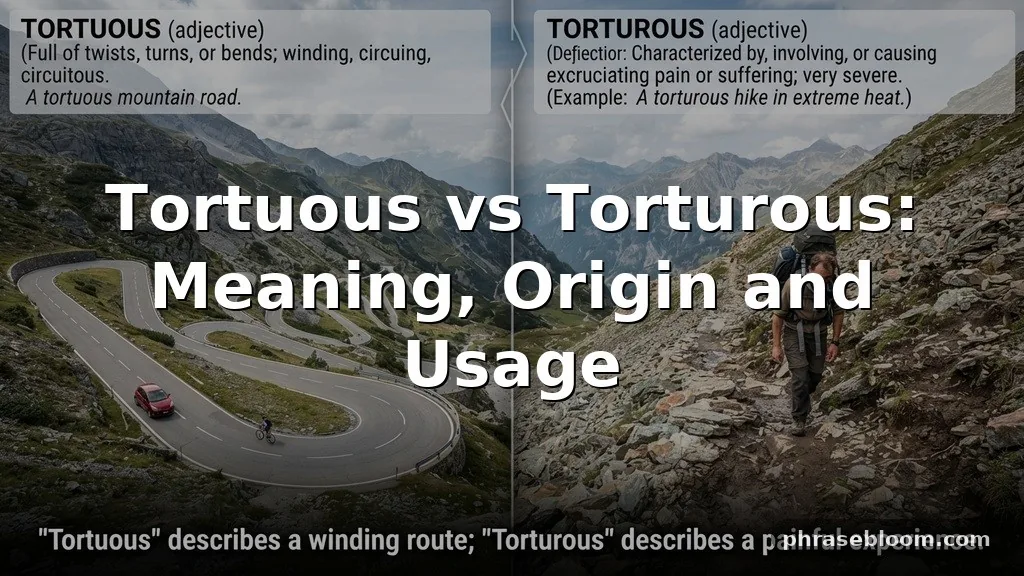
Tortuous vs torturous is a spelling distinction with a real difference in meaning. Tortuous describes something winding, indirect, or complicated, while torturous describes something that causes intense pain or suffering.
The words sound similar because both connect historically with the idea of twisting, but they do different work in modern English. A tortuous road has bends; a torturous experience causes misery. The definitions, sentence examples, pronunciation, and usage patterns below will help you choose the right word without relying on guesswork.
Tortuous vs Torturous: The Short Answer
Tortuous means winding, twisting, indirect, or difficult to follow. It can describe a literal route, such as a mountain road, or a figurative process, such as a complicated legal argument.
Torturous means extremely painful, distressing, or full of suffering. It can refer to physical pain, emotional suffering, or an experience that feels unbearably difficult.
| Word | Core meaning | Typical example |
|---|---|---|
| Tortuous | Winding, indirect, or complicated | A tortuous route through the hills |
| Torturous | Causing severe pain or suffering | A torturous recovery after the injury |
A simple memory aid is this: tortuous concerns twists, while torturous concerns torture. If you mean a winding path or indirect route, choose tortuous. If you mean a painful experience or severe emotional distress, choose torturous.
Neither word is automatically better or more formal. The correct choice depends on the meaning you intend.
What Does Tortuous Mean?
The tortuous definition begins with the idea of physical twisting. A tortuous object or route does not move in a straight line. It bends, turns, curves, or follows an irregular course.
You might describe a narrow trail as tortuous if it winds repeatedly around a hillside. A river can also have a tortuous course when it curves across a broad landscape instead of flowing directly toward its destination.
Examples of the literal meaning include:
- The hikers followed a tortuous path through the dense forest.
- After several hours, the tortuous road finally reached the village.
- The river took a tortuous course around the rocky valley.
- We climbed a tortuous staircase that seemed to turn in every direction.
The word also has a common figurative meaning. In that use, tortuous describes something indirect, overly complicated, or difficult to understand. A tortuous explanation may wander through too many qualifications before reaching a conclusion.
For example, a researcher might criticize a tortuous argument because its reasoning is hard to follow. A company’s tortuous approval process may require several unnecessary stages, forms, and meetings.
That figurative use does not necessarily mean painful. A tortuous process may be frustrating or confusing, but the central image is complexity and indirectness rather than suffering.
What Does Torturous Mean?
The torturous definition relates directly to torture or extreme suffering. Something torturous causes intense physical pain, severe emotional distress, or both.
A torturous medical procedure may involve considerable physical discomfort. A torturous wait for news may involve anxiety, fear, or emotional suffering rather than bodily pain.
Here are several natural examples:
- The patient described the recovery as a torturous ordeal.
- Waiting for the final decision was torturous for everyone involved.
- The heat made the long walk across the desert torturous.
- She endured a torturous period of uncertainty after the accident.
Torturous is usually stronger than difficult, unpleasant, or stressful. Calling an afternoon meeting torturous may be humorous exaggeration, but calling a prolonged illness torturous presents the experience as genuinely severe.
The word can describe a person’s experience, an event, a condition, or something that produces suffering. A torturous headache causes physical pain, while a torturous separation may involve emotional suffering.
Unlike tortuous, torturous does not normally describe a winding road or an indirect argument. A torturous road would suggest that the road itself causes extreme suffering, not simply that it contains many bends.
Tortuous vs Torturous in Meaning
The distinction becomes clearest when the words appear beside similar nouns. A tortuous path is a winding path. A torturous journey is a journey marked by severe pain or suffering.
Those meanings can overlap in one situation, but they remain separate. A journey may be tortuous because it follows an indirect route and torturous because the travelers face injury, danger, or exhausting conditions.
| Expression | What it suggests | Meaning in context |
|---|---|---|
| Tortuous road | Many bends and turns | A winding physical route |
| Torturous road trip | Severe discomfort or misery | A painful or exhausting journey |
| Tortuous negotiation | Indirect reasoning or repeated complications | A difficult process to follow |
| Torturous negotiation | Extreme distress during the process | A negotiation experienced as deeply painful |
| Tortuous explanation | Overly complex reasoning | An indirect or confusing explanation |
| Torturous explanation | Severe discomfort for the listener | An explanation that feels painfully difficult to endure |
Notice that context can make torturous sound figurative. A torturous explanation is not physically torturing someone, but it may be so confused or tedious that the listener experiences it as painful.
Still, tortuous is normally the better word for complexity. If you mean that an argument takes an indirect route, write “a tortuous argument.” If you mean that hearing the argument was emotionally unbearable, “a torturous argument” may be defensible, but it communicates a different idea.
Tortuous Definition, Literal Meaning, and Figurative Meaning
The literal meaning of tortuous is connected with shape and movement. A tortuous line curves repeatedly, and a tortuous road turns instead of continuing directly. The word can describe physical objects, routes, rivers, corridors, and paths.
Its figurative meaning extends the image of twisting to ideas and events. A tortuous explanation twists through details. A tortuous legal dispute may move through delays, appeals, procedural questions, and changing positions.
These examples show the figurative use:
- The report gives a tortuous account of how the error occurred.
- The project followed a tortuous route through several rounds of approval.
- His tortuous reasoning made a straightforward issue seem mysterious.
- The negotiations took a tortuous course before the parties reached an agreement.
In each example, tortuous means indirect or complicated. It does not necessarily mean dishonest. However, depending on context, a tortuous explanation may sound evasive because it avoids a direct answer.
That nuance matters in professional and academic writing. Calling a colleague’s reasoning tortuous can imply that it is difficult to follow, while calling it torturous suggests that it causes severe distress. The first is usually a criticism of structure; the second is a criticism of effect.
If your meaning is simply “complex,” “indirect,” or “long,” consider whether another word would be more precise. A complicated process may be complicated without being tortuous, and a detailed argument may be detailed without being hard to follow.
Torturous Definition and the Language of Suffering
Torturous describes an experience that feels like torture or produces extreme suffering. Its strongest uses involve serious pain, prolonged fear, harsh conditions, or intense emotional distress.
A torturous recovery can involve repeated procedures, sleepless nights, and ongoing physical pain. A torturous decision may involve grief, uncertainty, or the fear of causing harm to someone else.
The word often appears with nouns such as:
- ordeal
- journey
- recovery
- wait
- experience
- process
- period
- night
For example, “The wait was torturous” means the waiting caused intense distress. “The route was tortuous” means the route was winding or indirect. These sentences may describe the same event, but they focus on different features.
Writers sometimes use torturous for emphasis in informal language. Someone might call a slow checkout line torturous, even though the situation is merely annoying. This is understandable as hyperbole, but formal writing should reserve the word for experiences that genuinely involve severe discomfort or suffering.
The distinction also protects tone. A report about a patient’s pain should not use tortuous merely because the treatment involved multiple stages. A tortuous treatment plan is complicated; a torturous treatment experience is painful.
Pronunciation, Spelling, and Etymology
Tortuous and torturous are easy to confuse because their spellings differ by only a few letters. Both begin with “tort,” and both can relate to the idea of twisting. Their pronunciation is similar, but speakers may pronounce the middle syllables differently depending on accent and regional habit.
Tortuous is commonly pronounced with a sound pattern similar to “TOR-choo-us” or “TOR-choo-iss.” Torturous is commonly pronounced like “TOR-chur-us” or “TOR-chuh-rus.” The exact vowel sounds can vary in American English, British English, and other varieties.
The etymology explains part of the confusion. Tortuous traces back to Latin roots associated with twisting or bending. Torturous developed through the language of torture, which itself is historically connected with the idea of physical distortion or severe suffering.
Historical connections do not erase modern differences. English often preserves related words whose meanings have separated over time. That is why similar spelling does not mean interchangeable usage.
For a reliable reference on definitions, pronunciation, and word history, consult the Merriam-Webster dictionary. A dictionary is especially useful when you are unsure whether a word is being used literally, figuratively, or in a specialized sense.
Do not rely only on sound when choosing between the words. Ask what you want the sentence to communicate: twisting and complexity, or pain and suffering.
Sentence Examples You Can Use
Sentence examples are often more useful than a definition alone because they show how meaning changes with context. The following examples contrast physical routes, complicated processes, and painful experiences.
Physical routes and movement
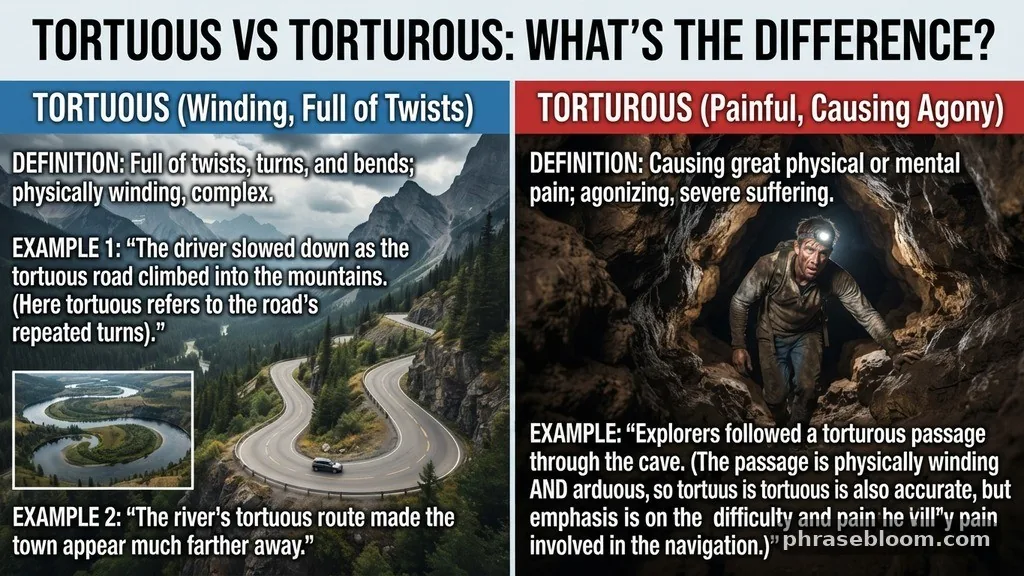
The driver slowed down as the tortuous road climbed into the mountains. Here, tortuous refers to the road’s repeated turns.
The explorers followed a tortuous passage through the cave. The passage is physically winding, so tortuous is the natural choice.
The river’s tortuous route made the town appear much farther away by water than it was by land. The word describes the river’s indirect course.
Complicated ideas and processes
The committee’s tortuous approval process delayed the launch by several months. The process is indirect and difficult to move through.
Her tortuous explanation left the audience unsure about the central conclusion. The problem is complexity, not necessarily emotional suffering.
The contract describes a tortuous path for resolving disputes. The phrase suggests multiple stages and procedural complications.
Painful or distressing experiences
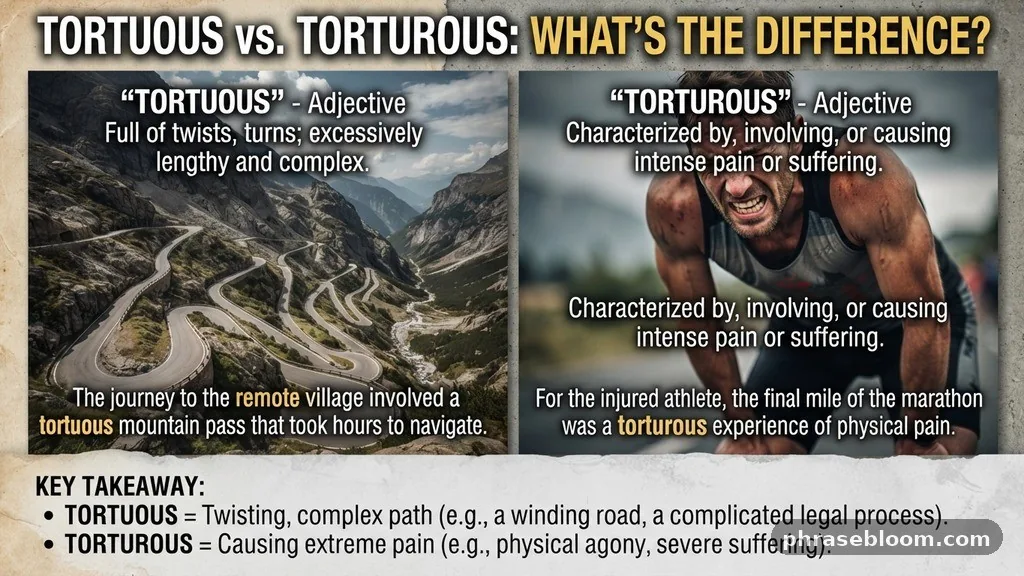
The athlete described the rehabilitation period as torturous. The emphasis is on physical pain and emotional strain.
Waiting for the emergency team was torturous for the family. The sentence focuses on emotional suffering.
The final hours of the expedition became torturous after the group ran out of water. The conditions caused severe distress.
Cases where both words may fit
The tortuous journey became torturous after the vehicle broke down. The first word describes the winding route, while the second describes the suffering caused by the breakdown.
The tortuous negotiations created a torturous atmosphere in the office. The negotiations were complicated, and the resulting atmosphere was extremely stressful.
Using both words in one sentence can make the contrast memorable, but ordinary business writing may benefit from simpler wording. “The negotiations were prolonged and stressful” may be clearer than using both terms.
Common Mistakes with Tortuous and Torturous
The most common mistake is using torturous to mean complicated. A writer may see a long process and choose torturous, even though the process is merely difficult to understand or complete.
Use “a tortuous application process” if the process has unnecessary turns, stages, or complications. Use “a torturous application process” only if the process causes extreme distress and that intensity is genuinely part of your meaning.
Another mistake is using tortuous for pain. “The injury caused a tortuous recovery” sounds as if the recovery was winding or indirect. “The injury caused a torturous recovery” correctly emphasizes suffering.
Writers may also use both words as though they were interchangeable. They are related in origin, but the modern meanings are distinct enough that substitution can change the sentence’s emotional force.
- Incorrect for complexity: The torturous approval chain had seven stages.
- Better: The tortuous approval chain had seven stages.
- Incorrect for pain: The patient endured a tortuous recovery.
- Better: The patient endured a torturous recovery.
- Potentially unclear: The torturous route crossed the plateau.
- Clearer for bends: The tortuous route crossed the plateau.
Another problem is overstatement. If a meeting was boring, “torturous” may sound melodramatic in a formal report. If a contract has several procedural stages, “tortuous” may be accurate, but “complex” may be more neutral.
Finally, do not assume that a word is correct simply because it sounds familiar. Check the intended meaning, then read the sentence aloud. If the word suggests pain when you mean complication, revise it.
How to Choose the Right Word
A practical decision method can reduce the confusion to one question: What kind of problem am I describing?
If the problem involves turns, detours, indirect reasoning, or unnecessary complexity, choose tortuous. If the problem involves severe pain, misery, fear, or emotional suffering, choose torturous.
Use this checklist before finalizing your sentence:
- Does the subject physically bend or wind around something?
- Is the idea, argument, or process indirect or difficult to follow?
- Does the situation cause severe physical pain?
- Does it create intense emotional suffering?
- Would “winding,” “complicated,” or “indirect” express the idea more plainly?
- Would “painful,” “distressing,” or “agonizing” express the idea more accurately?
Replace the word temporarily with a simpler synonym. If “winding” fits, tortuous is probably right. If “painful” fits, torturous is probably right.
Consider tone as well. Tortuous can sound critical when applied to someone’s reasoning, because it suggests unnecessary complexity or evasiveness. Torturous carries stronger emotional weight and should not be used casually in sensitive or formal contexts.
When the distinction remains uncertain, rewrite the sentence. “The process involved several unnecessary steps” is often clearer than “the process was tortuous.” “The recovery involved severe pain” is more precise than “the recovery was torturous.”
Usage in Formal, Academic, and Everyday Writing
In academic writing, tortuous usually describes a complicated argument, historical development, or chain of events. For example, a historian might refer to the tortuous development of a political institution when that development involved reversals and indirect changes.
Academic writers should use torturous only when suffering is central to the evidence or interpretation. A torturous period of imprisonment, a torturous illness, or a torturous migration experience may be appropriate. The word should not simply add drama to an ordinary difficulty.
In business writing, tortuous often applies to procedures, negotiations, approval chains, and organizational changes. “The tortuous procurement process delayed the purchase” suggests that the process was complicated or inefficient.
For workplace communication, clarity may matter more than literary precision. “The approval process has several delays” may help employees more than “the approval process is tortuous.” Choose the stronger word only when it adds a clear meaning.
Everyday speech uses torturous broadly, especially for exaggerated complaints. People may describe a long commute, a noisy flight, or a slow queue as torturous. That usage can be humorous, but it remains distinct from the literal or figurative meaning of tortuous.
| Context | Usually suitable | Reason |
|---|---|---|
| Mountain road | Tortuous | The road winds and turns |
| Legal procedure | Tortuous | The procedure is indirect or complicated |
| Serious injury recovery | Torturous | The recovery causes significant suffering |
| Long emotional wait | Torturous | The waiting creates intense distress |
| Unclear explanation | Tortuous | The reasoning is difficult to follow |
Related Words and Better Alternatives
Sometimes neither tortuous nor torturous is the best choice. A simpler alternative can prevent confusion and make your sentence easier to understand.
Use winding for a road, trail, river, or physical route with many curves. Use indirect for a method, answer, route, or explanation that does not proceed directly. Use complicated when the main issue is difficulty or the presence of many connected parts.
For suffering, alternatives include painful, agonizing, distressing, excruciating, and unbearable. Each carries a different intensity, so choose the one that matches the facts and tone.
Compare these revisions:
- Tortuous: The report gives a tortuous account of the negotiations.
- Clearer alternative: The report gives a complicated account of the negotiations.
- Torturous: The recovery was torturous.
- Clearer alternative: The recovery was physically painful and emotionally exhausting.
- Tortuous: We drove along a tortuous route.
- Clearer alternative: We drove along a winding route.
In professional documents, plain language is often preferable when the figurative word could distract readers. In creative writing, however, tortuous and torturous can add useful precision and emotional color.
Always ask whether the sentence needs a specialized word. A precise term is valuable when it communicates something that a simpler word cannot. It becomes a problem when it creates uncertainty without adding meaning.
Frequently Asked Questions
What is the difference between tortuous and torturous?
Tortuous means winding, indirect, or complicated. Torturous means extremely painful or distressing. A tortuous route has many turns, while a torturous experience causes suffering.
Is tortuous the same as difficult?
Not exactly. Tortuous can mean difficult because something is complicated or indirect, but it does not automatically imply pain. Depending on the context, complicated, convoluted, or indirect may be a more direct alternative.
Is torturous always about physical pain?
No. Torturous can describe physical pain, emotional suffering, fear, stress, or an experience that feels unbearable. A torturous wait is emotionally distressing even though it does not cause bodily pain.
Can a journey be both tortuous and torturous?
Yes. A journey can be tortuous if it follows a winding or indirect route, and torturous if the conditions make it intensely painful or distressing. The two words describe different aspects of the same journey.
What is an easy way to remember the difference?
Connect tortuous with twists and torturous with torture. If you mean bends, detours, or complicated reasoning, use tortuous. If you mean severe suffering, use torturous.
Final Takeaway on Tortuous vs Torturous
The difference between tortuous vs torturous is small in spelling but important in meaning. Tortuous describes winding routes, indirect reasoning, and complicated processes, while torturous describes intense physical pain, emotional suffering, or a deeply distressing experience.
Before choosing, replace the word with “winding,” “complicated,” or “painful.” The synonym that fits usually reveals the answer. Once you understand that distinction, tortuous and torturous become useful precision words rather than an easy pair to confuse.
Related: City vs Town vs Village · 24 Hours’ Notice · How to Use “My Question Is” Correctly
Explore more on PhraseBloom.