
Whole Day or All Day: Which Is Correct?
<meta name=”description” content=”Whole day or all day? Learn the meaning, grammar, differences, examples, and correct usage in English.”>
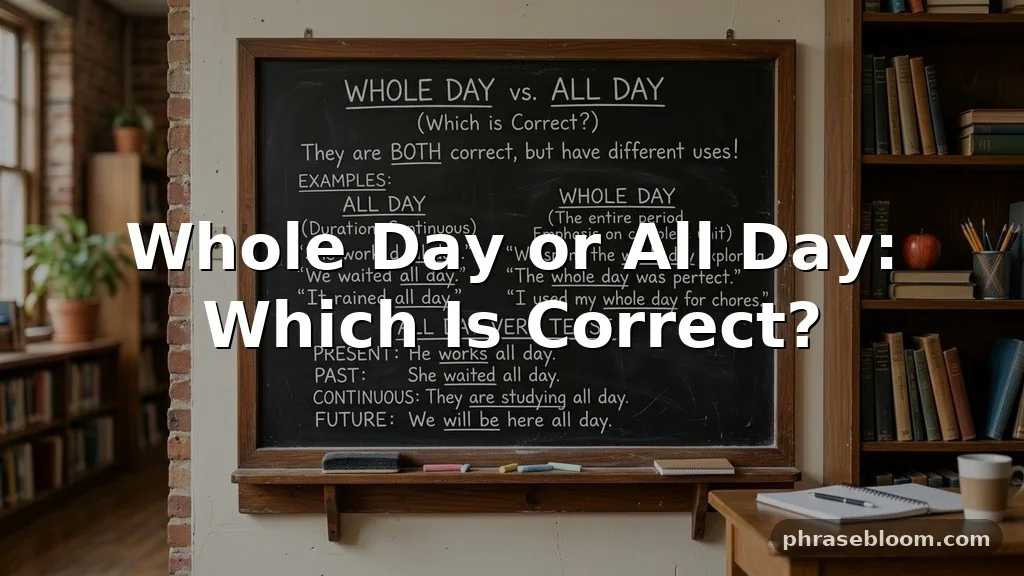
“Whole day” and “all day” can both be correct, but they do not always sound natural in the same sentences. The main difference is emphasis: “all day” usually describes duration, while “the whole day” highlights the complete day as one entirety. For example, “I worked all day” focuses on how long you worked, while “I spent the whole day at home” presents the day as a complete block of time.
Understanding the difference helps with emails, schedules, travel plans, workplace messages, and everyday conversation. This article explains whole day vs all day, shows how articles and determiners affect the phrase, and provides sentence examples you can adapt immediately.
Whole Day or All Day: The Quick Answer
“All day” is usually the most natural choice when you mean something continued throughout the day. Say, “The store was busy all day,” or “She studied all day.” Here, the phrase works as an adverbial phrase that tells us how long an action or condition lasted.
“The whole day” is also correct, but it usually emphasizes the complete day or the entirety of a person’s available time. Say, “We spent the whole day at the museum,” when you want to present the day as one complete period. The phrase normally needs the determiner “the” in this meaning.
“Whole day” without an article is generally incomplete in standard English when it refers to a complete day. “All day,” by contrast, does not need “the.” That difference explains why “I waited all day” sounds natural, while “I waited whole day” does not.
| Expression | Typical meaning | Example | Best use |
|---|---|---|---|
| all day | Throughout the day | The rain continued all day. | Duration and repeated activity |
| the whole day | The complete day as one period | We had the whole day to prepare. | Emphasis on entirety |
| a whole day | One complete day | The repair took a whole day. | Length or surprising duration |
| whole day | Usually incomplete by itself | Use “the whole day” instead. | Rare or context-dependent use |
Neither phrase is automatically more correct in every situation. The right choice depends on whether you are describing duration, emphasizing a complete period, or referring to one complete day as a measurable amount of time.
What “All Day” Means in English Grammar
“All day” means during the entire day or throughout the day. It commonly describes an action, event, condition, or repeated activity that continues from some point in the morning until later in the day, although it does not always mean every single minute.
For example, “The children played all day” means that playing occupied most or all of the day. It does not necessarily claim that the children never stopped for lunch, rest, or another activity. The phrase communicates broad duration rather than mathematical precision.
In grammar, “all day” often functions as an adverbial phrase. It modifies a verb or verb phrase by explaining how long something happened. In “Marcus worked all day,” the phrase modifies “worked.” In “The alarm sounded all day,” it modifies “sounded.”
All day and verb tense
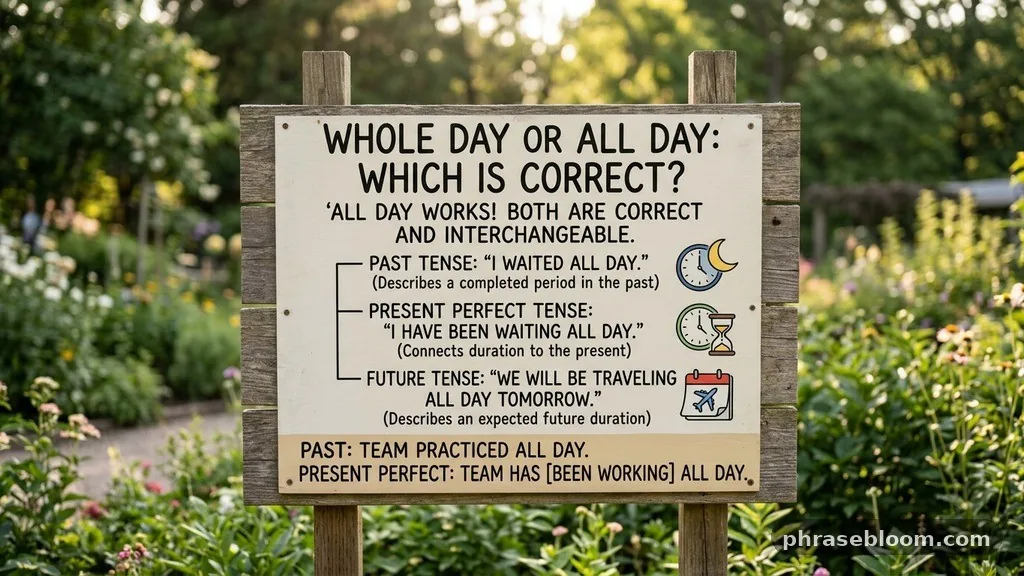
“All day” works with several verb tenses. “I waited all day” describes a completed period in the past, while “I have been waiting all day” connects the duration to the present. “We will be traveling all day tomorrow” describes an expected future duration.
- Past: The team practiced all day.
- Present perfect: The team has been practicing all day.
- Future: The team will practice all day tomorrow.
- Present state: The office is open all day.
The phrase can also describe a condition rather than an action. “The road was crowded all day” means the crowded condition lasted throughout the relevant day. Similarly, “She felt tired all day” describes a continuing experience.
For a useful reference on how time expressions work with determiners and related grammar patterns, consult the Cambridge Dictionary explanation of all and every. The key practical point remains simple: “all day” normally works without an article.
What “The Whole Day” Means
“The whole day” refers to the complete day considered as one unit. The adjective “whole” means complete or undivided, and “the” identifies a particular day that both the speaker and listener can understand from context.
Consider the difference between “I read all day” and “I read for the whole day.” The first sentence sounds natural and emphasizes duration. The second is grammatically possible, but it sounds more deliberate and may suggest that reading occupied the complete period under discussion.
“The whole day” is especially useful when contrasting a complete period with only part of it. “We had the whole day free, so we visited three towns” emphasizes that no part of the day was already committed. “I only had the afternoon” creates the implied contrast.
The role of “the”
In ordinary usage, “whole” before a singular countable time noun usually needs a determiner. Natural examples include “the whole day,” “a whole day,” and “my whole day.” The determiner tells readers how the complete day is being identified.
- The whole day: A particular complete day already understood from context.
- A whole day: One complete day, often viewed as an amount of time.
- My whole day: The complete portion of one person’s day.
- That whole day: A specific day referred to with distance or emphasis.
“Whole day” can appear in limited contexts where another word has already supplied the grammatical structure. For example, a timetable might contain the label “whole-day pass,” although “all-day pass” is often more idiomatic in everyday English. In a normal sentence, however, write “the whole day” or “a whole day,” not simply “whole day.”
Whole Day vs. All Day in Real Sentences
The difference becomes clearer when the same situation is expressed in two ways. “The technician worked all day” focuses on the duration of the technician’s work. “The technician spent the whole day repairing the machine” presents the complete day as time devoted to that task.
Both sentences can describe nearly the same event. The first is shorter and more conversational. The second places stronger emphasis on the complete use of the day and may suggest that the task took longer than expected.
Workplace and business examples
“The support team answered customer messages all day” describes ongoing activity. “The support team spent the whole day preparing the annual report” highlights the fact that the report consumed the team’s complete working period.
“Our office will be closed all day Friday” is a natural announcement about duration. “We have the whole day Friday to complete the audit” emphasizes the amount of time available for the task.
In workplace communication, “all day” is usually the better choice for schedules, operating hours, and continuing conditions. “The whole day” works well when someone is explaining how time was allocated or why a task could not be combined with another activity.
Travel and personal plans
“We walked around the city all day” sounds natural because walking continued over a long period. “We had the whole day in the city” means the complete day was available for sightseeing, even if the travelers stopped for meals and rest.
“She stayed at the beach all day” describes the duration of her stay. “She planned the whole day around the beach” means the beach shaped the complete schedule, which is a different emphasis.
Education and events
“The students studied all day for the exam” focuses on sustained preparation. “The students had the whole day to prepare” focuses on the complete amount of time provided to them.
For events, the adjective “all-day” is often used before a noun. “The company is hosting an all-day workshop” means the workshop is scheduled to last through most or all of the day. This compound adjective is different in form from the adverbial phrase “The workshop continued all day.”
When to Use “The Whole Day”
Use “the whole day” when you want to draw attention to the complete day as a single period. It is particularly effective when the day is being divided into possible portions, such as morning and afternoon, or when a person’s entire schedule is relevant.
“We had the whole day to solve the problem” suggests that the group had no tight deadline within that day. “He spent the whole day reorganizing the garage” suggests that the task occupied the full available period and perhaps left no time for other plans.
The phrase can also carry emotional emphasis. “You were away the whole day” may express surprise, disappointment, or simple observation depending on tone. “I waited the whole day for your call” sounds more emotionally charged than “I waited all day for your call,” although both can be correct.
Common patterns with “the whole day”
Several sentence patterns appear regularly in natural English. These patterns are useful in professional writing as well as casual conversation.
- Spend the whole day: We spent the whole day reviewing the contract.
- Have the whole day: You have the whole day to submit the form.
- Be away the whole day: Priya will be away the whole day.
- Take the whole day: The installation may take the whole day.
- Use the whole day: The class used the whole day for field research.
“The whole day” does not always mean an uninterrupted activity. “We spent the whole day at the festival” allows for eating, sitting, walking, and taking breaks. The phrase refers to the overall period, not necessarily to continuous action every second.
Use “a whole day” when the speaker means one complete day without referring to a particular day already known. “The application took a whole day to process” presents one day as a substantial duration. The indefinite article makes the meaning different from “the whole day.”
When to Use “All Day”
Choose “all day” when duration is the central idea. It is the natural option for activities, weather, operating conditions, and repeated events that continue throughout a day.
Examples include “The rain fell all day,” “The clinic accepts calls all day,” and “I have been answering emails all day.” These sentences do not treat the day as an object that someone possesses or divides. They describe what happened during the day.
“All day” can also appear with a time reference. “The museum is open all day Saturday” means its opening period covers Saturday broadly. “The museum was crowded all day yesterday” describes a condition that lasted across the relevant day.
All day versus all-day

“All day” and “all-day” have related meanings but different grammatical jobs. Without a hyphen, “all day” is usually an adverbial phrase. With a hyphen before a noun, “all-day” acts as a compound adjective.
| Form | Function | Example |
|---|---|---|
| all day | Adverbial phrase | The seminar lasted all day. |
| all-day | Compound adjective | We attended an all-day seminar. |
| the whole day | Noun phrase with adjective | We had the whole day available. |
| a whole-day | Usually less common compound modifier | A whole-day booking may be required. |
The hyphen in “all-day event” helps show that “all-day” modifies “event” as one unit. In “The event continued all day,” no hyphen is needed because “all day” follows the verb and functions adverbially.
Articles, Determiners, and Sentence Structure
Article usage explains much of the difference between “whole day” and “all day.” “All” can modify a time expression directly in “all day,” while “whole” generally appears with a determiner such as “the,” “a,” “my,” or “that.”
Compare these examples: “The project took all day,” “The project took the whole day,” and “The project took a whole day.” The first is the most ordinary duration statement, the second emphasizes a particular complete day, and the third stresses the amount of time as one full day.
“My whole day” is also natural because “my” acts as the determiner. “My all day” is not a normal equivalent. You could say “It took up all of my day,” but that structure uses “all of” before the possessive noun phrase.
Useful structural contrasts
- All day: The machine ran all day.
- The whole day: The machine ran for the whole day.
- A whole day: The machine needed a whole day of testing.
- My whole day: The machine problem disrupted my whole day.
- All of the day: The ceremony occupied all of the day, though this sounds more formal and less common.
The phrase “the whole day” can be used with “for,” but “for all day” is usually not standard in the same way. Say “for the whole day” or simply “all day.” “The meeting lasted all day” is more natural than “The meeting lasted for all day.”
English learners sometimes transfer patterns from another language and write “I worked whole day.” In standard English, add the article or use “all day”: “I worked the whole day” is possible, though “I worked all day” is more idiomatic in many contexts.
Is “Whole Day” Ever Correct by Itself?
“Whole day” can be correct inside a larger compound or specialized label, but it is usually not the preferred standalone phrase in ordinary prose. A sign might say “whole-day admission,” although “all-day admission” or “admission for the entire day” may sound more natural depending on the organization’s style.
In a sentence such as “The course is whole day,” the phrase is not standard English. Better alternatives are “The course lasts all day,” “The course runs for the whole day,” or “The course is an all-day course.”
Some fixed expressions or translated workplace materials may use “whole day” without an article. That does not make the pattern broadly natural in standard English. Writers should judge the full sentence rather than assuming that every phrase containing “whole” can omit a determiner.
Correcting common examples
| Less natural or incorrect | Better version | Reason |
|---|---|---|
| I worked whole day. | I worked all day. | “All day” naturally expresses duration. |
| We stayed whole day. | We stayed the whole day. | “Whole” needs a determiner here. |
| The course is whole day. | The course is an all-day course. | The compound adjective modifies “course.” |
| It took for all day. | It took all day. | Do not use “for” before “all day” in this pattern. |
The most reliable correction is often not to force one phrase into every sentence. Choose “all day” for duration, “the whole day” for a complete identified period, and “a whole day” for one complete unit of time.
British English, American English, and Formal Usage
Both British English and American English use “all day” and “the whole day.” The basic meaning and grammar are not divided by nationality. A writer should not assume that one phrase belongs exclusively to British English or that the other is exclusively American.
Regional preferences can affect how frequently a particular construction appears. Speakers may choose “all day,” “the whole day,” “all day long,” or “for the entire day” according to tone, context, and local habits. These are differences in style and preference, not firm national grammar rules.
In formal writing, “throughout the day” and “for the entire day” can sometimes sound more precise than either everyday phrase. A business report might say, “Customer demand remained high throughout the day,” while a workplace message might say, “Customer demand stayed high all day.”
Choosing for an international audience
For international business English, clarity matters more than trying to imitate a regional style. “All day” is short and widely understood. “Throughout the day” can be useful when a report needs a slightly more formal tone.
Academic writers should choose the expression that accurately describes the evidence. If observations were collected at several points during one day, “throughout the day” may be more precise than “the whole day,” which could imply continuous observation.
In schedules and public notices, “all-day” is a familiar compound adjective. Examples include “all-day ticket,” “all-day workshop,” and “all-day parking.” A publication’s style guide may recommend a different treatment, so check local editorial rules if the document belongs to an institution with established conventions.
Alternatives to “Whole Day” and “All Day”
Sometimes a rewritten phrase is clearer than choosing between “whole day” and “all day.” This is especially true in formal documents, international communication, or sentences where the exact duration matters.
- Throughout the day: Formal and useful for repeated or continuing events.
- For the entire day: Precise and explicit about completeness.
- For the full day: Suitable for schedules, bookings, and appointments.
- During the day: Neutral, though it does not necessarily mean the entire day.
- From morning until evening: Clear when the approximate time range matters.
- All day long: Conversational and often more emphatic than “all day.”
“Throughout the day” does not always mean continuously. “The system recorded temperature throughout the day” may mean that measurements were taken repeatedly at different times. “For the entire day” more strongly suggests that the complete day is included.
Use “the full day” for bookings and reservations: “The client reserved the conference room for the full day.” Use “all-day” before a noun: “The client booked an all-day conference room slot.” These alternatives can make business writing more direct.
Common Mistakes and How to Avoid Them
The most common error is omitting the determiner before “whole.” “I spent whole day writing” should become “I spent the whole day writing” or “I spent all day writing.” The first version emphasizes the complete day, while the second focuses on duration.
Another mistake is treating “all day” and “all-day” as interchangeable in every position. Write “The event lasted all day,” but “It was an all-day event.” The first phrase follows the verb as an adverbial phrase; the second comes before a noun as a compound adjective.
Writers also sometimes use “whole day” when they mean “all day” in short status updates. “Busy whole day” is not natural standard English. “Busy all day” or “Busy the whole day” is better, although “busy all day” is the usual choice.
Watch the intended meaning
“I was on the phone all day” says that phone calls occupied much of the day. “I was on the phone for the whole day” sounds more emphatic and may imply that the complete day was consumed by calls.
“The office was quiet all day” describes a continuing condition. “The office was quiet for the whole day” treats the day as a complete period and sounds more deliberate, perhaps because the writer is contrasting it with another day.
Do not use “whole day” as a noun by itself. “Whole day was difficult” needs an article: “The whole day was difficult.” Alternatively, use “The entire day was difficult,” which is slightly more formal.
How to Choose the Right Expression
A simple decision method can solve most whole day or all day questions. First, ask whether you are describing duration. If the answer is yes, “all day” will usually be the clearest choice.
Next, ask whether you are treating a particular day as one complete block of time. If so, use “the whole day,” “a whole day,” or a possessive phrase such as “my whole day.” The determiner depends on whether the day is specific, indefinite, or connected to a person.
- Use all day for an activity or condition that continues throughout the day.
- Use the whole day for a particular complete day.
- Use a whole day for one complete day viewed as an amount of time.
- Use all-day before a noun as a compound adjective.
- Use throughout the day or for the entire day when a formal rewrite is clearer.
Finally, read the sentence aloud. If “all day” sounds smooth, it probably expresses duration naturally. If the sentence contrasts part of a day with its complete span, “the whole day” may communicate the intended meaning more precisely.
Practical Guidance for Professional Writing
Business emails usually benefit from the shorter “all day.” Write, “I will be in training all day Tuesday,” or “The help desk will be available all day.” These forms are concise and easy to scan.
Employee handbooks and policies may prefer “throughout the day” or “for the entire day” when the rule needs formal precision. For example, “Employees must keep their identification badges visible throughout the day” is more specific than a casual phrase involving “all day.”
Schedules can use either “all-day” or a clock range. “All-day orientation” is clear in a calendar entry, while “Orientation runs from 9 a.m. to 5 p.m.” gives readers exact information. If the start and end times are known, the clock range is often more useful.
Examples for professional contexts
- Email: I will be unavailable all day while attending the regional meeting.
- Policy: The reception desk must remain staffed throughout the day.
- Calendar: An all-day planning session has been added to the team calendar.
- Report: Website traffic remained stable throughout the day.
- HR notice: Employees may use the training room for the whole day on Friday.
- Customer message: The maintenance work may affect service for the entire day.
Consistency matters inside one document. If a company’s calendar calls events “all-day meetings,” switching randomly to “whole-day meetings” can make the terminology look unedited, even if the meaning is understandable.
There is no universal requirement to use one expression in every professional context. Follow the organization’s house style if it has one, then apply the chosen pattern consistently across headings, body copy, forms, and digital interfaces.
Sentence Examples You Can Copy
The following examples show how grammar and meaning shape the choice. Each sentence uses a natural pattern that can be adapted for workplace, academic, travel, or personal writing.
- The engineers tested the new equipment all day.
- We had the whole day to review the proposal.
- The conference is an all-day event.
- The conference continued all day.
- She spent the whole day organizing the archive.
- The archive team worked all day to meet the deadline.
- The museum was open all day Saturday.
- We reserved the room for the whole day.
- A whole day was needed to complete the inspection.
- Customer inquiries arrived throughout the day.
- The software update may affect users for the entire day.
- I was away all day because of the appointment.
Notice that “all day” often follows the verb, while “the whole day” can function as the object of “spend,” “have,” “reserve,” or “use.” This is not an absolute rule, but it is a useful pattern for producing natural English.
When “all day” modifies a noun, add the hyphen: “an all-day workshop,” “an all-day pass,” or “an all-day examination.” When it follows the verb, leave it open: “The workshop lasted all day.”
Frequently Asked Questions
Is “whole day” or “all day” correct?
Both can be correct, but they are used differently. “All day” usually expresses duration, while “the whole day” emphasizes a complete, specific day. In most ordinary duration statements, “all day” is the more natural choice.
Is “the whole day” grammatically correct?
Yes. “The whole day” is a standard noun phrase in English. The article “the” identifies the particular day, and “whole” describes it as complete.
Can I say “I worked whole day”?
No, that sentence is not standard English. Write “I worked all day” or “I worked the whole day.” The first option is more idiomatic for a simple duration statement.
What is the difference between “all day” and “all-day”?
“All day” is usually an adverbial phrase, as in “The meeting lasted all day.” “All-day” is a compound adjective before a noun, as in “an all-day meeting.”
Is “a whole day” different from “the whole day”?
Yes. “A whole day” means one complete day without identifying a particular day, as in “The repair took a whole day.” “The whole day” refers to a specific complete day, as in “We spent the whole day at the site.”
Final Takeaway on Whole Day or All Day
Use all day when you are describing duration: “The team worked all day.” Use the whole day when you want to emphasize a particular day in its entirety: “The team had the whole day to work.” Use a whole day for one complete day viewed as an amount of time.
The best choice in a whole day or all day sentence depends on meaning, article usage, and the phrase’s grammatical role. Read the sentence aloud, choose the form that matches your emphasis, and use “all-day” with a hyphen when it comes directly before a noun. Once you distinguish duration from entirety, correct usage becomes much easier.
Related: 24 Hours’ Notice · Is Summer Capitalized? Grammar Rules Explained? · Alright vs All Right