
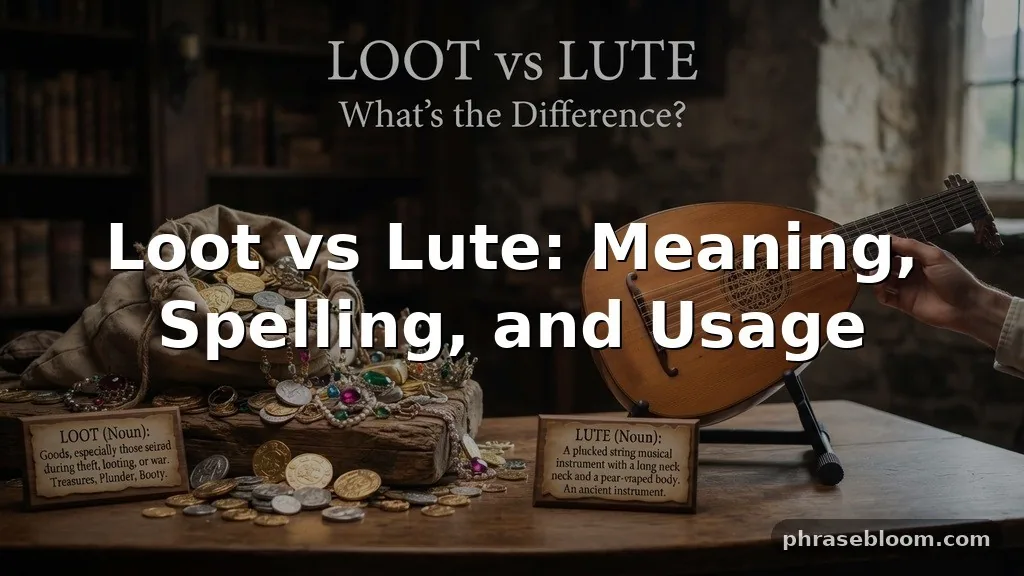
Loot vs lute is a spelling comparison between two words that sound alike but refer to completely different things. Loot means stolen goods, valuable items taken by force, or sometimes treasure collected in a game, while a lute is a plucked string instrument associated with early European music and the Renaissance. Their pronunciation is usually identical, but their meanings, origins, and grammatical uses are not.
That difference matters in schoolwork, fiction, gaming, historical writing, and everyday communication. A single letter changes a sentence from one about plunder to one about music, so learning the distinction gives you a reliable way to choose the correct spelling every time.
Loot vs Lute: The Short Answer
Loot refers to stolen goods, plunder, or valuable items obtained during a raid, conflict, or game. It can be a noun, as in “The thieves divided the loot,” or a verb, as in “The soldiers looted the abandoned town.”
Lute is a noun for a musical instrument with a rounded body, a neck, and strings that are plucked. A Renaissance lute is one of the best-known forms, but related instruments have appeared in several musical traditions and historical periods.
In most varieties of modern English, loot and lute are homophones. They are pronounced alike, usually as “loot,” with the vowel sound found in words such as “food” and “blue.” Their spelling is different because their histories and definitions are different.
The simplest rule is this: use loot for stolen property, treasure, or game rewards, and use lute for the musical instrument. If the sentence concerns music, strings, a performer, or historical instruments, the answer is almost certainly lute. If it concerns theft, plunder, rewards, or valuable objects, choose loot.
| Word | Basic meaning | Part of speech | Example |
|---|---|---|---|
| loot | Stolen goods, plunder, or valuable rewards | Noun and verb | The explorers found loot in the abandoned fort. |
| lute | A plucked string instrument | Usually a noun | The musician tuned the lute before the concert. |
What Loot Means
The noun loot traditionally means goods taken from a place or person during a raid, war, robbery, or period of disorder. The word often suggests that the goods were taken unlawfully or by force, although modern usage can be broader and more playful.
For example, “The invaders carried away the city’s loot” describes valuable objects taken after an attack. “Police recovered the stolen loot” refers to property obtained through theft. In both cases, the word concerns objects rather than a person or an action.
Loot can include money, jewelry, artwork, weapons, food, technology, or other valuable property. The word does not identify one particular type of object. Its meaning comes from how the items were acquired.
The word also appears frequently in fantasy novels, role-playing games, and video games. In those settings, loot may mean coins, equipment, weapons, armor, or items collected after defeating an enemy or opening a chest.
- Historical use: valuables taken during a raid or military campaign.
- Criminal use: property stolen during a robbery or burglary.
- Gaming use: rewards collected from enemies, containers, quests, or events.
- Informal use: a humorous term for desirable items or unexpected riches.
Loot can also be used as a verb. To loot a place means to steal goods from it, often during a riot, invasion, disaster, or collapse of public order. The verb normally takes an object, as in “The gang looted several shops,” although writers may also say that “the shops were looted.”
The verb is stronger than simply saying that someone “took” something. It usually implies widespread theft, disorder, or the removal of valuable goods. A person who takes one pen from a desk may have stolen it, but a group that strips a warehouse of its contents may be described as looting it.
What Lute Means
A lute is a plucked string instrument. Its traditional design includes a rounded or pear-shaped body, a neck, strings, and a pegbox used to tune the instrument.
The lute has a long history, and the name covers more than one exact design. European lutes were important in medieval and Renaissance music, while related instruments developed in the Middle East, North Africa, and Asia. The word should therefore be understood as part of a broad family of historical string instruments rather than as the name of one unchanging model.
A Renaissance lute often had several courses of strings, meaning pairs of strings tuned together or nearly together. Performers plucked the strings with their fingers, producing a soft and intricate sound that suited solo performance, chamber music, song accompaniment, and courtly settings.
The lute appears in writing about music, museums, historical fiction, art history, and early music performance. Common phrases include “lute music,” “lute player,” “lute repertoire,” and “a six-course lute.” These contexts make the intended spelling clear because they all relate to an instrument.
Unlike loot, the word lute is generally used as a noun. A sentence such as “She played the lute” identifies the object being played. Writers do not normally use “lute” as a general verb meaning “to perform music,” although specialized technical uses of the word can occur in other contexts.
The spelling of lute can confuse learners because the final silent “e” does not create a different pronunciation from “loot.” English contains many words whose spelling preserves older history even though their sounds have changed or merged with another word.
For an accessible overview of the instrument’s historical development and construction, the Encyclopaedia Britannica entry on the lute provides useful background.
Why Loot and Lute Sound the Same
Loot and lute are usually homophones, which means they have the same pronunciation but different spellings and meanings. Other familiar homophones include “flour” and “flower,” “right” and “write,” and “pair” and “pear.”
The pronunciation of both words is commonly represented as /luːt/ in phonetic notation. The vowel is long, and the final consonant is a clear “t.” In ordinary speech, a listener cannot identify the intended word from sound alone.
Context does the work. If someone says, “The band used a lute,” the musical setting identifies the instrument. If someone says, “The thieves divided the loot,” the reference to theft identifies the valuables.
Regional accents can affect many English vowels, but the central distinction remains the same: the two words are normally pronounced alike while being written differently. They are not interchangeable in text.
This is why spelling matters in captions, subtitles, essays, workplace documents, and online messages. A reader who sees “The pirate played a loot” may understand the intended meaning, but the sentence still contains a spelling error. Likewise, “The adventurers collected a lute from the treasure chest” may accidentally suggest that they found a musical instrument rather than general treasure.
Homophones are especially difficult because pronunciation cannot help you choose the spelling. The best solution is to connect each word with a visual meaning. Think of loot as something you collect or steal, and lute as something you tune or play.
Loot and Lute in Real Sentences
Seeing the words in different parts of speech makes their distinction easier to remember. Loot can describe either the goods themselves or the act of taking them, while lute normally names an instrument.
Examples with loot as a noun

“The museum returned the loot to the family that owned it.” Here, loot means valuable property that had been taken unlawfully.
“After completing the mission, the players divided the loot.” In this gaming example, loot means rewards or items collected during play. The word does not necessarily imply real-world theft.
“The novel opens with pirates hiding their loot on a remote island.” The historical or fictional setting gives loot a treasure-and-plunder meaning.
Examples with loot as a verb
“The rioters looted several stores after nightfall.” In this sentence, looted is the past tense of the verb meaning stole goods from the stores.
“The invading army looted the palace and removed its paintings.” The verb describes the act of taking valuable items from a place.
“The game lets players loot defeated enemies.” Here, loot is a verb used in a digital setting. It means to collect items from an enemy or its inventory.
Examples with lute as a noun

“The performer played a Renaissance lute during the museum’s evening program.” The instrument is identified by the historical context.
“The composer wrote a delicate melody for voice and lute.” The word names the instrument accompanying the singer.
“A painted lute appears beside the books in the still-life.” Art historians often recognize the lute as an object represented in European paintings.
These examples also show why a spell-checker may not catch every error. Both loot and lute are valid English words, so software may accept either one even when only one fits the sentence. Meaning and context remain essential.
Loot vs Lute: Etymology and Word History
The difference between loot and lute is not an arbitrary spelling trick. The words entered English through different historical routes, which helps explain why their meanings are unrelated.
Loot came into English through contact with South Asian languages. It is associated with the Hindi word lūt, meaning plunder or booty, and became familiar in English during the period of British involvement in India. Its history has always been connected with stolen property and seized valuables.
Lute has a different path. The English word developed through European forms related to the Old French lut and ultimately to Arabic expressions connected with the instrument known as the al-ʿūd. The details of the instrument’s name changed as it moved across languages and regions.
The related Arabic instrument, the oud, remains important in Middle Eastern and North African music. European lutes share broad structural relationships with such instruments, although their designs, tuning systems, performance traditions, and historical roles are not identical.
Etymology can explain spelling, but it should not be used as the only way to remember modern definitions. English vocabulary often contains words that have crossed languages, changed pronunciation, or acquired new meanings. A historical connection may be interesting without being useful for choosing a word in a sentence.
The practical distinction is therefore more important than the full history. Loot belongs to the vocabulary of plunder, theft, treasure, and rewards. Lute belongs to the vocabulary of music, instruments, performance, and cultural history.
Their shared pronunciation developed independently of those meanings. English spelling often preserves clues about a word’s origin, but it does not guarantee that similarly pronounced words are related. In this case, the different initial vowels in writing help readers distinguish two unrelated terms that sound the same.
Parts of Speech and Common Grammar Patterns
Understanding the parts of speech makes it easier to use loot accurately. As a noun, loot names the goods or rewards. As a verb, it describes the act of taking those goods.
When loot is a noun, it can appear after a determiner or possessive: “the loot,” “some loot,” “their loot,” or “a pile of loot.” It is often treated as an uncountable noun when referring to stolen goods generally, so writers commonly say “some loot” rather than “a loot.”
In a specific story, however, writers may refer to “different types of loot” or “several pieces of loot.” The countable noun “looter” identifies a person who loots, while “looting” names the activity or process.
As a verb, loot can take a direct object. Examples include “They looted the warehouse,” “The rebels looted the train,” and “Players looted the dungeon.” The past tense is looted, and the present participle is looting.
Lute is normally a countable noun. You can write “a lute,” “two lutes,” “the lute,” or “several antique lutes.” A sentence may describe its sound, construction, ownership, or performance.
- Noun: The guard discovered the loot.
- Verb: The raiders looted the village.
- Singular noun: The musician carried a lute.
- Plural noun: The collection includes three lutes.
- Related adjective: Lute music filled the hall.
One useful test is to replace the word with a clear synonym. If “stolen goods,” “plunder,” or “rewards” fits, use loot. If “instrument” or “string instrument” fits, use lute.
Common Mistakes with Loot and Lute
The most common mistake is choosing the spelling from sound alone. Because both words are pronounced “loot,” a writer may type the first spelling that comes to mind and fail to notice the error.
Another mistake is using lute for treasure. A fantasy writer might accidentally describe “a chest of lute” when the intended meaning is a chest of loot. The correct phrase is “a chest of loot,” unless the chest contains one or more musical instruments.
The opposite mistake occurs in music writing. “The singer accompanied herself on the loot” is incorrect if the instrument is a lute. The sentence should read, “The singer accompanied herself on the lute.”
Some writers also treat loot as though it always refers to criminal activity. That is too narrow for modern usage. In a video game, loot commonly means collected equipment or rewards, even though the word retains its older association with taking valuable things.
Another error is forgetting that loot can be a verb. “The soldiers took loot” and “The soldiers looted the town” are related but grammatically different constructions. The first uses loot as a noun, while the second uses it as a verb.
Writers should also avoid assuming that a spell-checker will resolve the problem. A digital tool can recognize that both words are spelled correctly, but it may not know whether the sentence concerns a musical instrument or stolen goods.
| Incorrect or confusing sentence | Better sentence | Reason |
|---|---|---|
| The band performed with a loot. | The band performed with a lute. | A lute is the instrument. |
| The pirates hid their lute. | The pirates hid their loot. | Loot means stolen treasure. |
| The players found valuable lute. | The players found valuable loot. | The game rewards are loot. |
| She bought a rare loot. | She bought a rare lute. | A single musical instrument is a lute. |
When proofreading, do not ask only whether the spelling looks familiar. Ask what the word represents in the sentence. That meaning-based check is faster and more reliable than relying on pronunciation.
How to Remember the Difference
A simple memory device can prevent most errors. Associate the double “o” in loot with a pile of objects, coins, or rewards. Associate the “u” in lute with music, strings, and the instrument itself.
You can also use a substitution test. Replace the word with “treasure” or “plunder.” If the sentence still makes sense, choose loot. Replace it with “instrument.” If that works, choose lute.
Another helpful method is to look for nearby vocabulary. Words such as pirate, raid, robbery, chest, coins, enemies, rewards, and stolen property point toward loot. Words such as music, strings, performer, melody, concert, Renaissance, tuning, and instrument point toward lute.
- Treasure or stolen goods: loot.
- To steal valuable goods: loot as a verb.
- A plucked musical instrument: lute.
- A historical performance involving strings: lute.
- A video game reward or collected item: usually loot.
Pronunciation should be treated as a warning that a homophone exists, not as a clue to the spelling. When you hear the word aloud, pause and decide which meaning you intend before writing it.
For learners of English, writing a short pair of contrastive sentences can help: “The hero collected loot.” “The musician played a lute.” The sentences are short, but they connect each spelling with a distinct image and grammatical pattern.
Usage in Fiction, Games, History, and Music
Loot is especially common in adventure fiction and games. A character may search a dungeon for loot, divide the loot after a battle, or lose loot after being defeated. In these contexts, the word usually means items with practical or financial value.
The gaming sense can include weapons, armor, currency, crafting materials, cosmetic items, and quest rewards. It does not require the items to have been stolen in a realistic legal sense. The word has expanded into a general term for valuable objects gathered through play.
Historical writing uses loot more carefully. A sentence such as “The army carried away the temple’s loot” describes seizure or plunder and may raise questions about ownership, violence, and cultural heritage. In formal writing, “looted artifacts” can refer to objects removed unlawfully from archaeological sites, museums, or communities.
Lute appears in historical fiction, art criticism, musicology, and descriptions of early performance. A character might tune a lute before a court performance, while a museum label might identify a painted lute as evidence of a musician’s status or a period’s artistic interests.
The phrase “lute music” does not mean music that is looted. The spelling signals the instrument, even though a listener hearing the phrase aloud would need context to interpret it.
Modern musicians may play historical reproductions, reconstructed instruments, or contemporary lutes based on older designs. Writers should avoid assuming that every lute looks exactly the same. The term has a broad historical range, and specific descriptions may distinguish a Renaissance lute from related instruments such as the oud or theorbo.
Both words can therefore appear in the same story. A fantasy narrative might say, “The thieves sold the loot while a lute player performed in the tavern.” The sentence works because each spelling assigns a different role to a sound-alike word.
Choosing the Correct Spelling in Professional and Academic Writing
Professional writing rarely requires a complicated rule for loot and lute. The main responsibility is to choose the word that matches the intended meaning, then proofread any occurrence that could be confused by sound.
In a business report, loot may appear in a discussion of wartime property, museum collections, cybersecurity incidents, or online games. For example, a report could refer to “artifacts identified as wartime loot” or “loot collected by users during the event.”
In academic writing, lute may appear in music history, cultural studies, art history, or historical performance research. A student might write about “the lute’s role in Renaissance chamber music” or compare the lute with other string instruments.
Legal and policy documents should be especially precise if they describe stolen property. “Recovered loot” may be suitable in a narrative summary, but a formal document may instead use “stolen property,” “recovered assets,” or “goods taken during the offense” if those terms are more exact for the subject.
Marketing and workplace communication are less likely to use lute unless the organization sells instruments, promotes concerts, or operates in the music sector. Loot is more likely in game publishing, entertainment, retail, or informal promotional language.
In any formal context, do not select a word merely because it sounds right. Confirm that the noun or verb fits the sentence, particularly in headings, captions, product descriptions, and accessibility text where surrounding context may be limited.
A useful editing checklist is short:
- Identify whether the sentence refers to valuables or an instrument.
- Check whether the word is acting as a noun or a verb.
- Read the sentence for nearby context such as “strings,” “pirates,” or “rewards.”
- Search the document for both spellings if the topic appears repeatedly.
- Ask a subject-matter editor to review specialized historical or musical usage.
Examples You Can Copy and Adapt
The following examples show natural uses across different contexts. They can serve as models for school assignments, workplace documents, fiction, game descriptions, and historical writing.
Examples using loot
“The archaeologists distinguished between legally excavated objects and material identified as looted cultural property.”
“Players can exchange ordinary loot for supplies at the trading post.”
“The thieves abandoned the loot when the alarm sounded.”
“The article examines how wartime loot was returned to its original owners.”
“After the raid, the group divided the loot according to each member’s role.”
“The game’s latest update adds rare loot to the final mission.”
Examples using lute
“The ensemble included a singer, a viol, and a Renaissance lute.”
“The museum’s label explains how the lute was tuned during the period.”
“She studied lute performance before joining the early-music group.”
“The painting shows a musician holding a lute beside a table of books.”
“The composer arranged the song for voice and lute.”
“The instrument maker built a replica lute based on a surviving historical design.”
Notice that both sets of examples use the same pronunciation but entirely different semantic fields. Loot connects to property and acquisition, while lute connects to sound and construction.
FAQ: Loot vs Lute
Is loot or lute correct?
Both are correct words, but they do not mean the same thing. Use loot for stolen goods, plunder, treasure, or rewards, and use lute for the plucked string instrument.
Are loot and lute homophones?
Yes. In most standard varieties of English, loot and lute are pronounced alike. Their different spellings reflect different meanings and word histories.
Is loot a noun or a verb?
Loot can be both. As a noun, it means stolen goods or collected rewards. As a verb, it means to steal valuable goods from a place or person, or to collect items in a game.
Is lute only a musical instrument?
In ordinary modern English, lute usually refers to a plucked string instrument. It is primarily used as a noun, especially in discussions of early music, Renaissance music, historical performance, and instrument design.
How can I remember which spelling to use?
Use loot for treasure, theft, plunder, and game rewards. Use lute for music, strings, tuning, performers, and the historical instrument.
Conclusion
The central point in Loot vs Lute is simple: loot means stolen goods, plunder, treasure, or collected rewards, while a lute is a plucked string instrument. The words are usually homophones, so pronunciation will not reveal the correct spelling.
Use the surrounding meaning as your guide. If the sentence concerns theft or valuable items, choose loot; if it concerns music or an instrument, choose lute. Keeping that distinction in mind will make your writing more accurate in school, work, fiction, gaming, and historical discussions.
Explore more on PhraseBloom.