
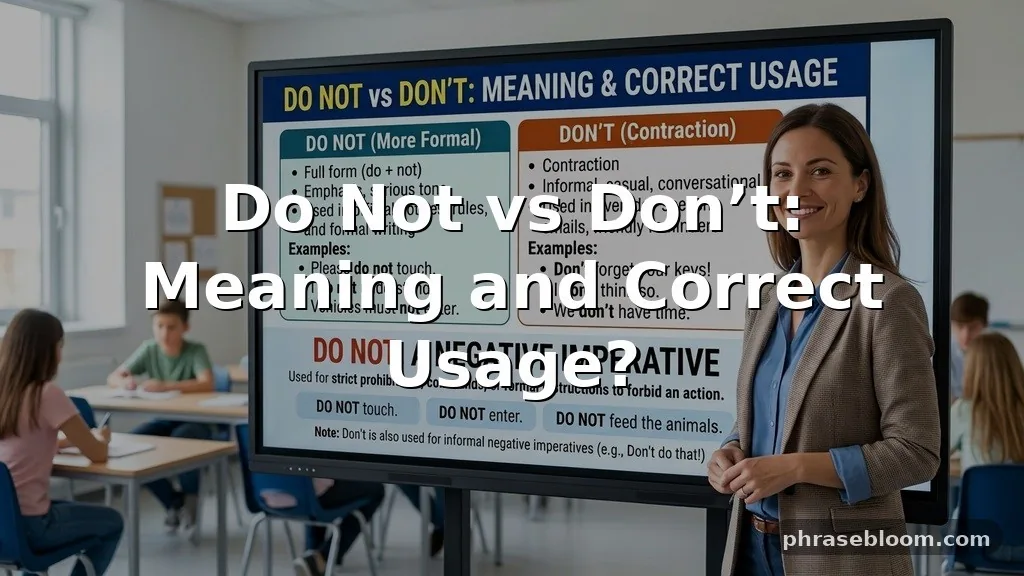
Do Not vs Don’t is mainly a question of register, tone, and emphasis rather than meaning. Both forms express negation, but do not is the full form, while don’t is its contraction. Choosing between them can change how direct, formal, forceful, or conversational a sentence sounds.
In most everyday sentences, either form is grammatically correct. This article explains the do not meaning and don’t meaning, shows how each works with an auxiliary verb, and gives practical guidance for formal writing, academic writing, workplace communication, spoken English, warnings, instructions, and negative imperatives.
Do Not vs Don’t: The Short Answer
Do not and don’t usually mean the same thing. The difference is that do not is written as two words, while don’t is a contraction formed by combining do and not with an apostrophe.
Use do not when you want a more formal, deliberate, or emphatic tone. Use don’t in conversational English, friendly workplace messages, dialogue, informal writing, and situations where a natural spoken rhythm matters.
| Form | Basic meaning | Typical tone | Common use |
|---|---|---|---|
| Do not | Negation or prohibition | Formal, firm, or emphatic | Policies, instructions, formal notices |
| Don’t | Negation or prohibition | Conversational and direct | Speech, emails, dialogue, informal writing |
Neither form is automatically more grammatically correct. The best choice depends on the sentence, the intended audience, the required level of formality, and any applicable style guide.
A useful rule is simple: choose do not for formal or emphatic writing, and choose don’t for ordinary conversational writing. If your organization has a house style, follow it consistently even when both forms would be acceptable under standard English.
What Does Do Not Mean?
The phrase do not creates a negative statement or instruction. In a sentence such as “We do not accept cash,” the words do not show that the company does not accept cash. In “Do not enter,” they create a prohibition.
Here, do is an auxiliary verb, also called a helping verb. The word not makes the clause negative, while the main verb remains in its base form: “do not accept,” “do not enter,” or “do not agree.”
This structure is especially important in the present simple tense. English generally uses do or does to form negatives with ordinary verbs, except with forms of be and modal verbs such as can, should, and must.
- I do not understand the instruction.
- They do not need additional approval.
- We do not publish customer addresses.
- Do not remove the safety label.
The full form can also add emphasis. Compare “I don’t remember the meeting” with “I do not remember the meeting.” The second sentence may sound more careful, more defensive, or more forceful depending on the surrounding context.
Do Not in a Negative Imperative
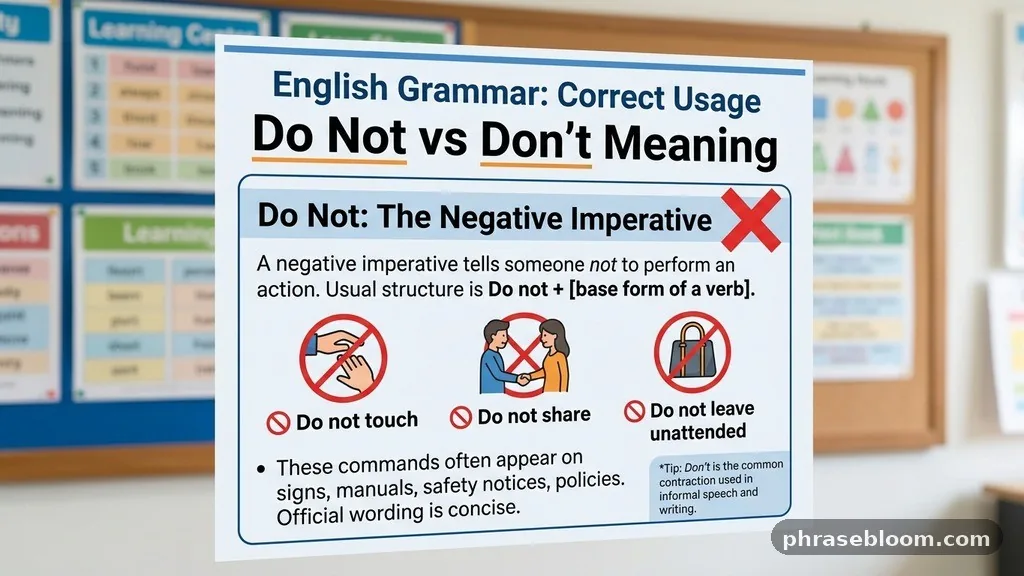
A negative imperative tells someone not to perform an action. The usual structure is do not plus the base form of a verb: “Do not touch,” “Do not share,” or “Do not leave the equipment unattended.”
These commands often appear in signs, manuals, safety notices, policies, and official instructions. The wording is concise because the subject you is understood.
“Do not submit the form twice” means “You should not submit the form twice.” The sentence does not need an expressed subject because imperative sentences normally address the reader directly.
In a formal notice, the full form can sound clearer and more authoritative than the contraction. A laboratory sign might say “Do not enter while testing is in progress,” while a colleague might write, “Don’t enter until the test is finished.”
What Does Don’t Mean?
Don’t is the contraction of do not. The apostrophe shows that letters have been omitted when the two words are shortened into one spoken and written form.
The don’t meaning is therefore normally identical to the do not meaning. “I don’t know” and “I do not know” both express a lack of knowledge, although the full version can sound more formal or more emphatic.
Don’t is common in spoken English because contractions make speech flow naturally. It is also normal in informal writing, personal correspondence, advertising, fictional dialogue, social posts, and many ordinary business emails.
- Don’t worry about the formatting.
- We don’t need to reschedule the call.
- Don’t send the report until the figures are checked.
- I don’t think that version is ready.
The contraction does not make a sentence careless or incorrect. Standard English accepts contractions, but their suitability depends on register. Register means the level of language associated with a particular situation, audience, or purpose.
A friendly message to a teammate may sound more natural with “Don’t forget the client call.” A legal notice may prefer “Do not disclose confidential information.” Both sentences are grammatical; they simply make different choices about tone.
Do Not vs Don’t in Formal and Informal Writing
Formal writing often favors the full form because it creates a measured and official tone. Academic writing, policy documents, government notices, formal reports, and contracts may use do not when the writer wants to avoid a conversational sound.
Informal writing generally allows don’t. Personal emails, internal chats, customer-friendly website copy, interview transcripts, and dialogue can all use contractions naturally.
| Situation | Usually suitable | Example |
|---|---|---|
| Safety sign | Do not | Do not operate this machine without authorization. |
| Academic paper | Do not, depending on style | The findings do not establish a causal relationship. |
| Workplace chat | Don’t | Don’t forget to attach the revised schedule. |
| Customer email | Either, depending on tone | We don’t store payment details on this system. |
| Policy document | Do not | Employees do not share login credentials. |
Formal writing does not require removing every contraction in every situation. Some modern academic and professional styles permit contractions when they support a clear, natural voice. The relevant question is whether the contraction fits the publication, institution, or document.
For a detailed reference on contractions and apostrophe use, consult the Grammarly reference on English contractions. The practical point remains the same: grammatical correctness and stylistic suitability are related but not identical.
When Full Forms Add Emphasis
Writers sometimes choose do not specifically to stress a correction or refusal. “We do not approve incomplete applications” sounds more deliberate than “We don’t approve incomplete applications.” The full form draws attention to the negative statement.
That emphasis can be useful, but it can also sound severe. In a customer-service message, “We do not accept returns after thirty days” may feel colder than “We don’t accept returns after thirty days,” even though the policy has not changed.
Context controls the effect. A manager correcting a serious misunderstanding may write, “We do not authorize employees to share this file,” while a colleague making a routine reminder may write, “We don’t share this file outside the team.”
Grammar: Auxiliary Verbs and Sentence Structure
Understanding the auxiliary verb makes the choice between do not and don’t easier. In negative present simple sentences, do or does carries the tense and not supplies the negative meaning.
With I, you, we, and they, use do not or don’t. With he, she, and it, use does not or doesn’t.
- I do not agree.
- You don’t agree.
- They do not agree.
- She does not agree.
- He doesn’t agree.
The main verb stays in its base form after do or does. “She does not work remotely” is correct, while “She does not works remotely” is incorrect because the third-person singular ending has already moved to does.
The same principle applies to questions. “Do you not understand?” is grammatical but may sound formal or confrontational. “Don’t you understand?” is more natural in conversation, although its tone can still be sharp.
Cases That Do Not Use Do or Don’t
Do not and don’t are not used with every verb. The verb be forms negatives directly: “I am not ready,” “She is not available,” and “They aren’t responsible.” You would not normally write “I do not be ready.”
Modal verbs also form negatives without do. Write “You must not disclose the information,” “We cannot approve the request,” or “They should not proceed.” Forms such as “You do not must disclose” and “We do not can approve” are not standard English.
This distinction matters in professional writing because attempts to make every negative sentence follow the same pattern can create grammatical errors. Identify the main verb first, then choose the appropriate negative structure.
| Positive verb type | Correct negative | Incorrect pattern |
|---|---|---|
| Ordinary verb | We do not approve it. | We do not approves it. |
| Be | We are not ready. | We do not be ready. |
| Modal verb | You must not enter. | You do not must enter. |
Do Not and Don’t in Workplace Communication
Business English requires more than grammatical accuracy. A message also needs the right level of authority, friendliness, and precision for its audience.
Use do not for rules, compliance instructions, formal announcements, and statements that must be difficult to misread. “Do not forward this message outside the department” is appropriate for a confidentiality reminder.
Use don’t for routine collaboration and approachable communication. “Don’t forget to review the budget notes before Thursday” sounds direct without creating unnecessary distance.
Emails and Internal Messages
In an email to a colleague, contractions usually make the message sound natural. “I don’t think the vendor has received the purchase order” is a normal professional sentence.
In a formal email to a regulator, client, or senior executive, the full form may be preferable when the message records a position or sets a boundary. “We do not have authority to change the filing date” has a careful, official tone.
Neither choice guarantees politeness. “Don’t ignore this request” is grammatically correct but potentially accusatory. “Please do not overlook this request” is more formal, while “Please make sure this request is included” may be clearer and less confrontational.
Policies and Procedures

Employee handbooks and internal policies often use do not because rules benefit from consistent, unambiguous wording. Examples include “Employees do not use personal devices to store confidential records” and “Do not install unapproved software.”
A policy can still use contractions if the organization’s house style permits them. The important issue is consistency across headings, instructions, examples, and related documents.
In software interfaces, brevity matters. A warning such as “Don’t close this window while the upload is running” may feel more human than “Do not close this window,” while a high-risk security alert may deliberately use the full form.
Do Not vs Don’t in Academic and Formal Writing
Academic writing often favors precision and a restrained tone. Many academic sentences use do not because the full form sounds less conversational: “The results do not support the original hypothesis.”
That does not mean don’t is always forbidden in academic work. A quotation, interview transcript, linguistic example, or discussion of spoken English may require the contraction exactly as it occurred.
Authors should check the publication’s style guide before making a blanket decision. Some institutions prefer a formal register throughout, while others allow natural contractions in introductions, reflections, or public-facing research summaries.
Do not can also prevent an unintended casual tone in a sentence that carries important qualifications. Compare “These results don’t prove that the treatment is safe” with “These results do not prove that the treatment is safe.” The second version may better suit a carefully qualified research conclusion.
Clarity Is More Important Than Mechanical Formality
Replacing every contraction with a full form can make prose stiff. A sentence such as “The study does not address the question, but it doesn’t claim to resolve it” may be stylistically inconsistent, yet the meaning remains clear.
A careful editor might revise both forms to “The study does not address the question, but it does not claim to resolve it,” or might use contractions throughout a less formal piece. The goal is not to obey a universal ban. It is to make a deliberate choice.
Formal writing also needs subject-verb agreement and accurate punctuation. Changing don’t to do not will not repair a sentence with a faulty subject, missing verb, or unclear reference.
Punctuation, Apostrophes, and Emphasis
The apostrophe in don’t replaces the letters omitted from do not. It is not a quotation mark, accent mark, or decorative symbol.
The correct spelling is don’t, with an apostrophe between the n and t. Common errors include “dont,” “dont’,” and “do’nt.” The first omits necessary punctuation, while the others place the apostrophe incorrectly.
Some keyboards and software may insert a curly apostrophe, while others produce a straight apostrophe. Both are commonly recognized in ordinary digital writing, although publishers may have a preferred typographic style.
- Correct: I don’t have the final figures.
- Incorrect: I dont have the final figures.
- Incorrect: I dont’ have the final figures.
- Correct full form: I do not have the final figures.
In a title or heading, capitalization depends on the publication’s style. A headline might use “Do Not Ignore These Warning Signs,” while sentence-style capitalization might produce “Do not ignore these warning signs.” The contraction still retains its apostrophe.
Writers should also distinguish don’t from dont as a stylistic error. In standard English, don’t requires the apostrophe because the punctuation shows the relationship between the full and shortened forms.
Negative Imperatives and Direct Instructions
A negative imperative tells someone not to do something. Both “Do not open the package” and “Don’t open the package” are correct, but they do not carry exactly the same tone.
The full form is common in warnings and formal instructions. It can signal seriousness, especially when the consequence of ignoring the instruction is significant.
The contraction is common in speech and personal communication. A parent may say “Don’t touch that,” and a teammate may write “Don’t move the deadline without checking with finance.”
| Instruction | Likely impression | Suitable setting |
|---|---|---|
| Do not restart the server. | Formal and authoritative | Technical procedure or alert |
| Don’t restart the server. | Direct and conversational | Team chat or spoken instruction |
| Please do not reply to this address. | Polite and official | Automated notice |
| Please don’t reply to this address. | Friendly and approachable | Customer email or informal message |
The word please affects tone, but it does not automatically make a command polite. “Please don’t send another incomplete form” may still sound irritated. A positive alternative such as “Please send the completed form” can be more constructive.
Common Mistakes With Do Not and Don’t
One frequent mistake is treating the full form and contraction as completely different grammatical structures. They are not. The contraction is simply a shortened form of do not, although the choice can produce a meaningful difference in register and emphasis.
Another mistake is using don’t with a singular third-person subject. Write “She doesn’t agree,” not “She don’t agree.” Write “The system does not respond,” not “The system do not respond.”
- Incorrect: She don’t understand the process.
Correct: She doesn’t understand the process. - Incorrect: He do not need approval.
Correct: He does not need approval. - Incorrect: They doesn’t have access.
Correct: They don’t have access.
Writers also sometimes add do or don’t before a modal verb. “You don’t need to wait” is correct because need is an ordinary verb in this structure. “You don’t must wait” is incorrect because must is already a modal verb.
Another practical issue is inconsistency. A policy that alternates randomly between “Employees do not” and “Employees don’t” may appear poorly edited even when every individual sentence is grammatical.
Inconsistent register can distract readers from the substance. Decide whether the document should sound formal, conversational, instructional, or mixed, then apply that decision with judgment rather than changing every sentence mechanically.
How to Choose the Right Form
Start by identifying the purpose of the sentence. Is it recording a formal rule, expressing a personal opinion, giving a spoken instruction, or writing in a friendly professional voice?
Next, consider the audience. A public safety notice and a message to a teammate may communicate the same prohibition, but they need different levels of formality.
Use this practical decision process:
- Choose do not if the sentence belongs in a policy, formal notice, legal document, academic argument, or serious warning.
- Choose don’t if the sentence belongs in conversation, dialogue, an informal email, or approachable public copy.
- Choose the full form when you want to emphasize a denial, correction, or firm boundary.
- Check whether a style guide or house style requires one approach.
- Read the sentence aloud and ask whether its tone fits the audience.
- Review the entire document for consistent usage.
Rewriting can sometimes improve a sentence more effectively than debating the contraction. Instead of “Don’t fail to submit the form,” write “Please submit the form by Friday.” The positive version is clearer and avoids a double-negative-like construction.
Consistency Does Not Mean Repetition
A consistent document does not necessarily use do not in every sentence. It uses each form intentionally. A formal policy may use do not for rules but preserve don’t inside a quoted employee statement.
Similarly, a marketing page may use contractions in its welcome text and full forms in a legally required disclaimer. Different sections can have different functions, provided the shift is deliberate and appropriate.
If several people edit the same document, record the preferred approach in the project’s style guide. A short instruction such as “Use contractions in customer emails, but use full forms in policy statements” can prevent repeated editing disputes.
Examples You Can Copy and Adapt
The following examples show how the choice affects tone without changing the basic meaning. Each pair describes a similar situation in a different register.
| Full form | Contraction | Difference in effect |
|---|---|---|
| We do not share customer data with advertisers. | We don’t share customer data with advertisers. | The first sounds more like a formal privacy statement. |
| Do not attach a password-protected file. | Don’t attach a password-protected file. | The first suits a procedure; the second suits a quick reminder. |
| I do not believe the figures are complete. | I don’t believe the figures are complete. | The first can sound more deliberate or emphatic. |
| We do not expect a delay. | We don’t expect a delay. | The second is natural in a routine client update. |
For a formal policy, write: “Employees do not install applications without approval from the information technology team.” The full form supports the document’s official tone.
For an internal email, write: “Don’t install the new application until the service desk confirms that it’s ready.” The contraction makes the instruction sound direct but cooperative.
For an academic sentence, write: “The available evidence does not establish that the two variables are related.” This wording is cautious and suitable for a formal argument.
For spoken dialogue, write: “I don’t know whether the meeting is still happening.” The contraction reflects ordinary speech and makes the line sound natural.
Do Not vs Don’t in Different Varieties of English
American English and British English both use do not and don’t. Neither form belongs exclusively to one variety, and it would be inaccurate to claim that one spelling is American while the other is British.
Regional expectations may affect frequency, tone, or editorial preference, but the central distinction remains register. A British policy can use do not, and an American conversation can use don’t.
International organizations should consider audience expectations rather than relying on a simplistic regional rule. Full forms may be easier to interpret in a formal translation workflow, while contractions may sound more natural in customer-facing English aimed at fluent speakers.
House style remains important. A multinational company might require full forms in compliance documents but permit contractions in support articles and employee communications.
Spoken English and Written English
Contractions are particularly common in spoken English because speech favors rhythm and economy. Native speakers often say “I don’t,” “we don’t,” and “they don’t” unless they are emphasizing the negative.
Written English gives the writer more control over emphasis. Choosing do not can signal that the negative is important, disputed, or official. That effect is not absolute, but readers often notice the change in tone.
For learners of English, both forms are worth mastering. Knowing the contraction improves listening comprehension, while knowing the full form helps with formal writing and careful grammatical analysis.
Frequently Asked Questions
Are do not and don’t the same in meaning?
Usually, yes. Don’t is the contraction of do not, so both normally express the same negative meaning. The main difference is tone, emphasis, and formality.
Is don’t grammatically correct?
Yes. Don’t is a standard English contraction with a correctly placed apostrophe. It is appropriate in conversational, informal, and many professional contexts.
Is do not more formal than don’t?
Generally, yes. Do not often sounds more formal, deliberate, or emphatic. However, formality depends on the whole sentence and the context, not on this one choice alone.
Should formal writing avoid don’t?
Not always. Academic, legal, and policy writing may prefer do not, but the relevant style guide or institution may allow contractions. Follow the required house style and keep the choice consistent.
Can do not be used for a command?
Yes. Do not is common in negative imperatives such as “Do not enter,” “Do not remove this label,” and “Do not share the access code.” It often sounds more authoritative than the conversational “Don’t.”
Conclusion
Do Not vs Don’t is not a contest between correct and incorrect English. Do not is the full form and usually suits formal, emphatic, or official writing, while don’t is its standard contraction and works naturally in conversation and approachable prose.
Choose based on audience, tone, grammatical context, and house style. If you are writing a policy or formal notice, start with do not; if you are writing a friendly message, don’t may sound better. Read the finished document for consistency, and let the purpose of the sentence guide the final decision.
Related reading: “Fish Don’t Fry in the Kitchen”, Unselect vs Deselect, Hassle vs Hastle.
9 thoughts on “Do Not vs Don’t: Meaning and Correct Usage?”