
One Fell Swoop: Meaning, Origin and Examples
The phrase One Fell Swoop means doing several things at once, usually in a single action or sudden movement. It is an English idiom, so its figurative meaning is more important than the literal image of something swooping through the air.
You will often see both “at one fell swoop” and “in one fell swoop.” The original wording comes from Shakespeare’s Macbeth, while the modern expression usually describes efficiency, sudden destruction, or multiple results produced by one act.
One Fell Swoop Meaning in Plain English
The one fell swoop definition is “all at once” or “in a single action.” If someone solves several problems with one decision, removes multiple obstacles with one step, or completes several tasks together, they may be said to do so in one fell swoop.
For example, a company might replace an outdated payment system, improve security, and simplify customer billing through one software update. A writer could say that the update addressed three problems in one fell swoop.
The expression often suggests speed or dramatic impact. It can describe a positive achievement, but it may also refer to sudden loss or destruction, depending on the surrounding context.
- Positive use: “The merger expanded the company’s reach and reduced operating costs in one fell swoop.”
- Neutral use: “The database search removed all duplicate records in one fell swoop.”
- Negative use: “The storm destroyed several coastal homes in one fell swoop.”
These examples share the same central idea: one event produces several consequences. The phrase does not necessarily mean that the actions happen literally at the same millisecond, only that they are handled together rather than separately.
What Does “Fell” Mean in the Expression?
Many readers assume that “fell” means past tense of fall. That is not the intended meaning in this expression. Here, fell is an older adjective meaning fierce, savage, deadly, or terrible.
A swoop is a sudden downward movement, especially the movement of a bird of prey as it dives toward something. The literal image is therefore a swift and violent attack from above.
That image explains why “one fell swoop” can sound more dramatic than a simple phrase such as “at the same time.” It suggests that one forceful movement has a broad effect.
| Word or phrase | Basic meaning | Role in the expression |
|---|---|---|
| One | A single event or action | Shows that the results come from one act |
| Fell | Fierce, deadly, or savage | Adds a sense of force or danger |
| Swoop | A sudden downward movement | Creates the image of a rapid strike |
| One fell swoop | Several effects produced at once | Functions as an idiomatic expression |
In everyday writing, speakers usually do not think about the older meaning of fell. They understand the full phrase as a fixed expression, much as they understand other common expressions whose individual words do not fully explain the idiom meaning.
The Phrase Origin: Shakespeare’s Macbeth
The phrase originates in William Shakespeare’s Macbeth. In Act 4, Scene 3, Macduff hears that Macbeth has ordered the murder of his wife and children. Malcolm describes the killings by asking, “What, all my pretty chickens and their dam / At one fell swoop?”
The line compares the murdered family to young birds and their mother. Macbeth’s act is imagined as the attack of a fierce bird that kills the entire group in one sudden movement.
Shakespeare’s wording is especially powerful because it combines a domestic image with violent predation. The “pretty chickens” sound vulnerable and harmless, while the “fell swoop” suggests the brutal force that destroys them.
Readers can consult the Folger Shakespeare Library’s text of Macbeth to see the phrase in its dramatic context. The surrounding scene makes clear that the original use is tragic rather than casually efficient.
“At” or “In” One Fell Swoop?
Shakespeare used “at one fell swoop.” That remains a correct and historically faithful form. Modern speakers also frequently say “in one fell swoop,” which has become a standard variation.
The two versions generally have the same meaning. “At” emphasizes the point or moment at which something happens, while “in” can suggest the process or action that accomplishes several results.
Both forms sound natural in present-day English:
- “The policy reduced paperwork and shortened approval times at one fell swoop.”
- “The policy reduced paperwork and shortened approval times in one fell swoop.”
Neither sentence needs correction. Writers should choose the version that fits their voice and then use it consistently if the expression appears more than once.
How the Idiom Works Grammatically
“One fell swoop” is a noun phrase inside a larger idiom. In practical terms, it usually appears after in or at, as in “in one fell swoop.” The phrase tells readers that multiple outcomes came from one action.
It can also appear after a verb such as accomplish, remove, solve, or eliminate. For example, “The redesign solved three navigation problems in one fell swoop” uses the phrase as an adverbial expression because it explains how the solving happened.
Common Sentence Positions
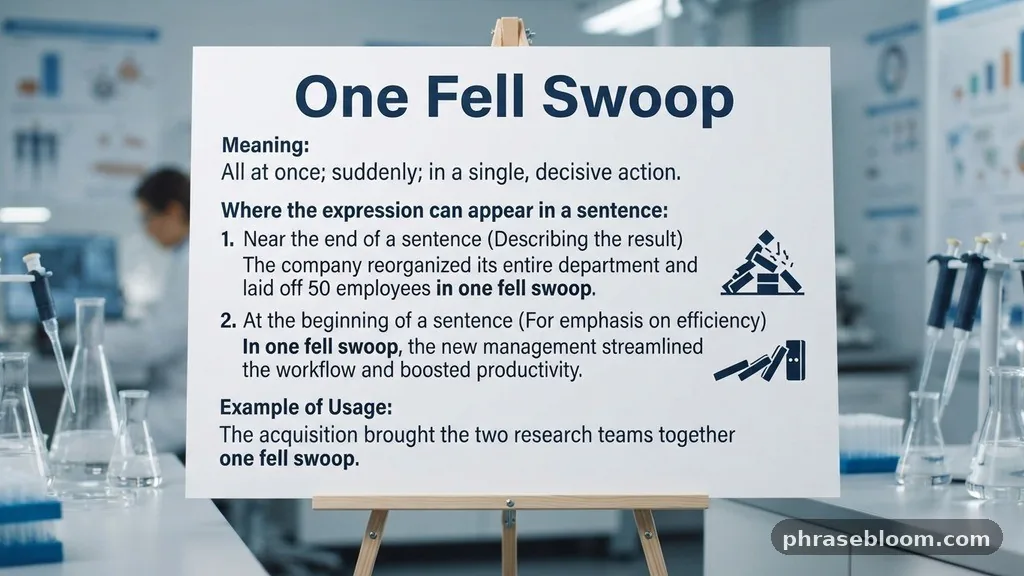
The expression can appear near the end of a sentence, where it describes the result of an action. It can also appear at the beginning when the writer wants to emphasize the unusual efficiency or force of the event.
- “The acquisition brought the two research teams together in one fell swoop.”
- “In one fell swoop, the new schedule removed three scheduling conflicts.”
- “The executive addressed several complaints at one fell swoop.”
These sentences use the idiom as a modifier of the action. It does not function as a noun naming a person, object, or independent event in the ordinary grammatical sense.
Literal and Figurative Meaning
The literal meaning refers to a fierce swooping movement, especially by a bird. In modern business English, however, the figurative meaning is almost always intended.
Someone describing an actual hawk might write, “The hawk caught the mouse in a single swoop.” That sentence does not use the full idiom in the usual figurative way. By contrast, “The budget cuts eliminated five programs in one fell swoop” clearly uses the expression metaphorically.
One Fell Swoop in Professional Writing
Business writers use the phrase to describe a decision with several effects. It can work in reports, presentations, emails, announcements, and strategy documents, especially when the writer wants a concise alternative to “through one action.”
For instance, a technology report might state, “The platform upgrade improved access controls, automated backups, and reduced maintenance work in one fell swoop.” The sentence is effective because it identifies the specific results instead of leaving the idiom to carry the entire message.
The expression also appears in organizational communication. A human resources announcement could say, “The revised benefits portal lets employees update dependents and review coverage in one fell swoop.” Here the phrase presents several related actions as a convenient combined process.
Company Policies and Internal Announcements
“The new remote-work policy clarified approval rules and standardized team schedules in one fell swoop.” This example works because two concrete changes result from one policy.
“The company announcement introduced the new office location, opening date, and parking procedure at one fell swoop.” The wording is understandable, although “in a single announcement” may sound more precise if the writer wants to emphasize communication rather than action.
In formal workplace writing, clarity should come first. The idiom adds color, but it should not replace the details readers need to understand what changed.
Training and Software Rollouts
“The training session covered the updated safety rules and demonstrated the reporting tool in one fell swoop.” This sounds natural because one session genuinely handles two connected objectives.
“The new software was introduced company-wide in one fell swoop” combines two ideas: the rollout reached the entire organization, and it happened as one coordinated action. If timing is important, “through a single organization-wide rollout” may be more exact.
Reports and Organizational Changes
“The restructuring combined three departments and removed duplicate management roles in one fell swoop.” This use is direct, but its dramatic tone may not suit every adiece because restructuring can affect people’s jobs.
“The report identifies the policy change as a way to improve compliance and reduce processing delays in one fell swoop.” The phrase works here because the report is describing a combined benefit, not making a casual joke about a sensitive event.
One Fell Swoop Examples for Everyday Use
Good one fell swoop examples show more than the phrase’s dictionary definition. They reveal its tone, placement, and relationship to the action being described.
| Context | Example sentence | Why it works |
|---|---|---|
| Workplace email | “The revised form collects the information we previously requested in three separate emails in one fell swoop.” | One form replaces several requests. |
| Benefits announcement | “Employees can confirm coverage and add dependents in one fell swoop through the new portal.” | One process handles two related tasks. |
| Company meeting | “The meeting will introduce the merger team and explain the reporting structure at one fell swoop.” | One meeting delivers two announcements. |
| Marketing communication | “The campaign promotes the product and highlights its environmental certification in one fell swoop.” | One campaign serves two communication goals. |
| Public statement | “The statement apologized for the delay and announced the revised launch date in one fell swoop.” | One public message addresses two issues. |
| Personal writing | “I cleaned the garage and donated the unused equipment in one fell swoop.” | One period of activity produces two results. |
The phrase is strongest when the sentence names the separate effects. “We fixed everything in one fell swoop” is grammatically fine, but “everything” is vague and gives the reader little useful information.
It is also useful to consider tone. “One fell swoop” can sound energetic, witty, or dramatic, so it may be less suitable for a condolence message, a serious legal finding, or a communication about personal harm.
Common Mistakes and Misunderstandings
Because the phrase contains an old word and a vivid image, writers sometimes alter it incorrectly. Most errors involve replacing fell, misunderstanding the phrase’s structure, or using it where a plainer expression would communicate more clearly.
“One Fell Soup”
A common humorous mistake is “one fell soup.” The correct phrase is “one fell swoop,” referring to a sudden movement through the air.
“Soup” may appear in jokes or deliberate wordplay, but it is not part of the standard English idiom. Formal writing should use “swoop.”
“One Foul Swoop”
“Foul” means unpleasant, unfair, or offensive, but it is not the word in the established expression. The correct form remains “one fell swoop,” even when the action being described is harmful.
Treating It as a Noun
A writer might say, “The one fell swoop made several changes.” That construction is awkward because the phrase normally describes how an action occurs rather than naming the action itself.
A clearer revision would be, “The company made several changes in one fell swoop.” The phrase follows the action and explains its manner or timing.
Using “Companywide” as a Synonym
“One fell swoop” does not mean “companywide.” The first expression means all at once, while the second means involving the entire company. A companywide change may happen gradually, and an action completed in one fell swoop may affect only a small group.
Confusing these expressions creates a difference in meaning, not merely a spelling problem. Writers should identify whether they mean speed and unity of action or organizational scope.
Overusing the Idiom
Repeating the phrase in every report or presentation can make writing sound theatrical. In many contexts, “at once,” “simultaneously,” “through one decision,” or “in a single step” is more direct.
Synonyms and Clearer Alternatives
The best alternative depends on the exact meaning. Some synonyms emphasize timing, while others emphasize efficiency, suddenness, or the number of outcomes.
- All at once: Best for several events happening together.
- At the same time: A neutral phrase with little dramatic force.
- In a single action: Useful in formal reports and instructions.
- In one move: Conversational and often strategic in tone.
- With one decision: Appropriate when a choice creates several effects.
- Simultaneously: Precise and formal, though sometimes less natural.
- In a single step: Good for procedures and process descriptions.
- All in one: Informal and useful for combined services or tasks.
Compare these sentences: “The update fixed three errors in one fell swoop” and “The update fixed three errors in a single release.” The first has more personality, while the second gives a technical audience a more specific description of how the result was achieved.
“All at once” is not always a perfect substitute. It can suggest simultaneous timing, whereas “in one fell swoop” often means that one action produces several consequences even if those consequences appear over a short period.
Choosing the Right Tone and Context
The idiom is common in conversation, journalism, commentary, and general professional writing. It is not inherently informal, but its dramatic quality means that tone deserves attention.
A marketing team might write, “The new package gives customers storage, support, and reporting tools in one fell swoop.” That wording is lively and persuasive. A contract might instead say, “This amendment replaces the three procedures listed below,” because legal drafting generally benefits from exact description over figurative language.
Business and Workplace Communication
In an email, the phrase can make a routine message sound more approachable: “Please review the attached document and submit your approval in one fell swoop.” Still, the sentence may be unclear if the reader does not know what “one” action involves.
A stronger version would name the action: “Please review the document and submit your approval through the same form.” The idiom is optional, not required for polished business English.
Academic and Formal Writing
Academic writers can use the expression when discussing a historical event, literary passage, or argument with several consequences. In a technical methodology section, however, “in a single procedure” or “through one intervention” is often more exact.
Formal writing does not ban idioms. It simply asks whether the idiom contributes meaning or merely adds decoration.
Marketing and Public Communication
Advertising often benefits from memorable expressions, so “one fell swoop” can be effective in a headline or campaign message. Public communications should use it carefully if the subject involves layoffs, accidents, illness, or other serious matters.
The phrase’s violent origin is not always obvious to readers, but its dramatic tone remains. A neutral alternative may be more respectful in sensitive announcements.
How to Use the Phrase Correctly
A reliable way to use the idiom is to identify one action and at least two results. If you cannot name the combined results, the phrase may be unnecessary or too vague.
- Identify the action that produced the results.
- List the separate effects or tasks involved.
- Place “in one fell swoop” or “at one fell swoop” after the action.
- Check whether the dramatic tone fits the audience.
- Replace the idiom with a precise alternative if clarity would improve.
For example, begin with the facts: a new form reduces data entry and shortens approval time. A polished sentence could then read, “The new form reduces data entry and shortens approval time in one fell swoop.”
If the intended meaning is only that events happened simultaneously, “at the same time” may be better. If the intended meaning is that one decision caused several consequences, “through a single decision” may communicate more accurately.
One Fell Swoop in a Sentence: Copyable Patterns
The following patterns are adaptable to workplace communication, personal writing, and formal explanation. Each one makes the central action and its results visible.
- “The revised process combines [task one] and [task two] in one fell swoop.”
- “The decision addressed [problem one], [problem two], and [problem three] at one fell swoop.”
- “By [specific action], the team achieved [result one] and [result two] in one fell swoop.”
- “The update removed the duplicate steps and improved reporting in one fell swoop.”
- “The announcement explained the change and outlined the next steps at one fell swoop.”
These patterns work because they do not rely on the idiom alone. The bracketed details tell readers exactly what happened, while the expression adds a sense of combined action.
Here is a more formal alternative: “The revised process achieves both objectives through a single procedure.” Here is a more conversational version: “The new process handles both jobs in one move.”
Frequently Asked Questions
What is the one fell swoop meaning?
It means accomplishing several things at once or producing several results through one action. The phrase may suggest speed, force, or sudden impact.
Is “at one fell swoop” or “in one fell swoop” correct?
Both are correct. “At one fell swoop” is the original Shakespearean form, while “in one fell swoop” is a common modern variation.
Does “fell” mean “fallen” in this phrase?
No. In the older expression, fell means fierce, deadly, or savage. The word helps create the image of a violent bird’s sudden attack.
Can I use one fell swoop in professional writing?
Yes, provided the tone fits the context. It works in many emails, reports, announcements, and presentations, but a precise phrase such as “through a single action” may be better in legal or highly technical writing.
What is a good alternative to one fell swoop?
Useful alternatives include “all at once,” “in a single action,” “at the same time,” “in one move,” and “through one decision.” Choose the alternative that best expresses timing, efficiency, or cause.
Conclusion
The phrase One Fell Swoop means that several effects occur through one action. Its origin in Shakespeare’s Macbeth gives it a dramatic image, but modern speakers use it in both serious and everyday contexts.
Use “in one fell swoop” or the original “at one fell swoop,” then name the specific results so the sentence stays clear. If the expression feels too dramatic, replace it with “in a single action” or “all at once.” The right choice depends on meaning, tone, and audience.
You may also like: Die vs Dice: Meaning, Plural, and Usage Explained