
How Was Your Night? Meaning and Usage Explained
The phrase “How was your night?” is a friendly past-tense question about someone’s evening, sleep, or overnight experience. The exact meaning depends on the situation: a friend may be asking about a date or party, while a family member may be asking how well you slept.
Understanding the How Was Your Night? Meaning and Usage helps you choose a natural response in conversational English. You’ll learn what the question usually implies, how its tone changes with context, and how to answer with responses such as “It was good,” “It was great,” or “It was okay.”
The Direct Meaning of “How Was Your Night?”
“How was your night?” asks someone to describe or evaluate the night that has just passed. Because “was” is the past tense of “be,” the question normally refers to a completed period rather than the present moment.
The word “night” can refer to several related experiences. It may mean the hours someone spent sleeping, the evening they spent away from home, or the general quality of their time between evening and morning.
For example, a parent might ask a child, “How was your night?” and mean, “Did you sleep well?” A friend who knows you went to a concert might ask the same question and mean, “Did you enjoy the concert and the rest of your evening?”
The phrase is usually warm and informal. It often appears in polite conversation, small talk, or a personal exchange between people who already know something about one another’s plans.
In simple terms, the question can mean any of the following:
- Did you sleep well?
- Did you enjoy your evening?
- How did your date go?
- Did you have a good time at the party?
- Was your night difficult, busy, relaxing, or enjoyable?
The surrounding context supplies the missing detail. If the speaker knows where you went, the question probably concerns those evening activities. If the conversation happens early in the morning at home, it may be asking about sleep.
How Context Changes the Meaning
The phrase does not have one fixed interpretation in every conversation. Asking about someone’s night is often intentionally broad, allowing the other person to decide how much information to share.
Asking about sleep
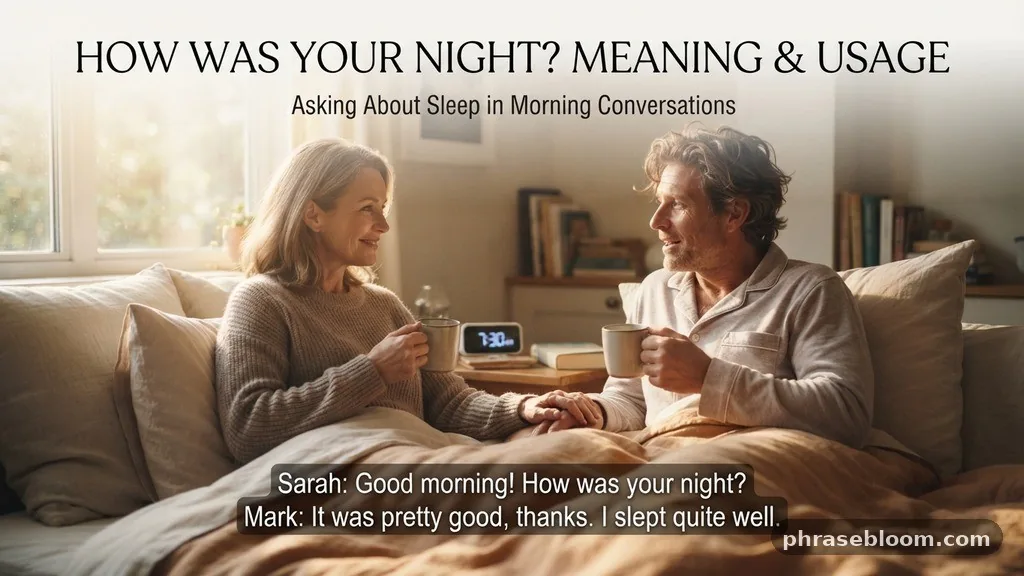
In a morning conversation, “How was your night?” commonly means “How did you sleep?” A partner might ask it after noticing that you were awake during the night, while a caregiver might use it to check whether a child or patient rested comfortably.
Example: “Good morning. How was your night?” “It was pretty good. I slept through until seven.” Here, the answer focuses on sleep rather than entertainment or social plans.
If you want to ask specifically about sleep, clearer alternatives include “Did you sleep well?” and “How did you sleep?” These questions reduce ambiguity, especially when speaking with an English learner.
Asking about a date
After a romantic date, “How was your night?” may invite the person to talk about the date without forcing them to reveal private details. A friend might ask it with a curious but supportive tone.
Example: “You went out with Jordan last night. How was your night?” A natural answer could be, “It was great. We had dinner and talked for hours.”
The same wording may also sound slightly playful or knowing if the speaker suspects the date went especially well. Tone, facial expression, and the relationship between the speakers affect that interpretation.
Asking about a party or event
When someone attended a party, concert, wedding, or other event, the question usually means “Did you have a good time?” It may refer to the entire outing rather than one specific activity.
Example: “How was your night at the company party?” “It was fun, although I left early because I was tired.” This response gives both a positive evaluation and a useful detail.
Asking about evening activities
Sometimes the speaker simply wants to know what happened during the previous evening. The question may invite a short update about dinner, a movie, work, travel, or time spent with friends.
Example: “How was your night?” “It was quiet. I cooked dinner, watched a documentary, and went to bed early.” Nothing unusual or dramatic is required for the question to sound natural.
Why the Past Tense “Was” Matters
“How was your night?” uses the past tense because the night has ended. The question asks for an evaluation of something that happened before the moment of speaking.
This pattern is common in English. We say “How was your weekend?” after the weekend ends, “How was the movie?” after someone watches it, and “How was your trip?” after someone returns.
The structure is straightforward:
| Part | Function | Example |
|---|---|---|
| How | Asks for an evaluation or description | How |
| was | Past-tense form of “be” | was |
| your | Shows whose experience is being discussed | your |
| night | Names the period or experience | night |
“How is your night?” has a different meaning because “is” is present tense. It can ask about a night that is still happening, although that wording is less common than “How is your evening?”
“How will your night be?” refers to the future. Someone might ask it when discussing plans, but it sounds more formal or less natural than “What are you doing tonight?”
For a useful reference on forming questions in English, readers can consult Cambridge Dictionary’s guide to questions. The key point is simple: the verb tells you whether the question concerns the past, present, or future.
Natural Responses to the Question
A good answer can be short or detailed. The best response depends on how close you are to the speaker, how much time you have, and whether the question sounds like casual small talk or a genuine invitation to talk.
Positive responses
“It was good” is a neutral positive response. It shows that the night went well without giving many details.
“It was great” sounds more enthusiastic. You might use it after a memorable date, an enjoyable party, or a relaxing night with friends.
“It was wonderul” and “I had a really nice time” are also positive, but they can sound more expressive. “I slept really well” is more precise if the speaker is asking about rest.
- “It was good. I got plenty of sleep.”
- “It was great. The concert was amazing.”
- “It went well. We had dinner and talked for a long time.”
- “Really relaxing. I stayed home and read.”
- “Excellent. I finally finished the book I’d been reading.”
Each answer gives the listener a slightly different amount of information. “It was good” closes the subject politely, while “The concert was amazing” encourages a follow-up question.
Neutral or mixed responses
“It was okay” usually means the night was acceptable but not especially enjoyable. Depending on tone, it may also suggest disappointment.
Other neutral answers include “It was fine,” “Not bad,” and “Pretty quiet.” These expressions are common in casual speech and do not necessarily invite a long conversation.
Example: “How was your night?” “It was okay. I had a lot of work to finish.” The second sentence explains why the answer is not strongly positive.
Negative responses
If the night was difficult, you can say “It was rough,” “Not very good,” or “I didn’t sleep well.” These responses are direct without being overly dramatic.
Example: “How was your night?” “Not great. The neighbors were loud, and I barely slept.” This answer makes it clear that the problem involved sleep, not necessarily the entire evening.
A more personal negative response might be, “It was a hard night, but I’m feeling better now.” That wording acknowledges the difficulty while signaling that you may not want to discuss every detail.
“How Was Your Night?” in Workplace and Social English
The phrase can appear at work, but its suitability depends on the relationship and subject. A manager asking an employee about a work-related event might say, “How was your night at the client dinner?” A coworker may ask, “How was your night?” after learning that you worked a late shift.
In professional settings, the question should have a reasonable connection to the conversation. Asking a colleague about a business trip, conference reception, or evening shift is usually appropriate, while asking for intimate personal details may cross a boundary.
Workplace examples
“How was your night at the conference?” invites an evaluation of the conference evening. “Did you get enough rest?” is a better choice if the concern is sleep or travel fatigue.
“How was your night shift?” is more specific than “How was your night?” It asks about the person’s work experience and avoids confusion with social or personal activities.
“How was the team dinner?” focuses on a named event. This is often the clearest option in internal communication because it tells the listener exactly what part of the night interests you.
Text messages and informal conversation
In a text message, “How was your night?” may sound caring, curious, or flirtatious. The meaning depends heavily on the previous conversation and the relationship between the people texting.
After a first date, someone might text, “How was your night?” as a broad way to ask whether the evening felt successful. After a friend has gone to a party, the same message is simply a request for an update.
Short answers work well in text messages: “Good,” “It was fun,” “Pretty quiet,” or “A little rough, honestly.” A longer answer is appropriate when the sender has shown genuine interest.
Common Grammar and Usage Questions
The expression is grammatically complete as written. “How” introduces the question, “was” functions as the past-tense verb, “your” identifies the person involved, and “night” names the experience being evaluated.
Is “How was your night?” polite?
Yes. It is generally a polite and friendly question, especially when the speaker uses a warm tone. It is less formal than “How did your evening proceed?” and much more natural in everyday conversation.
However, politeness does not guarantee that every context is appropriate. A person may not want to discuss a date, party, or private evening, so a brief answer should be accepted without pressure.
Is “How was your night?” the same as “How did your night go?”
These questions are very similar. “How did your night go?” often sounds slightly more conversational and may focus on how events unfolded, while “How was your night?” asks for a general evaluation.
Compare these examples: “How was your night?” “It was relaxing.” “How did your night go?” “It started badly, but things improved after dinner.” The second version can encourage a narrative about events.
Can “night” refer to the previous evening?
Yes. In everyday English, “last night” clearly refers to the previous night, but “your night” can also refer to the previous evening when the context makes that clear.
If precision matters, use “How was your evening?” for activities before bedtime and “How did you sleep?” for rest. Clearer wording is especially useful in customer service, healthcare, education, and professional communication.
Related Expressions and Their Differences
Several expressions overlap with “How was your night?” but carry slightly different meanings. Choosing among them helps you sound natural and avoid asking a broader question than you intended.
| Expression | Most likely meaning | Typical situation |
|---|---|---|
| How was your night? | How was your evening, sleep, or overnight experience? | General conversation |
| How did you sleep? | Was your sleep comfortable and sufficient? | Morning conversation |
| How was your evening? | How did your evening activities go? | Social or polite conversation |
| How did your night go? | How did the events of the night develop? | Casual conversation after plans |
| Did you have a good night? | Did you enjoy yourself? | Parties, dates, dinners, and events |
| What did you do last night? | Which activities did you do? | Requesting specific information |
“How was your evening?” is often better in a formal or professional setting because “evening” focuses on social and work-related activities. “How did you sleep?” is more direct when rest is the real subject.
“Did you have a good night?” can sound more personal than “How was your night?” In some contexts, it may carry a romantic or sexual suggestion, so speakers should consider the relationship and tone before using it.
Examples You Can Copy and Adapt
Natural examples help show how flexible the phrase is. Each sentence below uses “How was your night?” in a different setting, so the surrounding detail clarifies the intended meaning.
- Morning at home: “How was your night? You seemed restless.” This clearly asks about sleep.
- After a date: “You went out with Maya last night. How was your night?” The question invites a personal update without demanding details.
- After a party: “How was your night at the birthday party?” The added phrase identifies the event.
- After a concert: “How was your night? Did you enjoy the opening band?” The follow-up shifts the conversation toward the music.
- With a coworker: “How was your night shift?” This version is precise because it refers to work.
- In a text message: “Hope you got home safely. How was your night?” The first sentence makes the question sound caring.
- After travel: “How was your night at the hotel?” This may ask about both sleep and the hotel experience.
- After an evening class: “How was your night class?” The question concerns the class rather than the person’s whole evening.
- After a difficult event: “How was your night after the storm?” The context signals that the speaker is checking on the person’s wellbeing.
- After a quiet evening: “How was your night?” “Pretty peaceful. I cooked and watched a movie.” The answer adds enough detail to continue naturally.
Notice that the phrase often works best when the speaker has some shared context. If the listener has no idea what “night” refers to, a more specific question can prevent confusion.
For example, “How was the networking event?” is clearer than “How was your night?” when the event is the real subject. Specific questions also make professional conversations easier because they limit the answer to an appropriate topic.
How Tone and Relationship Affect the Question
The words remain the same, but tone can change the social meaning. A cheerful voice may communicate friendly interest, while a quiet voice may show concern after a difficult experience.
In a romantic conversation, “How was your night?” can sound affectionate or flirtatious. Between close friends, it may invite gossip about a date or party. Between acquaintances, it usually functions as brief small talk.
Text messages remove many vocal clues, so punctuation and context become more important. “How was your night?” sounds neutral, while “How was your night?” followed by a heart emoji may feel more intimate.
When a short answer is enough
You do not need to provide a detailed story every time someone asks the question. “Good, thanks,” “It was fine,” or “Pretty quiet” are complete and natural responses.
If you want to end the exchange politely, add “How about yours?” This returns the question and keeps the conversation balanced.
When to give more detail
Give more detail when the speaker knows the context, asks a follow-up question, or appears genuinely concerned. A useful pattern is evaluation plus one supporting detail.
Examples include “It was great. We found a small restaurant downtown,” and “It was rough. I had trouble sleeping.” This pattern sounds natural because it answers the question and provides a reason.
Common Mistakes and Better Alternatives
Most mistakes with this phrase involve tense, meaning, or unnecessary directness rather than serious grammar errors. Small changes can make the question more precise and socially appropriate.
Using the wrong tense
“How is your night?” is not usually the best choice when the night has already ended. Use “How was your night?” for a completed evening and “How is your evening?” for an evening that is happening now.
Correct example: “You got home this morning. How was your night?” The past tense matches the finished experience.
Using a broad question when a specific one is better
“How was your night?” can be ambiguous. If you want to ask about sleep, say “Did you sleep well?” If you want to ask about a date, say “How did the date go?”
Specific wording is especially helpful with children, English learners, patients, and colleagues who may interpret “night” differently.
Pressuring someone to share private information
After asking about a date or party, avoid treating a short answer as an invitation to investigate. If someone says “It was fine,” a respectful response is “Glad to hear it,” not a series of increasingly personal questions.
Assuming a positive answer
“How was your night?” does not assume that the night was enjoyable. The answer may be positive, neutral, or negative, so listen for the person’s actual evaluation.
Instead of saying “I knew you had a great time,” try “Tell me about it if you feel like talking.” This leaves room for a more complicated experience.
Choosing the Best Wording for Your Situation
The safest version depends on what you want to know. Start by identifying the subject: sleep, a date, a party, work, travel, or the person’s general wellbeing.
- Use “How was your night?” for a broad, friendly question.
- Use “How did you sleep?” when rest is the main concern.
- Use “How was your evening?” for a slightly more polished social question.
- Use “How did the date go?” when the date is the specific topic.
- Use “How was the event?” when discussing a meeting, party, concert, or conference.
- Use “How was your night shift?” when asking about someone’s work.
For an intermediate English learner, “How was your night?” is a useful phrase because it is short, common, and flexible. Memorizing a few natural responses makes it easier to participate in morning conversations, text messages, and casual workplace exchanges.
For professional communicators, clarity should guide the choice. A manager checking on an employee after travel may say, “Did you get enough rest?” rather than using a broad phrase that could seem personal.
For anyone writing dialogue, the expression can reveal a relationship. A close friend may ask it casually, a romantic partner may ask it tenderly, and a coworker may ask it only when the context is already clear.
Frequently Asked Questions
What is the meaning of “How was your night?”
It asks how someone’s previous night went. Depending on context, it may refer to sleep, a date, a party, a work shift, or general evening activities.
Is “How was your night?” correct English?
Yes. It is a grammatically correct and natural question in conversational English. The past-tense verb “was” is appropriate when the night has ended.
What is a natural response to “How was your night?”
You can say “It was good,” “It was great,” “It was okay,” “Pretty quiet,” or “Not very good.” Add a detail if you want to continue the conversation.
Does “How was your night?” ask about sleep?
It can, especially in the morning or when the speaker knows you were resting. If sleep is the only subject, “Did you sleep well?” is clearer.
Is “How was your night?” formal?
It is polite but generally informal or conversational. In a formal setting, use a more specific question such as “How did the conference dinner go?” or “Did you get enough rest?”
Conclusion
The phrase “How was your night?” is a natural past-tense question with a flexible meaning. It can ask about sleep, a date, a party, work, or the general quality of someone’s evening, so context and tone do much of the work.
Understanding How Was Your Night? Meaning and Usage makes it easier to choose a precise response and a suitable alternative. Use “It was good” for a simple positive reply, add a detail when you want to continue, and choose “Did you sleep well?” or “How did the event go?” when greater clarity matters.
You may also like: Wonder vs Wander: Meaning, Difference and Usage