
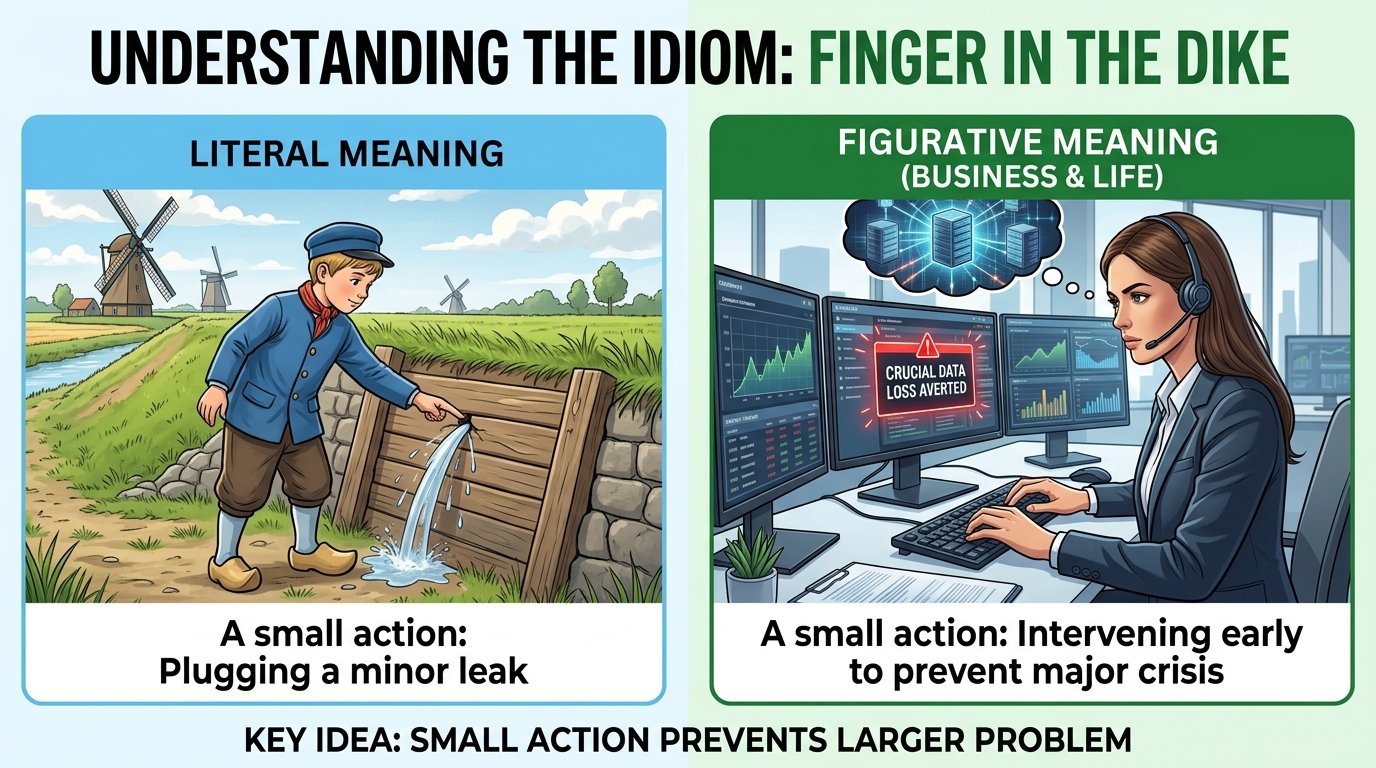
The idiom finger in the dike describes a small action that prevents a larger problem from becoming worse. It suggests that someone takes a timely action, often under pressure, to stop a leak, failure, crisis, or other danger before it grows.
Although the image sounds literal, the expression is usually used as a metaphor. It can describe a person, repair, policy, decision, or temporary measure that keeps a serious situation under control.
For example, an employee who notices a billing mistake and corrects it before hundreds of customers are affected may act as a finger in the dike.
Understanding this idiom also means knowing when it fits, what it means, where it came from, and how to use it naturally in everyday and professional writing.
Finger in the Dike: Why Does the Confusion Exist?
The phrase can be confusing because its literal image is unusual. A person putting a finger into a dike seems far too small to stop a flood. However, that contrast is exactly what gives the expression its power.
A dike is a water barrier designed to hold back water. If a small leak appears, plugging it quickly can prevent a much larger breach. The image therefore represents problem solving through immediate and focused action.
In modern English, the phrase rarely refers to an actual flood. Instead, it describes damage prevention, crisis prevention, and early intervention.
The important idea is the relationship between the action and the result:
small action → immediate prevention → larger problem avoided
That meaning separates the expression from a general quick fix. A quick fix may simply repair something temporarily, while a finger in the dike specifically emphasizes preventing a situation from escalating.
Why It Matters in Professional Settings
The expression can work well in business, management, policy, technology, and community discussions.
For instance, a temporary software patch might prevent a system-wide outage. An early financial audit might uncover an error before it causes costly delays. A temporary regulation might protect an organization while lawmakers develop a permanent solution.
In these situations, the expression praises quick thinking and timely choice.
However, formal documents sometimes benefit from neutral wording. Instead of saying something was a finger in the dike, a report may describe it as an early intervention, temporary measure, or stopgap solution.
This approach makes the meaning easier for international readers and audiences unfamiliar with the idiom.
Finger in the Dike: Which One Is Correct?
The standard expression is finger in the dike. However, English also contains the spelling dyke, especially in British English and in historical or regional usage.
The words dike and dyke can refer to a raised bank or barrier used to control water. Depending on the audience, writers may also use bank or embankment.
Therefore, the main expression can appear in different forms, but the underlying idea remains the same: a small action helps hold back disaster.
American English commonly uses “dike,” while British English may use “dyke” or related terms. When writing for a global audience, a short explanation can remove uncertainty.
For example, you might write that a finger in the dike is “a small act that prevents a larger failure.”
That explanation is particularly useful when readers may not know the figurative meaning of the phrase.
What Does “Finger in the Dike” Mean? Origins, Definition, and Usage
The phrase refers to an action that temporarily prevents a much larger problem.
Its meaning is closely connected with the image of someone stopping water from escaping through a small opening in a dike. The action does not permanently solve every problem. Instead, it buys valuable time.
That is why temporary solution, stopgap, and short-term solution are closely related concepts.
Definition of Finger in the Dike
Finger in the dike means a small intervention that prevents a larger problem, failure, or disaster from developing.
The person or thing performing the action may be a manager, employee, volunteer, policy, repair, or tool.
Consider this example:
A technician notices a damaged server connection and makes a quick repair before the company’s entire network goes offline.
The repair is a preventive action because it stops the situation from becoming more serious.
In another example, a volunteer may organize an emergency solution that prevents an event from being canceled. Here, the volunteer becomes the small team effort that prevents a wider failure.
Origins of the Word “Finger in the Dike”
The expression is connected with a well-known story about a child who notices water leaking through a dike. The child places a finger into the opening and continues holding it there to stop the water.
The story illustrates the importance of acting before a minor problem becomes a disaster.
Whether the story is treated as legend or popular historical folklore, its symbolic meaning is clear. A very small action can have an enormous effect when it happens at exactly the right moment.
This is why the idiom emphasizes urgency, prevention, and immediate harm rather than permanent repair.
Why Finger in the Dike Is a Commonly Misused Expression
People sometimes use the phrase for any small action. That is not quite accurate.
A small action becomes a finger in the dike only when it helps prevent escalation, stop damage, or keep a larger problem under control.
For example, simply smiling during a difficult meeting does not qualify. Calling an important client and correcting a serious booking error before the client leaves does.
The action must have a clear cause-and-effect relationship.
It should be possible to explain:
- What problem was developing?
- What small action was taken?
- What larger consequence did that action prevent?
If those questions cannot be answered, another expression may be more appropriate.
Exploring the Significance of Finger in the Dike in Everyday Language
The phrase is useful because it describes a situation that occurs in many areas of life.
A parent may quickly fix a broken lock before a security problem develops. A teacher may address a small conflict before it turns into a major dispute. A manager may correct an accounting error before it affects an entire department.
In each case, the action is small compared with the potential problem.
The phrase can therefore describe crisis prevention, problem solving, and damage prevention without suggesting that the larger issue has been permanently solved.
Role of a Finger in the Dike in a Professional Environment
In a workplace, a quick intervention can protect time, money, customers, or reputation.
Suppose a company discovers that an automated system is sending incorrect invoices. One employee identifies the problem and temporarily disables the faulty process. That decision may prevent thousands of incorrect invoices.
The employee’s action functions as a finger in the dike.
Similarly, a software team may release a temporary patch while engineers work on the underlying cause. The patch keeps the service operating, but it does not necessarily represent a true cure.
That distinction is important. A finger in the dike is often valuable precisely because it buys time for a stronger solution.
Common Reasons for the Finger in the Dike Misuse
Several mistakes appear when people use this idiom.
First, writers may use it after the damage has already happened. The phrase works best when the action is preventive.
Second, people may use it to describe something that has no meaningful effect. A small action must actually help stop a larger problem.
Third, writers sometimes mix metaphors. Combining finger in the dike with unrelated expressions such as “putting the cart before the horse” can make a sentence confusing.
Fourth, the phrase can be overused. Calling every minor improvement a finger in the dike weakens its impact.
Finally, some audiences may not recognize the expression. In formal or international writing, terms such as temporary measure, early intervention, or stopgap solution may communicate the idea more clearly.
Side-by-Side Comparison: Finger in the Dike and Related Expressions
| Expression | Main Meaning | Typical Tone |
|---|---|---|
| finger in the dike | Small action preventing a larger problem | Usually positive |
| stopgap | Temporary solution used until something better arrives | Neutral |
| bandage the wound | Temporary fix that treats a visible problem | Often critical |
| holding back the tide | Trying to resist a powerful or growing force | Often negative |
| quick fix | Fast solution to an immediate problem | Neutral |
| temporary measure | Action intended to work for a limited period | Formal |
| early intervention | Action taken before a problem becomes serious | Professional |
| true cure | Solution that addresses the underlying problem | Positive |
The difference becomes clearer when you consider intention.
A finger in the dike prevents expansion. A stopgap solution buys time. Bandage the wound can suggest that the underlying issue remains. Holding back the tide may suggest that the effort is ultimately difficult or futilely delaying an inevitable result.
Everyday Examples of Finger in the Dike in Language
Here are several natural examples.
A manager notices a billing error and corrects it before thousands of customers receive incorrect invoices. Her action was a finger in the dike.
A technician applies a temporary patch to a server problem while engineers investigate the cause. The patch acts as a finger in the dike.
A volunteer organizes extra staff when an event suddenly loses several workers. The effort becomes a small intervention that prevents cancellation.
A government introduces a temporary rule while lawmakers develop a broader policy. The measure serves as a finger in the dike because it prevents immediate harm.
A school counselor intervenes early when two students begin arguing repeatedly. The early intervention prevents a larger conflict.
These examples show why concrete verbs work well with the expression. Writers can use words such as act, serve, plug, patch, stop, prevent, alert, repair, and reduce.
For example, an employee can patch an error, alert a manager, or stop a problem from spreading.
“How to Spell Finger in the Dike”: Remember the Correct Spelling
If you are wondering how to spell “finger in the dike”, the common American English spelling is:
finger in the dike
The word “dike” refers to a barrier that helps control water.
You may also encounter “dyke,” particularly in British English and historical contexts. Therefore, seeing the alternative spelling does not automatically mean that the writer has made a mistake.
For most American English content, however, finger in the dike is the straightforward spelling to use.
Practice Sentences
Practice can make the meaning easier to remember.
Her early audit acted as a finger in the dike and prevented costly delays.
The emergency repair served as a finger in the dike while the engineers searched for a permanent fix.
The volunteer’s quick decision was a finger in the dike that saved the event.
The temporary policy acted as a stopgap solution until lawmakers approved a permanent measure.
The technician patched the breach before it caused a major system failure.
Notice that each example contains a preventive action. That is the key feature of the idiom.
Literature and Media Mentions: Correct Usage of Finger in the Dike
The image behind finger in the dike has remained memorable because it creates a strong contrast between a tiny action and a huge threat.
Literature, journalism, speeches, business writing, and commentary can use this contrast to describe people who prevent larger failures.
A leader might praise an employee by saying that the employee was a finger in the dike during a difficult period. A journalist might describe a temporary government policy as a finger in the dike against a growing crisis.
However, writers should consider tone and audience.
In an informal article or speech, the metaphor can be vivid and memorable. In a highly formal report, temporary measure, early intervention, or preventive action may be clearer.
The phrase is strongest when followed by a concrete result. Instead of simply saying someone was a finger in the dike, explain what they prevented.
For example, say that an early audit reduced lost hours by 40% and prevented a larger operational failure. Concrete evidence makes the metaphor more credible.
Frequently Asked Questions about Finger in the Dike
What’s the correct way to spell “finger in the dike”?
The common American spelling is finger in the dike. “Finger in the dyke” also appears, especially in British English and historical writing.
Is “finger in the dike” a French phrase?
No. Finger in the dike is an English idiom based on a story about stopping water from escaping through a barrier.
Why is spelling “finger in the dike” correctly important?
Correct spelling helps readers recognize the idiom immediately and prevents confusion when searching dictionaries, articles, examples, or other English-language resources.
Can finger in the dike describe a person?
Yes. A person, tool, policy, repair, or decision can serve as a finger in the dike when it prevents a larger problem.
Is finger in the dike formal or informal?
It works in many contexts, but formal reports may prefer temporary measure, stopgap, or early intervention for clearer professional communication.
Conclusion: Why It’s Important to Use “Finger in the Dike” Correctly
Finger in the dike describes a small but important action that prevents a larger problem from developing. Its power comes from the contrast between a tiny intervention and a potentially serious consequence.
Use the expression when an action genuinely provides problem solving, damage prevention, or crisis prevention. Make the prevention clear by explaining what happened and what larger failure was avoided.
The phrase works in everyday conversations, business writing, policy discussions, and leadership contexts. However, formal audiences may understand temporary measure, stopgap solution, or early intervention more easily.
Remember the central idea: a small action matters when it happens at the right time and prevents something much bigger.
FAQs
What does finger in the dike mean?
It means a small action that prevents a much larger problem from becoming worse, emphasizing timely intervention, prevention, and immediate practical action.
How do you use finger in the dike?
Use it for a preventive action that stops escalation, such as fixing an error before it spreads or preventing a crisis from growing.
Is finger in the dike an idiom?
Yes. It is an English idiom based on an image of stopping water through a dike and represents preventing larger problems.
What is another word for finger in the dike?
Related terms include stopgap, temporary measure, early intervention, quick fix, short-term solution, and preventive action, depending on the intended meaning.
Is dike or dyke correct?
Both spellings exist. “Dike” is common in American English, while “dyke” also appears in British English and historical usage.
Related: Any Problem or Any Problems · 24 Hours’ Notice · Team That, Team Who, or Team Which