
Die vs Dice: Meaning, Plural, and Usage Explained
Die vs dice is a question about number, not two completely different kinds of gaming object. Die is the singular noun for one numbered object, while dice is traditionally the plural form for two or more. In modern casual English, some speakers also use “dice” for one object, especially in gaming communities, but “one die” remains the clearest standard choice in formal writing.
The distinction matters in tabletop games, board games, role-playing games, probability discussions, and everyday descriptions of chance. Once you know how singular and plural nouns work, terms such as six-sided die, polyhedral dice, d6, and d20 become much easier to understand and use accurately.
Die vs Dice: The Direct Answer
A die is one numbered playing object, usually marked with faces that display numbers or symbols. Dice is traditionally the plural noun for more than one die, although “dice” is also widely used as a singular mass or count noun in informal gaming language.
For example, “Roll one die” refers to a single object, while “Roll two dice” refers to two objects. The sentence “The player rolled three dice” follows the traditional plural pattern, whereas “The player selected one die” uses the standard singular form.
| Term | Number | Example | Best use |
|---|---|---|---|
| die | Singular | Roll one die. | Formal and precise writing about one object |
| dice | Traditional plural | Roll two dice. | Writing about multiple objects |
| dice | Informal singular or collective use | Choose a dice from the tray. | Common in some gaming speech, but less formal |
| dice set | Collection | She bought a new dice set. | Referring to multiple gaming dice as a group |
If you need a simple rule, use die for one and dice for more than one. That choice is understood across board games, casino games, classroom explanations, and professional writing.
The broader language issue is that English sometimes allows an older plural form to develop a newer informal singular use. “Dice” is a good example. That newer use does not erase the traditional distinction, but it explains why both “one die” and “one dice” may appear in gaming conversations.
What Does Die Mean?
In games, a die is a small object used to generate a random result. A conventional die has six faces, numbered from one through six, with dots called pips, although dice can have different numbers of faces and may use symbols, letters, or custom markings instead of ordinary numerals.
The word “die” is a singular noun. It names one object, just as “card” names one playing card and “token” names one game token. You can say, “The blue die landed on a four,” because the sentence identifies one physical object.
A standard six-sided die is usually shaped like a cube. Its six square faces meet along edges, and the edges meet at vertices, or corners. The geometric design helps the object tumble and settle on one face.
Examples of Die in a Sentence
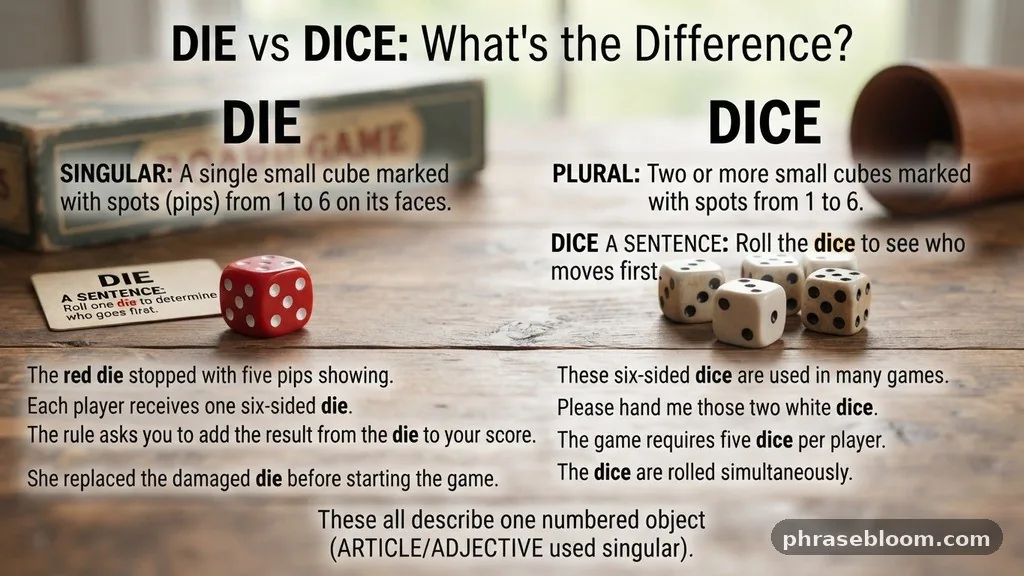
- Roll one die to determine who goes first.
- The red die stopped with five pips showing.
- Each player receives one six-sided die.
- The rule asks you to add the result from the die to your score.
- She replaced the damaged die before starting the game.
These examples all describe one numbered object. The article or adjective before the noun can make the number especially clear: “a die,” “one die,” “this die,” and “the die” are singular expressions.
“Die” also appears in technical and manufacturing contexts with meanings unrelated to games. A die can be a tool used to shape or cut material, and “die” can also refer to a mold or stamping device. In a gaming sentence, however, the surrounding vocabulary usually makes the meaning obvious.
For language learners, one helpful comparison is “mouse” and “mice.” The plural of “die” is not formed by adding a normal ending. It changes to “dice,” which is why learners sometimes hesitate over the pair.
What Does Dice Mean?
Dice is traditionally the plural of die. If a player rolls two, three, or several numbered objects, “dice” is the standard plural noun: “The game uses four dice,” or “Place the dice beside the board.”
The word is common in descriptions of gaming dice, gambling, probability, and tabletop games. A role-playing game might require a player to roll a collection of polyhedral dice, including a d4, d6, d8, d10, d12, and d20.
In current informal usage, “dice” can also refer to one object. A gamer might say, “Hand me a dice,” particularly when discussing a specialized RPG dice set. Many listeners understand the meaning immediately, but traditional grammar treats “one die” as the more precise form.
Why One Dice Appears in Real Usage
Several factors help explain the singular use. First, “dice” is strongly associated with the entire category of gaming objects, so speakers may treat it like a general material or equipment word. Second, many modern dice are sold in sets, which makes the collective word more familiar than the older singular noun.
Gaming communities also use “dice” in product names and technical shorthand. A player may discuss “a d20 dice” or “a dice roller,” even though traditional grammar would prefer “a d20 die” or “a die roller” in some contexts.
This does not mean every use of singular “dice” is equally suitable. In a rulebook, academic paper, museum description, or formal explanation, “one die” avoids ambiguity and follows the conventional singular and plural distinction.
Use “dice” confidently when you mean multiple objects. Use “one die” when precision matters. In casual conversation, the singular “dice” may be understood, but it can sound less polished to readers who expect the traditional form.
Die and Dice in Tabletop Games
Tabletop games use both “die” and “dice” constantly, but the correct choice depends on how many objects the sentence describes. A board game may ask a player to roll one die for movement, while a role-playing game may instruct the player to roll several dice and combine the results.
Gaming notation makes the distinction even more visible. The letter “d” usually means “die” in expressions such as d6 or d20, while the number before the notation tells you how many dice to roll. Thus, “1d6” means one six-sided die, and “3d8” means three eight-sided dice.
| Notation | Meaning | Traditional wording | Typical use |
|---|---|---|---|
| d4 | One four-sided die | Roll a d4 | Damage, random tables, small effects |
| d6 | One six-sided die | Roll a d6 | Board games and familiar probability |
| d8 | One eight-sided die | Roll a d8 | Role-playing game damage |
| d10 | One ten-sided die | Roll a d10 | Percentile systems and RPG mechanics |
| d12 | One twelve-sided die | Roll a d12 | Specialized tabletop rules |
| d20 | One twenty-sided die | Roll a d20 | Checks, attacks, and saving throws |
When a rule says “roll 2d6,” it means “roll two six-sided dice.” The notation does not change the underlying grammar. One d6 is a die; two d6 objects are dice.
Polyhedral dice have different numbers of faces and are common in role-playing games. A d4, d8, d12, and d20 are all individual dice when considered as physical objects, but a set containing several of them is also correctly called a set of dice.
In ordinary game instructions, clarity is more important than showing off technical terminology. “Roll two dice and add the results” is often easier for new players than “Roll 2d6,” even though both directions can describe the same action.
Die vs Dice in Everyday Examples
Natural examples are useful because the difference becomes easy to recognize once you see the number of objects involved. The singular form usually appears with “a,” “one,” “this,” or “each,” while the plural form often appears with numbers greater than one or with words such as “several” and “many.”
Board Game Examples
“Each player rolls one die at the beginning of the turn” describes a single object assigned to each player. “The players roll two dice and move according to the total” describes two objects used together.
“The die has blue numbers” refers to one physical item. “The dice have blue numbers” refers to a group, even if the group contains only two objects.
Role-Playing Game Examples
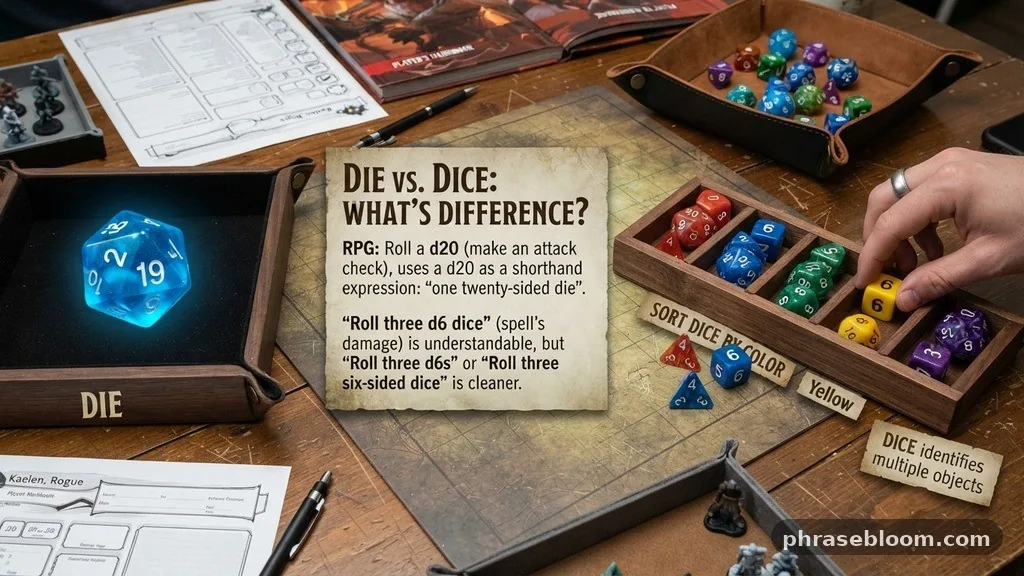
“Roll a d20 to make an attack check” uses “a d20” as a shorthand expression for one twenty-sided die. “Roll three d6 dice for the spell’s damage” is understandable, but “roll three d6s” or “roll three six-sided dice” is usually cleaner.
“Put the die back in the tray” identifies one object. “Sort the dice by color” gives an instruction involving several objects.
Casual Conversation
In casual speech, a player may say, “Can I borrow a dice?” The intended meaning is clear, especially in a group already discussing tabletop games. A more traditional version would be, “Can I borrow a die?”
Some speakers avoid the issue by saying, “Can I borrow one of the dice?” This wording is fully natural and makes the singular meaning clear without requiring the less familiar word “die.”
The phrase “roll the dice” is also an established idiom meaning to take a risk. It normally remains plural in the idiom, even when the situation is metaphorical rather than an actual game.
Common Mistakes With Die and Dice
The most common error is using “dice” after the word “one.” Traditional English treats that combination as a number disagreement: “one” is singular, while “dice” is the conventional plural. The clearest correction is “one die.”
- Less traditional: Roll one dice. Preferred: Roll one die.
- Less traditional: The game includes a red dice. Preferred: The game includes a red die.
- Correct plural: The game includes three red dice.
- Clear alternative: The game includes one piece of dice equipment. This is grammatical but usually less natural than “one die.”
A second mistake is adding a regular plural ending to “die” when the intended word is the gaming object. “Dies” is not the traditional plural of a gaming die. It can be the plural of “die” in technical manufacturing contexts, or the third-person singular form of the verb “die,” but it normally does not mean multiple gaming objects.
A third mistake occurs when writers treat “dice” as if it always referred to a complete set. Dice can mean two objects, ten objects, or a mixed collection of polyhedral pieces. If the exact number matters, state it directly.
Another issue is inconsistency within the same document. A rulebook that uses “one die” in one chapter and “one dice” in another may make readers wonder whether the terms describe different equipment. They do not, so select a convention and maintain it.
Finally, avoid correcting every informal speaker in conversation. Language changes through use, and singular “dice” is established in some communities. Reserve strict correction for situations where accuracy, teaching, editing, or formal style genuinely matters.
Is Die or Dice More Formal?
For a single object, “die” is the more formal and traditionally accepted choice. It is especially suitable for academic writing, published game rules, instructional materials, technical descriptions, and edited prose.
“Dice” is entirely formal when it functions as the plural noun. There is nothing informal about sentences such as “The experiment used two dice” or “The probability of rolling a six on a fair die is one in six.” The issue is not that “dice” is casual, but that singular “dice” may be viewed as less traditional.
In professional writing, choose the form that communicates quantity immediately. A sentence such as “The participant rolled one die five times” is precise and leaves no question about the procedure.
Formal Writing and Probability
Mathematics and probability texts often use “die” for one random variable generated by a single object. They may describe “the outcome of a fair six-sided die” or “the sum obtained by rolling two independent dice.”
This distinction can matter in research because the number of dice affects the probability distribution. One die produces one result from its faces, while multiple dice create combinations and totals.
In a classroom, the traditional forms also help students learn singular and plural nouns. A teacher might write, “Roll one die three times,” then “Roll two dice once,” giving students both forms in a meaningful context.
Formal Game Rules
Published game rules generally benefit from consistent terminology. If a game uses different shapes, the rules can say “one d6,” “two d10s,” or “a six-sided die and a ten-sided die.”
In a highly specialized gaming community, “one dice” may appear in product descriptions, forums, or informal instructions. That usage does not necessarily prevent understanding, but editors may replace it with “one die” for a more traditional register.
How Die and Dice Relate to Game Terminology
Dice vocabulary extends beyond singular and plural forms. A face is one flat surface of a die, while a result usually refers to the number or symbol displayed on the upper face after the roll. A six-sided die has six faces, although not every die uses numbers from one to six.
The terms edges and vertices describe the geometry of the object. A cube-shaped six-sided die has square faces, straight edges, and vertices where the edges meet. Other polyhedral dice use shapes with different numbers of faces and corners.
Pips are the small dots traditionally used to display numbers on many six-sided dice. A face with four pips represents the number four, while a face with no pips may contain a printed symbol, letter, or decorative design instead.
Gaming dice can be made from plastic, resin, wood, metal, stone, or other materials. The material does not change the grammar. One metal object is a die, and a collection of metal objects is dice.
Why d6 and d20 Can Be Confusing
The notation “d6” can refer to one die or to a type of die. In “Roll a d6,” it usually means one six-sided die. In “The box contains six d6s,” it means six individual six-sided dice.
Plural notation varies by community. Some writers use “d6s,” while others write “d6 dice.” Both can be understood, but “six d6s” is concise and “six six-sided dice” is often clearest for general readers.
The same principle applies to d20. One d20 is one twenty-sided die, while a pouch containing several d20s contains multiple dice. The abbreviation describes the shape, not a special grammatical category.
When to Use “Die” and “Dice” in Different Contexts
In board game instructions, use “die” for one object and “dice” for multiple objects. This is the most familiar pattern for players and is easy to apply in directions such as “Roll one die” or “Roll both dice.”
In workplace or educational writing, avoid assuming that every reader knows gaming shorthand. “The students rolled one six-sided die” is clearer than “The students rolled a d6,” particularly in a lesson about probability rather than game design.
In product descriptions, “dice set” is natural because the product usually contains multiple pieces. A product listing might accurately describe “a seven-piece polyhedral dice set,” even though one individual piece from that set is a die.
In marketing copy, “gaming dice” is a common category phrase. Here, “dice” functions as a plural or collective term, and the phrase does not need to identify one specific object.
In academic writing, define specialized notation on first use. For example: “Participants rolled one six-sided die, referred to below as a d6.” After that definition, the shorter notation can be used consistently.
Useful Alternatives
Sometimes you can avoid the singular-plural issue by rewriting the sentence. “Choose one of the dice” is an easy alternative to “choose one dice,” and “select a piece from the dice set” may be useful when discussing a collection.
- Use “one die” for direct, traditional precision.
- Use “one of the dice” when selecting from a group.
- Use “a six-sided die” for general readers.
- Use “a d6” when the audience understands gaming notation.
- Use “a dice set” for a collection sold or stored together.
Rewriting is not a sign that the original distinction is impossible. It is a practical way to make a sentence sound natural for a particular audience.
How to Remember the Difference
A short memory rule works well: one die, two dice. The phrase has a natural rhythm, and it reflects the traditional grammar used in formal English.
You can also connect the forms to the words “single” and “several.” A single numbered object is a die; several numbered objects are dice. The number before the noun usually tells you which form belongs there.
| Quantity | Correct traditional noun | Example |
|---|---|---|
| One | die | One die is on the table. |
| Two | dice | Two dice are on the table. |
| Several | dice | Several dice are needed for the game. |
| Unspecified collection | dice | The dice are stored in a pouch. |
If the word follows “a” or “one,” choose “die” in formal and standard writing. If it follows “two,” “three,” “several,” or “many,” choose “dice.”
There is one useful qualification: gaming communities may use “dice” as a singular noun. You will encounter that form, and it is usually understandable from context. Knowing the traditional rule lets you choose deliberately rather than using one form by accident.
Frequently Asked Questions About Die vs Dice
Is “die” singular and “dice” plural?
Yes. In traditional English, “die” is the singular noun for one gaming object, and “dice” is its plural form. “Dice” is also used as a singular term in some informal gaming communities, but “one die” is the safest choice in formal writing.
Is it correct to say “one dice”?
It is common in some casual gaming contexts, but it does not follow the traditional singular-plural distinction. Use “one die” in edited, academic, instructional, or professional writing.
Can dice refer to one object?
Yes, especially in informal speech and modern gaming discussions. A speaker may use “dice” as a general term for a gaming object, but readers who expect traditional grammar may prefer “die” for one object.
What is the plural of d6 or d20?
Common forms include “d6s” and “d20s,” as in “roll three d6s” or “the set includes four d20s.” For a general audience, “three six-sided dice” and “four twenty-sided dice” are even clearer.
Why do people say “roll the dice” in a singular situation?
“Roll the dice” is a fixed expression and usually refers to taking a risk, whether literally or metaphorically. In an actual game involving one object, the traditional wording would be “roll the die,” but the idiom remains plural because that is its established form.
Conclusion
The practical rule for Die vs Dice is simple: use die for one gaming object and dice for two or more. A six-sided die, d20, or other individual polyhedral piece is singular, while a group of gaming dice is plural. Singular “dice” appears in informal usage, but it is less dependable when you need formal precision.
Use the traditional forms in rules, academic work, business communication, and educational writing, and define shorthand such as d6 or d20 for unfamiliar readers. Once you remember “one die, two dice,” the distinction becomes easy to apply whenever you roll the dice or write about them.
Related: How to Use “My Question Is” Correctly · Is Summer Capitalized? Grammar Rules Explained? · Some of Whom vs Some of Who
Explore more on PhraseBloom.