
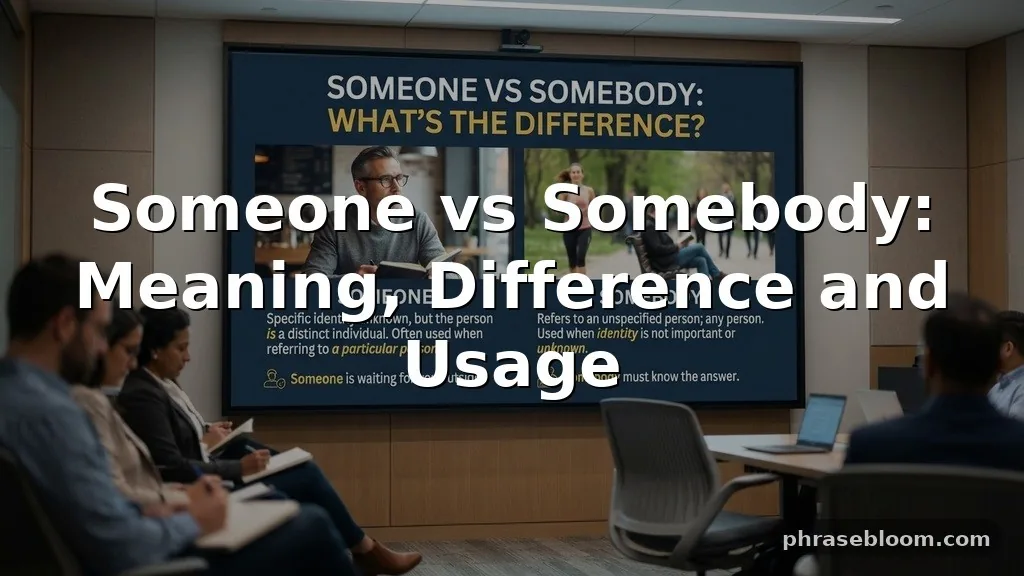
The difference between someone and somebody is smaller than many learners expect. Both words mean an unspecified person, both take a singular verb, and both are standard English in ordinary speech and writing.
In practice, context and tone matter more than meaning. This article explains someone vs somebody, shows how each word works in questions and sentences, and gives you a clear rule for choosing the natural form in formal English, informal English, and everyday conversation.
The Direct Answer: Someone and Somebody
Someone and somebody are interchangeable indefinite pronouns. They refer to one person whose identity is unknown, unstated, or unimportant in the sentence.
For example, these sentences have essentially the same meaning:
- Someone left a message for you.
- Somebody left a message for you.
- Someone is waiting outside.
- Somebody is waiting outside.
The main difference is a slight difference in tone. Someone often sounds a little more neutral or polished, while somebody can sound more conversational or personal. That distinction is not absolute, however, and native speakers regularly use both forms in the same kinds of sentences.
If you need one safe choice for professional or formal writing, choose someone. It appears naturally in business emails, reports, academic writing, instructions, and public communication.
That recommendation does not mean somebody is incorrect or unprofessional. A sentence such as “Somebody from the finance team will contact you” is perfectly acceptable, especially in a friendly workplace email. The choice depends on the voice you want, not on a major difference in grammar.
What Someone and Somebody Mean
Someone and somebody both mean “an unspecified person.” The speaker knows that one person is involved, but the sentence does not identify that person by name or description.
Consider the sentence, “Someone called while you were away.” The word someone tells us that one person called, but it does not tell us who that person was. The identity may be unknown, or the speaker may simply choose not to mention it.
Somebody works in the same way. “Somebody moved the files” means that an unspecified person moved them. The sentence does not necessarily suggest blame, although the surrounding context can make it sound accusing.
These pronouns can refer to people in many situations:
- Someone needs to approve this request.
- Somebody has taken my seat.
- We need someone with customer-service experience.
- Did somebody leave this umbrella here?
- If someone asks for me, tell them I’ll return shortly.
Both words are singular in meaning. That matters for singular verb agreement. We say “Someone is calling,” not “Someone are calling,” even though the person’s identity is unknown.
The same rule applies to somebody: “Somebody has forgotten the password” is correct. The pronoun refers to one person, so the verb should be singular.
For a dictionary definition and examples of standard usage, readers can consult the Merriam-Webster Dictionary entry for someone. Major English dictionaries treat someone and somebody as standard pronouns with closely related meanings.
Someone vs Somebody in English Grammar
Someone and somebody are indefinite pronouns. “Indefinite” means that the pronoun does not identify a particular person, while “pronoun” means that it stands in place of a noun or noun phrase.
Instead of writing “A person should check the form before submitting it,” you could write, “Someone should check the form before submitting it.” The pronoun makes the sentence shorter and avoids repeating a general noun phrase.
Subject use
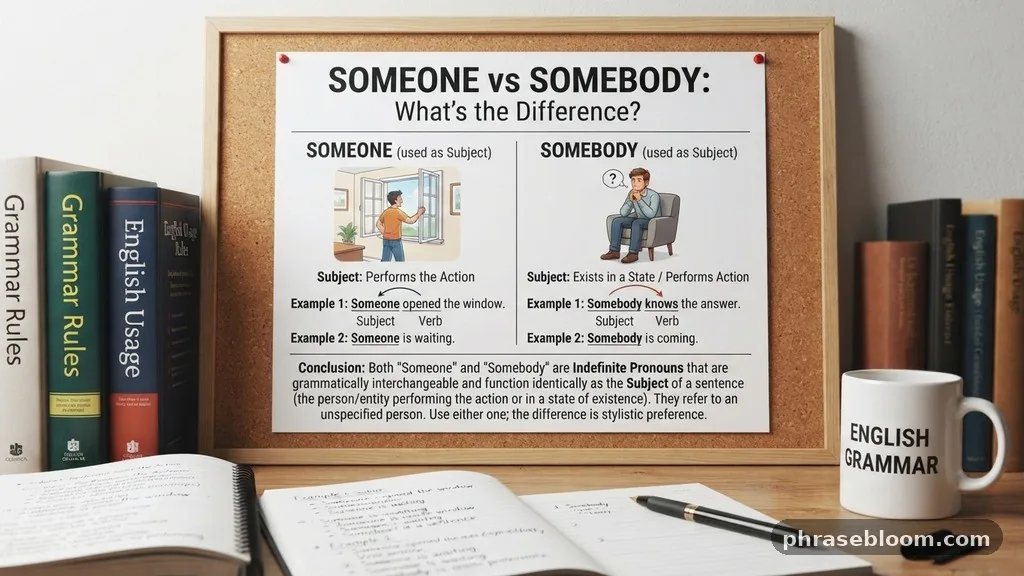
Someone and somebody can act as the subject of a sentence. The subject is the person or thing that performs the action or exists in a particular state.
For example, “Someone opened the window” uses someone as the subject of opened. In “Somebody knows the answer,” somebody is the subject of knows.
Because each word refers to one person, the verb remains singular:
- Someone wants to speak with you.
- Somebody knows where the keys are.
- Someone was standing near the entrance.
- Somebody has sent an updated document.
Object use
These pronouns can also function as the object of a verb or preposition. In “I saw someone in the lobby,” someone receives the action of saw.
Examples include “Please ask somebody to help,” “The manager spoke with someone from legal,” and “We need to hire someone for the evening shift.” The grammar is the same whether you choose someone or somebody.
Possessive forms
The possessive forms are someone’s and somebody’s. They show that something belongs to, relates to, or is associated with an unspecified person.
Examples include “Someone’s phone is ringing” and “Somebody’s coat is still in the conference room.” The apostrophe and final s are important because “someones” and “somebodys” are not standard possessive spellings.
In modern written English, people may use singular they after someone or somebody when the person’s gender is unknown or irrelevant. “Someone left their badge at reception” is widely accepted standard usage and avoids the outdated assumption that an unknown person must be he or she.
Is Someone More Formal Than Somebody?
Someone is often perceived as slightly more formal, neutral, or polished. That perception comes from usage patterns rather than a strict grammar rule.
For example, a company handbook may say, “If someone has questions, contact Human Resources.” A manager writing a friendly message might say, “If somebody has questions, send me a note.” Both sentences are correct, but the first has a more neutral written tone.
Somebody can feel warmer, more direct, or more conversational. It is common in spoken English, personal stories, informal questions, and expressions that emphasize a real person.
- Someone has requested access to the file. This sounds neutral and administrative.
- Somebody has to take responsibility. This sounds more forceful or conversational.
- Could somebody help me carry these boxes? This is a natural spoken request.
- Someone will review your application. This suits a formal notice.
The tone can also change because of the verb or surrounding words. “Somebody special” may sound affectionate, while “someone qualified” sounds neutral and professional. The pronoun alone does not determine the entire style of a sentence.
In academic writing, someone is usually the safer default because it has a restrained tone. Yet somebody is not automatically too informal for a serious text. If a quotation, example, or conversational discussion uses somebody naturally, changing it solely to someone may make the writing less authentic.
Someone and Somebody in Different Sentence Types
Both pronouns appear in affirmative sentences, questions, and negative sentences. Their grammatical behavior does not change between these forms.
Affirmative sentences
An affirmative sentence makes a positive statement. “Someone sent the invoice” and “Somebody sent the invoice” both state that an unidentified person sent it.
In workplace communication, someone often sounds suitably neutral: “Someone from our accounting team will follow up tomorrow.” Somebody may sound more personal: “Somebody from accounting will give you a call.”
Questions
Questions often use somebody when the speaker expects that a person may be available or wants to sound approachable. “Can somebody help me with this printer?” is a familiar spoken request.
Someone is equally grammatical: “Can someone help me with this printer?” This version may sound slightly more neutral, and it is especially common in written instructions or formal requests.
Questions can also use these pronouns to ask whether an unidentified person exists or has taken an action:
- Did someone call while I was in the meeting?
- Has somebody seen the revised schedule?
- Would someone from your team confirm the deadline?
- Does somebody know how to reset the device?
Negative sentences
Negative sentences require some care. In standard English, we usually say “I didn’t see anyone” rather than “I didn’t see someone” when we mean that no person was seen.
Someone and somebody are normally used in positive statements, while anyone and anybody commonly appear in questions and negative sentences. However, someone or somebody can appear in a negative sentence when the meaning is specific or contrastive.
Compare these examples:
- I didn’t speak to anyone. No person was spoken to.
- I didn’t speak to someone from the sales team. I may have spoken to other people, but not that particular type of person.
The second sentence does not simply replace anyone with someone. It creates a narrower meaning. Context controls the choice.
Someone vs Somebody in Professional Writing
Professional writing benefits from clarity, consistency, and an appropriate tone. Someone usually fits easily into business English because it is neutral and does not draw attention to itself.
Use someone naturally in company policies, employee announcements, training materials, internal communications, and reports:
- Someone from Human Resources will contact you within two business days.
- If someone notices an error in the report, please notify the project lead.
- Someone must approve the purchase before the order is placed.
- Ask someone on the support team to reset your account.
These examples work because the identity of the person is not important. The sentences focus on the action or responsibility rather than on a named individual.
Somebody can still be appropriate in workplace writing. An email from a manager might say, “Can somebody send me the latest sales figures?” The wording sounds natural and direct, especially when the writer is speaking to a familiar team.
For legal documents, formal policies, and academic writing, someone is usually the less marked option. Even there, the best choice may be a more precise noun phrase such as “the designated employee,” “an authorized representative,” or “a member of the review committee.”
Clarity matters more than forcing either pronoun into a sentence. “An authorized employee must sign the form” is more precise than “Someone must sign the form” when only a particular person has permission.
Workplace contexts
In employee handbooks, someone can express a general rule without sounding casual: “If someone experiences harassment, they should report it to Human Resources.” In a training presentation, somebody may create a friendlier tone: “If somebody makes a mistake, use it as a learning opportunity.”
For public-facing websites and marketing materials, someone often sounds inclusive and natural. “Someone is ready to help” is a simple customer-service message, while “Somebody is ready to help” may sound more conversational and personal.
Neither word should be treated as a technical term. If a sentence concerns a legal duty, security control, or organizational responsibility, name the role when possible. Pronoun usage should not make an important obligation vague.
Related Forms and Useful Alternatives
Someone and somebody have related forms that should not be confused. Anyone and anybody usually refer to any person at all, especially in questions and negative sentences. No one and nobody mean not one person.
| Word | Typical meaning | Common example | Usual tone |
|---|---|---|---|
| someone | An unspecified person | Someone left a message. | Neutral or slightly formal |
| somebody | An unspecified person | Somebody called earlier. | Conversational or personal |
| anyone | Any person, often in questions or negatives | Did anyone report the issue? | Neutral |
| anybody | Any person, often in questions or negatives | Can anybody join the call? | Conversational |
| no one | Not one person | No one approved the request. | Neutral or formal |
| nobody | Not one person | Nobody knew the answer. | Conversational or neutral |
The choice between these forms depends on meaning, not only formality. “Anyone can apply” means every person is allowed to apply, while “Someone can apply” usually means one unspecified person can do so.
Other alternatives can make a sentence more specific. Use a person for a general human reference, an individual for a formal or analytical tone, and a role such as the coordinator or an employee when the person’s function matters.
For example, “Someone should check the figures” is broad. “A member of the finance team should check the figures” identifies the relevant group and reduces uncertainty.
Common Mistakes with Someone and Somebody
Most errors involving these words concern verb agreement, spelling, or meaning. The words themselves are simple, but their indefinite meaning can lead writers to make the sentence less precise than intended.
Using a plural verb
Incorrect: “Someone are waiting in the lobby.” Correct: “Someone is waiting in the lobby.”
Someone and somebody refer to one person, so they require a singular verb. This remains true even when the writer does not know whether the person is male or female.
Adding an unnecessary plural ending
Incorrect: “Someones are responsible for the decision.” Correct: “Some people are responsible for the decision.”
Someone is already a singular pronoun. If you need a plural expression, use people, some people, employees, participants, or another suitable plural noun.
Confusing someone with anyone
“Someone can use the meeting room” normally suggests that an unspecified person has permission or ability to use it. “Anyone can use the meeting room” means that every person or any person is allowed to use it.
The distinction is important in policies and instructions. A single word can change a limited permission into an open invitation.
Using double negatives
In standard written English, avoid combinations such as “I didn’t see nobody” when you mean that you saw no person. Use “I didn’t see anybody” or “I saw nobody.”
Double negatives may appear in some dialects or informal speech, but they are generally unsuitable for formal writing and professional communication.
Assuming somebody is incorrect
Somebody is not a mistake, a slang term, or a nonstandard spelling. It is a standard English pronoun with the same basic meaning as someone.
A writer may choose someone for a neutral tone, but that preference should not be presented as a grammar rule. Both forms can be correct in the same sentence position.
How Context Changes the Nuance
The difference between someone and somebody is often a difference in emphasis. Someone can sound less personal because it presents the person as an unspecified participant in an event. Somebody can bring the person slightly closer to the conversation.
Compare “Someone wants to meet with you” and “Somebody wants to meet with you.” The first sounds like a neutral message from a receptionist or system. The second may suggest that the speaker knows or imagines the person and is speaking more casually.
There can also be an emotional difference:
- Someone left the lights on. This is a neutral observation.
- Somebody left the lights on. This may express annoyance or surprise.
- Someone special is visiting tonight. This sounds affectionate or deliberately vague.
- Somebody special is visiting tonight. This has a similarly warm, conversational feeling.
These are tendencies, not fixed definitions. A speaker can use somebody in a formal situation or someone in a casual one. Intonation, sentence structure, and the surrounding words often have a stronger effect on tone than the pronoun itself.
Written English gives readers more time to notice word choice, so someone may appear more frequently in edited prose. Spoken English is more flexible, and somebody is common in everyday conversation.
Regional preferences can also influence a speaker’s habits. Some people use someone almost exclusively, while others use somebody regularly without intending any special nuance.
Choosing the Right Form
When you are unsure, begin with meaning. Ask whether you mean one unidentified person, any person, no person, or a specific role. Once the meaning is clear, choose the form that fits the tone of the sentence.
Use this practical process:
- Identify the intended meaning. Choose someone or somebody for one unspecified person, anyone or anybody for an open question or broad possibility, and no one or nobody for zero people.
- Check verb agreement. Use a singular verb with someone and somebody.
- Consider the audience. Someone is a reliable neutral choice for formal or international readers.
- Listen to the tone. Somebody may sound warmer or more conversational in a personal message.
- Choose precision when necessary. Replace the pronoun with a role or noun phrase if the person’s identity or responsibility matters.
In a business email, “Could someone send me the revised contract?” is a safe, professional request. In a team chat, “Can somebody send me the revised contract?” is equally natural.
In academic writing, “Someone might argue that the policy has unintended effects” is often preferable to “Somebody might argue that the policy has unintended effects.” The first sounds more detached, which suits analytical prose.
In a personal conversation, the reverse may happen. “Somebody told me about that restaurant” sounds relaxed, while “Someone told me about that restaurant” sounds slightly more neutral but remains completely natural.
Examples You Can Copy and Adapt
The following examples show how the pronouns work in different settings. Each sentence is grammatically correct, but the preferred form depends on tone and meaning.
Office communication
Someone from the operations team will join the call at noon. This is neutral and clear when the person’s name is not necessary.
Could somebody review the attached spreadsheet before Friday? This sounds like a friendly request to a familiar group.
Policies and procedures
If someone notices a security problem, they should report it immediately. Someone works well in a company policy because the sentence addresses any individual employee.
Someone must authorize the payment before it is released. If only a designated employee may authorize it, a more precise version would be “An authorized employee must approve the payment.”
Customer service
Someone will respond to your request within one business day. This fits a formal acknowledgment or automated message.
If somebody on our team has already contacted you, please reply to that message. The conversational form can make a customer-service message feel less stiff.
Questions and requests
Has someone reserved the training room? This is a neutral question about whether an unidentified person made the reservation.
Can somebody help move these chairs? The wording is natural in spoken English and suggests an immediate request for assistance.
Reports and explanations
Someone entered the incorrect figure during data entry. This reports an event without identifying the employee.
Somebody must have changed the settings. The form sounds more conversational and may suggest surprise or suspicion.
The examples show why someone vs somebody is mainly a question of tone and context. Neither word has a separate core meaning that would make the other incorrect.
Frequently Asked Questions
Is someone or somebody correct?
Both are correct. Someone and somebody are standard indefinite pronouns meaning an unspecified person.
Is someone more formal than somebody?
Someone often sounds slightly more neutral or formal, while somebody may sound more conversational. This is a tone preference, not a strict grammar rule.
Do someone and somebody take a singular verb?
Yes. Write “Someone is calling” and “Somebody has arrived.” Both pronouns refer grammatically to one person.
Should I use someone in professional writing?
Someone is a safe default for reports, policies, academic writing, and business communication. Somebody is also acceptable when a friendly or conversational tone fits the context.
Are someone and somebody interchangeable in every sentence?
They are interchangeable in most sentences when they mean one unspecified person. Context can create a slight difference in tone, so read the whole sentence aloud before choosing.
Final Rule for Someone vs Somebody
Someone vs somebody is not a contest between a correct word and an incorrect one. Both mean one unspecified person, both follow the same grammar rules, and both belong to standard English.
Choose someone for a neutral, formal, or professional tone, and choose somebody when a more conversational or personal sound fits. If you are writing for work, either form is acceptable, but someone is the safest default. Above all, preserve the intended meaning, use singular verb agreement, and keep your word choice consistent with the voice of the document.
Related reading: Unselect vs Deselect, Hassle vs Hastle, Continuous vs Continous.
4 thoughts on “Someone vs Somebody: Meaning, Difference and Usage”