
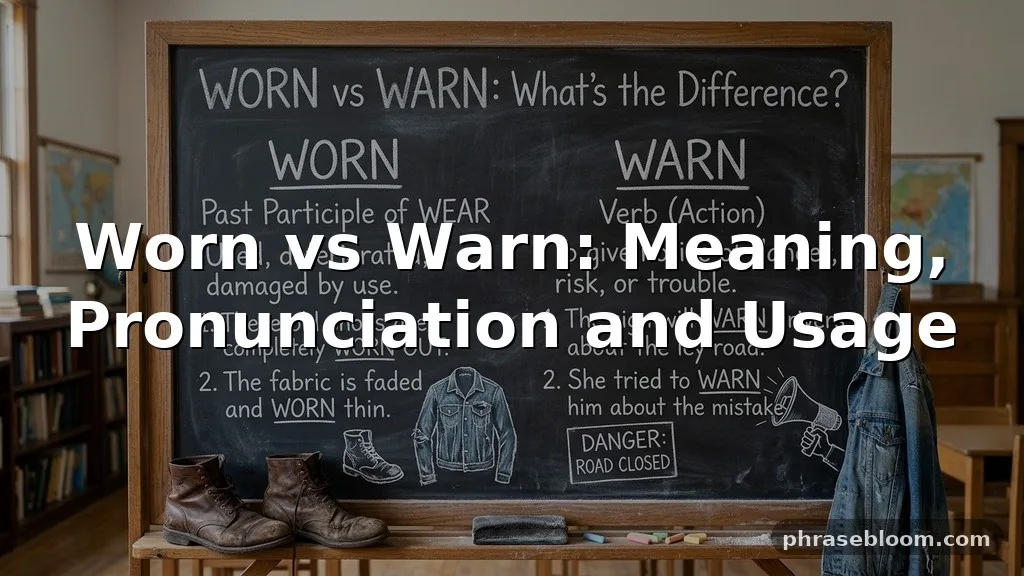
Worn vs Warn: Meaning, Pronunciation and Usage
Worn vs warn is a common English mix-up because the words sound similar, but they have different meanings, spellings, and grammatical roles. Worn relates to wearing something or becoming damaged through use, while warn means to tell someone about a danger, problem, or possible consequence.
The difference becomes easier once you connect worn with the verb wear and warn with the idea of giving a warning. You’ll learn the worn definition, the warn definition, their pronunciation, their verb forms, and practical sentence examples that show exactly when each word belongs.
Worn vs Warn: The Short Answer
Worn is the past participle of wear. It can describe clothing that someone has put on, or an object, person, or surface that has become damaged, tired, or less attractive through use.
Warn is a verb meaning to alert someone to danger, difficulty, risk, or an unwanted result. You can warn someone about a storm, warn a colleague of a deadline, or warn against making a careless decision.
| Word | Part of speech | Core meaning | Example |
|---|---|---|---|
| worn | Past participle or adjective | Used, damaged, or put on | She has worn that jacket before. |
| warn | Verb | Alert someone to a danger or problem | Please warn the team about the delay. |
These words are not interchangeable. “The manager worn the staff” is incorrect because worn is not the verb that means “alerted.” The correct sentence is “The manager warned the staff.”
Likewise, “He has warn the same coat all winter” is incorrect. The correct form is “He has worn the same coat all winter.”
A useful memory aid is simple: worn connects to wear, while warn connects to warning. If the sentence involves clothing, use, fatigue, or deterioration, worn may be the word you need. If it involves alerting someone, warn is the better choice.
The Worn Definition and Its Grammar
The worn definition has two closely related uses. First, worn is the past participle of the irregular verb wear. Second, worn can function as an adjective describing something damaged, old, tired, or visibly affected by use.
The verb forms of wear are not regular. The basic forms are wear, wore, worn. “Wear” is the present form, “wore” is the simple past tense, and “worn” is the past participle.
- Present: I wear a uniform to work.
- Simple past: I wore the uniform yesterday.
- Past participle: I have worn this uniform for six months.
- Adjective: The uniform looks worn after constant washing.
Because worn is a past participle, it often appears with an auxiliary verb such as has, have, or had. For example, “Maya has worn the gloves before” uses worn as part of the present perfect verb phrase.
Worn can also appear in passive constructions. “The safety equipment was worn by every technician” means every technician put on the equipment. In that sentence, worn does not mean damaged, although the surrounding context could make either interpretation possible in other sentences.
As an adjective, worn often describes an object in a worn condition. A worn carpet has been used so much that its fibers may be flattened. Worn-out clothing may have faded colors, thin fabric, holes, or frayed seams.
The word can describe people as well. Someone may look worn after a long shift, a stressful week, or several nights of poor sleep. Here, worn means tired or exhausted rather than physically damaged.
For more detail on the forms of wear and related usage, consult the Cambridge Dictionary entry for “worn”.
The Warn Definition and Its Grammar
The warn definition is more direct: to warn means to give information about a danger, threat, mistake, or likely consequence. The word is an ordinary verb, and it can take several useful grammatical patterns.
You can warn someone about something. “The supervisor warned the new employees about the wet floor” identifies the person receiving the warning and the subject of the warning.
You can also warn someone of something. “The engineer warned us of a possible power failure” uses of to introduce the danger or problem.
Another common structure is warn someone not to do something. For example, “The doctor warned him not to ignore the symptoms” gives a person advice connected to a possible negative result.
The pattern warn against is also common, especially in formal writing. “The report warns against relying on outdated figures” means the report advises people not to rely on them.
Finally, writers use warn of danger when the focus is on an approaching risk. “The signs warn of falling rocks” means the signs alert people to a hazardous condition.
- warn someone about something: The trainer warned us about the loose cable.
- warn someone of something: The notice warned visitors of strong currents.
- warn someone not to do something: She warned the interns not to share the password.
- warn against something: The auditor warned against approving incomplete records.
- warn of danger: The flashing light warns of an open door.
The past tense and past participle of warn are both warned. That makes its verb pattern regular: warn, warned, warned. It is not related to wear, even though the pronunciation of warn may sound somewhat similar to worn in some accent.
Why Worn and Warn Are Commonly Confused
Worn and warn are commonly confused words because they are near-homophones for many speakers. A homophone is a word that sounds the same as another word, or close enough to create confusion, while having a different spelling and meaning.
The exact pronunciation varies by accent. In many varieties of American English, worn and warn have very similar vowel sounds, although some speakers make a clearer distinction. In other accents, the vowel quality or length may separate them more noticeably.
Spelling provides an important clue. The “o” in worn connects it to wore and wear. The “a” in warn connects it to alert, warning, and caution.
Pronunciation alone is not always enough to choose the right word. The surrounding sentence supplies the strongest evidence because the words occupy different grammatical roles.
| Question to ask | Likely word | Reason |
|---|---|---|
| Does the sentence involve clothes or something put on? | worn | Worn is connected to the verb wear. |
| Does it describe damage from use? | worn | Worn can describe a used or deteriorated condition. |
| Does someone alert another person? | warn | Warn means to give notice of a risk or problem. |
| Does the sentence contain “against” or “of danger”? | warn | These are common warn constructions. |
Reading the sentence aloud can help, but it should not replace checking the meaning. If the sentence is about a jacket, uniform, or surface, worn is probably correct. If it is about advice, risk, or a threat, warn is almost certainly the intended verb.
Worn in Sentence Examples
Worn appears in several kinds of sentences, so learning one example is not enough. Its meaning changes slightly depending on whether it refers to clothing, physical condition, emotional fatigue, or the completed action of wearing something.
Worn as the past participle of wear
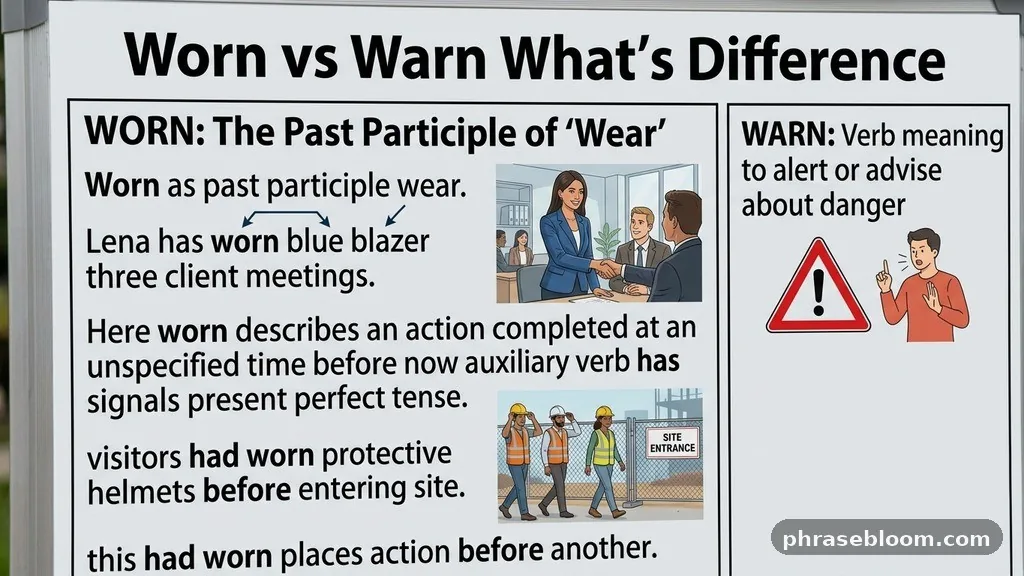
“Lena has worn the blue blazer to three client meetings.” Here, worn describes an action completed at an unspecified time before now. The auxiliary verb has signals the present perfect tense.
“The visitors had worn protective helmets before entering the site.” In this example, had worn places the action before another past event. The sentence is about putting on equipment, not damaging it.
Worn as an adjective for condition
“The reception desk has a worn surface near the payment terminal.” Worn describes a physical condition caused by repeated contact and use.
“The costume department repaired several worn-out coats before the performance.” The compound adjective worn-out emphasizes that the clothing had become badly used or damaged.
Worn as a description of fatigue
“After the overnight installation, the technicians looked worn.” Here, worn describes physical or emotional exhaustion. It does not mean that the technicians were wearing a particular item of clothing.
“The long dispute left both sides worn and less willing to negotiate.” This use is figurative, but it still relates to the idea of being depleted through extended strain.
Worn may also describe something old-fashioned or overused in a figurative sense. “The proposal relies on a worn argument that the committee has already rejected” means the argument is tired, familiar, or no longer persuasive.
Warn in Sentence Examples
Warn is an action performed by a person, organization, sign, device, or document. The subject does not need to be human. A weather alert can warn residents, a label can warn consumers, and a software message can warn users about a risk.
“The facilities manager warned staff about the temporary elevator closure.” The manager gives information, and staff members receive it.
“The product label warns users not to operate the machine without protective eyewear.” This structure is especially common in instructions and safety documents. The verb warns introduces a prohibition connected to a possible injury.
“The finance team warned of delays if the approval was not completed by Friday.” The phrase warned of identifies a likely consequence or developing problem.
“The consultant warned against changing the database structure during business hours.” The phrase warned against expresses advice to avoid an action.
“Please warn the reception desk before the contractors arrive.” This sentence uses the imperative form. The speaker asks someone to pass along information in advance.
“The system warned users that their session would expire soon.” In this case, a computer system performs the warning through a message. The meaning remains the same: it alerts users to an upcoming event.
- Safety: The supervisor warned the crew about the exposed wiring.
- Operations: The coordinator warned of a delivery delay.
- Compliance: The policy warns employees against sharing confidential data.
- Customer service: The website warns visitors that prices may change.
- Technology: The application warns users before deleting a record.
These examples show why warn cannot be replaced with worn. Warn describes communication about risk, while worn describes wearing, use, or deterioration.
Worn, Wore, Wear, and Warn Compared
The biggest grammar trap is often not worn versus warn alone. Writers may also confuse worn with wore, especially because both words come from the irregular verb wear.
Use wear for the present or base form. “I wear safety glasses at work” describes a current habit. Use wore for a completed action in the simple past: “I wore safety glasses during yesterday’s inspection.”
Use worn after forms of have or in other grammatical structures that require a past participle. “I have worn these glasses for two years” is correct. “I have wore these glasses” is not.
Use warn when someone gives information about a danger or consequence. “The supervisor warned us about the chemical spill” has no connection to clothing or physical wear.
| Form | Verb family | Typical use | Example |
|---|---|---|---|
| wear | wear | Present or base form | They wear badges at work. |
| wore | wear | Simple past | They wore badges yesterday. |
| worn | wear | Past participle or adjective | They have worn badges for years. |
| warn | warn | Present or base form for giving an alert | They warn visitors about the hazard. |
| warned | warn | Past tense or past participle | They warned visitors yesterday. |
One quick test is to substitute alert. If alert fits the meaning, use warn or warned. If the sentence means put on, used, or damaged through use, choose wear, wore, or worn according to the tense.
Worn vs Warn in Formal and Everyday English
Both words are standard English and appear in casual conversation, workplace communication, academic writing, technical instructions, and formal reports. The challenge is not deciding which word sounds more formal. The challenge is identifying the intended meaning and using the correct verb form.
In an email, you might write, “I wanted to warn you that the meeting room has changed.” That wording is direct and natural. A more formal version could say, “Please be advised that the meeting room has changed,” but warn is not incorrect or unprofessional.
In a report, worn may describe equipment condition. “The inspection found worn insulation near the main panel” is concise and precise. The same report might use warn in a recommendation: “The report warns that continued use could increase the risk of failure.”
Academic writers should pay attention to tense and sentence structure. “The participants wore protective clothing” describes a past event, while “The results warn of a possible limitation” uses warn in the present tense. “The results have worn” would be grammatically and logically different.
Technical writers often use warn in instructions because safety communication depends on clear verbs. “The device warns the operator when the temperature exceeds the safe range” identifies the alerting function of the device.
Marketing copy may use worn to describe a product’s appearance or warn to communicate a limitation. “The leather develops a worn finish over time” and “The label warns that colors may vary” are both appropriate, but they serve entirely different purposes.
In formal writing, avoid choosing a word simply because it appears more sophisticated. Plain, accurate vocabulary is stronger than an impressive-looking error.
Memory Tricks and Editing Tests
Several simple editing tests can prevent a worn versus warn mistake. The best method depends on whether you are checking meaning, grammar, or pronunciation.
Use the wear test

Replace the word with a form of wear. If the sentence still makes sense, worn may be correct. “She has worn the uniform” becomes “She has worn the uniform,” while “She has warned the uniform” clearly fails.
Use the alert test
Replace the word with alert. If the sentence means that someone receives information about danger, warn is the right word. “The sign warns drivers of ice” can become “The sign alerts drivers to ice.”
Check the tense
Ask whether the sentence needs a present verb, a simple past verb, or a past participle. “They wear,” “they wore,” and “they have worn” belong to the wear family. “They warn” and “they warned” belong to the warning family.
Look for nearby clues
Words such as clothing, jacket, uniform, surface, and tired often point toward worn. Words such as danger, risk, against, caution, and deadline often point toward warn.
- If the subject gives an alert, choose warn.
- If the subject has clothing on, choose a form of wear.
- If an object shows damage from use, choose worn.
- If the action happened in the simple past, check whether wore or warned is required.
- If the pronunciation is unclear, let the meaning and verb form decide.
These tests are especially useful during proofreading because they focus on the sentence’s function rather than on how the word sounds in isolation.
Common Errors with Worn and Warn
A frequent mistake is writing “The notice worn employees about the closure.” The correct sentence is “The notice warned employees about the closure.” The notice communicates information, so the verb must be warned, the past tense of warn.
Another error is using wore after has or have. “He has wore the helmet all morning” is incorrect because the present perfect requires the past participle. Write “He has worn the helmet all morning.”
Some writers use warn when they mean that an object has deteriorated. “The tires are warning” does not mean the tires are in poor condition. “The tires are worn” describes damage or reduced condition, while “the warning light is on” describes an alert.
Meaning can also be confused in sentences about people. “She looked worn after the conference” means she looked tired. “She warned the team after the conference” means she gave the team information about a problem.
Do not assume that similar pronunciation makes the words interchangeable. English contains many commonly confused words whose sounds overlap, but grammar and meaning still determine correct spelling.
| Incorrect | Correct | Why |
|---|---|---|
| The manager worn us about the delay. | The manager warned us about the delay. | The manager gave an alert. |
| She has wore the coat twice. | She has worn the coat twice. | Have requires the past participle worn. |
| The carpet is warning. | The carpet is worn. | The carpet is damaged through use. |
| The sign worn visitors of danger. | The sign warned visitors of danger. | The sign communicated a warning. |
Choosing the Right Word in Professional Writing
Professional writing rewards precision, particularly in safety notices, policies, reports, and customer communication. A single spelling error can make a sentence difficult to understand, especially when the surrounding topic involves equipment, clothing, compliance, or risk.
Before sending a workplace email, identify the action. If you are informing people about a problem, write warn or warned. If you are describing what someone had on, write the correct form of wear.
In an employee handbook, write sentences such as “The policy warns employees against sharing access credentials.” In an equipment report, write “The protective gloves were worn after repeated exposure to solvents.” The first sentence concerns an alert, while the second describes condition.
In a safety procedure, avoid relying only on context if a clearer sentence is available. “Inspect worn cables before operating the machine” describes the cables. “Warn the operator before restarting the machine” gives an instruction.
Editors should check not only spelling but also verb form. “The company has warned staff” is correct, while “The company has warn staff” is missing the past participle ending. “The company wore staff” is a different error because it uses the wrong verb family altogether.
For international readers, clear wording is particularly valuable. Pronunciation varies across American English, British English, and other varieties, but the written distinction remains stable: worn belongs to wear, and warn belongs to warning.
A final professional edit should ask three questions: What does the word mean here? What grammatical form does the sentence require? Would a reader understand the intended action without hearing the sentence aloud?
Frequently Asked Questions About Worn vs Warn
What is the difference between worn and warn?
Worn is the past participle of wear and can describe clothing, use, damage, or tiredness. Warn is a verb meaning to alert someone to danger, risk, or a possible problem.
Is worn the past tense of wear?
No. Wore is the simple past tense of wear, while worn is the past participle. Write “She wore the jacket yesterday” but “She has worn the jacket before.”
Can warn be used after a verb?
Yes. Warn is itself a verb and can appear in forms such as “The manager warns the team,” “The manager warned the team,” or “The manager has warned the team.” It can also follow an auxiliary verb in a phrase such as “will warn.”
How can I remember worn versus warn?
Connect worn with wear, clothing, and damage caused by use. Connect warn with warning, alerts, danger, and advice about what not to do.
Are worn and warn homophones?
They are near-homophones for many speakers because their pronunciation is very similar, though accents differ. Their meanings and spellings are different, so context should determine which word you write.
Conclusion: Keep Worn and Warn Separate
The practical distinction in Worn vs Warn is straightforward: worn belongs to the wear family, while warn describes giving an alert. Use worn for clothing that has been put on, an object in a used or damaged condition, or a person who looks exhausted. Use warn when a person, sign, system, or document communicates danger or a possible consequence.
When proofreading, replace worn with a form of wear and warn with alert. That quick meaning test usually reveals the correct spelling and verb form. If you have a sentence that still feels uncertain, read it aloud, check its tense, and consider the context before choosing the word.
Explore more on PhraseBloom.