
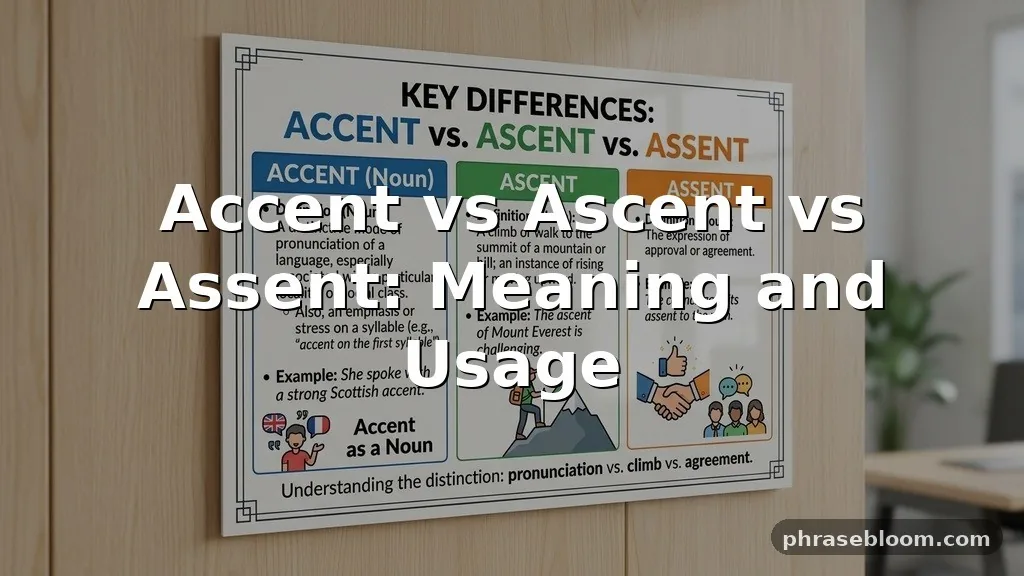
Accent vs Ascent vs Assent: Meaning and Usage
The difference among accent, ascent, and assent comes down to meaning, pronunciation, and grammatical use. These three words are homophones in English for many speakers, so they sound alike even though their spellings and definitions are different.
Accent usually relates to pronunciation, emphasis, or a mark written above a letter. Ascent means a rise or climb, while assent means agreement or approval. Once you connect each spelling to its core meaning and part of speech, the distinction becomes much easier to remember and apply in everyday writing.
The Quick Difference Between Accent, Ascent, and Assent
The simplest way to separate these words is to focus on what each one describes. Accent can be a noun or a verb, ascent is usually a noun, and assent can function as either a noun or a verb.
| Word | Part of speech | Core meaning | Example |
|---|---|---|---|
| accent | Noun or verb | Pronunciation, emphasis, or a written mark | She has a regional accent. |
| ascent | Noun | A rise, climb, or upward movement | The climbers began their ascent. |
| assent | Noun or verb | Agreement, approval, or consent | The board gave its assent. |
Accent is associated with speech, emphasis, and marks over letters. Ascent describes movement upward, whether literal or figurative. Assent concerns agreement with an idea, request, plan, or decision.
For a broader reference on how English words are defined and used, the Merriam-Webster dictionary provides entries, pronunciation information, and example sentences for all three terms.
What Does Accent Mean?
Accent has several related meanings, but they all involve emphasis or distinctive pronunciation. In speech, an accent is a recognizable pattern of pronunciation associated with a particular region, language background, social group, or community.
For example, someone may speak English with a Scottish accent, a New York accent, or an accent shaped by another first language. An accent does not necessarily indicate a person’s level of education or fluency. It describes how speech sounds.
Accent can also mean special emphasis placed on a word, syllable, phrase, color, design feature, or idea. A speaker might accent the first syllable of a word, while a designer might use a bright color as an accent in a room.
Accent as a noun
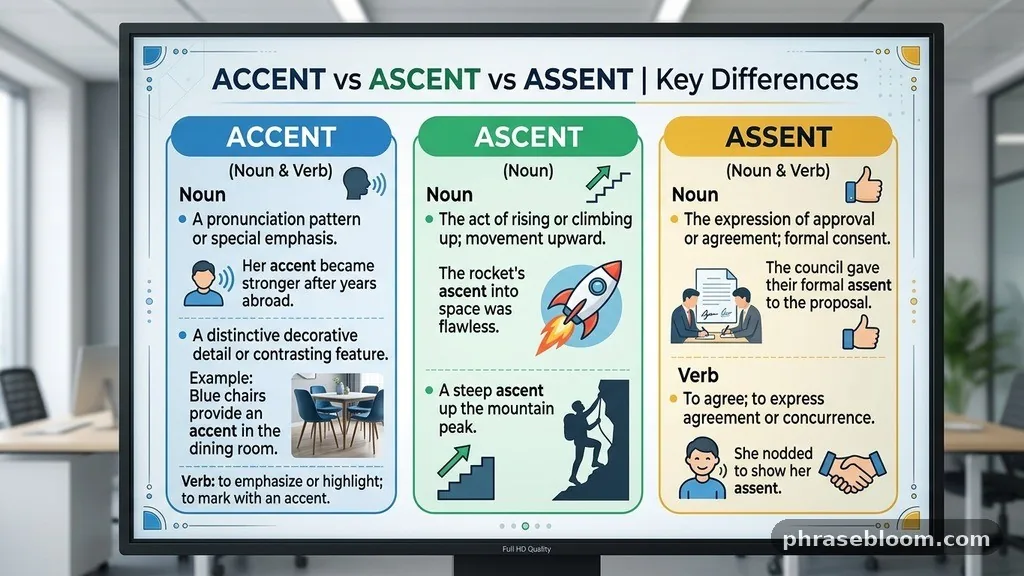
As a noun, accent identifies the pronunciation pattern itself or the emphasis being given to something. In the sentence “Her accent became stronger after years abroad,” the word refers to speech pattern.
In “The blue chairs provide an accent in the dining room,” accent means a distinctive decorative detail. In “The speech placed an accent on public safety,” it means emphasis, although “emphasis” would often sound more natural in modern business writing.
Accent as a verb
As a verb, accent means to emphasize or draw attention to something. A presenter might accent the final point of a proposal, and a tailor might accent a jacket with contrasting stitching.
The verb appears less often in ordinary conversation than related words such as emphasize, highlight, or stress. Still, it is grammatically correct in sentences such as “The lighting accents the sculpture” and “The speaker accented the importance of preparation.”
Accent marks and pronunciation
An accent mark is a written symbol added to a letter. Common examples include the acute accent in café, the grave accent in some borrowed words, and the circumflex in words from languages such as French.
Accent marks may indicate pronunciation, distinguish words, preserve the spelling of another language, or show where stress falls. English uses them inconsistently because many borrowed words eventually become familiar without their original marks.
What Does Ascent Mean?
Ascent means an upward movement, rise, or climb. It is usually a noun, and it can describe physical movement toward a higher place or a figurative movement toward greater success, power, status, or importance.
In a literal sense, hikers begin an ascent up a mountain. An aircraft makes an ascent after takeoff. A balloon’s ascent carries it higher into the sky.
The word can also describe progress. A journalist might write about an athlete’s rapid ascent to international fame, or a business report might discuss a company’s ascent in a competitive market.
Literal ascent
A literal ascent involves movement from a lower position to a higher one. The sentence “The final ascent took six hours” suggests a difficult climb, perhaps along a mountain trail.
Likewise, “The pilot announced that the aircraft’s ascent would be smooth” refers to the plane’s upward movement. In both examples, the word describes direction and elevation.
Figurative ascent
A figurative ascent involves improvement, advancement, or increased influence rather than physical height. “Her ascent through the organization was unusually quick” means that she advanced rapidly in her career.
This use is common in journalism, biographies, politics, sports, and business writing. It can sound formal, so everyday speakers may choose “rise,” “progress,” or “success” instead.
Ascent is related to the verb ascend, which means to move upward. The connection between the two spellings is useful: both contain the letters “asc,” which can remind you of climbing or going higher.
What Does Assent Mean?
Assent means agreement, approval, or consent. It can be a noun or a verb, and it usually concerns accepting a proposal, decision, opinion, request, or action.
When someone gives assent, that person agrees to something. The agreement may be formal, as in a board approving a policy, or personal, as in a parent consenting to a child’s plan.
Assent is more formal than agree in many contexts. It commonly appears in legal writing, government documents, academic prose, formal discussions, and descriptions of institutional decisions.
Assent as a noun
As a noun, assent names the agreement itself. “The committee gave its assent to the revised budget” means that the committee approved the budget.
Another example is “The researchers obtained the participants’ assent before beginning the interview.” Here, assent means agreement or permission, although the precise legal meaning of assent can depend on the context.
Assent as a verb
As a verb, assent means to agree or approve. It is often followed by the preposition “to,” as in “The director assented to the proposed schedule.”
The verb is usually formal. In a casual email, “The director agreed to the proposed schedule” would be more natural. In a contract, report, or historical account, “assented to” may fit the tone better.
Assent and consent
Assent and consent overlap, but they are not always interchangeable. Assent generally emphasizes agreement with an idea, proposal, or decision, while consent often emphasizes permission for an action to take place.
For example, a committee may assent to a recommendation. A patient may consent to a medical procedure. The distinction can become important in legal, medical, research, and ethical writing.
Accent vs Ascent vs Assent in Pronunciation
For many English speakers, accent, ascent, and assent sound the same or nearly the same. Each word commonly has two syllables, with the main stress on the second syllable: ac-CENT, a-SCENT, and as-SENT.
The initial consonant may be pronounced differently depending on the speaker and regional variety of English. In some accents, accent begins with a clear “k” sound, while ascent and assent begin with an “s” sound. The endings of ascent and assent are especially easy to confuse because both often sound like “sent.”
Why homophones cause spelling mistakes
Homophones are words that share a pronunciation but have different meanings and spellings. English contains many familiar examples, including pairings such as “right” and “write,” “site” and “sight,” and “flower” and “flour.”
Because sound alone does not identify the correct word, writers must use context. If the sentence discusses a mountain, altitude, or career rise, ascent is probably correct. If it concerns approval, assent is the likely choice.
Accent is easier to identify when the sentence mentions speech, pronunciation, emphasis, or a mark over a letter. A useful proofreading habit is to replace the questionable word with a short definition before deciding on its spelling.
Stress and pronunciation are different ideas
The word accent itself can refer to stress within a word, but pronunciation includes more than stress. Pronunciation also involves individual sounds, rhythm, intonation, and the speech pattern associated with a language or region.
For example, a speaker can place stress on the correct syllable while still having a regional accent. This is why “accent” should not be treated as a synonym for every aspect of pronunciation.
Accent, Ascent, and Assent in Real Sentences
Context usually reveals the intended word. The following examples show how each term works in ordinary writing and how the surrounding vocabulary signals its meaning.
- Accent: “The new employee speaks English with a noticeable regional accent.”
- Accent: “The editor asked the narrator to accent the final word in the sentence.”
- Accent: “The designer used yellow cushions as an accent against the gray sofa.”
- Ascent: “The team paused halfway through its ascent because the weather changed.”
- Ascent: “The athlete’s ascent to the national team attracted widespread attention.”
- Ascent: “The aircraft began its ascent shortly after leaving the runway.”
- Assent: “The board gave its assent to the merger proposal.”
- Assent: “The publisher would not proceed without the author’s assent.”
- Assent: “Several members assented to the chair’s recommendation.”
Notice the grammatical differences. Accent may refer to a feature, an action, or a design element. Ascent names an upward movement, while assent names agreement or describes the act of agreeing.
Writers sometimes choose the wrong word because the sentence sounds correct when read aloud. Reading silently is not enough for homophones. You need to check the intended meaning and the word’s part of speech.
Examples in professional writing
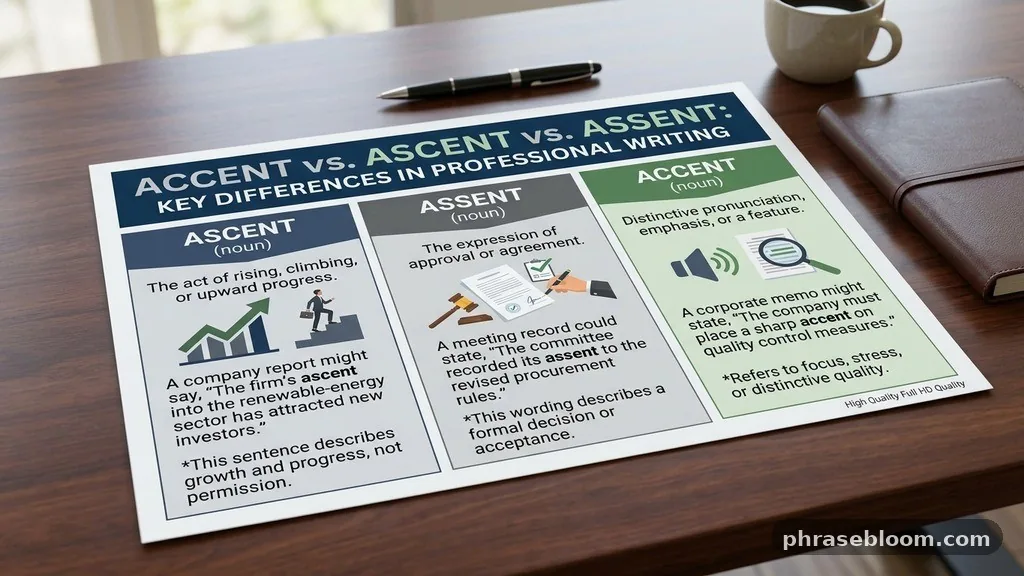
A company report might say, “The firm’s ascent in the renewable-energy sector has attracted new investors.” The sentence describes progress, not approval.
A meeting record could state, “The committee recorded its assent to the revised procurement rules.” That wording describes a formal decision.
An employee profile might read, “Her international accent reflects years of work in several countries.” Here, accent refers to speech and identity, not advancement or agreement.
Common Mistakes With These Homophones
The most common error is using ascent when the sentence requires assent, or assent when the sentence requires ascent. Spell-checking software may not catch the problem because both are legitimate English words.
Using ascent for agreement
The sentence “The council gave its ascent to the proposal” is incorrect if the intended meaning is approval. The correct version is “The council gave its assent to the proposal.”
Remember that assent contains “ass,” which can be connected mentally with accepting or saying yes to something. This is only a memory aid, not an explanation of the word’s history.
Using assent for climbing
“The hikers prepared for their assent up the ridge” is incorrect. The correct sentence is “The hikers prepared for their ascent up the ridge.”
The spelling ascent is connected to ascend, so it belongs with climbing, rising, and upward movement. Words such as mountain, ladder, aircraft, altitude, and career often signal this meaning.
Using accent when another word is needed
“The manager gave her accent to the new plan” is not standard English if the intended meaning is approval. Use assent, agreement, or consent instead.
Likewise, “The company’s accent in the industry” is probably a mistaken use of ascent. If the meaning is growth or progress, write “the company’s ascent in the industry” or, more simply, “the company’s rise in the industry.”
Confusing an accent mark with an accent in speech
An accent mark is a written symbol, while a spoken accent is a pronunciation pattern. The two ideas are related through emphasis, but they are not the same thing.
For example, “résumé” may contain accent marks, while a person may speak English with a French accent. Clear writing should preserve that distinction.
How to Remember the Three Spellings
A memory device works best when it links spelling to meaning. Since these words are homophones, visual associations are more useful than pronunciation alone.
| Word | Memory connection | Meaning to recall |
|---|---|---|
| accent | Accent relates to speech and emphasis | Pronunciation, stress, or a mark |
| ascent | Ascend means to go up | Rise or climb |
| assent | Assent means accepting an idea | Agreement or approval |
Another useful test is to identify the likely replacement word. If you can replace the term with “pronunciation,” use accent.
If “climb” or “rise” fits, use ascent. If “agreement” or “approval” fits, use assent.
Then check the grammar. “The ascent was difficult” uses a noun. “The committee assented” uses a verb. “Her accent is noticeable” uses a noun. The sentence structure can confirm the choice after meaning points you in the right direction.
A three-question proofreading test
- Does the sentence refer to speech, emphasis, or a written mark? Choose accent.
- Does it describe upward movement or advancement? Choose ascent.
- Does it describe agreement, permission, or approval? Choose assent.
Keep the test simple. You do not need to memorize a complicated grammar rule for every sentence.
Related Words and Parts of Speech
Understanding related vocabulary makes these spelling differences easier to manage. Accent has the related verb accent, though emphasize is often a more common alternative. Ascent connects with ascend, ascending, and ascension.
Assent connects with the verb assent and the related noun consent, although the two words can carry different shades of meaning. These relationships show why spelling matters: a single letter can place a word in an entirely different family of meanings.
| Base word | Related word | Meaning relationship |
|---|---|---|
| accent | accentuate | To make something more noticeable or emphasized |
| ascent | ascend | To rise or move upward |
| assent | assent | To agree or approve when used as a verb |
Parts of speech also help distinguish the words. Accent and assent can both be nouns and verbs, while ascent is normally used as a noun. That difference is not enough to solve every question, but it provides a useful grammatical clue.
Accent and accentuate
Accent can describe emphasis, while accentuate means to make a feature especially noticeable. “The white trim accents the windows” and “The white trim accentuates the windows” are both possible, although accentuate often sounds more deliberate or formal.
Ascent and ascend
Ascent is the noun, and ascend is the verb. Compare “The ascent was steep” with “The climbers ascended the steep path.” The first sentence names the climb; the second describes the action.
Assent and agree
Assent is a formal noun or verb for agreement. In casual conversation, agree is usually more direct: “I agree with the recommendation.” Formal minute might instead say, “The members assented to the recommendation.”
Choosing the Right Word in Formal and Everyday Writing
Formal writing often requires precision because the surrounding context may be legal, academic, technical, or professional. A mistaken homophone can change the meaning of a sentence even when the grammar appears sound.
Before submitting a report, policy, article, or academic assignment, search for each occurrence of accent, ascent, and assent. Read the whole sentence and ask whether it refers to speech, upward movement, or agreement.
In everyday writing, context may make the intended meaning obvious, but accuracy still matters. A short message such as “Please record my ascent” could confuse a reader if you mean approval. “Please record my assent” is precise, although “Please record my approval” may be clearer.
When a simpler word is better
Specialized vocabulary is not always stronger vocabulary. If readers may not know assent, use agreement or approval.
If ascent sounds overly formal, use rise or climb. If accent is being used in an unusual figurative sense, use emphasis instead.
Plain language can prevent both spelling mistakes and interpretation problems. The best word is the one that conveys the intended meaning naturally to the target audience.
Editing documents for consistency
Consistency matters especially when several related terms appear in one document. A report discussing a mountain expedition may use ascent repeatedly, while a report about a board decision may need assent in a formal section.
Do not change a correctly used word merely to avoid repetition if the meaning changes. Instead, vary the sentence structure or use a clear synonym such as climb, rise, agreement, approval, speech pattern, or emphasis.
FAQ: Accent vs Ascent vs Assent
Are accent, ascent, and assent homophones?
For many English speakers, they are homophones or near-homophones because they have the same or very similar pronunciation. Their meanings and spellings are different, so context is essential.
What is the difference between ascent and assent?
Ascent means a rise, climb, or upward movement. Assent means agreement, approval, or consent. A mountain ascent involves climbing, while a committee’s assent involves accepting a proposal.
Is accent only related to pronunciation?
No. Accent can refer to a speech pattern, a stressed syllable, emphasis, a decorative feature, or a written accent mark. The surrounding context determines which meaning applies.
How can I remember which word means agreement?
Remember that assent means agreement or approval. If the sentence could use agree, approve, or consent, assent may be the formal noun or verb you need.
Which word should I use for a climb?
Use ascent for a climb or rise. It is the noun related to ascend, as in “the ascent of the mountain” or “the aircraft’s ascent.”
Final Takeaway on Accent vs Ascent vs Assent
Accent, ascent, and assent sound alike for many speakers, but their word meanings are distinct. Accent concerns speech, emphasis, or a written mark; ascent describes a rise or climb; assent expresses agreement or approval.
When checking Accent vs Ascent vs Assent, replace the word with a plain synonym first, then verify its part of speech and spelling. That quick habit prevents most errors and makes your writing clearer, whether you are preparing an email, academic paper, report, or formal document.
2 thoughts on “Accent vs Ascent vs Assent: Meaning and Usage”