
Having vs Having Had: Meaning and Usage
The difference between Having vs Having Had is mainly about time and meaning. “Having” can describe an action in progress, a general activity, or possession, while “having had” shows that one action happened before another action or point in time.
Both forms are grammatical, but they do different jobs. Once you identify whether you mean an ongoing action, an experience, ownership, or a prior event, choosing between “having” and “having had” becomes much easier in conversation, academic writing, workplace emails, and formal documents.
Having vs Having Had: The Short Answer
Having is the present participle of “have.” It may function as part of a verb phrase, a gerund acting like a noun, or a participial phrase that gives background information. It can describe an action happening around another action, such as “Having dinner, she checked her messages,” although “While having dinner” is often more natural.
Having had is a perfect participle. It combines “having” with the past participle “had” to show that the experience or action connected with “had” occurred before the main verb: “Having had breakfast, Marcus left for work.” He ate breakfast first, then left.
| Form | Basic meaning | Typical function | Example |
|---|---|---|---|
| having | An action, activity, or state connected with the present context | Present participle, gerund, or part of a verb phrase | “Having lunch takes time.” |
| having had | An earlier action or experience before another event | Perfect participle in a participial phrase | “Having had lunch, she returned to work.” |
| have had | An experience or state continuing into or connected with the present | Present perfect tense | “We have had several meetings.” |
| had had | An experience or state completed before another past event | Past perfect tense | “They had had enough time.” |
The simplest rule is this: use having when you are not specifically marking an earlier completed action, and use having had when you need to make that prior action clear. Context can sometimes make the time relationship obvious without the perfect participle.
What “Having” Means
“Having” has several meanings because “have” itself is a flexible main verb and auxiliary verb. It can refer to possession, experience, participation, or an activity. In “She is having lunch,” “having” is part of the present progressive verb phrase and describes an activity in progress.
In “Having a reliable laptop helps,” the word “having” acts as a gerund. A gerund is an -ing form that functions like a noun, so the entire phrase “Having a reliable laptop” serves as the subject of the sentence. The meaning is not that the person is actively acquiring a laptop at that exact moment.
“Having” can also introduce a participial phrase. In “Having reviewed the contract, the attorney called the client,” the phrase “Having reviewed the contract” supplies background for the main clause. Here, the form shows an earlier action, although the phrase does not contain “had.”
Having as an Auxiliary Verb
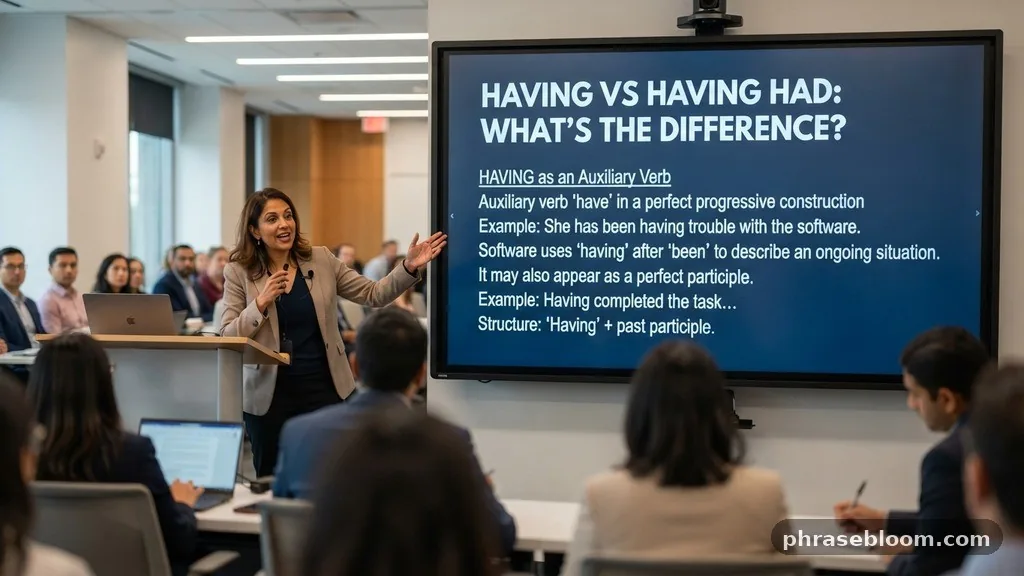
“Having” may be the -ing form of the auxiliary verb “have” in a perfect progressive construction. For example, “She has been having trouble with the software” uses “having” after “been” to describe an ongoing situation.
It may also appear in the perfect participle “having completed.” In that structure, “having” is an auxiliary element, while “completed” is the past participle of the main verb. The phrase means that completion occurred before the main action.
- Possession: “Having enough storage space is useful.”
- Experience: “Having difficult conversations is part of management.”
- Activity: “They are having a meeting.”
- Background action: “Having checked the figures, Lina approved the report.”
- Cause or condition: “Having no other option, the team postponed the launch.”
The surrounding words determine the grammatical role. A useful test is to ask whether “having” means owning or experiencing something, names an activity, or introduces an action connected to the main verb.
What “Having Had” Means
“Having had” contains two forms of “have,” but they do not perform the same job. The first “having” creates the perfect participle, and the second “had” is the past participle of “have” used inside that construction.
Consider the sentence, “Having had several warnngs, the employee understood the consequence.” The warnings came first, and the employee’s understanding followed. The phrase establishes a clear temporal sequence between a prior action or experience and the main clause.
“Having had” often refers to possession, experience, or a condition that existed before another event. In “Having had enough time to prepare, the presenters began,” the preparation period came before the beginning of the presentation.
Why the Repeated Forms Are Correct
English permits “having had” because “have” can appear as both an auxiliary verb and a main verb. In “having had experience,” the first word marks perfect aspect, while “had” carries the meaning of possessing or experiencing something in the earlier situation.
The same pattern appears in ordinary sentences such as “Having had coffee, I felt more alert” and “Having had the opportunity to speak, she left the meeting.” The repetition may look unusual, but the grammar is regular.
“Having had” does not necessarily mean that the earlier event happened long ago. It only places it before the main event in the relevant sequence. “Having had lunch, he returned to his desk” may describe events separated by only a few minute.
Present Participle, Perfect Participle, and Gerund
The labels can seem technical, but each one describes a different use of an -ing form. A present participle is an -ing form used in a verb phrase or to modify a noun. A gerund is also an -ing form, but it functions as a noun.
In “The employees are having lunch,” “having” is a present participle within the present progressive tense. In “Having lunch at your desk can be tiring,” “having” is a gerund because the phrase acts as the sentence subject.
In “Having had lunch, the employees returned to work,” “having had” is a perfect participle. It does not create a complete finite verb by itself, so it depends on the main clause “the employees returned to work.”
| Grammar term | Plain-English explanation | Example |
|---|---|---|
| Present participle | An -ing form used in a verb phrase or descriptive phrase | “They are having lunch.” |
| Gerund | An -ing form acting like a noun | “Having patience helps.” |
| Perfect participle | A phrase showing an earlier action before the main verb | “Having had lunch, she left.” |
| Past participle | A verb form used in perfect constructions or passive voice | “They had had lunch.” |
| Participial phrase | A phrase built around a participle that adds information | “Having reviewed the file, he replied.” |
For a more technical reference on participle clauses, readers can consult the Cambridge Dictionary explanation of participle clauses. In practical writing, however, the most important question is usually whether the earlier action needs to be marked explicitly.
How Time Changes the Meaning
The contrast between “having” and “having had” is closely related to perfect aspect. Perfect aspect presents one event as completed or prior in relation to another time, while the simple -ing form does not automatically express that relationship.
“Having a meeting, the managers discussed the proposal” can sound awkward because the phrase may suggest that the meeting and discussion happen together. “Having had a meeting, the managers discussed the proposal” clearly says the meeting came first.
Compare these grammar examples:
- Having concerns about the plan, Priya asked for more information. The concerns exist while she asks.
- Having had concerns about the plan, Priya revised the proposal. The earlier concerns led to a later revision.
- Having reviewed the plan, Priya asked for more information. The review happened before the request.
- Having had the plan reviewed, Priya sent it to the board. Someone else reviewed it before she sent it.
The difference is not always dramatic, and writers sometimes choose a simpler clause. “After reviewing the plan, Priya asked for more information” is often clearer than either participial construction.
Present Perfect and Past Perfect
Do not confuse “having had” with “have had” or “had had.” “We have had three meetings” uses the present perfect tense and connects past meetings with the present situation. “We had had three meetings before the decision was made” uses the past perfect tense to place those meetings before another past event.
“Having had three meetings, we understood the issue better” is a participial phrase rather than a complete tense. It condenses the relationship into an introductory phrase, but the main clause still provides the sentence’s finite verb.
The choice depends on sentence structure as well as time. Use a full verb phrase when you need a complete independent clause; use “having had” when a dependent or subordinate clause can efficiently provide background information.
Using Having and Having Had in Professional Sentences
Professional writing often uses these forms to connect decisions with earlier events. The construction can make reports concise, but it must clearly identify who performed the action. A participial phrase should normally refer to the subject of the main clause.
Company and Workplace Communication
“Having reviewed the updated company policy, employees must complete the acknowledgment form” is potentially misleading. Grammatically, it suggests that the employees reviewed the policy, but the wording may be intended to address managers or administrators.
A clearer version is “After reviewing the updated company policy, employees must complete the acknowledgment form.” If the intended subject is the HR team, write “Having reviewed the updated company policy, the HR team issued the acknowledgment form.”
Useful workplace examples include:
- “Having had several discussions with the client, the project team revised the delivery schedule.”
- “Having reviewed the training materials, employees can begin the assessment.”
- “Having had the software tested by the security team, IT approved the rollout.”
- “Having received the benefits announcement, staff members submitted their questions.”
- “Having had enough time to consider the proposal, the committee voted.”
Each sentence uses the opening phrase to establish background before the main action. The subject of the main clause also performs or experiences the action in the introductory phrase, which keeps the grammar clear.
Reports, Emails, and Meetings
In a business report, “Having analyzed the quarterly figures, the finance department recommended a revised forecast” efficiently connects analysis with recommendation. In an email, “Having had a chance to review your draft, I’ve attached two suggestions” sounds natural and courteous.
For meeting communication, “Having discussed the risks, the group agreed to delay the launch” places the discussion before the agreement. “Having a discussion about the risks, the group agreed” would describe simultaneous activity and sounds less polished.
These forms work best when the relationship between actions matters. If the sentence becomes difficult to process, use “after,” “because,” or “once” instead.
Common Mistakes and Better Corrections
The most common error is choosing “having” when the sentence needs to show a completed prior action. Another frequent problem is using a participial phrase with the wrong implied subject. Both issues can be fixed without changing the main message.
Using Having for a Clearly Earlier Action
Less clear: “Having lunch, Daniel returned to the office.” This may suggest that Daniel returned while he was eating, which is probably not the intended meaning.
Better: “Having had lunch, Daniel returned to the office.” Even more direct: “After eating lunch, Daniel returned to the office.” The second revision avoids the repeated form and may be preferable for learners.
Creating a Dangling Participial Phrase
Incorrect or confusing: “Having completed the audit, several errors were found.” The errors did not complete the audit, so the introductory phrase has no logical subject.
Better: “Having completed the audit, the auditors found several errors.” Another option is “After the audit was completed, several errors were found.” The passive version works when the person who completed the audit is not important.
Treating Having Had as a Complete Sentence
“Having had enough time to respond” is not normally a complete sentence. It is a dependent clause or participial phrase that needs a main clause, such as “Having had enough time to respond, the customer closed the ticket.”
Do not use the phrase alone in formal writing unless it is deliberately functioning as a fragment in a note or headline. A full sentence could be “The customer had had enough time to respond.”
Confusing Had Had with Having Had
“The team had had enough time” is grammatically complete because “had” is the past perfect auxiliary and the second “had” is the main verb. “Having had enough time, the team began the presentation” is a participial phrase followed by a main clause.
The forms are related, but they are not interchangeable in every sentence. Check whether you need a finite verb or a phrase that supplies background information.
Choosing the Right Form in Formal and Everyday Writing
Choose “having” when the action or state is ongoing, general, or simultaneous with the main action. Choose “having had” when a completed prior experience or event is important to the sentence’s logic.
| Situation | Preferred form | Example |
|---|---|---|
| An activity is in progress | having | “They are having a planning session.” |
| An activity is a general subject | having | “Having regular feedback improves performance.” |
| An earlier experience caused a later action | having had | “Having had prior approval, the team proceeded.” |
| A full present perfect statement is needed | have had | “We have had positive results.” |
| A full past perfect statement is needed | had had | “We had had several warnings before the outage.” |
| The relationship may confuse the reader | after or once clause | “After reviewing the data, we changed the plan.” |
In formal writing, clarity matters more than choosing the most compact structure. “After we had reviewed the data” is not less professional than “Having reviewed the data.” It may be better if the sentence contains several layers of information.
In everyday speech, people often use “after,” “because,” and “when” clauses instead of perfect participles. These alternatives are especially useful when the subject changes or when the time sequence is not immediately obvious.
Alternatives to Having and Having Had
Several alternatives express the same relationship with less grammatical compression. “After” is usually the most direct replacement for “having” or “having had” when one event precedes another.
- After reviewing the contract, we approved it.
- Once she had received approval, she published the announcement.
- Because he had experience with the system, he led the training.
- After the team had completed testing, IT released the update.
- Since we had already discussed the issue, the meeting was brief.
“After reviewing” and “having reviewed” are often close in meaning. “Having reviewed” sounds slightly more compressed and written, while “after reviewing” is transparent and natural in both business English and everyday communication.
“Having had” can often be rewritten with “after experiencing,” “after receiving,” “because of,” or a full clause. For example, “Having had several delays, the company changed suppliers” can become “After experiencing several delays, the company changed suppliers.”
Do not replace every participial phrase automatically. A well-formed construction can make a report efficient, especially when the subject remains the same and the temporal sequence is central.
Practical Editing Checklist
When editing a sentence with “having” or “having had,” first identify the main verb. Then ask what happened first and whether the sentence needs to show that order explicitly.
- Check whether “having” describes possession, experience, an activity, or background information.
- Ask whether the action in the opening phrase occurred before the main action.
- If it did, decide whether “having had” or another perfect participle is needed.
- Confirm that the implied subject of the participial phrase matches the subject of the main clause.
- Replace the phrase with “after,” “once,” or “because” if the meaning becomes easier to understand.
- Read the complete sentence aloud to test whether the time relationship sounds natural.
For example, “Having completed the survey, the results were summarized” fails the subject check because the results did not complete the survey. “After completing the survey, the researchers summarized the results” fixes both the grammar and the meaning.
Another useful test is to expand the phrase into a full clause. “Having had prior approval, the team launched the campaign” becomes “Because the team had received prior approval, the team launched the campaign.” If that expanded version makes sense, the shorter construction is probably sound.
Frequently Asked Questions
What is the difference between having and having had?
“Having” generally presents an action, activity, or state without specifically marking it as completed before another action. “Having had” shows that an experience or action occurred earlier than the main event.
Is having had grammatically correct?
Yes. “Having had” is a correct perfect participle construction, as in “Having had enough time to prepare, the speaker began.” It needs a main clause unless it is being used in a special fragmentary context.
Is having had a tense?
Not by itself. “Having had” is a perfect participle, while “have had” is present perfect and “had had” is past perfect. The surrounding main verb determines the complete sentence’s tense.
Can I use having had in professional writing?
Yes, especially when you need to show that one action or experience preceded another. If the sentence feels compressed or ambiguous, use a clearer alternative such as “after,” “once,” or “because.”
Is having always followed by a noun?
No. “Having” may be followed by a noun, as in “having experience,” but it can also introduce a participial phrase, appear in a progressive verb phrase, or be followed by a past participle in a perfect construction.
Conclusion
The practical distinction in Having vs Having Had is timing. “Having” can describe an activity, experience, possession, or background action, while “having had” marks an earlier completed experience before the main event.
Use “having had” when the prior action matters, but do not force it into every sentence. If a reader might pause, rewrite with “after” or “once,” check the implied subject, and choose the clearest structure. With that simple test, you can use both forms confidently in professional, academic, and everyday English.
You may also like: Worn vs Warn: Meaning, Pronunciation and Usage
Explore more on PhraseBloom.