
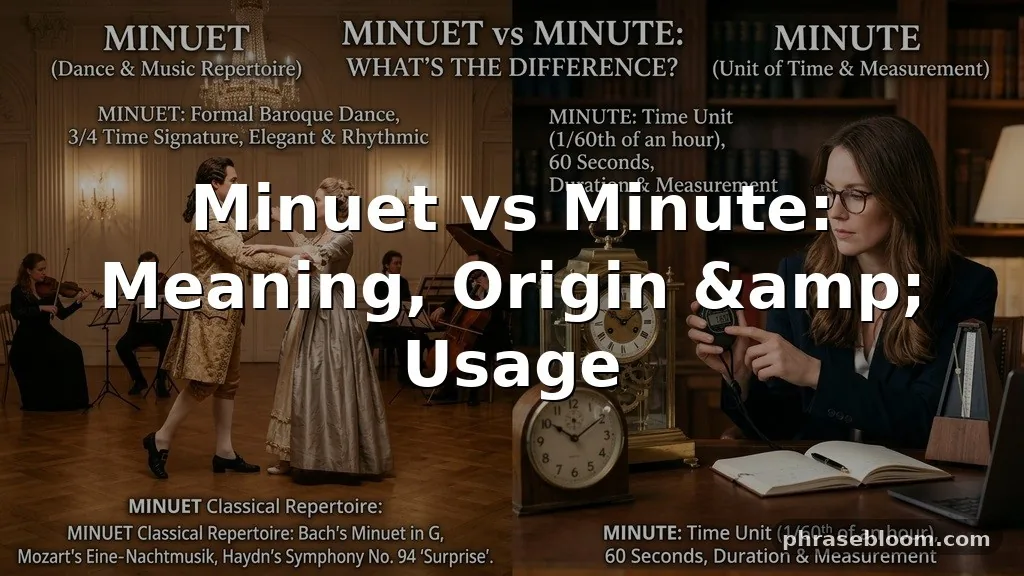
The difference between minuet and minute is more than a single letter. A minuet is a formal dance and a piece of music associated with courtly European culture, while minute usually refers to a unit of time, a written record, or something extremely small. The two words are often confused because their spelling is similar, but their meanings and pronunciations are different.
Understanding Minuet vs Minute helps you avoid errors in writing, music history, workplace documents, and everyday conversation. This article explains each definition, shows how the pronunciation changes, traces both words to their origins, and gives practical examples you can use with confidence.
Minuet vs Minute: The Quick Answer
A minuet is a slow, graceful dance that developed in France and became popular in European courts during the seventeenth and eighteenth centuries. The word also describes the musical composition written to accompany that dance, especially in classical music.
A minute has several unrelated meanings. It can mean a unit of time equal to sixty seconds, a brief period, an official record of a meeting, or something very small. As a verb, minute can mean to record the proceedings of a meeting, although this use has a different pronunciation from the time-related noun.
| Word | Primary meaning | Pronunciation | Example |
|---|---|---|---|
| minuet | A formal dance or musical composition | mih-NOO-et | The orchestra performed a minuet. |
| minute | A unit of time | MIN-it | Wait one minute. |
| minute | Extremely small | my-NOOT | The instrument detected a minute crack. |
| minute | A written record of a meeting | MIN-it | She circulated the meeting minutes. |
The safest way to remember the spelling difference is simple: the dance is a minuet, while a period of time is a minute. They are not interchangeable, even though both may appear in discussions of music, history, or performance.
What Does Minuet Mean?
A minuet is a slow and measured social dance traditionally performed by couples. Dancers used controlled steps, upright posture, formal gestures, and carefully arranged movements rather than the fast turns or athletic patterns associated with many later ballroom dances.
The minuet became especially important in the European court culture of the seventeenth and eighteenth centuries. It was associated with etiquette and social rank, so performing it required more than learning a sequence of steps. A dancer also had to show restraint, precision, and awareness of the other people in the room.
The word minuet entered English through French menuet. The French term is commonly connected with the idea of small or delicate steps, which fits the dance’s controlled style. Historical explanations of the word’s earliest development vary, but its French origin and courtly association are well established.
Minuet can also refer to a piece of minuet music. Composers wrote instrumental movements based on the dance’s character and rhythmic structure, even when the music was intended for listening rather than actual dancing.
- Minuet as a dance: a formal social dance performed with deliberate, elegant movements.
- Minuet as music: a musical movement modeled on the dance.
- Minuet in history: a cultural feature of European court life and later ballroom traditions.
- Minuet in modern speech: a term used mainly in music history, dance writing, and discussions of classical repertoire.
For a concise historical overview, the Encyclopaedia Britannica entry on the minuet provides useful background on the dance and its place in European music.
What Does Minute Mean?
The most familiar meaning of minute is a unit of time. One minute contains sixty seconds, and sixty minutes make one hour. In this sense, minute is pronounced MIN-it, with the stress on the first syllable.
Examples include “The train leaves in five minutes” and “The presentation lasted forty minutes.” Here, minute functions as a noun because it names a measurable period of time.
Minute can also mean a brief or limited period without referring to an exact sixty-second interval. If someone says, “Give me a minute,” they may mean “Give me a short amount of time.” The expression is informal and does not always describe precisely one minute of time.
Another meaning appears in formal workplace language. The minutes of a meeting are the written record of what participants discussed, decided, or assigned. The word remains pronounced MIN-it, as in “The secretary distributed the minutes after the board meeting.”
Minute has a separate meaning as an adjective: extremely small or difficult to see. In that sense, it is pronounced my-NOOT. A scientist might describe a minute particle, a minute variation, or a minute fracture in a material.
There is also a less common verb use. To minute a meeting means to record it in minutes.
This verb is pronounced MIN-it, not my-NOOT. The surrounding sentence usually makes the intended meaning clear, as in “Jordan was asked to minute the committee meeting.”
Minuet Meaning, Pronunciation, and Musical Context
The pronunciation of minuet is usually given as mih-NOO-et, with the middle syllable receiving the strongest emphasis. It has three syllables in careful speech, although the final sound may be pronounced lightly in fast conversation.
Unlike minute, minuet does not change pronunciation according to its grammatical role. Whether it refers to a dance or a musical movement, it keeps the same basic pronunciation.
The minuet dance is normally associated with triple meter. That means the music is organized around groups of three beats, often written in a 3/4 time signature. The rhythm gives the dance a steady, balanced quality that supports its formal steps.
It is important not to reduce every minuet to a single rigid musical pattern. Composers adapted the style in different ways, and a piece inspired by the dance may emphasize musical form more than practical movement. Still, its connection with triple meter, graceful pacing, and court dance tradition remains central.
In Baroque dance and classical music, the minuet often appeared as one movement within a larger work. Composers used it in suites, chamber compositions, symphonies, and other instrumental settings.
Minuet in Classical Repertoire
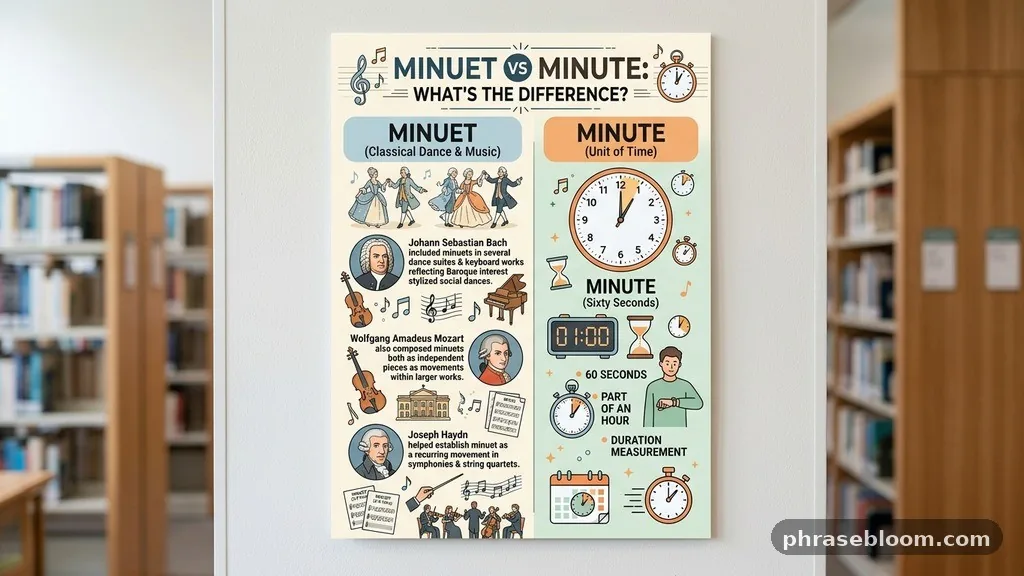
Johann Sebastian Bach included minuets in several dance suites and keyboard works, reflecting the Baroque interest in stylized social dances. Wolfgang Amadeus Mozart also composed minuets, both as independent pieces and as movements within larger works.
Joseph Haydn helped establish the minuet as a recurring movement in the classical symphony and string quartet. In later works, the minuet was often replaced by the scherzo, which generally moved faster and created a more energetic contrast within a multi-movement composition.
These musical examples show why minuet is not simply another spelling of minute. It belongs to a specific historical and artistic vocabulary involving dance, rhythm, orchestration, and musical form.
Minute Pronunciation and Its Different Meanings
Minute has two major pronunciations because English uses the same spelling for words with different histories and meanings. This is one reason the spelling can be confusing even for fluent speakers.
| Meaning | Part of speech | Pronunciation | Example |
|---|---|---|---|
| Sixty seconds | Noun | MIN-it | The call starts in a minute. |
| A short period | Noun | MIN-it | It will be ready in a minute. |
| Meeting record | Noun | MIN-it | Please approve the minutes. |
| To record a meeting | Verb | MIN-it | Priya will minute the session. |
| Extremely small | Adjective | my-NOOT | The test found a minute difference. |
The adjective minute is closely related to the idea of something measured in very small detail. A minute distinction may be real but difficult to notice, while a minute object may be physically tiny.
Context matters greatly. In “The meeting lasted a minute,” the word refers to time.
In “The analyst observed a minute change,” it means extremely small. In “The clerk will minute the discussion,” it functions as a verb meaning to record.
These different uses make minute a good example of a heteronym, or a word whose spelling stays the same while pronunciation and meaning change. Minuet is not a heteronym in this way.
Minuet vs Minute in Real Sentences
Seeing the words in complete sentences is often more useful than memorizing definitions. The following examples cover music, history, time, meetings, and technical writing.
- “The students practiced a minuet before the historical dance exhibition.”
- “The composer wrote a minuet in a light triple meter.”
- “Please arrive ten minutes before the concert begins.”
- “The committee approved the minutes at its next meeting.”
- “The laboratory detected a minute change in temperature.”
- “A minute later, the conductor raised the baton.”
- “The administrator will minute the discussion and circulate the record.”
- “The program pairs a Baroque minuet with a modern musical composition.”
In the first two examples, minuet names either a dance or a type of musical movement. In the next several examples, minute refers to time, a written record, or a small change.
The sentence “The orchestra played a minute” is incorrect if the intended meaning is a dance. It should say “The orchestra played a minuet,” unless the writer means that the orchestra played for one minute.
Likewise, “The dancers performed a minute” does not describe the formal dance. The correct sentence is “The dancers performed a minuet.” A single letter changes the meaning completely.
The Difference Between a Minuet and a Minute of Time
A minuet and a minute of time belong to entirely different categories. One is a dance or musical form; the other is a measurement used in clocks, schedules, science, and ordinary conversation.
The phrase minute of time is sometimes used for extra clarity, especially when a writer wants to distinguish the time-related noun from another meaning of minute. For example, “The device records data every minute of time” is understandable, although “every minute” is usually more natural.
Minuet is connected with movement and music. Minute is connected with duration, records, or small size. The two words may appear in the same paragraph, particularly in a review of a concert, but they still have separate meanings.
Consider this sentence: “After a minute of silence, the ensemble began the minuet.” The first word refers to a period of sixty seconds or a short period, while the second refers to the musical selection. Context does not merge their meanings; it simply places them together.
The spelling difference also reflects different word histories. Minuet came through French and is associated with European dance culture. The several meanings of minute developed through Latin and French forms connected with time, detail, smallness, and written records.
Common Confusions and Mistakes
Most errors arise from hearing the words rather than seeing them in writing. A speaker may know the intended meaning but choose the wrong spelling because minuet and minute look similar on the page.
Using minute for the dance
“The dancers performed a minute” is a spelling error when the writer means the historical dance. Replace minute with minuet: “The dancers performed a minuet.”
Using minuet for time
“The bus arrives in a minuet” is incorrect. The correct sentence is “The bus arrives in a minute.” The word must be minute because the sentence describes duration.
Confusing minute and minutes
Meeting minutes are written records, not short periods of time. “Please read the minutes” usually refers to an official account of a meeting, while “Please wait a minute” refers to time.
Mispronouncing the adjective minute
When minute means extremely small, it is pronounced my-NOOT. Saying MIN-it can make the listener expect a time reference, although context may still clarify the meaning.
Assuming spelling determines pronunciation every time
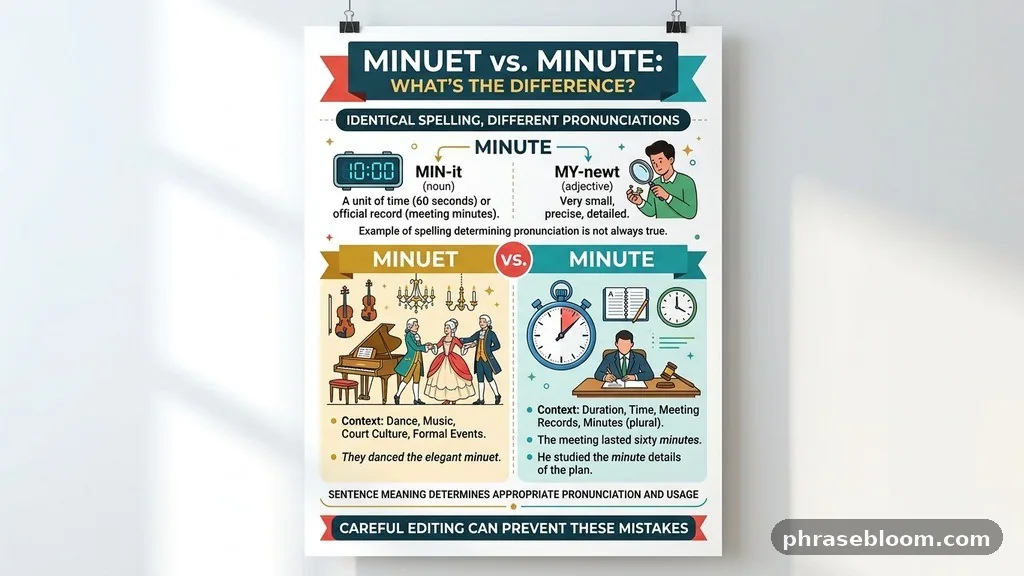
Minute demonstrates that identical spelling does not always produce identical pronunciation. The sentence and meaning determine which pronunciation is appropriate.
Careful editing can prevent these mistakes. If the sentence involves a dance, music, or court culture, check for minuet. If it involves duration, meeting records, or small size, minute is usually the intended word.
Minuet, Minute, and Related Musical Terms
The word minuet appears alongside several terms from music history. A discussion of a minuet may mention Baroque dance, court dance, ballroom dance, triple meter, tempo, suite, movement, and musical composition.
A minuet is not simply any slow piece in 3/4 time. The time signature describes the organization of beats, while the word minuet identifies a historical style and form. A modern composition can use triple meter without being a minuet.
The dance’s formal character also distinguishes it from many later ballroom dances. Minuet steps were typically controlled and ceremonious, reflecting the social expectations of the court environment in which the dance flourished.
In a classical symphony, the minuet may function as a movement rather than as a practical dance. The composer may preserve its rhythmic identity while developing themes through orchestration, repetition, contrast, and variation.
Readers may also encounter the term minuet and trio. In this structure, the main minuet section returns after a contrasting middle section called the trio. The trio does not necessarily require three performers; its name comes from the historical development of the form.
Minute does not belong to this musical vocabulary unless it appears in a different context. A program might say that a minuet lasts four minutes, but the two words still perform separate jobs in the sentence.
American and British English Usage
American English and British English use the same basic distinction between minuet and minute. A minuet remains a dance or musical composition in both varieties, while minute can refer to time, meeting records, small size, or the act of recording a meeting.
Pronunciation can vary slightly by speaker and region, but the central contrast remains stable. The dance is generally pronounced mih-NOO-et, the time-related minute is MIN-it, and the adjective meaning extremely small is commonly pronounced my-NOOT.
Spelling differences between American and British English are not the main issue here. Unlike words such as color and colour, minuet and minute are not standard regional variants of one another. They are separate words with different meanings.
British and American writers may use the words in different institutional contexts. For example, British workplace documents commonly refer to “the minutes of the meeting,” while American organizations use the same expression. Neither usage changes the spelling or meaning of minuet.
Formal writing in either variety benefits from checking pronunciation and context rather than relying on regional assumptions. A writer should not assume that minuet is British or that minute is American. Both words are established in both forms of English.
How to Choose the Correct Word
A quick decision process can make the choice almost automatic. Ask what the word is naming before you think about pronunciation.
- If it names a formal dance or a piece of dance-based music, choose minuet.
- If it describes sixty seconds or a short period, choose minute.
- If it refers to an official meeting record, choose minutes.
- If it means extremely small, choose minute, pronounced my-NOOT.
- If it means to record a meeting, choose minute as a verb.
The surrounding nouns often provide a useful clue. Words such as dance, orchestra, suite, composer, movement, and Baroque point toward minuet. Words such as hour, second, meeting, record, detail, tiny, and schedule point toward minute.
Reading the sentence aloud can help, but pronunciation alone is not enough. Because minute has more than one pronunciation, you must first identify its meaning and then use the corresponding sound.
A dictionary is useful when a sentence remains unclear, especially in technical, historical, or academic writing. Check the definition and example sentences rather than choosing the word that merely looks familiar.
Examples for Work, School, and Everyday Writing
Although minuet usually appears in music or cultural writing, minute is common across professional and academic communication. The following examples show how each word works in a realistic setting.
Academic and music writing
“The essay examines how the minuet reflects the etiquette of the European court.” This sentence uses minuet as a noun referring to a historical dance.
“The composer adapted the minuet form for a chamber ensemble.” Here, minuet describes a musical structure or style rather than a dance lesson.
Workplace communication
“The chair asked Maya to minute the planning meeting.” In this sentence, minute is a verb meaning to create a written record.
“The approved minutes will be attached to next week’s agenda.” Here, minutes is a plural noun referring to the record of the meeting.
Scheduling and everyday conversation
“The technician will call back in a minute.” The word means a short period, not necessarily an exact sixty seconds.
“The appointment begins in twenty minutes.” This is the precise time-related noun.
Technical and scientific writing
“The inspection found a minute crack near the edge of the panel.” Minute is an adjective meaning extremely small, and it is pronounced my-NOOT.
“The sensor can detect minute changes in pressure.” The same adjective describes variations that may be difficult to observe without specialized equipment.
Why Context Matters More Than Visual Similarity
Minuet and minute are easy to confuse visually because both begin with the letters minu. Yet visual resemblance does not indicate a shared modern meaning. Many English words contain similar letter sequences while belonging to unrelated vocabulary groups.
Context supplies the missing information. A sentence about dancers, a harpsichord, or a symphony calls for minuet, while a sentence about a deadline, a meeting record, or a tiny flaw calls for minute.
Pronunciation adds another layer. Minuet usually has a clear “new-et” ending, while minute can sound like MIN-it or my-NOOT. Listening carefully to the stress and vowel pattern can help, but written context remains the strongest guide.
This is especially important for language learners. Homophones and near-homophones can create confusion because a learner may recognize the sound without knowing which spelling matches the intended meaning. Writing the full sentence and identifying the part of speech makes the choice easier.
The same principle applies to editing. Instead of scanning only for spelling, ask whether the selected word fits the sentence’s subject, grammatical role, and meaning. A technically familiar word can still be wrong if it names the wrong concept.
Frequently Asked Questions
Is minuet the same as minute?
No. A minuet is a formal dance or a related musical composition. A minute can refer to a unit of time, a meeting record, something extremely small, or the act of recording a meeting.
How do you pronounce minuet?
Minuet is usually pronounced mih-NOO-et, with the strongest stress on the middle syllable. The pronunciation is generally the same whether the word refers to a dance or a piece of music.
How do you pronounce minute?
Minute meaning a unit of time or a meeting record is pronounced MIN-it. Minute meaning extremely small is pronounced my-NOOT.
Is minute a noun, adjective, and verb?
Yes. As a noun, minute can mean sixty seconds or a meeting record. As an adjective, it means extremely small, and as a verb, it means to record the proceedings of a meeting.
What is the easiest way to remember minuet vs minute?
Associate the extra “e” in minuet with an elegant dance or musical event. Use minute for time, meeting records, small details, and the verb meaning to record.
Conclusion
The practical lesson from Minuet vs Minute is straightforward: choose minuet for the formal dance and its related music, and choose minute for time, meeting records, very small things, or recording a meeting. The words look alike, but their meanings, histories, and pronunciations are distinct.
When you encounter either spelling, read the whole sentence before deciding how to pronounce or use it. That small check will keep a minuet on the dance floor and a minute on the clock, where each belongs.
Related reading: Takes One to Know One, Too Many Irons in the Fire, A Chip Off the Old Block.
2 thoughts on “Minuet vs Minute: Meaning, Origin & Usage”