
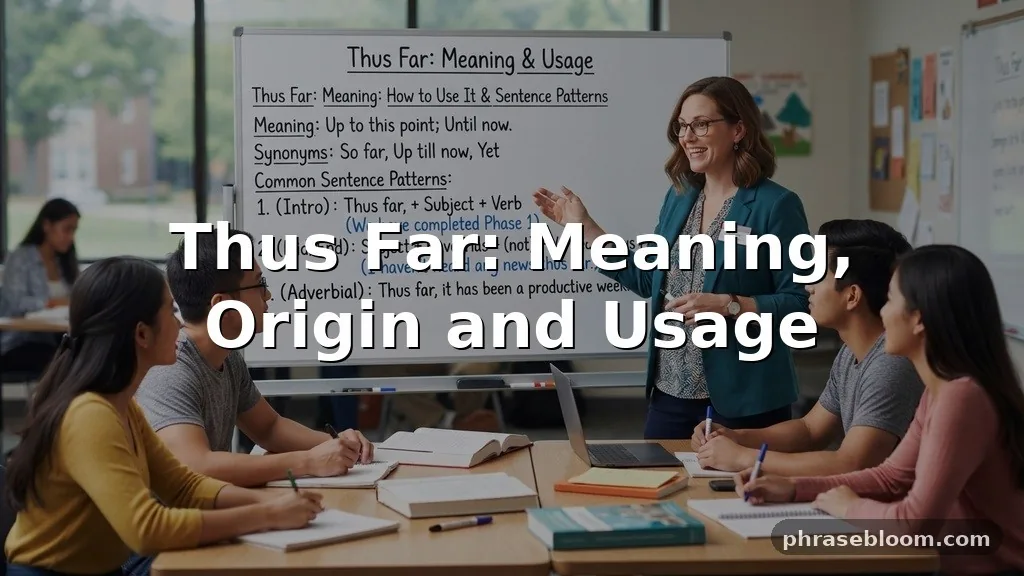
“Thus far” means “up to this point” or “until now.” It often describes progress, results, events, or knowledge that have continued from the past to the present. You’ll see it in formal English, business reports, academic writing, news, and careful everyday speech.
The phrase can usually replace “so far,” but the tone is slightly different. “So far” sounds more conversational, while “thus far” often sounds more formal or deliberate. Understanding its grammar, position in a sentence, and relationship to phrases such as “to date” will help you use it naturally rather than mechanically.
Thus Far Meaning and Definition
The basic thus far meaning is “up to now” or “up to this point in time.” The phrase looks backward over a period that began earlier and reaches the present moment. It may refer to an action, a development, a record, or the information available at a particular stage.
For example, in “The project has thus far stayed within budget,” the speaker means that the project has remained within budget from its beginning until now. The sentence does not necessarily say what will happen next. It reports the situation at the current point.
“Thus far” is an adverbial phrase. That means it acts like an adverb by giving information about a verb, adjective, or whole statement. It tells us how far a process has progressed in time or development.
- Progress: “The team has thus far completed three stages.”
- Results: “The treatment has thus far produced positive results.”
- Knowledge: “Thus far, no reliable explanation has been confirmed.”
- Experience: “The conference has been successful thus far.”
The phrase does not mean “in this manner.” In modern usage, “thus” contributes the sense of “to this point,” while “far” refers to the extent of time or progress. The phrase is therefore a time expression, not a description of physical distance.
Its meaning is close to the following expressions:
| Expression | Basic meaning | Typical tone | Example |
|---|---|---|---|
| Thus far | Up to this point | Formal or neutral | The plan has thus far worked well. |
| So far | Up to now | Conversational or neutral | The plan has worked well so far. |
| Until now | Before the present moment | Neutral, sometimes contrastive | Until now, the process was manual. |
| To date | Up to the current date | Formal, administrative | To date, the company has received 400 applications. |
| Up to now | Until the present | Neutral and direct | Up to now, demand has remained steady. |
How to Use Thus Far in a Sentence
“Thus far” can appear at the beginning, in the middle, or at the end of a sentence. Its position depends on what the writer wants to emphasize and how the sentence is structured. The meaning usually stays the same, although the rhythm and focus can change.
At the beginning, the phrase frames the entire statement:
“Thus far, the investigation has found no evidence of misconduct.”
This placement makes the time limit clear immediately. It tells readers that the statement is accurate only based on what investigators have learned up to the present point.
In the middle of a sentence, “thus far” often follows an auxiliary verb such as “has,” “have,” or “is”:
“The company has thus far avoided changes to its pricing model.”
This position is common in formal reports because it fits smoothly into a longer sentence. It also keeps the main subject and verb together before adding the time expression.
At the end, the phrase can sound more conversational or provide a neat closing:
“The new software has performed reliably thus far.”
That sentence is correct, although many speakers would choose “so far” in casual conversation. In formal writing, the final position can work well when the sentence has a short, clear structure.
Common sentence patterns

Several patterns are especially useful in business English and academic writing. The present perfect tense is common because it connects a past action or period with the present:
- Subject + has or have + thus far + past participle: “The program has thus far improved retention.”
- Thus far + comma + subject + has or have: “Thus far, the committee has approved two proposals.”
- Subject + has or have + past participle + thus far: “Researchers have identified four factors thus far.”
- Subject + be + adjective + thus far: “The response has been encouraging thus far.”
The simple past tense can also appear with “thus far” when the phrase refers to a completed period viewed from a past point. For instance, “By the end of June, the team had thus far delivered five reports” describes progress as measured at a past date. The tense changes the viewpoint, not the basic meaning of the phrase.
Thus Far Examples in Professional Writing
Professional writers use “thus far” when they need to report progress without suggesting that the situation is final. It is especially useful in updates, evaluations, board papers, and formal correspondence. The phrase signals that later information may change the conclusion.
Policies and internal communication
“The company-wide policy has thus far reduced duplicate approval requests.”
This sentence reports an observed result while leaving room for future review. It does not claim that the policy will always produce the same outcome.
“Thus far, the employee announcement has generated few questions from staff.”
Here, the phrase limits the statement to the period since the announcement was made. That qualification is useful in internal communications because employee reactions may develop over several days.
Training and workplace emails
“The new training program has thus far received positive feedback from regional managers.”
The wording fits a progress update or workplace email. “Thus far” sounds more measured than “so far,” especially when the writer is documenting feedback rather than chatting with a colleague.
“We have thus far completed the introductory modules, with the compliance sessions scheduled for next week.”
This example uses the phrase to separate completed work from future work. It gives the reader a clear status report without repeating the full project timeline.
Reports and organizational changes
“The restructuring has thus far affected reporting lines but not employee benefits.”
The expression helps distinguish current effects from possible later changes. That distinction matters in reports about organizational change, where the first stage may not show the full impact.
“The quarterly report identifies no material decline in demand thus far.”
Placed at the end, “thus far” keeps the report concise. It also avoids making an absolute claim about demand for the entire year.
Technology, meetings, and public communication
“The software rollout has thus far reached 72 percent of eligible devices.”
This is a natural use in a technology update. The phrase tells readers that the percentage is current and may rise as deployment continues.
“Thus far, the company meeting has focused on customer retention and product quality.”
The sentence can describe a meeting that is still in progress. It indicates that the topics covered so far may not be the only topics discussed.
“The initiative has thus far attracted strong interest from small-business customers.”
This public-facing example works in marketing communication, provided the company can support the claim. “Thus far” sounds restrained and avoids implying a permanent result.
Thus Far vs So Far, Until Now, and To Date
“Thus far” and “so far” are usually interchangeable. Both mean “up to now,” and both can describe progress or results. The main difference is register, which means the level of formality or conversational tone.
“So far” is more common in everyday speech: “So far, the trip has been easy.” A friend, colleague, or customer may naturally choose it without any loss of clarity.
“Thus far” is more formal or reflective: “Thus far, the study has produced consistent findings.” It often appears in writing that evaluates evidence, records progress, or qualifies a conclusion.
The contrast between thus far vs so far is therefore usually stylistic rather than grammatical. Neither expression is automatically more correct.
Thus far vs until now
“Until now” can carry a stronger sense of change or contrast. Consider the sentence, “Until now, the department had no dedicated support team.” It suggests that a support team has recently been created or that the situation is about to change.
“Thus far” does not necessarily suggest a change. “Thus far, the department has handled requests internally” simply reports the department’s experience up to the present point.
That distinction makes “until now” useful when the present differs from the past. Use “thus far” when you mainly want to measure progress or describe the current record.
Thus far vs to date
“To date” is common in financial reports, legal documents, fundraising updates, and administrative writing. It can sound more specific and record-oriented than “thus far,” particularly when the statement includes a current total.
For example, “To date, the fund has distributed $2 million” sounds like a formal accounting statement. “Thus far, the fund has distributed $2 million” is also correct, but it places slightly more emphasis on the progress made rather than the reporting date.
Other useful alternatives include “up to now,” “at this stage,” “so far,” and “to this point.” Choose based on audience and context rather than trying to make every sentence sound formal.
Thus Far Grammar and Grammatical Function
In thus far grammar, the most important point is that the phrase functions adverbially. It modifies a statement by setting a time boundary. It does not act as a noun, and it does not usually describe a physical object.
The phrase often appears with the present perfect tense, which uses “has” or “have” plus a past participle. This tense is suitable because it links an earlier period with the present:
“The researchers have thus far identified three possible causes.”
The research began earlier, and the identified causes remain relevant now. The sentence also implies that more causes may be identified later.
“Thus far” can also work with the verb “be”:
“The results have been encouraging thus far.”
Here, the phrase modifies the adjective “encouraging” by limiting the judgment to the current stage. It does not need to appear directly next to the main action.
Using thus far with different tenses
The present perfect is common, but it is not mandatory. The simple present can describe a current assessment:
“Thus far, the evidence suggests that the process is reliable.”
The past perfect can place the phrase inside a past narrative:
“By the time the review ended, the panel had thus far rejected every proposed amendment.”
The simple past may also be appropriate when the time period is complete:
“During the first week, the campaign thus far exceeded its target.”
That last example is less natural than “During the first week, the campaign exceeded its target,” because “thus far” usually points toward a present or reference point. Removing it may improve the sentence when the period is already clearly finished.
Position and punctuation
When “thus far” begins a sentence, a comma usually follows it: “Thus far, the plan has worked.” When it appears inside or at the end of a sentence, a comma is normally unnecessary.
Do not add a comma simply because the phrase sounds formal. In “The plan has thus far worked,” the phrase fits naturally between the auxiliary verb and the main participle. In “The plan has worked thus far,” it closes the sentence without extra punctuation.
Formal English, Academic Writing, and Everyday Speech
“Thus far” is particularly comfortable in formal English because it sounds careful without being obscure. It is common in analytical writing, research discussion, institutional reports, and professional evaluations. Writers use it to avoid overstating evidence.
In academic writing, the phrase can help distinguish current findings from final conclusions:
“The available studies have thus far focused on short-term outcomes.”
This wording tells the reader that the research record may expand. It is more precise than saying, “The studies focus on short-term outcomes,” which could sound like a complete description of all relevant research.
Business writers can use “thus far” in board reports, project reviews, and executive summaries. It works especially well when the document discusses milestones, risks, or incomplete data.
“The pilot has thus far met its service-level objectives, although the sample remains limited.”
The second clause supplies an important qualification. “Thus far” should not be used as a substitute for evidence; it should help define the period to which the evidence applies.
In casual speech, “so far” will often sound more natural:
“How’s the new job going so far?”
“How’s the new job going thus far?” is grammatical, but it sounds unusually formal for a friendly conversation. Matching the phrase to the audience is part of good style.
For readers learning English, the practical rule is simple: use “so far” in relaxed conversation and “thus far” when a more formal or measured tone suits the situation. Native speakers may use either one, and context matters more than a rigid rule.
Thus Far in a Sentence: Copyable Examples
The following thus far examples show how the phrase works in several settings. Each sentence can be adapted by changing the subject, verb, or result.
- Company policy: “The revised leave policy has thus far reduced scheduling conflicts.”
- Employee benefits: “Thus far, enrollment in the new health plan has exceeded expectations.”
- Training: “The company has thus far completed training for all customer-support supervisors.”
- Internal communication: “Thus far, no changes have been made to the reporting structure.”
- Business report: “The figures have thus far remained consistent with the annual forecast.”
- Software rollout: “The update has thus far caused no significant service interruptions.”
- Marketing: “The campaign has thus far generated interest in three priority markets.”
- Organizational change: “The merger has thus far affected procurement and finance operations.”
- Meeting update: “Thus far, the discussion has centered on staffing and customer support.”
- Academic writing: “The literature has thus far offered limited evidence for this explanation.”
These examples work because “thus far” identifies a continuing time frame. The results are current, but they are not necessarily final.
Writers can also place the phrase after a noun phrase and verb:
“The department has delivered four workshops thus far.”
Or they can use a related phrase for variety:
“The department has delivered four workshops to date.”
Both sentences are correct. The first is slightly more general, while “to date” can sound more like a formal record.
Common Mistakes and Better Choices
Most errors involving “thus far” concern meaning, tone, or unnecessary repetition rather than basic grammar. The phrase is short, but its time reference must still fit the sentence.
Using it with a clearly finished period
Awkward: “The company thus far closed the project last year.”
Better: “The company closed the project last year.”
“Thus far” points toward a current or relevant reference point. If the project ended last year and no continuing assessment is intended, the phrase adds confusion.
Using it with a final, absolute claim
Awkward: “Thus far, the policy will never change.”
Better: “Thus far, the policy has not changed.”
The first sentence combines a limited time expression with an absolute prediction. The second reports an observable fact and leaves future decisions open.
Repeating the same time expression
Awkward: “Thus far up to now, the system has worked well.”
Better: “Thus far, the system has worked well.”
“Thus far” already means “up to now,” so using both phrases together is redundant. Choose one.
Using a wordier alternative without a reason
Possible but heavy: “At this point in time, the project has, up to now, met its targets.”
Better: “Thus far, the project has met its targets.”
The shorter version is clearer because it expresses one time relationship directly. Concision is especially valuable in reports and workplace emails.
Choosing formality over naturalness
Unnatural in casual speech: “Thus far, I have enjoyed the concert.”
Natural: “I’ve enjoyed the concert so far.”
The formal phrase is not wrong, but “so far” better matches the conversational setting. Good writing is not always the most formal writing.
Thus Far, Dictionary Usage, and Word History
“Thus far” is an established English phrase rather than a recently invented business expression. “Thus” has long been used to mean “in this way” or “to this degree,” and “far” can refer to extent. Together, the words developed a conventional meaning connected with progress up to a point.
Dictionary entries can help confirm the phrase’s meaning and examples, although dictionaries may differ in how much detail they provide. The Oxford English Dictionary is a major historical reference that traces English words and expressions across earlier and modern usage.
Merriam-Webster is also a familiar reference for contemporary American English. When checking a dictionary, look for example sentences as well as a short definition. Examples reveal whether a phrase is usually formal, conversational, literary, or restricted to a particular grammatical pattern.
The thus far definition remains stable: “up to now” or “up to this point.” It does not usually signal a different meaning from “so far.” Differences in tone come from usage patterns, not from a separate event or concept.
Some writers associate “thus far” with formal or old-fashioned language because “thus” is less common in casual conversation. It is not incorrect or obsolete, however. It remains useful in modern reports, research, organizational communication, and careful explanatory writing.
Choosing Between Thus Far and Its Alternatives
The best choice depends on what the sentence needs to communicate. If the goal is a direct, conversational update, “so far” may be ideal. If the goal is a measured assessment, “thus far” can provide the right tone.
- Choose “so far” for everyday conversation, informal emails, and friendly updates.
- Choose “thus far” for formal reports, academic analysis, and cautious evaluation.
- Choose “until now” when the sentence contrasts an earlier situation with a new one.
- Choose “to date” for records, totals, financial statements, and administrative documents.
- Choose “up to now” when you want a plain, direct expression understood by a broad audience.
- Choose “throughout this period” when the emphasis is on continuity rather than a current result.
Do not change every instance of “so far” to “thus far” simply to make a document sound more professional. Repetition can make the prose stiff. A report may use “thus far” in an analytical section and “to date” in a financial table if each phrase fits its context.
Clarity should come first. If a sentence becomes easier to understand when rewritten, rewrite it:
“The team has thus far completed the first phase.”
can become:
“The team has completed the first phase so far.”
Both are grammatical, but the first version usually has a smoother formal rhythm. In another context, “The team has completed the first phase to date” may sound more appropriate for a project record.
Frequently Asked Questions About Thus Far
What does “thus far” mean?
“Thus far” means “up to now,” “up to this point,” or “until now.” It describes progress, results, or knowledge within a period that reaches the present or another stated reference point.
Is “thus far” formal?
It is generally more formal than “so far,” although it is not limited to highly formal writing. It fits reports, academic work, business communication, and careful explanations.
Is “thus far” the same as “so far”?
Usually, yes. The two phrases have the same basic meaning, but “so far” is more common in everyday speech and “thus far” often sounds more measured or formal.
Can “thus far” be used at the beginning of a sentence?
Yes. For example: “Thus far, the project has met its deadlines.” Use a comma after the phrase when it introduces the sentence.
Can “thus far” appear after a verb?
Yes. You can write, “The new system was introduced thus far” only if the sentence has a suitable reference point, but more natural examples are “The system has performed well thus far” and “The team has thus far met its goals.”
What is the best thus far synonym?
“So far” is the closest everyday synonym. Depending on the context, “up to now,” “until now,” “to date,” and “to this point” can also work.
Should I use “thus far” in academic writing?
Yes, when it accurately limits a claim to the evidence or progress available at that point. It is especially useful when a study or argument is ongoing rather than complete.
Is “thus far” still used in modern English?
Yes. It appears in formal English, academic writing, professional reports, journalism, and institutional communication. It is less common in casual conversation, where “so far” usually sounds more natural.
Conclusion: How to Use Thus Far Naturally
“Thus far” means “up to now” or “up to this point.” Use it when you want to report current progress, results, or knowledge, especially in formal or professional writing. Its closest synonym is “so far,” but the two phrases differ mainly in tone, not meaning.
Remember that “thus far” is an adverbial phrase often used with the present perfect tense: “The project has thus far met its goals.” If a simpler style suits your audience, choose “so far,” “up to now,” or “to date.” With the right context, Thus Far sounds precise, natural, and appropriately careful.
Explore more on PhraseBloom.