
Booze vs Boos: Meaning, Spelling, and Usage
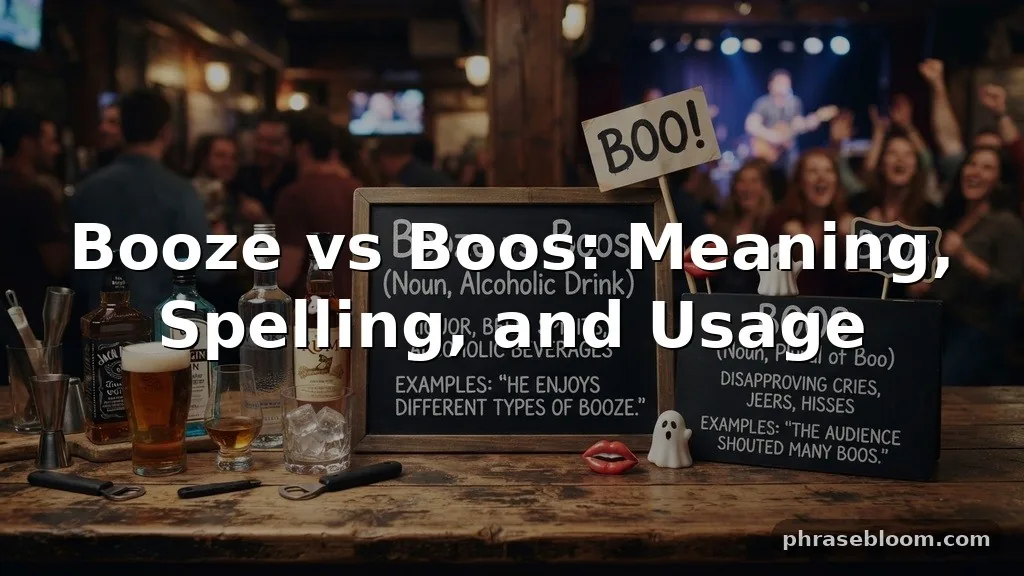
Booze vs boos is a spelling distinction between two words that sound alike but mean entirely different things. Booze means alcohol or alcoholic drinks, while boos means shouted expressions of disapproval, usually from an audience.
The difference becomes clear once you look at the surrounding sentence. This article explains the booze definition, the boos definition, their pronunciation, grammatical roles, common mistakes, and natural examples so you can choose the right word confidently.
Booze vs Boos: The Direct Answer
Booze is an informal noun for alcohol, liquor, beer, wine, or other alcoholic drinks. It can also function as a verb meaning to drink alcohol, usually in a casual or excessive way.
Boos is the plural form of the noun boo, meaning cries, shouts, or sounds that show disapproval. It can also be the third-person singular form of the verb boo, as in “The crowd boos the referee.”
| Word | Meaning | Part of speech | Example |
|---|---|---|---|
| booze | Alcohol or alcoholic drinks | Noun or verb | “They bought some booze for the party.” |
| boos | Expressions of disapproval | Plural noun or verb | “The speaker was met with boos.” |
The words are pronounced the same in standard English: /buːz/. They are homophones, which means they share a pronunciation but have different spellings and meanings.
In short, booze belongs to the subject of alcohol, while boos belongs to the subject of criticism, rejection, or audience reaction. Context does the rest.
What Does Booze Mean?
The noun booze is an informal word for alcohol. It may refer to one alcoholic drink, a collection of drinks, or alcohol generally. For example, someone might say, “There was plenty of booze at the wedding,” without naming the particular beer, wine, or spirits available.
The word is common in everyday conversation, workplace social planning, entertainment writing, and informal journalism. It is less suitable for highly formal documents, medical writing, legal wording, or public health communication, where alcohol or alcoholic beverages is usually more precise.
- Beer, wine, and cocktails can all be called booze.
- Liquor and spirits are also types of booze.
- Alcohol is the more neutral and formal term.
- Booze often sounds casual, humorous, or slightly blunt.
Consider the sentence, “The hotel does not allow booze in the conference room.” Here, booze means alcoholic drinks generally. A formal policy would more likely say, “The hotel does not allow alcohol in the conference room.”
Booze can also describe drinking as an activity. “They spent the evening boozing” means they spent the evening drinking alcohol, often suggesting that drinking was a major part of the occasion. The tone may be lighthearted, but the verb can also imply excessive drinking depending on context.
Booze as a noun
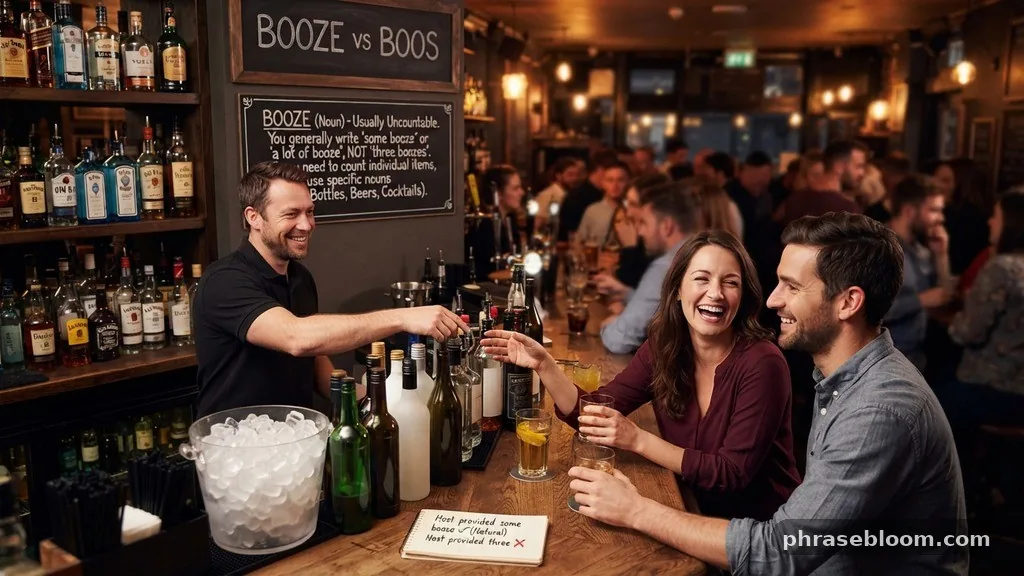
As a noun, booze is usually uncountable. You generally write “some booze” or “a lot of booze,” not “three boozes.” If you need to count individual items, use a more specific noun such as drinks, bottles, beers, or cocktails.
For example, “The host provided some booze” sounds natural, while “The host provided three boozes” does not. You could instead write, “The host provided three bottles of wine and several beers.”
Booze as a verb
As a verb, booze means to drink alcohol. The forms include booze, boozes, boozed, and boozing.
“He boozes on weekends” describes a repeated activity. “They were boozing after the concert” describes drinking in progress, while “She boozed too much at the party” suggests excessive drinking.
What Do Boos Mean?
Boos refers to sounds or words that express disapproval. A crowd may boo a performer, athlete, politician, referee, or speaker. The plural noun can describe the reaction itself: “The player left the field to a chorus of boos.”
The singular word boo can also describe one cry of disapproval. In practice, however, audiences often produce many such sounds, so boos is common in reports about public events.
The verb boo means to make that sound. Its forms include boo, boos, booed, and booing.
| Form | Grammatical role | Example |
|---|---|---|
| boo | Singular noun or base verb | “One loud boo came from the back row.” |
| boos | Plural noun or third-person verb | “The crowd boos the decision.” |
| booed | Past-tense verb | “Fans booed the announcement.” |
| booing | Present participle or gerund | “The booing continued for several minutes.” |
Boos are related to other words for negative audience reactions, including jeers, taunts, catcalls, and heckling. These terms are not identical. A boo is usually a simple sound of disapproval, while a jeer may include mocking words or insults.
For example, “The actor heard boos after the final scene” reports a reaction without explaining what people said. “The actor faced jeers from the audience” suggests more pointed mockery.
Boos in sports and public events
Sports reporting uses boos frequently. Fans may boo a referee’s decision, a player who leaves a team, or a poor performance. The word does not necessarily describe a serious conflict; sometimes it refers to a brief, emotional reaction from spectators.
“The home crowd responded with boos after the penalty” is a natural sentence. Here, boos is a plural noun because it names the sounds made by the crowd.
Why Booze and Boos Sound the Same
The pronunciation of booze and boos is the same in most varieties of English. Both normally sound like “booz,” with a long oo vowel and a final z sound.
That makes them homophones. Homophones are words that sound alike but differ in spelling, meaning, or both. Other familiar examples include pair and pear, or right and write.
The spelling difference is meaningful even though the pronunciation is not. The letters -ze in booze belong to the word connected with alcohol, while the letters -s in boos show the plural or verb form of boo.
Pronunciation alone cannot tell a listener which word is intended. If someone says, “There were boos outside,” the listener must use the situation to understand that the speaker means expressions of disapproval. If the sentence is “They brought booze outside,” the surrounding words identify alcohol.
Spelling clues
A useful spelling clue is the final letter. Booze contains the letter z, which is part of the word itself. Boos ends in -s because it is related to the word boo.
You can also remember the grammatical connection. Booze is its own word for alcohol, while boos is what happens when people boo. The extra s marks either several booing sounds or the action performed by one subject, as in “The audience boos.”
The Difference Between Booze and Boos in a Sentence
The easiest way to identify the correct spelling is to ask what the sentence describes. If it concerns drinking, bottles, bars, parties, or alcoholic beverages, choose booze. If it concerns an audience, criticism, rejection, or loud disapproval, choose boos.
| Context | Correct word | Example |
|---|---|---|
| Alcohol at a celebration | booze | “The organizers ordered wine and other booze.” |
| Audience disapproval | boos | “The proposal received boos from the crowd.” |
| Drinking alcohol | booze | “They planned to booze after the game.” |
| Making a disapproving sound | boos | “The crowd boos whenever the referee appears.” |
Context also helps distinguish the verb forms. In “The fans boo the singer,” boo is a verb. In “The fans’ boos fill the theater,” boos is a noun describing the sounds.
In “The group boozes every Friday,” boozes is a verb describing alcohol consumption. The spelling looks similar to boos, but the meaning comes from the subject and the rest of the sentence.
Paired examples
“The band brought booze backstage” refers to alcoholic drinks. “The band heard boos backstage” refers to negative reactions, although the second sentence would need a believable situation because audiences usually boo performers from in front of a stage.
“The team celebrated with booze” describes drinking. “The team walked off to boos” describes spectators expressing disapproval. The change of one letter changes the entire meaning.
“The restaurant sells expensive booze” concerns a product. “The restaurant received boos after raising its prices” concerns a public response. These examples show why spelling matters even when pronunciation cannot help.
Common Mistakes With Booze and Boos
Because the words are homophones, mistakes often appear in informal writing, captions, messages, and social media posts. Spell-checkers may not catch them because both forms are valid English words.
Using boos for alcohol
The sentence “We need to buy some boos for the reception” is incorrect if the intended meaning is alcoholic drinks. The correction is, “We need to buy some booze for the reception.”
The noun booze does not take the plural spelling boos. Although alcohol can include many individual drinks, booze is normally treated as an uncountable noun.
Using booze for disapproval
“The politician was greeted by booze” is incorrect if the writer means negative audience sounds. The correct sentence is, “The politician was greeted by boos.”
If you want a more formal expression, write “The politician was greeted by expressions of disapproval.” That wording is longer but appropriate for a formal report.
Confusing the verb forms
“The audience boozed the speaker” is incorrect because boozed means drank alcohol. The correct sentence is, “The audience booed the speaker.”
By contrast, “The guests boozed after the ceremony” can be correct if it means they drank alcohol. The verbs differ in both spelling and meaning: booed comes from boo, while boozed comes from booze.
Writing the wrong plural
Do not write “two boozes” when you mean two alcoholic drinks. Write “two drinks,” “two beers,” or “two bottles of wine.” The phrase “booze” is a general category, not usually a countable item.
Likewise, do not write “a boos” for one sound of disapproval. Use a boo: “A single boo came from the balcony.”
Booze and Boos in Professional and Everyday Writing
Booze is common in casual speech, advertising with a relaxed tone, entertainment coverage, and informal workplace conversation. It may sound friendly or humorous, but it can also sound unprofessional in a document about safety, health, compliance, or employee conduct.
For example, “Please do not bring booze to the office event” might be perfectly natural in a casual message from a manager. A formal policy would more likely say, “Employees may not bring or consume alcohol at the office event.”
Boos is acceptable in news reports, sports coverage, event summaries, and ordinary conversation. A formal report may replace it with “audience disapproval,” “negative reactions,” or “vocal opposition,” depending on the level of precision required.
- Use booze in casual writing about alcohol.
- Use alcohol or alcoholic beverages in policies, medical writing, and formal notices.
- Use boos for audience sounds of disapproval.
- Use jeers when the reaction includes mocking or insulting remarks.
- Use expressions of disapproval when a formal tone is necessary.
Business writers should also consider the audience. A company newsletter about a relaxed holiday gathering might say, “Food, music, and a little booze will be available.” An employee handbook should use exact language about alcohol instead.
Workplace examples
“The team arranged food and booze for the informal retirement party” is conversational and clear. “The company prohibits alcohol at client meetings” is more formal and better suited to a policy.
“The proposal was met with boos at the public meeting” is a natural event summary. “The proposal received strong public opposition” is more neutral and may be preferable in an official report.
Related Words and Clear Alternatives
The best alternative depends on whether you mean alcohol or disapproval. In formal writing, a more specific word often improves clarity and tone.
| Informal term | Possible alternative | When the alternative works best |
|---|---|---|
| booze | alcohol | General formal or neutral writing |
| booze | alcoholic beverages | Policies, notices, and professional documents |
| booze | liquor or spirits | Distilled alcoholic drinks specifically |
| boos | jeers | Mocking or hostile audience reactions |
| boos | negative reaction | Neutral reports and summaries |
| boos | expressions of disapproval | Formal or analytical writing |
Do not treat booze, alcohol, liquor, and spirits as exact synonyms in every sentence. Alcohol is the broadest neutral term, while liquor and spirits usually refer to distilled drinks such as whiskey, vodka, rum, gin, or tequila.
Similarly, boos, jeers, and criticism describe different levels or forms of opposition. Boos are sounds, jeers are often mocking comments, and criticism may be written, spoken, or implied without any audience noise.
Choosing a clearer rewrite
Instead of “The event included booze,” write “The event included beer, wine, and cocktails” if the exact drinks matter. Instead of “The mayor faced boos,” write “The mayor faced angry objections from residents” if the audience’s words, rather than its sounds, are important.
Rewriting can also remove ambiguity. “The group celebrated with alcoholic drinks” is clearer than “The group celebrated with booze” in a formal report. “The proposal drew loud disapproval” is clearer than “The proposal drew boos” when the report is intended for readers unfamiliar with the event.
How to Remember the Spelling
A simple memory aid is to connect the z in booze with the buzzing sound of a drink-filled party, although this is only a mnemonic and not an etymological rule. The more reliable method is to connect boos directly with the verb boo.
If you can replace the word with alcohol, use booze. If you can replace it with negative shouts, use boos.
- “They bought some alcohol” becomes “They bought some booze.”
- “The crowd shouted disapproval” becomes “The crowd gave boos.”
- “They drank alcohol” can become “They boozed.”
- “The crowd shouted against the decision” can become “The crowd booed the decision.”
Another useful test is to check whether the word describes an object or a reaction. Alcohol is something people buy, serve, drink, or regulate. Boos are sounds people make when they dislike or reject something.
For a deeper dictionary reference, the Merriam-Webster entry for “booze” shows how the word works as both a noun and a verb. A dictionary can also help when you need a more formal synonym.
Booze vs Boos in Natural Sentences
The following examples show how the words work in everyday and professional contexts. Each sentence uses the spelling that matches its meaning.
Examples with booze
“The wedding bar offered beer, wine, and other booze.” Here, booze is an informal noun for alcoholic drinks.
“The hotel’s event policy limits the amount of booze guests may bring.” This sentence is understandable, although a formal policy might replace booze with alcohol.
“After the concert, the musicians went out to booze with friends.” In this sentence, booze is a verb meaning to drink alcohol.
“The magazine’s review focuses on affordable booze for summer parties.” The casual word fits a relaxed lifestyle or entertainment context.
Examples with boos
“The referee walked toward the tunnel as the crowd erupted in boos.” The word is a plural noun naming the audience’s sounds of disapproval.
“Fans booed the team after its late collapse.” The past-tense verb is booed, not boozed.
“The proposal received both applause and boos during the town-hall meeting.” The sentence contrasts approval and disapproval from the audience.
“The singer paused while the boos died down.” Here, boos describes sounds that gradually stopped.
Examples that contrast both words
“The crowd rejected the plan with boos, while the organizers served booze at the reception afterward.” Both terms appear in one sentence, and the different meanings are clear from the context.
“The players celebrated with booze after the victory, but they had heard boos from the same fans the previous week.” The first word refers to alcohol, and the second refers to audience disapproval.
“The article discusses booze at celebrity events and boos during award-show speeches.” The parallel structure makes the spelling distinction easy to see.
Frequently Asked Questions
What is the difference between booze and boos?
Booze means alcohol or alcoholic drinks. Boos means cries or sounds of disapproval, or it can mean that someone expresses disapproval, as in “The crowd boos the speaker.”
Is booze a noun or a verb?
It can be both. As a noun, booze means alcohol. As a verb, to booze means to drink alcohol, usually in an informal context.
Are booze and boos pronounced the same?
Usually, yes. They are homophones and are generally pronounced /buːz/. Their different meanings come from spelling and context, not pronunciation.
Is “boozed” the same as “booed”?
No. Boozed means drank alcohol, while booed means expressed disapproval by shouting or making a booing sound. “They boozed after dinner” and “They booed the referee” have completely different meanings.
What is a formal alternative to booze or boos?
Use alcohol or alcoholic beverages instead of booze. Use expressions of disapproval, negative reactions, or audience opposition instead of boos, depending on the context.
Conclusion: Choosing Between Booze and Boos
The difference between booze and boos is simple once you connect each spelling with its meaning. Booze is alcohol, and it can also be a verb for drinking alcohol. Boos are sounds of disapproval, while booed is the past-tense form of the verb boo.
Use the surrounding sentence as your final check: if the topic is drinking, choose booze; if the topic is audience criticism, choose boos. Remembering that distinction will make your writing clearer in casual messages, workplace communication, event coverage, and formal reports.
Related: Alright vs All Right · Team That, Team Who, or Team Which · Some of Whom vs Some of Who
Explore more on PhraseBloom.