
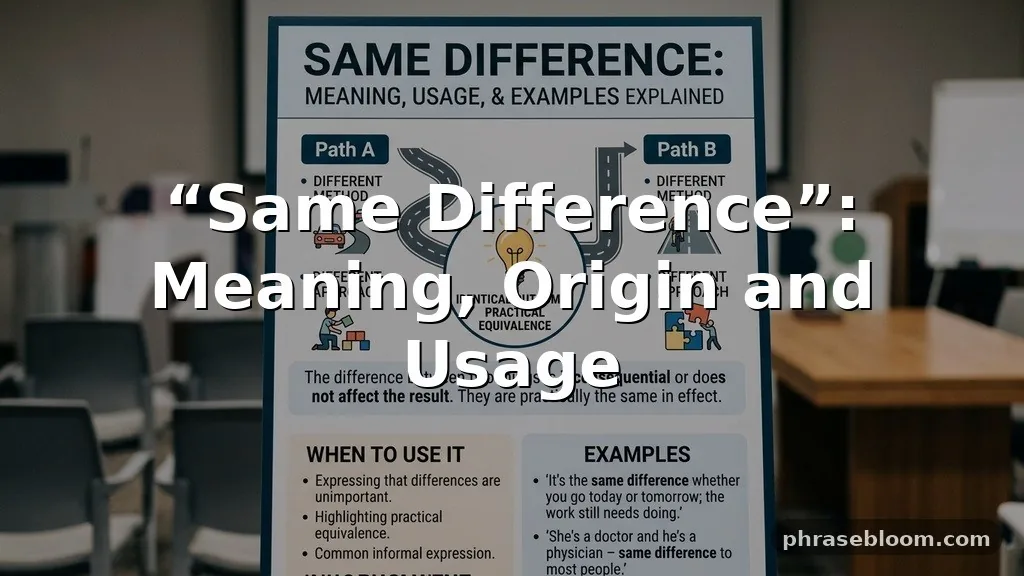
“Same Difference”: Meaning, Origin and Usage
The phrase “same difference” usually means that two options are effectively equivalent, even if they are technically different. It’s a colloquial expression often used in conversational English to dismiss a distinction that the speaker considers minor or irrelevant.
The phrase can sound casual, sarcastic, ironic, or even mildly argumentative depending on tone. Understanding the same difference meaning helps you recognize when someone is pointing out practical equivalence, brushing aside an opposing viewpoint, or making a joke about a negligible distinction.
What “Same Difference” Means
The basic same difference definition is simple: two things may differ in some detail, but the difference does not matter for the issue being discussed. A person who says “same difference” is usually saying, “The result is essentially the same,” or, “That distinction doesn’t change anything important.”
For example, imagine someone asks whether a meeting starts at 2:00 or 2:05. If the meeting will not begin until several minute after everyone arrives, another person might reply, “Two or five, same difference.” The times are not identical, but the speaker regards the distinction as insignificant.
The phrase can also signal equivalence between two labels or descriptions. If one employee calls a document a “project outline” and another calls it a “project brief,” a third person might say, “Same difference,” provided both terms refer to the same practical document.
That interpretation depends heavily on context. A five-minute difference may be negligible for an informal meeting but important for a train departure, a legal deadline, or a medical appointment.
The central idea of practical equivalence
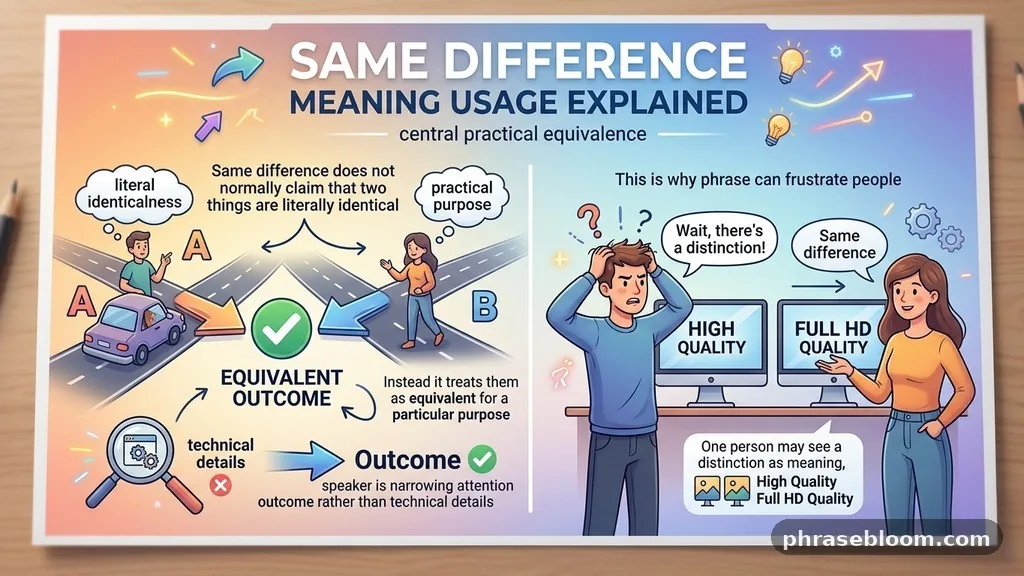
“Same difference” does not normally claim that two things are literally identical. Instead, it treats them as equivalent for a particular purpose. The speaker is narrowing attention to the outcome rather than the technical details.
This is why the phrase can frustrate people. One person may see a distinction as meaningful, while the other sees it as irrelevant. The disagreement is often not about the facts themselves but about how much importance those facts deserve.
- Literal identity: two things are exactly the same.
- Practical equivalence: two things differ, but the difference has no important effect.
- Dismissal: the speaker does not want to spend more time debating the distinction.
- Irony: the speaker highlights the tension between the words “same” and “difference.”
In most everyday conversations, the second meaning is the most useful one. The expression describes a negligible distinction rather than perfect sameness.
Why the Phrase Sounds Contradictory
“Same difference” is built from two words that appear to conflict. “Same” suggests identity, while “difference” suggests contrast, so the phrase creates a small logical collision.
That tension is part of its appeal. The expression compresses a longer thought into two memorable words: “They are different in theory, but the difference does not matter in practice.”
English contains many expressions that work through this kind of tension. Speakers sometimes use contradiction, exaggeration, or deliberate understatement to communicate attitude as well as information. “Same difference” is therefore more than a neutral synonym for “equivalent.”
Irony and sarcasm
The phrase may be ironic because it treats two unlike things as though they were the same. A speaker might use it to acknowledge a technical distinction while refusing to give that distinction serious weight.
It can also be sarcastic. Suppose someone spends ten minutes arguing about whether a report should be called a “forecast” or a “projection,” although the document serves the same purpose. A colleague might say, “Forecast, projection, same difference,” with a deliberately impatient tone.
In that example, the words do not merely communicate equivalence. They criticize the discussion for becoming overly technical. The phrase meaning includes an attitude toward the debate.
However, not every use is hostile. Friends may use “same difference” lightly when choosing between two restaurants, colors, routes, or brands. Tone, facial expression, and the importance of the subject determine whether the expression sounds playful or dismissive.
“Same Difference” Usage in Everyday English
The same difference usage is most natural in informal speech and relaxed writing. It appears in conversations, text messages, workplace chats, online discussions, comedy, and fictional dialogue.
It is less suitable when precision and neutrality are essential. A scientific paper, contract, formal report, or official public statement should usually explain the relationship directly instead of relying on a colloquial phrase.
| Situation | Natural use | Possible effect |
|---|---|---|
| Choosing between two similar options | “Either route is fine. Same difference.” | Casual and practical |
| Debating minor wording | “They’re both acceptable, same difference.” | May sound dismissive |
| Discussing a legal distinction | Usually avoid the phrase | Could minimize an important issue |
| Friendly conversation | “Tea or coffee? Same difference to me.” | Relaxed and harmless |
| Formal academic writing | Use a precise alternative | More objective and controlled |
The expression is especially common when the speaker is making a decision. “Morning or afternoon, same difference” means that either time works equally well for the speaker.
It can also appear after a correction. Someone may say, “It was Tuesday, not Wednesday.” The response “Same difference” suggests that the exact day does not affect the current point, although that response could sound careless if the date matters.
Examples in conversation
“Should we call it a workshop or a seminar?”
“For this event, same difference. Everyone knows what we mean.”
“The file is in the shared folder, not the team folder.”
“Same difference. The whole department can access both.”
“Do you want the blue notebook or the green one?”
“Same difference to me. Pick whichever is closer.”
These examples show that the phrase generally responds to another person’s distinction. It is not usually a standalone description of two objects; it is a reaction to a comparison.
Same Difference Examples Across Contexts
Meaning becomes clearer when the expression is placed in different social and professional situations. The same words can sound efficient in one setting and rude in another.
Workplace communication
In a casual team chat, an employee might write, “Tuesday or Wednesday, same difference, as long as the client receives the draft this week.” The sentence treats the dates as equivalent because the real deadline is the end of the week.
A manager could use the phrase during a low-stakes planning discussion: “We can call this phase testing or review. Same difference for the internal schedule.” The speaker is signaling that the label will not alter the schedule.
In an email to a client, however, “same difference” may sound too casual or dismissive. A clearer version would be, “Both terms refer to the same stage of the project, so either label is acceptable.”
Personal decisions
“Do you want to take the highway or the local road?”
“Same difference. They both get us there in about the same time.”
Here the phrase communicates flexibility. The speaker has no meaningful preference and does not need a detailed comparison.
Arguments and corrections
“You said the package arrived on Thursday, but the tracking rcord says Friday.”
“Same difference. The important point is that it arrived before the presentation.”
This use is more sensitive. The expression may be reasonable if the exact day has no bearing on the conclusion, but it can also seem like an attempt to avoid admitting an error.
Marketing and public communication
Brands should use the phrase carefully in customer-facing communication. “Basic plan or starter plan, same difference” may appear dismissive if customers are asking about genuine differences in features or price.
Marketing copy normally benefits from direct wording. If two service names refer to the same package, “Both names describe the same package” is more professional and less open to misinterpretation.
The phrase works best when the audience understands the informal tone and the distinction truly has little practical importance.
When “Same Difference” Is Helpful
The expression can be efficient because it avoids a longer explanation. If two options have the same effect, repeating their similarities may waste time, especially in a relaxed conversation.
It also gives speakers a way to express indifference. “The blue one or the black one, same difference” means that the speaker is happy with either choice and wants the other person to decide.
Another useful function is perspective. The phrase reminds listeners that not every distinction deserves equal attention. A conversation can contain many accurate details, but some have no practical consequence.
Useful signals in the phrase
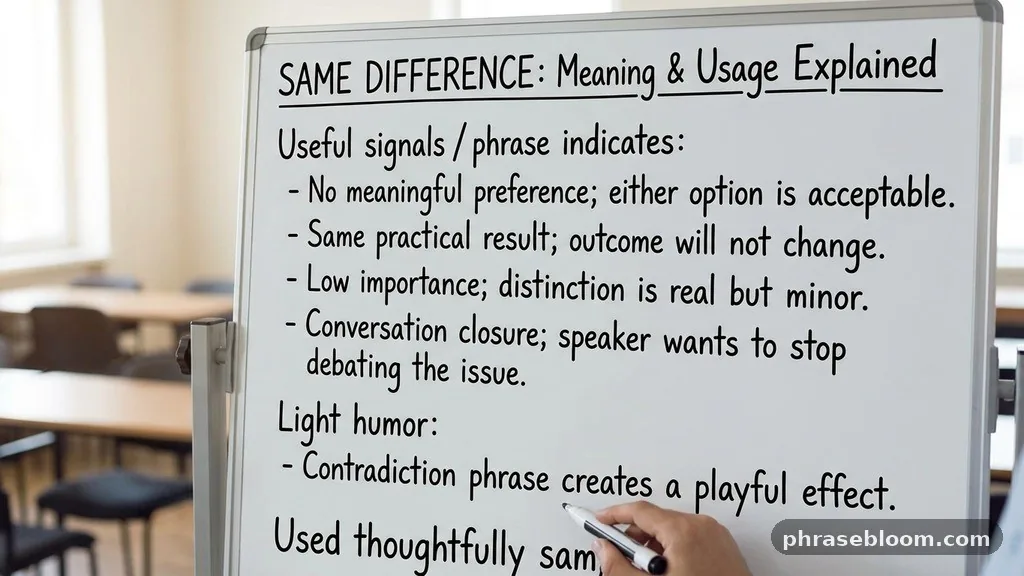
- No meaningful preference: either option is acceptable.
- Same practical result: the outcome will not change.
- Low importance: the distinction is real but minor.
- Conversation closure: the speaker wants to stop debating the issue.
- Light humor: the contradiction in the phrase creates a playful effect.
Used thoughtfully, “same difference” can keep a conversation moving. It is particularly natural when people are deciding between alternatives that have already been shown to be comparable.
The difficulty arises when the speaker assumes that a distinction is minor without checking its importance to others. A term that seems interchangeable to one person may carry legal, technical, cultural, or financial consequences for another.
When the Expression Can Cause Problems
“Same difference” can sound dismissive because it shuts down a distinction rather than examining it. If someone has raised a concern, responding with the phrase may suggest that the concern is not worth hearing.
That risk is greater in professional settings. A colleague discussing accessibility, safety, compliance, compensation, or customer impact may not appreciate having the issue reduced to “same difference.”
The expression can also hide an inaccurate comparison. Two products may look similar but have different warranties.
Two contract terms may sound alike but create different obligations. Two job titles may overlap but carry different authority.
Situations that require precision
Avoid relying on the phrase when the distinction affects a decision, record, obligation, or measurable outcome. In those situations, explain exactly what is similar and what remains different.
- Legal agreements and contractual language
- Medical instructions and health information
- Financial reports and tax documents
- Safety procedures and technical specifications
- Academic definitions and research findings
- Performance reviews and employment decisions
Instead of saying, “The two clauses are the same difference,” write, “The clauses produce the same result in this case, although their wording differs.” That version preserves the useful comparison without pretending that the details are identical.
Respect also matters. If another person considers a distinction important, a neutral response is better than an automatic dismissal.
You can say, “I see the difference. For this particular decision, though, either option would work.”
Origin, Tone, and Regional Usage
The phrase is a modern idiomatic expression in English, but its exact origin is not generally treated as a single, clearly documented invention. It became established through informal speech and popular usage rather than through a formal technical vocabulary.
Because it developed in conversational language, “same difference” carries a relaxed tone. It is not normally used to establish a precise definition in a formal document.
The expression appears in both American English and British English. It should not be treated as exclusively American or exclusively British, although individual speakers and publications may differ in how often they use it.
Regional context can affect tone. A phrase that sounds humorous and ordinary in one group may sound flippant or overly blunt in another, particularly when speakers have different expectations about directness.
American English and British English
There is no dependable rule saying that American English uses “same difference” while British English avoids it, or the reverse. Both varieties contain informal expressions that use apparent contradiction for emphasis or humor.
Differences are more likely to come from age, profession, region, social group, or editorial preference than from a strict national divide. A formal British report and a formal American report may both replace the phrase with “effectively equivalent” or “for practical purposes, the same.”
Writers who need neutral international English should explain the idea directly. The Merriam-Webster dictionary entry for “same difference” is useful for checking the expression’s general sense, but context still determines whether it is appropriate.
In spoken dialogue, regional and personal style can be preserved. In formal prose, clarity usually matters more than reproducing a conversational expression.
Synonyms and Clearer Alternatives
Several alternatives communicate the same general idea without the irony or dismissive edge of “same difference.” The best choice depends on whether you want to emphasize practical equivalence, indifference, or a shared result.
| Alternative | Best use | Example |
|---|---|---|
| Effectively the same | Neutral professional writing | “The two methods are effectively the same for this test.” |
| Equivalent in practice | Technical or analytical contexts | “The options are equivalent in practice.” |
| Either works | Decisions and workplace communication | “Either format works for the presentation.” |
| No meaningful difference | Formal explanation | “There is no meaningful difference in the final result.” |
| More or less the same | Informal but less sharp language | “The two routes are more or less the same.” |
| For practical purposes | Careful formal qualification | “For practical purposes, the systems function alike.” |
“Equivalent” is concise, but it can sound technical. “Either works” is friendlier and often better for workplace communication.
“No significant difference” may be appropriate in research or reporting, but writers should use it carefully. In some fields, “significant” has a specialized statistical meaning, so “no important difference” may be clearer for a general audience.
Rewriting can also remove the need for a direct synonym. Instead of saying, “The morning or afternoon session is the same difference,” write, “The two sessions cover the same material, so either time is fine.”
Common Mistakes and Better Choices
One common mistake is treating “same difference” as a formal synonym for “identical.” The phrase usually implies practical equivalence, not literal sameness.
Another mistake is using it to dismiss a correction automatically. If someone points out an error, “same difference” may sound defensive even when the error has no effect on the final conclusion.
Writers sometimes use the expression in documents that require an objective tone. A policy, report, or academic paper should normally state the relationship directly instead of depending on an idiomatic expression.
Mistake: minimizing a real distinction
Weak: “The two insurance plans are the same difference.”
Better: “The plans have similar premiums, but their coverage limits differ.”
The revised sentence avoids an unsupported conclusion. Similarity in one feature does not establish equivalence in every relevant feature.
Mistake: using the phrase without context
Weak: “The results were the same difference.”
Better: “The results were different numerically, but both methods led to the same recommendation.”
The better version tells readers which aspect was equivalent. That extra precision matters in professional and academic writing.
Mistake: confusing casual tone with clarity
Weak: “Use either file name, same difference.”
Better: “Either file name is acceptable because both point to the same document.”
The second sentence is still concise, but it gives the reader a reason for the equivalence. It also avoids sounding irritated or careless.
How to Use “Same Difference” Well
Before using the phrase, ask whether the difference truly has no effect on the point under discussion. If the answer is yes, the expression may be natural in conversation.
Next, consider the audience and the setting. A text to a friend allows more informal language than a policy memo, research paper, customer response, or executive briefing.
Finally, check your tone. Read the sentence as if you were the recipient. If it could sound like “I don’t care about your concern,” choose a more neutral alternative.
A practical decision process
- Identify the two things being compared.
- Ask whether they are literally identical or only equivalent for a specific purpose.
- Decide whether the difference matters to the audience.
- Choose an informal phrase only if the tone fits the situation.
- Explain the relevant similarity when precision is important.
This process is especially useful in workplace communication. You may know that two options produce the same result, but your audience may need to understand why.
For instance, “Either version is fine” works for a quick internal message. “Both versions meet the submission requirement, so you can use either one” is better for a formal instruction.
The phrase is strongest when it saves time without hiding information. It is weakest when it replaces an explanation that readers genuinely need.
“Same Difference” in Formal and Professional Writing
Professional writing does not ban idiomatic expressions, but it requires judgment. A conversational phrase can make an internal message sound friendly, while the same phrase can make a customer response sound dismissive.
In business emails, use “same difference” only when the relationship is informal and the issue is genuinely minor. For a broader audience, “either option is acceptable” is usually safer.
In academic writing, prefer language such as “the distinction is not relevant to this analysis” or “the two approaches produce comparable results.” These alternatives identify the scope of the equivalence.
In legal or policy writing, describe the exact relationship. A reader should not have to infer whether “same” means identical wording, identical effect, or merely similar treatment.
Recommended choices by setting
| Setting | Recommended wording | Reason |
|---|---|---|
| Text message to a friend | “Same difference.” | Natural and conversational |
| Internal team chat | “Either option works.” | Casual but clear |
| Business email | “Both options are acceptable.” | Professional and neutral |
| Academic paper | “The distinction is not material to this analysis.” | Precise and formal |
| Policy document | Describe the specific shared effect | Avoids ambiguity |
| Marketing copy | Explain the similarity directly | Builds reader confidence |
Professional writing benefits from controlled informality. You do not need to eliminate every familiar phrase, but you should avoid expressions that could be interpreted as careless, sarcastic, or dismissive.
FAQ About “Same Difference”
What does “same difference” mean?
“Same difference” means that two things are technically different but effectively equivalent for the matter being discussed. It can also suggest that the distinction is too minor to matter.
Is “same difference” an idiom?
Yes. It is an idiomatic expression and colloquial phrase whose meaning cannot be understood simply by treating “same” and “difference” as separate literal terms. Tone helps communicate whether it is humorous, neutral, or dismissive.
Is “same difference” formal English?
It is accepted informal English, but it is not usually the best choice for formal writing. In a report, contract, academic paper, or official message, use “effectively equivalent,” “either option is acceptable,” or another precise alternative.
Can “same difference” sound rude?
Yes. It may sound rude when someone is raising a serious concern or correcting an important fact. If the distinction matters to the other person, acknowledge it and explain why it does or does not affect the decision.
What is a clearer alternative to “same difference”?
Useful alternatives include “effectively the same,” “equivalent in practice,” “either works,” “no meaningful difference,” and “for practical purposes, the same.” Choose the wording that matches the level of formality and precision required.
Conclusion
“Same difference” is a compact, often playful way to say that two things differ in detail but have the same practical effect. Its tone can range from friendly indifference to sarcasm, so the subject, audience, and relationship matter as much as the words themselves.
Use the phrase freely in suitable informal conversation, but choose a clearer alternative in formal, technical, legal, academic, or sensitive communication. Once you understand the same difference meaning, you can recognize the idiom’s irony while deciding whether its casual tone fits your own sentence.
You may also like: Cord vs Chord: Meaning, Origin and Usage