
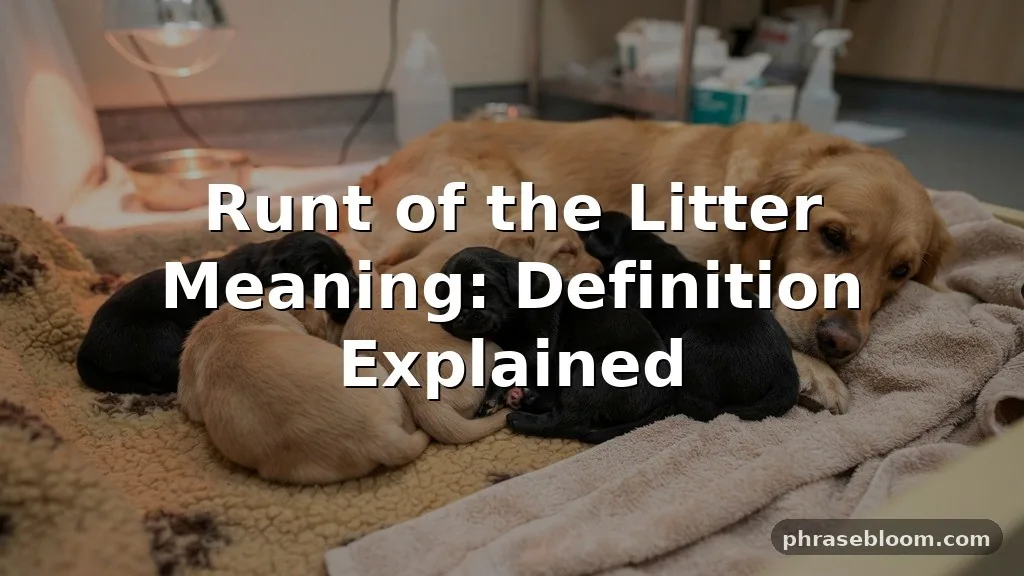
People often search for the runt of the litter meaning when they encounter a phrase that describes the smallest or least powerful member of a group. Literally, a runt is an unusually small animal in a litter, such as a litter of puppies or kittens. Figuratively, the expression can describe a person who seems disadvantaged, overlooked, or lower in status than others.
The phrase can sound affectionate, insulting, or simply descriptive depending on the speaker and context. Understanding the runt definition, its history, and its metaphorical use helps you recognize whether it refers to physical size, family dynamics, social hierarchy, or an underdog who eventually proves people wrong.
Runt of the Litter Meaning at a Glance
The runt of the litter is the smallest or weakest-looking animal among its siblings, especially animals born at the same time. A litter is a group of young mammals born to one mother, so the phrase most often applies to puppies, kittens, piglets, rabbits, and similar animals.
In plain English, the expression means “the smallest member of a group.” It does not always mean that the animal is unhealthy or incapable of surviving. Size at birth can be influenced by position in the womb, access to nutrients before birth, genetics, and the normal variation found among animal siblings.
| Expression | Basic meaning | Typical use |
|---|---|---|
| Runt | An unusually small or weak animal | Literal description |
| Runt of the litter | The smallest animal among its siblings | Animal groups and figurative comparisons |
| Smallest animal in a litter | A neutral description of relative size | Careful factual writing |
| Runt of the group | The least powerful or least prominent member | Figurative or informal writing |
The phrase can also have a figurative meaning. Someone may call a person the “runt of the litter” because that person is the youngest, shortest, least experienced, least influential, or most underestimated member of a family, team, or organization.
That figurative use is not a precise scientific judgment. It is a metaphor, and metaphors often reveal the speaker’s attitude. The term may express sympathy, teasing, affection, or contempt depending on the relationship and the surrounding words.
What Is the Runt Definition?
The basic runt definition is an undersized or weak animal, especially the smallest member of a group born at the same time. Traditional dictionary definitions often connect the word with an animal that is smaller than its siblings and may appear less likely to thrive.
Modern animal care makes the word less absolute than it once sounded. A small newborn may receive veterinary attention, supplemental feeding, warmth, and careful monitoring. With proper support, that animal may grow normally or develop into a healthy adult.
The word describes relative size, not a guaranteed outcome. An animal can be the smallest at birth without remaining the smallest later in life. Growth rates differ, and early size does not provide a complete prediction of strength, health, intelligence, or temperament.
A more neutral phrase is the smallest animal in a litter. That wording reports a physical fact without suggesting weakness or low status. Breeders, veterinarians, and animal-care writers may choose neutral language when they want to avoid the negative connotation attached to “runt.”
- Literal sense: the smallest or weakest-looking animal among its siblings.
- Relative sense: a comparison with other animals in the same litter, not an absolute judgment about health.
- Figurative sense: the least powerful, least experienced, or most overlooked member of a group.
- Emotional sense: a nickname that can be affectionate, teasing, protective, or insulting.
For readers who want a concise dictionary reference, the Merriam-Webster entry for “runt” provides the established lexical sense of the word. In actual conversation, however, the surrounding context matters as much as the dictionary definition.
Why Animals Are Called the Runt of the Litter
A litter may contain siblings that differ noticeably in weight and size. Several factors can contribute, including genetics, the order in which embryos develop, where each fetus is positioned, and how much nourishment reaches each one before birth.
In some species, competition continues after birth. The stronger or larger animals may reach the mother first, occupy the warmest positions, or compete more successfully for food. This can make the smallest sibling appear weaker even when the original difference began before birth.
The phrase is especially common with a litter of puppies or a litter of kittens. People often use it informally when choosing a pet and noticing that one animal is smaller than the others. Responsible owners should avoid assuming that the smallest animal is automatically unhealthy or that the largest is automatically the best choice.
Size is only one part of an animal’s condition. Appetite, energy, breathing, movement, hydration, coat quality, and veterinary examination provide more useful information than the label “runt” by itself.
Small Size Does Not Define the Animal

Calling an animal a runt can create expectations that do not match reality. A small puppy may be energetic and healthy, while a larger puppy may still have medical needs or developmental problems.
That is why a neutral observation is often better in formal or educational writing. “The smallest puppy in the litter received additional feeding” communicates a clear fact without making a broad claim about the animal’s future.
The word can still be natural in personal speech. A family may affectionately call its smallest kitten “the runt,” especially if the name reflects a fond relationship rather than a judgment. Tone makes a difference.
Runt of the Litter as a Figurative Expression
The runt of the litter definition becomes more flexible when the phrase describes people. In figurative use, it may refer to the member of a family or group who is smallest, youngest, less experienced, less respected, or less successful than the others.
For example, a journalist might describe a small company competing against several much larger firms as “the runt of the industry.” The comparison concerns market power, resources, and reputation rather than physical size.
A sports commentator could call a shorter player the “runt of the team,” although that wording may be playful or disrespectful. A novelist might use the phrase for a younger sibling who is constantly underestimated by an accomplished family.
The metaphor often carries an underdog quality. The person or organization appears to begin with a disadvantage, which creates the possibility of an unexpected success story. That is why the phrase may sound admiring in one sentence and cruel in another.
| Context | What “runt” may suggest | Likely tone |
|---|---|---|
| Family | The youngest, smallest, or least dominant sibling | Affectionate or teasing |
| Sports | A physically smaller or overlooked player | Playful, dramatic, or dismissive |
| Business | A smaller competitor with fewer resources | Underdog framing |
| School or work | A less experienced or less influential member | Potentially insulting |
| Literature | A disadvantaged individual who is underestimated | Symbolic or dramatic |
The figurative meaning should not be treated as a direct measurement of a person’s value. It reflects a comparison inside a social hierarchy. A person called the “runt” may have less authority in that setting but may possess abilities that the group fails to recognize.
Family Dynamics, Birth Order, and Social Status
The expression often appears in discussions of family dynamics because families naturally compare siblings. One child may be described as the runt because that child is younger, shorter, quieter, less athletic, or less successful than brothers and sisters.
Birth order can influence how people interpret the phrase, but it does not determine personality or ability. The youngest child may receive the nickname simply because the older children are physically larger. In another family, the phrase may refer to the sibling who has the least social power.
Calling someone the runt can reinforce a low-status role. Once a family repeats a label, the person may be treated as fragile, immature, or incapable, even after the original reason for the nickname disappears.
At the same time, some people reclaim the word as an affectionate nickname. A parent may call a small child “our little runt” with warmth, while the same phrase from a stranger could sound insulting. The relationship, delivery, and setting determine how the listener receives it.
Affectionate Nickname or Negative Connotation?
A nickname can be affectionate when it communicates closeness and does not deny the person’s dignity. Family members sometimes use “runt” in the same way they use “shorty” or “little one.” The meaning depends on shared history and mutual comfort.
The word has a negative connotation when it suggests that someone is inferior, helpless, or less deserving than the rest of the group. In professional settings, calling an employee the “runt” would usually be inappropriate because it reduces a colleague to a status judgment.
Before using the phrase about a person, consider whether the audience will hear humor, warmth, or humiliation. If the intention is simply to describe size or scale, a more precise expression is usually safer.
Runt Etymology and the Development of the Phrase
The word runt has long been associated with an undersized animal. Its exact historical development is less straightforward than the modern meaning suggests, and etymological references connect it with older regional and dialectal uses for an inferior, stunted, or small creature.
Over time, the word expanded beyond livestock and domestic animals. English speakers began applying it to people who seemed physically small, socially unimportant, or lacking in power. This movement from literal description to figurative insult is common in language.
The phrase “runt of the litter” makes the comparison more specific. It does not merely describe a small animal in isolation. It places that animal beside its siblings and creates a ranking based on size or apparent strength.
That ranking helps explain the phrase’s emotional force. A small animal may be treated as vulnerable because it must compete with larger siblings. In metaphorical use, a business, family member, or team can be placed in the same underdog position.
The expression is an idiom in the broad sense that its meaning is understood as a familiar phrase rather than calculated from completely literal details. It is also a metaphorical use because the animal comparison is transferred to another situation.
Language changes gradually, so not every speaker uses “runt” with exactly the same force. Some hear a neutral or old-fashioned animal term.
Others hear a sharp insult. Modern writers should consider that range before choosing it.
Company, Team, and Organizational Uses
In business writing, “runt of the litter” is most often a colorful metaphor for a small or disadvantaged competitor. A startup may be called the runt of a group of established companies because it has fewer employees, less capital, or a smaller market share.
For example, “The regional firm was the runt of the litter when it entered the national market” presents the company as an underdog. The sentence works because the comparison is clearly figurative and connected to business scale.
The expression can also describe an internal department, product, or project. A small division may be the “runt” beside larger divisions, while a minor product may be overshadowed by the company’s best-known brands.
Still, professional writers should use the phrase carefully. It is informal, vivid, and evaluative. A financial report would usually be clearer with language such as “the smallest subsidiary,” “the least-funded division,” or “the company’s newest market entrant.”
- Informal business writing: “The small startup became the runt of the industry’s major players.”
- Neutral report writing: “The startup was the smallest company among the five major entrants.”
- Public marketing: “The underdog brand challenged much larger competitors.”
- Internal analysis: “The division has the fewest resources but serves a strategically important market.”
These alternatives preserve the intended comparison without assigning a potentially insulting label. Choose “runt” when the writing benefits from personality and contrast, not when a precise measurement is required.
Runt of the Litter in a Sentence
Readers often want to know how to use the expression naturally. The following examples show literal and figurative uses across different settings.
Literal Animal Examples
“The smallest puppy in the litter needed extra attention during its first week.” This is a careful, neutral sentence because it describes size without assuming that the puppy is unhealthy.
“Everyone expected the runt of the litter to be timid, but the kitten quickly became the most adventurous.” Here, the expression creates a contrast between the animal’s small size and its confident behavior.
“The breeder monitored the runt closely and arranged a veterinary examination.” The wording is natural in an informal account, while the specific action gives the sentence useful context.
Family and Personal Examples
“As the runt of the litter, Maya was often underestimated by her older brothers.” This sentence uses the phrase metaphorically to describe family dynamics and a perceived difference in status.
“He had been the family’s runt, but he became the first sibling to start a successful business.” The word sets up an underdog narrative, but the second clause shows that early status did not determine the outcome.
“Her parents used ‘the runt’ as an affectionate nickname when she was young.” This example makes the emotional meaning explicit instead of assuming that every reader will interpret the term as loving.
Business and Group Examples
“The small publisher was the runt of the industry, yet its specialized catalog attracted a loyal audience.” The phrase is figurative, and the sentence explains the company’s apparent disadvantage.
“At six feet four, Jordan was hardly the runt of the team.” This uses the expression humorously by rejecting the expected meaning and emphasizing the person’s height.
“The project began as the runt of the department but eventually became its most profitable initiative.” The wording gives the project a low-status starting point and a later reversal.
Related Expressions and Better Alternatives
Several alternatives can express part or all of the runt of the litter meaning without its emotional weight. The best choice depends on whether you want to emphasize size, location, power, experience, or competitive position.
| Alternative | Best for | Example |
|---|---|---|
| Smallest member | Neutral size comparison | “She was the smallest member of the family.” |
| Underdog | A likely loser who may succeed | “The underdog defeated the established champion.” |
| Least experienced member | Workplace or team context | “He was the least experienced member of the group.” |
| Smaller competitor | Business and market analysis | “The smaller competitor gained attention quickly.” |
| Youngest sibling | Family and birth order | “As the youngest sibling, she was often protected.” |
| Smallest company | Formal business writing | “It was the smallest company in the comparison.” |
Underdog is often the closest positive alternative. It suggests a disadvantaged individual or group that may overcome expectations. Unlike “runt,” it does not necessarily imply small physical size or inferior social status.
“The smallest member” is more factual. “The least powerful member” focuses on social hierarchy. “The newest participant” emphasizes experience or time rather than ability.
Writers should also distinguish “runt of the litter” from “black sheep.” A black sheep is usually someone who differs from family or group expectations, while a runt is framed as smaller or weaker. The two expressions can overlap in a story, but they do not have the same meaning.
Common Mistakes and Misunderstandings
One common mistake is assuming that the runt must be unhealthy. The word traditionally suggests weakness, but current usage does not prove a medical condition. A smaller animal should be assessed on observable health and professional advice, not on the label alone.
Another mistake is using the phrase as though it were always affectionate. Some speakers use it warmly, but others hear it as an insult. If the relationship or tone is unclear, “smallest member” or “underdog” may communicate the intended point more safely.
Writers sometimes treat the expression as a literal statement about human worth. That is a poor interpretation. The figurative use describes a position in a comparison, not an objective measure of intelligence, character, or future success.
- Mistake: “The runt is always the weakest animal.”
Better: “The runt is usually described as the smallest animal in the litter.” - Mistake: “She is the runt, so she cannot lead.”
Better: “She was underestimated because she was younger and less experienced.” - Mistake: Using “runt” in a formal report without explanation.
Better: Use “smallest competitor,” “smallest division,” or another measurable description. - Mistake: Assuming every use is negative.
Better: Examine the speaker’s relationship, tone, and surrounding details.
A further misunderstanding concerns the word “litter.” In this expression, “litter” means a group of young animals born to the same mother. It does not refer to discarded waste, even though that is another common meaning of the noun.
How to Choose the Right Meaning in Context
Start by asking whether the phrase refers to animals or people. If it describes a puppy, kitten, piglet, or another young animal, the literal meaning probably concerns relative size. If it describes a person, company, team, or department, the phrase is likely metaphorical.
Next, identify the comparison. Is the subject physically smaller, less experienced, less influential, less wealthy, or simply less famous? The answer will tell you whether “runt” is accurate or whether a more specific alternative would be clearer.
Pay attention to tone. A humorous story may welcome an expressive idiom, while a medical note, school record, employment document, or formal report usually benefits from neutral wording.
Use this practical decision process:
- Identify the subject and determine whether the use is literal or figurative.
- Ask what characteristic the phrase is meant to highlight: size, power, experience, or social position.
- Consider whether “runt” adds useful imagery or merely creates a negative label.
- Choose a neutral alternative if the audience may misunderstand the tone.
- Read the sentence aloud and check whether the comparison sounds fair and precise.
This approach is particularly useful for intermediate English learners. Learning the dictionary definition is only the first step. Understanding connotation, audience, and metaphorical use is what makes the expression sound natural.
Frequently Asked Questions
What is the runt of the litter meaning?
It means the smallest or weakest-looking animal among siblings born in the same litter. Figuratively, it can describe the least powerful or most underestimated member of a family, team, or organization.
Does runt always mean unhealthy?
No. “Runt” describes relative size and may suggest weakness, but it does not establish a medical condition. A small animal can be healthy and develop normally.
Is “runt of the litter” an insult?
It can be. The phrase may also be an affectionate nickname or a playful metaphor, so the speaker’s tone and relationship with the subject matter greatly.
Can the phrase describe a person?
Yes. It is commonly used metaphorically for someone who is smaller, younger, less experienced, less influential, or underestimated. In professional settings, a more precise alternative is often better.
What is a good alternative to “runt of the litter”?
Use “smallest member” for a neutral size comparison, “underdog” for a disadvantaged competitor, “youngest sibling” for family birth order, or “smallest competitor” for formal business writing.
Conclusion
The Runt of the Litter Meaning is straightforward at its core: the phrase identifies the smallest animal among its siblings and often carries an implication of weakness or disadvantage. In figurative language, it can describe an underdog, a low-status family member, or a smaller competitor that others underestimate.
Use the expression when its imagery and tone fit the situation. Choose a more precise alternative when writing formally or discussing health, ability, or professional status. Understanding both the literal runt definition and its metaphorical use will help you interpret the phrase accurately and use it with greater care.
Related reading: IONK Meaning in Text, ILY Meaning in Text, NMMS Meaning in Text.