
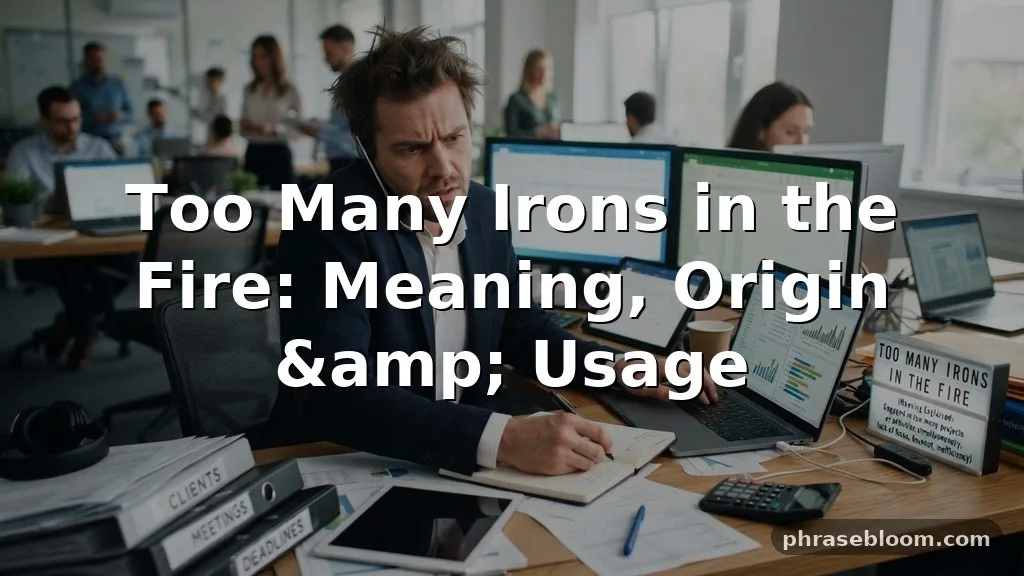
The phrase “too many irons in the fire” describes having too many projects, responsibilities, or opportunities active at the same time. It usually suggests that someone has become overcommitted and may struggle to give each task enough attention.
This English idiom comes from historical blacksmithing, where several pieces of iron might be heated in a forge at once. The image is useful because it explains both the appeal and the danger of multitasking: more irons may create more possibilities, but they also demand careful timing and control.
What “Too Many Irons in the Fire” Means
The basic idiom meaning is being involved in too many activities or plans at once. A person with too many irons in the fire may be managing multiple projects, pursuing several opportunities, or accepting more commitments than their available time and energy can support.
The phrase is usually figurative rather than literal. Nobody is normally talking about actual iron, a forge, or a blacksmith’s workshop. Instead, the “irons” represent tasks or ventures, while the “fire” represents the limited time, attention, money, or effort required to keep those ventures moving.
For example, a manager might say, “Jordan has too many irons in the fire right now,” after learning that Jordan is leading a product launch, hiring new employees, taking a course, and preparing for a conference. The sentence does not necessarily accuse Jordan of being careless. It warns that divided attention could affect performance.
The expression can also carry a positive implication. Someone with several irons in the fire may have many promising options, professional contacts, or business opportunities. The concern begins when the number of active commitments becomes difficult to control.
- “Irons” represent projects, plans, responsibilities, or opportunities.
- “The fire” represents the effort and attention needed to develop them.
- “Too many” signals overload, overcommitting, or an unsustainable workload.
- The phrase often implies that some opportunities may be neglected or lost.
In plain English, the expression often means, “You have more going on than you can manage well.” It is a vivid way to discuss workload management without listing every individual task.
Where the Idiom Came From
The phrase is connected to the work of a blacksmith, an artisan who heats and shapes metal. In historical blacksmithing, an iron bar had to reach the right temperature before it could be hammered, bent, or shaped. If it cooled too much, the blacksmith had to return it to the forge.
A skilled worker might place several pieces of iron in the fire so that more than one item was being prepared. That approach could improve efficiency, but it also created a demanding timing problem. Each piece needed attention at the right moment, and an iron left unattended could become too hot, cool down, or fail to receive the necessary work.
The physical image behind the expression is therefore easy to understand. A blacksmith handling several heated irons has several opportunities in progress, but success depends on managing them carefully. Too many irons would make it difficult to monitor temperature, timing, and the sequence of work.
The phrase belongs to a broader family of expressions rooted in practical trades. English idioms often preserve images from older occupations even after everyday life changes. People may no longer work at a forge, but the underlying problem of taking on too much remains familiar.
Exact claims about the first recorded use should be treated cautiously because idioms often develop gradually in speech before appearing in print. Still, the connection to ironworking provides a clear explanation of the phrase’s figurative language and continuing appeal.
Readers interested in historical word development can compare this idiom with entries in the Online Etymology Dictionary, while remembering that an etymology entry may summarize evidence rather than establish one certain moment of invention.
How the Phrase Works in Figurative Language
“Too many irons in the fire” is a metaphorical expression. It transfers a concrete image from metalworking into a modern situation involving time, attention, and commitments. The phrase works because the listener can imagine several demanding objects requiring action at once.
Its figurative meaning is broader than simply being busy. A person can be busy without having too many irons in the fire if their tasks are organized and manageable. The idiom usually points to a risk: the number or variety of commitments may exceed the person’s ability to handle them effectively.
The phrase can refer to several kinds of activity:
- A freelancer handling too many client projects.
- A student balancing school, work, family duties, and extracurricular activities.
- An entrepreneur developing several business ideas at once.
- A company negotiating multiple deals before its staff can support them.
- A job candidate pursuing several career options simultaneously.
- A household managing repairs, travel plans, financial goals, and personal obligations.
Context determines whether the expression sounds critical, sympathetic, or admiring. A colleague might use it gently to encourage someone to reduce their workload. An investor might use it favorably to describe a company with several possible growth opportunities.
The phrase can also describe hidden complexity. A project may look like one “iron” from the outside, but it may contain several deadlines, stakeholders, and dependencies. That is why people sometimes discover that they have too many irons in the fire only after their workload begins to expand.
Unlike a literal statement, an idiom does not require the listener to interpret every word separately. The meaning comes from the complete expression. Translating it word for word into another language may produce an image that makes little sense unless the translator also explains the cultural meaning.
Too Many Irons in the Fire in a Sentence
The expression is common in conversations about work, business, education, and personal planning. It can appear in formal writing, but it has a conversational tone and may sound more natural in an email, interview, meeting, or opinion article than in a highly technical report.
Work and business examples

“Our department has too many irons in the fire, so we need to decide which launch deserves priority.” The sentence works because “irons” refers to several active initiatives, while “priority” makes the workload-management concern explicit.
“The consulting firm has several irons in the fire with potential clients.” Here, the phrase suggests multiple business opportunities rather than an immediate crisis. The surrounding context would show whether those opportunities are promising or distracting.
“Maya is carrying too many irons in the fire this quarter, including the audit, the software migration, and two hiring projects.” This example names the specific commitments after using the idiom, making the figurative language clear to the reader.
Education and personal life examples
“By the middle of the semester, Luis realized he had too many irons in the fire.” This use refers to academic and personal responsibilities, but it does not identify them. A later sentence could explain that he was taking extra shifts and preparing for several examinations.
“I’ve got too many irons in the fire to join another volunteer committee.” The first-person form sounds natural in everyday speech and politely communicates a limit without rejecting the value of the committee.
“She keeps several irons in the fire while deciding which career path to pursue.” In this example, the phrase is not necessarily negative. It means she is exploring multiple options before making a final decision.
Written communication examples
“We currently have too many irons in the fire to add another feature to the release.” This sentence could appear in a workplace email. It is direct, but the informal idiom may be best followed by a precise explanation of deadlines or staffing.
“The candidate appears to have several irons in the fire, so we should clarify our hiring timeline.” In a business report, “several irons in the fire” can describe competing opportunities, though a more formal alternative may be preferable if the document is intended for a legal or executive audience.
“The team has too many irons in the fire, and quality checks are beginning to slip.” This example shows the consequence that often accompanies the idiom. The second clause prevents the phrase from remaining vague.
“Several Irons in the Fire” Versus “Too Many Irons”
The phrase is often shortened or adjusted depending on the speaker’s intended meaning. “Several irons in the fire” means that multiple plans or opportunities are active. It does not automatically suggest a problem.
“Too many irons in the fire” adds a warning about overload. The speaker believes that the number of active commitments may be greater than the person or organization can manage effectively.
| Expression | General meaning | Typical tone | Example |
|---|---|---|---|
| Several irons in the fire | Several plans or opportunities are active | Neutral or cautiously positive | “The studio has several irons in the fire.” |
| Too many irons in the fire | There are more commitments than can be handled well | Concerned or critical | “The studio has too many irons in the fire.” |
| Keep an iron in the fire | Maintain an option or ongoing opportunity | Strategic or practical | “Keep an iron in the fire while you negotiate.” |
| Put another iron in the fire | Start another project or pursue another option | Neutral, sometimes cautionary | “We shouldn’t put another iron in the fire yet.” |
This distinction matters in professional communication. Saying that a team has “several irons in the fire” may reassure stakeholders that the team has alternatives. Saying it has “too many” may signal that leadership should reduce scope or sequence the work.
The idiom is flexible enough to describe both opportunity and danger. The adjective “too” supplies the negative judgment, while “several” or “multiple” may simply describe quantity.
Synonyms and Clearer Alternatives
English offers many alternatives to “too many irons in the fire.” The best choice depends on whether you want to emphasize workload, distraction, opportunity, or strategic flexibility.
- Overcommitted: emphasizes that a person has accepted more responsibilities than they can reasonably complete.
- Spread too thin: emphasizes reduced time, energy, or attention across many demands.
- Juggling too much: uses another familiar image for managing several difficult tasks at once.
- Taking on too much: uses direct, plain English and works well for intermediate English learners.
- Managing multiple priorities: sounds neutral and professional.
- Pursuing several opportunities: highlights potential rather than overload.
- Divided attention: focuses on the risk that concentration is being weakened.
- Overextending resources: suits business, finance, and organizational writing.
For example, “The team is spread too thin” is clearer than the idiom when the main issue is staffing. “The company is pursuing several opportunities” may be better when leadership wants to sound positive rather than warn about overcommitment.
“Across several fronts” can describe simultaneous activity without suggesting that the situation is unmanageable. “Balancing multiple projects” is another neutral alternative, especially in a report or performance review.
An opposite idiom is “putting all your eggs in one basket.” That expression warns against relying on only one plan or source of success. The two idioms describe different risks: too many irons suggest excessive commitments, while one basket suggests insufficient diversification.
Another contrasting idea is “focusing on one thing at a time.” This is not a fixed idiom, but it communicates the practical remedy clearly. It may be preferable when readers come from different language backgrounds and could misunderstand an English idiom.
Why Too Many Commitments Can Become a Problem
Having multiple projects is not automatically inefficient. Some forms of multitasking involve simple tasks that can coexist, and some opportunities can share resources. The problem appears when active commitments compete for the same scarce attention, people, budget, or deadline.
Divided attention can make small delays spread across a project. A missed approval may postpone a meeting, which may delay a vendor, which may then affect a public launch. The idiom captures this pressure without specifying the exact chain of consequences.
Overcommitting also makes prioritization harder. If every project is described as urgent, people may lack a clear basis for deciding what to complete first. In that environment, a long list of active plans can create the appearance of progress while the most important work remains unfinished.
Too many irons can also create communication problems. Stakeholders may receive changing deadlines, incomplete updates, or unclear ownership because the person managing the work is moving constantly between projects.
There is a psychological cost as well. Switching repeatedly between unrelated tasks can make it harder to maintain context. A worker may remember the general purpose of each project but lose track of a key detail, decision, or dependency.
Good time management does not require rejecting every additional opportunity. It requires identifying capacity, estimating effort honestly, and making trade-offs visible. Sometimes the right response is to pause one project, delegate part of another, or define a smaller deliverable.
How to Manage the Irons in Your Fire
When someone realizes they have too many irons in the fire, the first step is to list every active commitment. Include work that has not formally started but still requires planning, communication, funding, or emotional attention. Hidden work often explains why a schedule feels more crowded than it appears.
Next, classify each item by urgency, importance, deadline, and consequence. A project with a fixed external deadline may need attention before an attractive idea with no confirmed launch date.
- Name the active commitments. Write down projects, recurring responsibilities, pending decisions, and promises made to other people.
- Define the next meaningful result. Replace vague goals with a concrete outcome, such as approving a design or submitting a proposal.
- Estimate available capacity. Count realistic working time rather than assuming every hour is available for focused work.
- Choose a short priority list. Decide which items deserve active attention now and which should wait.
- Communicate trade-offs. Tell affected colleagues what will be delayed, reduced, delegated, or removed.
- Review the list regularly. New commitments can enter the queue only after someone evaluates their cost.
A simple project board can help separate active work from possible future work. Keeping an idea in a “later” column means it has not been forgotten, but it also prevents the idea from consuming the same attention as a current deadline.
Teams can use a similar approach by assigning one accountable owner to each major project. Shared responsibility may sound collaborative, yet without a clear owner, tasks can remain unresolved because everyone assumes someone else is handling them.
Another useful practice is to define what “done” means. A project that remains permanently open creates another iron in the fire even if its remaining work is minor. A clear completion standard allows the team to close the item and recover attention.
Finally, say no to some new work. No is not always a rejection of the idea. It may mean “not now,” “not with this deadline,” or “not without additional resources.” Clear limits protect the projects that already deserve careful attention.
Using the Idiom in Professional Writing
“Too many irons in the fire” is acceptable in many workplace settings, especially emails, meetings, interviews, newsletters, and internal communications. It can make a message sound human and approachable.
In a formal policy, contract, audit, or technical specification, direct wording is usually safer. Instead of writing, “The department has too many irons in the fire,” write, “The department is managing more active projects than current staffing can support.” The second version states the operational issue without relying on figurative language.
Audience matters. A team of native English speakers will probably understand the idiom immediately, while an international audience may benefit from a plain-English explanation nearby.
The phrase also needs the right level of seriousness. It can sound light or conversational, so it may not fit a message about a major failure, safety concern, or legally significant delay. In those contexts, precise language should come first.
Useful professional patterns
- “We have several initiatives in progress, but we should avoid taking on too many irons in the fire.”
- “The department has too many irons in the fire to commit to another deadline this month.”
- “The new director wants to keep several irons in the fire while evaluating long-term options.”
- “Because the team has too many irons in the fire, leadership will pause two lower-priority projects.”
Each sentence makes the meaning easier to understand by adding a business detail such as deadlines, initiatives, options, or project decisions. The idiom should support the message, not replace the information the reader needs.
In a presentation, the expression can create a memorable image. In a board report, “multiple active initiatives” may be more suitable. Both choices can be correct; the issue is tone, precision, and audience expectation.
Common Mistakes with the Expression
One common mistake is assuming that the phrase always means poor planning. A person may have several irons in the fire deliberately, particularly when developing backup plans or negotiating several opportunities. The word “too” is what introduces the concern.
Another mistake is using the idiom without explaining the practical issue. “We have too many irons in the fire” may leave readers asking what should change. Add a specific consequence, such as limited staff, competing deadlines, or delayed approvals.
Some writers also mix the expression with unrelated idioms. Phrases such as “too many eggs in the fire” or “too many irons in one basket” combine separate images and may confuse the reader. Use “too many irons in the fire” or choose another complete expression.
Literal interpretation can cause difficulty for English learners. The sentence “The company has too many irons in the fire” normally says nothing about metalworking. It refers to projects, deals, plans, or responsibilities.
Another error is assuming that “irons” must refer to business projects. The phrase can describe family duties, social plans, creative work, academic courses, or any set of active commitments. Context determines the specific meaning.
Writers sometimes use the expression to sound clever when a direct statement would be stronger. If a report must communicate that a deadline is impossible, say so plainly. Figurative language is useful, but clarity should control the choice.
Related Idioms and Comparisons
“Too many irons in the fire” is related to several English idioms about work, pressure, and decision-making. Comparing them helps readers choose an expression that matches the situation.
| Idiom | Meaning | Best used when |
|---|---|---|
| Too many irons in the fire | Too many active projects or opportunities | Someone may be overcommitted |
| Spread too thin | Resources or attention are divided excessively | Limited staff or energy is the main concern |
| Juggling too many balls | Managing many responsibilities at once | The focus is on constant coordination |
| All hands on deck | Everyone’s help is needed | A team faces an urgent situation |
| Put all your eggs in one basket | Rely too heavily on one option | The risk is a lack of alternatives |
| Keep your options open | Avoid deciding too early | Several possibilities remain under consideration |
“Juggling too many balls” is often more immediate and informal. “Too many irons in the fire” has a stronger sense of projects being developed or opportunities being pursued over time.
“Spread too thin” focuses on capacity rather than the number of opportunities. A team can be spread too thin by one enormous project, while too many irons normally suggests several separate commitments.
“Keep your options open” is usually positive and deliberate. It does not carry the same warning as the word “too.” Selecting among these expressions accurately helps the reader understand whether the situation involves strategy, overload, or risk.
Frequently Asked Questions
What does “too many irons in the fire” mean?
It means having too many active projects, responsibilities, plans, or opportunities at the same time. The phrase often suggests that the person may be overcommitted or unable to give each item enough attention.
Is “too many irons in the fire” a negative expression?
Usually, yes, because “too many” signals a problem with workload or focus. However, the related phrase “several irons in the fire” can be neutral or positive when it describes multiple opportunities.
Where did the phrase come from?
The image comes from historical blacksmithing. A blacksmith might heat several pieces of iron in a forge, but too many pieces would be difficult to monitor and shape at the right time.
Can I use the idiom in a business email?
Yes. It works well in a conversational business email, especially when writing to colleagues who understand English idioms. For a formal report or legal document, a direct phrase such as “managing too many active projects” may be clearer.
What is a good alternative to the expression?
Depending on the meaning, use “overcommitted,” “spread too thin,” “juggling too much,” “managing multiple priorities,” or “pursuing several opportunities.” Choose the alternative that states the specific concern most clearly.
Conclusion
The expression “too many irons in the fire” means having more active commitments than you can manage comfortably or effectively. Its blacksmithing image makes the warning memorable: several projects may create opportunities, but each one still needs attention at the right time.
Use the idiom when a conversational, figurative phrase fits the audience, then explain the practical issue if clarity matters. If the situation involves deadlines, staffing, or risk, pair the expression with specific facts. Recognizing when you have too many irons in the fire is useful; choosing which one to set aside is even more valuable.
Related reading: Takes One to Know One, Minuet vs Minute, Playing With Fire.