

Company-Wide or Companywide: Which Is Correct?
Both company-wide and companywide are used in English, and they normally carry the same basic meaning: affecting the entire company. For most professional writing, company-wide is the safest and clearest choice when the term appears before a noun, such as in “company-wide policy” or “company-wide announcement.”
However, the closed form companywide is also established usage, particularly in business and organizational communication. The best choice depends on grammatical position, audience, applicable style guidance, and your organization’s house style. The most important rule is consistency.
What Company-Wide Means
Company-wide describes something that affects, includes, applies to, or covers an entire company rather than only one department, office, team, or location. A company-wide policy applies throughout the business, while a department policy applies only to a particular part of it.
The word usually works as an adjective, which means it modifies a noun. In “company-wide training,” the expression tells readers what kind of training is being discussed. In “company-wide changes,” it describes changes that reach across the organization.
The hyphen shows that company and wide function together as one compound modifier. Without that visual connection, a reader may briefly wonder whether “company” is being used as a noun and “wide” is being used separately.
Here are several common examples:
- company-wide policy: a policy that applies to all employees or business units
- company-wide announcement: a message distributed across the organization
- company-wide initiative: a program involving the company as a whole
- company-wide training: training offered or required throughout the company
- company-wide change: an organizational change with broad reach
The expression does not necessarily mean that every person experiences something in exactly the same way. A company-wide software rollout, for example, may reach every office while different teams receive different training sessions.
What Companywide Means
Companywide is a closed compound, meaning the expression is written as one word without a hyphen. It has the same central meaning as company-wide: something extends across the entire company.
The difference is usually one of spelling and editorial preference, not meaning. A writer who uses “companywide policy” generally intends the same thing as a writer who uses “company-wide policy.” Neither form automatically signals a different type of policy.
English develops compound words in several ways. Some remain open as two words, some use a hyphen for a period of time, and some eventually become closed compounds. Different dictionaries and style systems do not always make those stages look identical.
For that reason, writers should not treat companywide as an invented or careless form. It appears in established business usage and is recognized by reference works such as the Merriam-Webster dictionary entry for companywide. At the same time, company-wide remains a clear and widely accepted spelling, especially when the term directly modifies a noun.
The practical question is not usually “Which spelling has a completely different meaning?” It is “Which spelling fits the publication, organization, and sentence, and can I use it consistently?”
Company-Wide vs. Companywide in Real Sentences
Both spellings can appear in realistic workplace writing. The examples below use company-wide because the hyphen makes the compound modifier immediately visible, but companywide can often replace it if an organization’s style prefers the closed form.
Policies and employee announcements
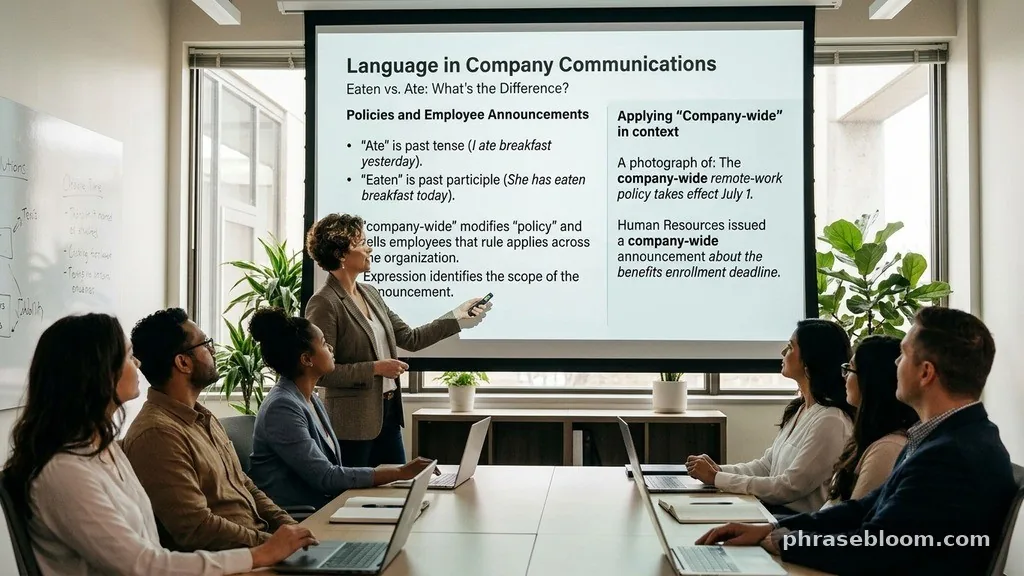
“The company-wide remote-work policy takes effect on July 1.” Here, company-wide modifies policy and tells employees that the rule applies across the organization.
“Human Resources issued a company-wide announcement about the benefits enrollment deadline.” The expression identifies the scope of the announcement rather than the department that wrote it.
“The updated company-wide code of conduct applies to employees, contractors, and interns.” The modifier comes directly before a noun phrase and clearly signals broad organizational coverage.
Training and internal communication
“All managers must complete company-wide training on the revised safety procedure.” The training is not limited to one office or operating division.
“The chief executive addressed the company-wide meeting after the acquisition was announced.” In this sentence, the meeting is intended for the whole company.
“The project team shared a companywide update through the internal communications platform.” This example uses the closed form. It is suitable if the organization has adopted companywide as its preferred spelling.
Reports and organizational changes
“The annual report describes a company-wide initiative to reduce energy use across all facilities.” The initiative has a company-level scope, even if individual facilities carry it out differently.
“Companywide changes to the approval process will affect purchasing and finance.” Here, companywide appears before changes as a closed compound.
“The new system was introduced company-wide after a three-month pilot.” In this position, the expression describes how broadly the system was introduced. Many writers retain the hyphen, while others use companywide according to house style.
Public communication and marketing
“The company-wide customer service standard is now published on the corporate website.” The policy or standard belongs to the company as a whole.
“A companywide brand refresh will update store signage, packaging, and digital channels.” The closed spelling works naturally in a public-facing business sentence.
In each case, the meaning comes from the scope of the activity. The spelling choice affects presentation and style more than the underlying message.
When Should Company-Wide Be Hyphenated?
The clearest traditional use of the hyphen is in a compound modifier placed immediately before a noun. That is why forms such as company-wide policy, company-wide announcement, and company-wide initiative are so common.
A compound modifier contains two or more words that work together to describe another word. In “company-wide training,” the full expression modifies training. The hyphen helps readers process company-wide as a single descriptive unit.
This does not mean every instance must be hyphenated under every style system. The closed compound companywide is also used before nouns, and an organization may prefer it throughout its documentation.
Consider these two versions:
- “The board approved a company-wide policy on data retention.”
- “The board approved a companywide policy on data retention.”
Both sentences communicate the same basic idea. The first is often the safer choice for a general audience because the compound structure is unmistakable. The second is appropriate when the publication or organization uses companywide as its standard spelling.
Context can also affect readability. If several modifiers appear together, adding or retaining a hyphen may help readers identify which words belong together. Yet writers should avoid inventing extra hyphens merely because a sentence contains a long noun phrase.
A reliable approach is to check the relevant style guide before making a final decision. If no style guide applies, choose company-wide for a compound modifier, especially in formal or externally published writing, and use that form consistently.
Is Company Wide Without a Hyphen Correct?
Company wide, written as two separate words, can appear in English, but it is generally not the preferred spelling when the words function together as one compound expression. In most workplace sentences, readers expect either company-wide or companywide.
For example, “The company wide policy begins next month” looks less polished than “The company-wide policy begins next month” or “The companywide policy begins next month.” The problem is not that the words are impossible to understand. The problem is that the open form does not clearly present them as one established modifier.
The two-word form may be defensible in a sentence where wide functions independently as an adjective or adverb, but those cases are uncommon with company. Most writers are trying to express the single idea “throughout the company,” not describe a company that happens to be wide.
Compare these sentences:
- Preferred compound: “The company-wide audit starts Monday.”
- Preferred closed compound: “The companywide audit starts Monday.”
- Less polished in this context: “The company wide audit starts Monday.”
If you encounter company wide in an older document or informal message, the intended meaning is usually clear. Still, professional writers should normally choose one of the established compound forms.
Rewriting is another option. “The audit will cover every department” avoids the spelling question entirely while making the scope explicit.
Can Company-Wide Appear After a Noun or Verb?
Yes. Company-wide can appear after a linking verb as a predicate adjective. In “The policy is company-wide,” the expression describes the subject, policy, after the verb is.
It can also appear after a verb in an adverbial role. In “The new system was introduced company-wide,” the expression explains the extent or scope of the introduction. It answers the question “Where or how broadly was the system introduced?”
Common examples include:
- “The revised procedure is company-wide.”
- “The benefits change applies company-wide.”
- “The new identity-management system was deployed company-wide.”
- “The survey will be administered company-wide.”
Placement can influence how writers handle the hyphen. Before a noun, company-wide visibly functions as a compound modifier. After a linking verb or at the end of a clause, the compound may be easier to understand without that same structural cue.
Even so, many organizations keep the same spelling everywhere. A house style may use company-wide before nouns and after verbs, or it may use companywide in every position. Neither approach is inherently confusing if it is applied consistently.
The key distinction is grammatical function. In “company-wide training,” the expression is an adjective phrase modifying training. In “the training applies company-wide,” it has an adverbial function, describing the reach of applies.
American English and British English Usage
The choice between company-wide and companywide is not a simple American-versus-British divide. Writers should not assume that companywide belongs exclusively to American English or that company-wide belongs exclusively to British English.
Both forms can be found in professional English on both sides of the Atlantic. Preferences may vary among publishers, government departments, universities, corporations, and individual editors. A particular style guide can matter more than national identity.
Compound words often move gradually between open, hyphenated, and closed forms. That development does not occur at the same speed in every country or industry. Technology companies, legal departments, newspapers, and academic publishers may make different choices even when they operate in the same language variety.
Formal writing therefore benefits from checking the style authority that governs the document. A British organization may prefer company-wide in its employee handbook, while an American software company may use companywide throughout its interface text. The reverse is also possible.
International audiences introduce another consideration. Readers who use different varieties of English are likely to understand both forms, but consistency makes the document feel controlled and professionally edited.
If no regional or institutional rule exists, company-wide is a conservative choice before a noun because the hyphen makes the compound relationship clear. If your team already uses companywide, changing isolated instances may create more inconsistency than clarity.
Alternatives That Avoid the Hyphenation Question
Sometimes the best solution is not to choose between company-wide and companywide. A small rewrite can make the scope clearer, sound more natural, or suit a particular audience better.
Across the company
Across the company is direct and conversational. “The survey will be distributed across the company” clearly means that employees throughout the business will receive it.
Throughout the company
Throughout the company emphasizes coverage across locations, teams, or departments. “The new safety standard will be applied throughout the company” works well in formal policy writing.
Across the organization
Across the organization is useful when the entity is not technically a company, such as a nonprofit, public agency, university, or association. It can also sound less repetitive in a report that uses company several times in nearby sentences.
Organization-wide
Organization-wide follows the same general pattern as company-wide. It is useful when the subject includes subsidiaries, nonprofit units, or other groups that do not fit neatly under the word company.
Enterprise-wide
Enterprise-wide often appears in technology, finance, and large-scale management contexts. It can suggest coverage across a complex business environment, including subsidiaries, platforms, and operating divisions.
Compare the following versions:
- “The company-wide initiative begins in April.”
- “The initiative begins across the company in April.”
- “The initiative begins throughout the organization in April.”
- “The enterprise-wide initiative begins in April.”
These alternatives are not always exact substitutes. Enterprise-wide may imply a broader or more complex scope, while across the company sounds more ordinary and accessible. Choose the phrase that matches the entity and the intended level of formality.
Common Mistakes With Company-Wide and Companywide
Most errors involve inconsistency or an awkward grammatical choice rather than a failure to understand the meaning. A careful editing pass can correct them quickly.
Switching forms without a reason
A report that uses company-wide in one section and companywide in another may look unfinished. Select one form for the document unless a specific style rule requires a distinction.
Better: Use “company-wide policy,” “company-wide training,” and “company-wide reporting” throughout the same report.
Using company wide as the default compound
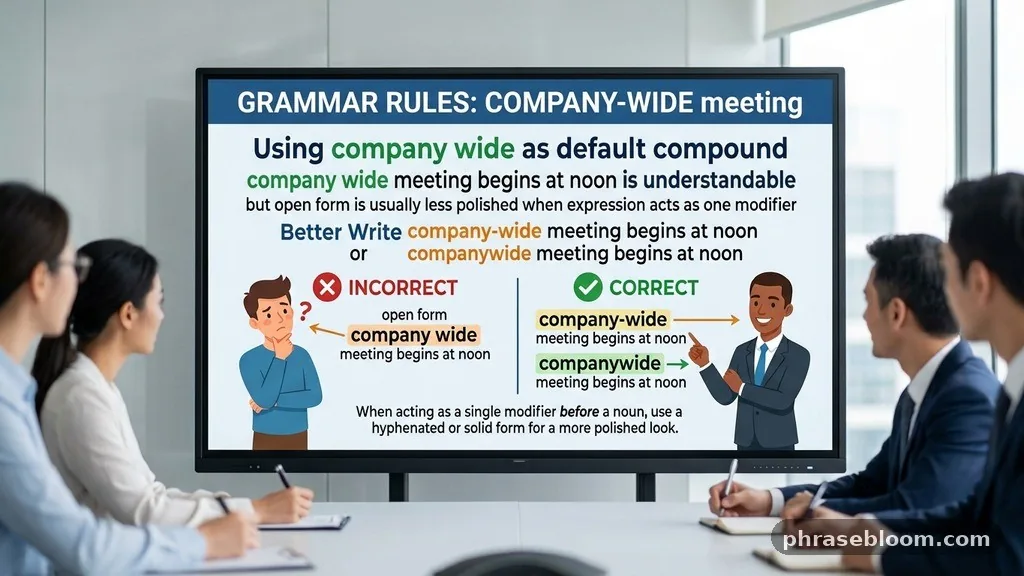
“The company wide meeting begins at noon” is understandable, but the open form is usually less polished when the expression acts as one modifier.
Better: Write “The company-wide meeting begins at noon” or “The companywide meeting begins at noon.”
Inventing companywidely
Companywidely is not a standard solution for expressing broad company coverage. Writers who need an adverb should use company-wide or a clearer phrase such as across the company.
Better: “The new process was implemented company-wide” or “The new process was implemented throughout the company.”
Treating companywide as a noun
Companywide describes something, but it does not normally function as a noun. “The companywide begins Monday” does not identify what begins.
Better: “The companywide training begins Monday” or “The company-wide rollout begins Monday.”
Assuming spelling changes meaning
Company-wide policy and companywide policy generally refer to the same kind of policy. The difference is normally editorial, not semantic.
Choosing a complicated form when a simpler one works
Some sentences become clearer when the writer replaces the compound with a phrase. “Every department must follow the new procedure” may be more precise than “The new procedure is company-wide,” particularly if the document needs to identify exactly who is covered.
How to Choose the Right Form
A short decision process can resolve most company-wide usage questions. Start with the sentence, then check the organization’s established practice.
- Identify the meaning. Confirm that you mean something affecting the entire company.
- Check the grammatical position. If the term modifies a noun, company-wide is a clear traditional choice.
- Look for a style guide. Follow the rules used by your publisher, employer, school, or legal department.
- Check existing documents. Search the handbook, website, templates, and internal communications for the established form.
- Consider the audience. International readers generally understand both, but a familiar and visibly clear compound can help.
- Rewrite if necessary. Use across the company or throughout the company if the sentence becomes cleaner.
- Apply the decision consistently. Do not change forms from section to section without a documented reason.
For a document with no house style, the practical default is simple: use company-wide before a noun, especially in formal writing, and retain that spelling throughout the document. Companywide is also acceptable when it matches the established style of the publication or organization.
Consistency matters more than trying to prove that one form is the only legitimate option. Readers care primarily about whether the sentence is clear and whether the document appears carefully edited.
Professional Writing Guidance by Context
The right choice can vary slightly depending on where the expression appears. The underlying meaning remains the same, but audience expectations and document controls differ.
Business emails
In an email, either form is normally understandable. “We will share a company-wide update by Friday” is a safe choice for a broad employee audience.
Informal communication does not require a complicated explanation of the hyphen. Choose the form used in your company’s templates and use it consistently.
Employee handbooks and policy documents
Handbooks benefit from a stable house style because employees may consult them repeatedly. If the handbook uses company-wide policy in one section, avoid switching to companywide policy elsewhere unless an editor has made that choice deliberately.
Legal and compliance documents may also need precise scope. If every employee, contractor, and subsidiary is covered, state that directly instead of relying only on the modifier.
Business reports
Reports often use company-wide or companywide alongside terms such as enterprise-wide, department-level, and regional. Consistency across those related expressions helps readers compare levels of organizational scope.
“The company-wide initiative produced different results by region” is clear because the broad initiative can still have varied local outcomes.
Websites and marketing materials
Public-facing copy should favor familiar, plain wording. “Available across the company” may sound more natural than either compound in a short customer-facing sentence.
Marketing teams should also follow the brand’s editorial standards. A website that uses companywide in its newsroom should not casually switch to company-wide in every new announcement.
Internal software interfaces
Short interface labels have limited space, so “Companywide settings” may be preferred if that is the product’s terminology. In help text, “Settings that apply across the company” may be easier for new users to understand.
Academic and formal writing
Academic writers should follow the required style manual or publisher instructions. If no instruction exists, company-wide is a defensible choice before a noun because it clearly identifies the compound modifier.
Formal writing should also avoid using the term as a substitute for precise scope. “The company-wide program included all domestic offices” is more informative than a vague claim that something was company-wide if important exclusions exist.
Quick Comparison: Company-Wide, Companywide, and Company Wide
| Form | Spelling | Meaning | Typical grammatical function | Common context | Practical recommendation |
|---|---|---|---|---|---|
| company-wide | Hyphenated compound | Across or affecting the entire company | Adjective or adverbial modifier | Policies, reports, announcements, formal writing | Safest default before a noun when no house style applies |
| companywide | Closed compound, one word | Across or affecting the entire company | Adjective or adverbial modifier | Business writing, internal systems, established house styles | Use when the organization or publication prefers it |
| company wide | Two separate words | Usually intended to mean across the company | Open phrase | Informal or inconsistent usage | Usually revise to company-wide, companywide, or across the company |
Examples You Can Copy and Adapt
The following sentences show how both forms work in common professional settings. Replace the nouns and details to match your situation.
- “The company-wide policy requires annual security training.”
- “The companywide policy will be reviewed by the compliance team.”
- “Please share this company-wide announcement with remote employees.”
- “The companywide rollout begins after the final software test.”
- “Our company-wide training session will be recorded for employees who cannot attend.”
- “The benefits update applies company-wide.”
- “The new reporting platform was deployed companywide.”
- “The CEO introduced a company-wide initiative to improve customer response times.”
- “Managers should explain how the companywide changes affect local workflows.”
- “The revised standard applies throughout the company.”
- “Every department will receive the same announcement.”
- “The survey will be distributed across the organization.”
The first five examples use the hyphenated form before nouns. The next several use companywide or company-wide in different positions, showing that the central issue is not a major change in meaning.
Notice the difference between “The policy is company-wide” and “The company-wide policy begins Monday.” In the first sentence, company-wide follows a linking verb and describes the policy. In the second, it appears directly before policy as a compound modifier.
If your organization uses companywide, you can adapt the same sentences without changing their meaning. The important editing decision is to establish the preferred form before final publication, then apply it to headings, body text, captions, interface labels, and related documents.
Frequently Asked Questions
Is company-wide or companywide correct?
Both forms are used and generally have the same meaning. Company-wide is often the safest default before a noun, while companywide is appropriate when a style guide or house style prefers the closed compound.
Is company-wide more formal?
Not necessarily. The hyphenated form may look more traditional or immediately clear in formal writing, but companywide is also used in professional documents. Formality depends more on accurate scope, clear wording, and consistent editing than on the spelling alone.
Should company-wide be hyphenated before a noun?
Usually, yes, if you are following the traditional compound-modifier approach. Write “company-wide policy” or “company-wide announcement,” unless your organization’s style specifically uses the closed form companywide.
Is company wide wrong?
It is usually not the preferred spelling when the words work together as one compound expression. In professional writing, revise “company wide policy” to “company-wide policy,” “companywide policy,” or “policy across the company.”
Can I write “the policy is company-wide”?
Yes. In that sentence, company-wide is a predicate adjective describing the policy after the linking verb is. You can also write “the policy applies company-wide” for an adverbial use, or replace it with “the policy applies throughout the company.”
Can company-wide be used after a verb?
Yes. Examples include “The changes apply company-wide” and “The system was introduced company-wide.” Some style systems retain the hyphen in this position, while others use companywide consistently.
Is companywide one word?
Yes. Companywide is a closed compound written as one word. It generally means the same thing as company-wide.
Which form should I use in professional writing?
Use your organization’s house style if one exists. If there is no established preference, company-wide is a clear practical choice before a noun, particularly in formal or externally published writing.
Is there an American versus British difference?
There is no simple rule that assigns one form exclusively to American English and the other exclusively to British English. Editorial policies, dictionaries, publishers, and organizational preferences can differ within either variety.
What is a good alternative to company-wide?
Depending on the sentence, use “across the company,” “throughout the company,” “across the organization,” “organization-wide,” or “enterprise-wide.” Choose the alternative that accurately describes the entity and scope.
Should I use one spelling consistently throughout a document?
Yes. Choose company-wide or companywide and use it consistently in headings, paragraphs, captions, forms, and related materials. Consistency makes the document look intentional and reduces unnecessary editorial distraction.
Final Recommendation
The practical answer to the company-wide or companywide question is straightforward: both forms are established, and both generally mean “throughout the company.” Use company-wide as the clear default before a noun when no style guide or house style tells you otherwise, especially in a company-wide policy, report, or announcement.
Companywide is also a valid professional option, while company wide is usually best revised when the words function as one compound. Check your organization’s preferred usage, consider rewriting as across the company when that sounds clearer, and apply your choice consistently. That approach keeps company-wide usage accurate, readable, and professional.
Related: Alright vs All Right · Whole Day or All Day
1 thought on “Eaten vs Ate: What’s the Difference?”