
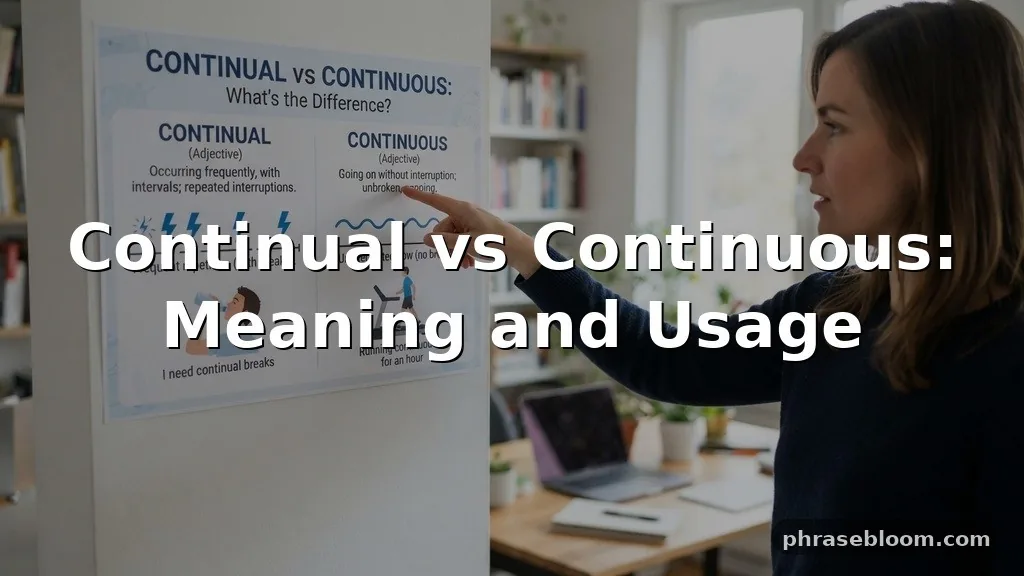
Continual vs continuous is a useful distinction because both adjectives describe something that happens over time, yet they do not emphasize the same pattern. Continual usually means repeated or recurring, often with pauses between events, while continuous means ongoing without interruption. The difference is small in form but important in workplace writing, academic prose, reports, and everyday sentences.
For example, continual interruptions happen again and again, but continuous noise does not stop. The sections below explain the meanings, show the contrast in natural sentence examples, and give you a practical way to choose the right word without relying on guesswork.
Continual vs Continuous: The Short Answer
Continual describes something that happens repeatedly, usually with breaks or interruptions. Continuous describes something that continues without stopping, or without a meaningful interruption.
That distinction gives you a reliable starting point:
- Continual: recurring, repeated, or happening frequently over a period of time.
- Continuous: uninterrupted, unbroken, or extending from one point to another without a gap.
- Continually: repeatedly or frequently.
- Continuously: constantly or without interruption.
Consider two simple examples. “The continual alarms distracted the staff” suggests that the alarms sounded repeatedly, with quiet periods between them. “The machine ran continuously for six hours” means it operated throughout that entire period without stopping.
Both words can refer to an ongoing situation, so the boundary is not always absolute. In ordinary usage, however, continual focuses on repeated events, while continuous focuses on uninterrupted duration.
That is the central answer to the continual vs continuous question. Use the word that matches the pattern you mean, not simply the word that sounds more formal.
What Does Continual Mean?
Continual means happening repeatedly over time. The events may occur at regular intervals, irregular intervals, or so frequently that they seem nearly constant, but the word leaves room for pauses between them.
A continual event is therefore recurring rather than necessarily uninterrupted. A customer who sends continual requests sends many requests over a period of time, but does not send them every second. A team facing continual revisions deals with one revision after another, with work occurring between changes.
The word often carries a negative or tiring suggestion because repeated events can become annoying. “Continual delays affected the project” implies that delays kept returning. “Continual complaints made the meeting difficult” suggests a series of complaints, not one uninterrupted complaint lasting for the entire meeting.
Still, continual is not automatically negative. You can write about “continual support from volunteers” or “continual improvements to the service.” In those examples, the emphasis is on repeated help or recurring improvements rather than a single unbroken process.
Continual as an adjective
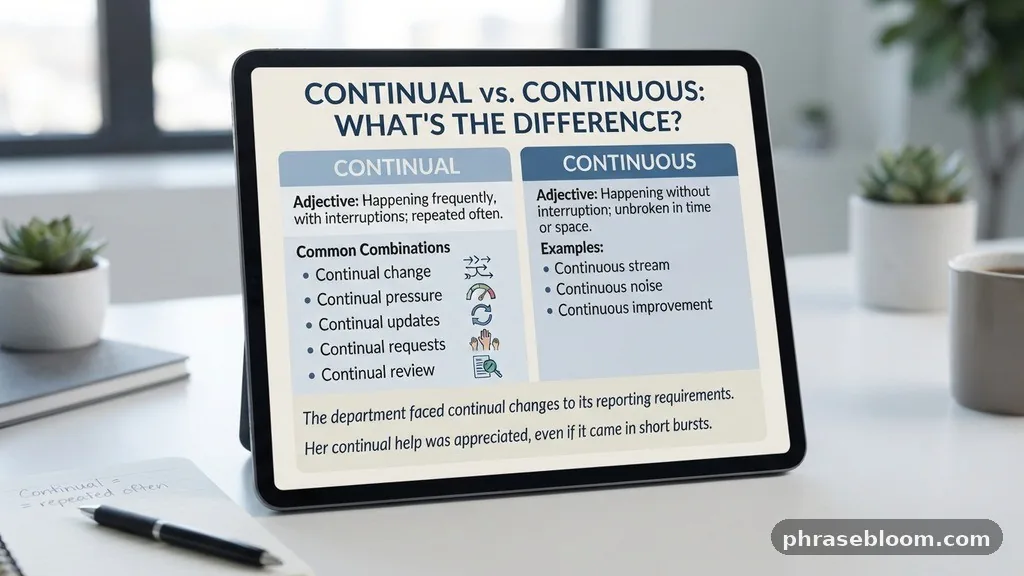
Continual is an adjective, which means it describes a noun. Common combinations include continual change, continual pressure, continual updates, continual requests, and continual review.
Here are several natural examples:
- The department faced continual changes to its reporting requirements.
- Her continual questions helped the instructor identify a gap in the lesson.
- The software requires continual maintenance as new devices are added.
- We received continual feedback throughout the design process.
In each sentence, the noun describes something that happens repeatedly or returns over time. The activity is ongoing in a broad sense, but the sentence does not promise that it happens without even a brief pause.
Continually as an adverb
The adverb continually modifies a verb, adjective, or another adverb. It usually means repeatedly, frequently, or again and again.
“The schedule continually changes” means that the schedule changes repeatedly. “The company continually reviews its safety procedures” means the reviews recur as part of an ongoing practice, not that someone reviews the procedures every instant.
This distinction matters in formal writing. If you write that a system “operates continually,” many readers will understand that it operates repeatedly or almost constantly. If you need to guarantee uninterrupted operation, continuously is usually more precise.
What Does Continuous Mean?
Continuous means extending or proceeding without interruption. It can describe an activity, sound, line, process, period, or sequence that remains unbroken from beginning to end.
Continuous rain falls without a meaningful pause during the period being discussed. A continuous recording captures sound throughout the session. A continuous line does not break into separate marks.
The word does not always mean that something lasts forever. “The plant maintained continuous production for twelve hours” refers to an uninterrupted twelve-hour period, not an endless operation. The relevant question is whether the process stopped during the time under discussion.
Continuous can also describe a smooth connection rather than an activity. In mathematics, a continuous function has a technical meaning related to how its values behave. In ordinary writing, though, the core idea remains an unbroken or connected sequence.
Continuous as an adjective
Continuous is also an adjective, so it commonly appears before a noun. Examples include continuous improvement, continuous monitoring, continuous service, continuous communication, and continuous operation.
These phrases can be precise, but their meaning depends on context. “Continuous monitoring” usually suggests that monitoring happens without a gap. “Continuous improvement” may be used more broadly for an ongoing program of repeated improvements, even though individual improvements happen at separate times.
That is one reason the continual vs continuous distinction cannot be handled as a rigid substitution exercise. Established business expressions sometimes use continuous to describe an ongoing organizational philosophy rather than an activity performed every second.
Continuously as an adverb
Continuously means without interruption. It modifies an action or condition and is especially helpful when uninterrupted duration is the key point.
“The backup system ran continuously overnight” tells the reader that the system did not stop during the night. “The sensor continuously records temperature” suggests a constant recording process rather than occasional readings.
Compare that with “The sensor continually records temperature.” That sentence may be understood, but continually could suggest repeated recording sessions or frequent updates. If the device truly records at every moment, continuously is the clearer choice.
Continual and Continuous in Real Sentences
The easiest way to understand these adjectives is to compare them in realistic contexts. The following examples use workplace, academic, technical, and everyday situations where the difference affects the intended meaning.
Workplace communication
“The manager dealt with continual requests for schedule changes” describes repeated requests arriving over time. The requests may come from different employees and may be separated by hours or days.
“The manager maintained continuous communication with the emergency team” describes communication that remained active without a meaningful break. The sentence emphasizes uninterrupted contact, not a series of separate messages.
In an email, you might write, “Continual revisions have delayed approval of the proposal.” This means the proposal keeps returning for changes. If a video meeting remains connected for an entire afternoon, “The team maintained continuous contact during the exercise” is more suitable.
Technology and operations
“The server provides continuous access to the customer portal” presents access as available without interruption. It is the right choice if the service is intended to remain available throughout the stated period.
“The server receives continual security updates” describes repeated updates released or installed over time. The updates are not being applied every second, so continual emphasizes recurrence.
Technical writers should be especially careful with these words because operational claims can carry practical consequences. Continuous monitoring may imply that a system observes data at all times, while continual monitoring may allow periodic checks.
Education and research
“The student made continual progress during the semester” means progress occurred repeatedly or steadily across the term. It does not necessarily mean improvement was measurable every day.
“The instrument made continuous measurements for three hours” indicates that the instrument collected data without stopping during that period. A research report should use continuous only if the method supports that claim.
Academic writers should also consider whether ongoing, repeated, uninterrupted, or recurring would make the meaning more exact. A plain alternative is often better than a word chosen only because it sounds sophisticated.
Public announcements and policies
“The company introduced a continual review of its privacy procedures” suggests recurring reviews. “The company introduced continuous monitoring of network traffic” suggests monitoring that operates without interruption.
A public notice might say, “The road will remain closed because of continuous flooding.” That wording describes an uninterrupted condition. If flooding returns after separate storms, “repeated flooding” may communicate the situation more accurately than either adjective.
When to Choose Continual
Choose continual when the main idea is recurrence. The event happens more than once, returns over time, or occurs frequently enough to be a noticeable pattern.
A useful test is to ask, “Could there be pauses between the events?” If the answer is yes and those pauses do not conflict with your intended meaning, continual may be appropriate.
- continual interruptions during a presentation
- continual requests for additional information
- continual changes to the project schedule
- continual training for newly hired staff
- continual adjustments to the company’s pricing model
- continual complaints about delivery delays
For example, “Continual interruptions made it difficult to complete the interview” clearly suggests multiple interruptions. The interview itself continued, but the interruptions occurred at separate moments.
“The policy requires continual review” means the policy must be reviewed repeatedly as circumstances change. It does not necessarily demand one uninterrupted review session. If the organization performs a formal review every quarter, continual can describe the larger pattern.
Continual may also be suitable when the gaps are brief but still real. “Continual noise from the construction site” can describe a pattern of repeated drilling, machinery, and banging even if each sound stops occasionally.
When to Choose Continuous
Choose continuous when the main idea is an unbroken stretch. The activity, condition, line, or process continues without a meaningful gap during the relevant period.
Ask, “Would a pause change the meaning or make the statement inaccurate?” If a pause would contradict the claim, continuous is likely the stronger word.
- continuous operation of the cooling system
- continuous recording during the experiment
- continuous power for the medical equipment
- continuous coverage during the storm
- continuous service throughout the business day
- continuous movement along the production line
“The pump operated continuously for eight hours” makes a clear claim about uninterrupted operation. If the pump stopped several times and restarted, the sentence would overstate the facts.
Continuous can also describe a physical connection. A continuous path has no break between its sections. A continuous border runs around an area without gaps, while a recurring border might appear in separate segments.
Use continuously when the verb needs an adverb. “The monitor continuously displayed the patient’s heart rate” indicates an uninterrupted display. If the monitor showed the rate every few minutes, “continually displayed” would be less precise, and “displayed repeated readings” might be clearer.
Common Confusions and Borderline Cases
The distinction becomes less obvious when an event happens very frequently. Something can be continual in ordinary language even if the pauses are so short that people experience it as nearly continuous.
“Continual rain” may describe rain that stops briefly and starts again throughout the day. “Continuous rain” normally suggests that the rain does not stop during the period being considered. The exact boundary depends on the writer’s intended emphasis and the facts being described.
Business language creates another source of uncertainty. The phrase “continuous improvement” is widely used for an ongoing management approach involving repeated adjustments. The individual improvements are not literally happening without interruption, but the program is treated as a continuing process.
That does not make continual improvement impossible. It simply means that continuous improvement is an established expression in many professional contexts. A writer should consider the audience’s expectations as well as the dictionary distinction.
Do not confuse frequency with duration
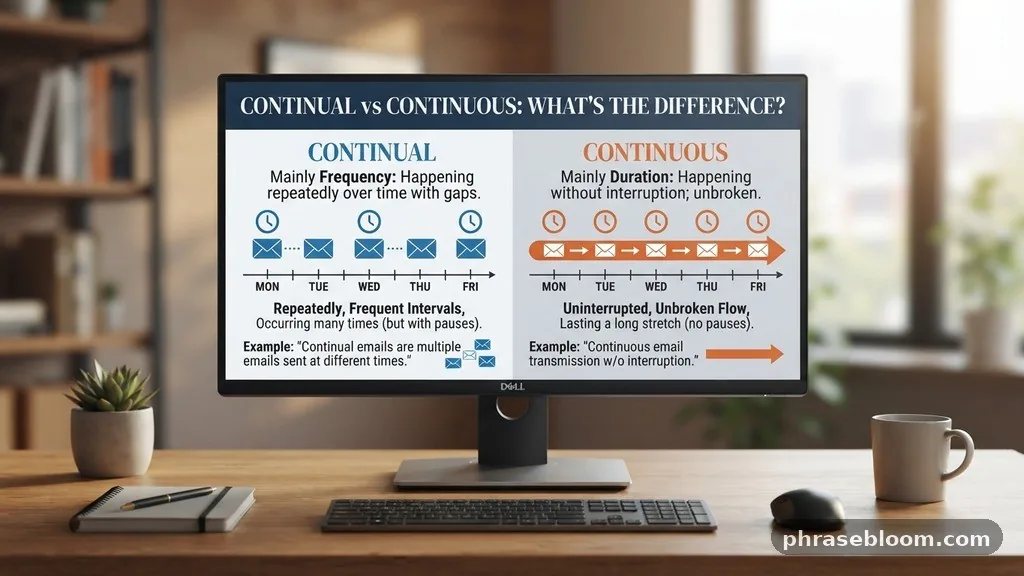
Continual is mainly about frequency across time. Continuous is mainly about duration without a break. A continual event can happen many times, while a continuous event can happen once and last for a long stretch.
For instance, continual emails are multiple emails sent at different times. Continuous email transmission would suggest a stream of transmission that does not stop. Those are very different operational descriptions.
Consider the time frame
Everyday statements often leave the time frame unstated. “The lights were continuous” sounds incomplete because the reader wants to know during which period the lights remained on. A more natural sentence is, “The lights remained on continuously throughout the night.”
Similarly, “The team faced continual delays during the construction phase” supplies a period in which repeated delays occurred. Adding a time frame can make the intended contrast much easier to understand.
Grammar, Sentence Position, and Word Choice
Both continual and continuous are adjectives. They can appear before a noun as attributive adjectives or after a linking verb as predicate adjectives.
Before a noun, the adjective directly modifies that noun:
- The project experienced continual delays.
- The laboratory requires continuous ventilation.
- We received continual feedback from customers.
- The device provides continuous output.
After a linking verb, the adjective describes the subject:
- The delays were continual.
- The ventilation remained continuous.
- The feedback was continual throughout the pilot.
- The signal was continuous for the duration of the test.
The adverbs continually and continuously are different forms. “The alarm sounded continually” suggests repeated sounding, while “The alarm sounded continuously” suggests one uninterrupted sound. If the alarm emitted separate beeps, continually is more accurate; if it produced one sustained tone, continuously is better.
Grammar alone does not decide every case. Context, technical meaning, ordinary collocation, and the writer’s intended level of precision all matter. A sentence may be grammatically correct but still choose the less suitable word.
Continual vs Continuous in Formal and Professional Writing
Formal writing benefits from precision, but precision does not mean choosing continuous whenever a process is important. A policy, report, or academic paper should distinguish repeated activity from uninterrupted activity when that difference affects the reader’s understanding.
In a business report, write “The department experienced continual staff turnover” if employees left and were replaced repeatedly. Write “The department maintained continuous staffing coverage” if the department remained staffed without a gap.
In a policy, “continuous service” may create a specific expectation that service will remain available throughout a stated period. “Continual service” may sound less exact because it can imply recurring service rather than uninterrupted availability.
In academic writing, describe the actual method. “Participants received continual reminders” means they received repeated reminders. “The recording continued continuously for 30 minutes” is awkward because continue and continuously repeat the same idea, so “The recording lasted for 30 minutes without interruption” may be cleaner.
Professional writers should also avoid using continual or continuous as vague substitutes for ongoing. If a project is active but involves pauses, meetings, and separate stages, ongoing may be more accurate than continuous. If a project returns to the same issue repeatedly, recurring may be the clearest option.
Useful alternatives
Several alternatives can remove ambiguity or better match the intended meaning:
- Ongoing: still in progress or continuing over time.
- Recurring: happening again at intervals.
- Repeated: occurring more than once.
- Uninterrupted: continuing without a break.
- Constant: remaining the same or present all the time.
- Persistent: continuing despite attempts to stop or resolve it.
Compare “continual technical problems” with “recurring technical problems.” The second phrase makes repetition especially clear. Compare “continuous access” with “uninterrupted access.” The latter states the practical condition directly.
What Major Reference Sources Say About the Distinction
Reference works generally recognize a relationship between the two words rather than treating them as unrelated terms. Dictionaries such as Merriam-Webster commonly present continual as meaning recurring or repeated, while continuous is associated with uninterrupted extension or sequence.
The Oxford English Dictionary entry for continual is useful for readers who want historical detail, quotations, and documented senses. Historical usage can show why the words overlap, but everyday writers still need to decide which meaning best fits the sentence in front of them.
The distinction is not a rule that every speaker applies identically. Some writers use continual for conditions that feel almost constant, and some use continuous in broad expressions describing an ongoing effort. Established phrases can preserve a usage that is slightly broader than the simplest classroom definition.
That flexibility does not eliminate the contrast. If the sentence describes separate interruptions, continual is likely to guide the reader correctly. If it describes a process that remains active without a gap, continuous is normally the safer choice.
Reference sources also help explain why a word can have several related senses. Grammar usage develops through actual English use, so dictionary definitions often include both a central meaning and established extensions. Good writing respects that range while still choosing the most precise word for the context.
Quick Comparison Table
| Word | Core meaning | Typical pattern | Example | Best practical use |
|---|---|---|---|---|
| Continual | Repeated or recurring | Separate events over time | Continual interruptions delayed the meeting. | Use for frequent events that may have pauses. |
| Continuous | Uninterrupted or unbroken | One sustained process or condition | Continuous noise disturbed the residents. | Use when a meaningful break does not occur. |
| Continually | Repeatedly or frequently | Adverb modifying an action | The requirements continually change. | Use for recurring actions. |
| Continuously | Without interruption | Adverb modifying an ongoing action | The system continuously records data. | Use for uninterrupted actions. |
Practical Editing Method
When you are unsure, do not begin by asking which word sounds more formal. Begin by identifying the pattern described in the sentence.
- Ask whether the event happens more than once with possible pauses. If so, test continual or continually.
- Ask whether the event remains active without a meaningful interruption. If so, test continuous or continuously.
- Check whether the word is an adjective or an adverb. A noun usually needs continual or continuous, while a verb may need continually or continuously.
- Read the complete sentence aloud. If the wording sounds broader than the facts support, replace the adjective with ongoing, repeated, or uninterrupted.
- Check the surrounding document for consistency. A report should not switch between terms if the same process is being described in the same way.
Suppose you have written, “The team conducted continual monitoring.” Ask whether the team checked the system at repeated intervals or watched it without interruption. If checks happened every hour, “regular monitoring” or “continual monitoring” may work. If software watched the system at every moment, “continuous monitoring” is more precise.
This method is especially useful for editors. Mark the word only when the distinction affects meaning, tone, or a factual claim. Do not change a well-established expression merely to impose a preference that the context does not require.
Examples You Can Copy and Adapt
The following sentence examples show how the words function in common settings. They are written as practical models rather than isolated definitions.
- Continual: Continual changes to the launch date made it difficult to update the sales materials.
- Continual: The help desk received continual requests for access to the new platform.
- Continual: Her continual follow-up kept the application moving through the approval process.
- Continuous: The medical unit needs continuous power for its monitoring equipment.
- Continuous: The camera provided continuous coverage of the loading entrance.
- Continuous: The factory maintained continuous production during the overnight shift.
- Continually: The forecast continually changed as new information arrived.
- Continuously: The instrument continuously measured the pressure inside the chamber.
- Ongoing alternative: The organization has an ongoing review of its customer-support procedures.
- Uninterrupted alternative: The contract guarantees uninterrupted access to the emergency hotline.
Notice that continual examples involve a sequence of events, such as changes, requests, or follow-up actions. Continuous examples involve a sustained state or operation, such as power, coverage, production, or measurement.
Some sentences permit more than one word but shift the emphasis. “The team made continual improvements” highlights repeated improvements. “The team pursued continuous improvement” presents improvement as an ongoing management principle.
Neither sentence needs to be treated as automatically wrong. The surrounding context determines whether the writer is describing individual changes or a continuing approach.
Common Mistakes to Avoid
Using continuous for repeated events
“The employee made continuous requests” may imply one uninterrupted stream of requests. If the employee sent several requests at different times, “continual requests” or “repeated requests” is clearer.
Using continual for uninterrupted operation
“The generator provided continual power” may be understood, but it does not state uninterrupted operation as clearly as “continuous power.” Technical and legal documents should prefer the word that matches the actual service condition.
Assuming the distinction is absolute
English usage includes overlap. Continuous can describe an ongoing program, and continual can describe something that occurs so often that it feels constant. Treat the distinction as a guide to emphasis, not as a claim that every real sentence has only one possible answer.
Repeating the idea unnecessarily
“The system continuously continued to run” is awkward because the verb and adverb duplicate each other. Write “The system ran continuously” or “The system continued to run without interruption.”
Ignoring clearer alternatives
A writer who is uncertain may choose a word that leaves the timing vague. “The service remained available without interruption” is often better than debating between continuous service and continual service if uninterrupted availability is the contractual point.
Frequently Asked Questions
What is the main difference between continual and continuous?
Continual usually means repeated or recurring, with possible pauses between events. Continuous means ongoing without interruption or a meaningful break.
Is continual more formal than continuous?
No. They are different adjectives, not formal and informal versions of the same word. Choose continual for recurrence and continuous for uninterrupted duration.
Can continual and continuous ever be interchangeable?
Sometimes they overlap, especially when an activity occurs very frequently or describes a broad ongoing process. Even then, continual emphasizes repetition, while continuous emphasizes an unbroken stretch.
Should I write continuously or continually with a verb?
Use continually for repeated actions and continuously for actions that do not stop. “The policy continually changes” means it changes again and again, while “The machine continuously operates” means it keeps operating without a break.
What is the safest choice in formal writing?
Use the word that accurately describes the facts, then check the conventions of your field or organization. If uninterrupted duration matters, continuous is usually clearer; if recurring events matter, continual is usually clearer.
Conclusion
The practical distinction in continual vs continuous is straightforward: continual points to repeated events, while continuous points to an uninterrupted process or condition. Continually means repeatedly, and continuously means without a break.
Before publishing, check whether your sentence describes separate occurrences or one sustained stretch. If neither word feels exact, use ongoing, recurring, repeated, or uninterrupted. That small editing decision can make professional, academic, and everyday writing much clearer.
Related reading: Unselect vs Deselect, Hassle vs Hastle.