
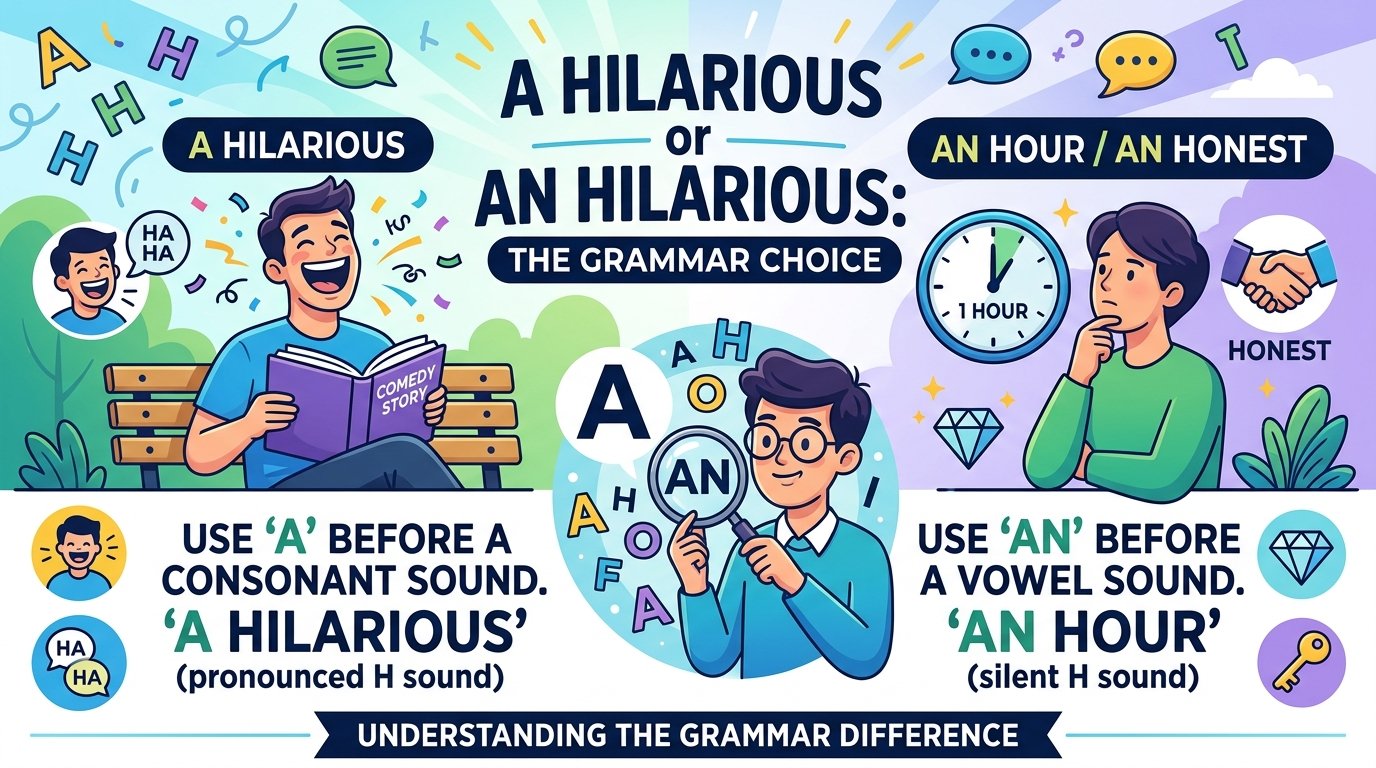
Wondering whether to write “a hilarious” or “an hilarious”? You are not alone. This small grammar choice often causes confusion because many people think English articles depend on the first letter of a word.
The correct modern form is “a hilarious.”
The reason is simple: English uses “a” before a consonant sound and “an” before a vowel sound. Since hilarious begins with a clearly pronounced H sound, it takes “a,” not “an.”
This guide explains the rule in simple English. You will learn the difference between a vs an grammar, understand hard H and silent H words, see real examples, and learn an easy way to remember the correct choice.
“A Hilarious or An Hilarious”: Why Does the Confusion Exist?
The confusion exists because people often focus on spelling instead of pronunciation.
Both “a” and “an” are indefinite articles. However, the choice does not depend simply on whether the next word begins with a vowel or consonant letter. Instead, it depends on the sound that comes next.
For example:
- a hilarious story
- a happy child
- a huge mistake
- an hour
- an honest answer
- an heir
At first glance, all these words beginning with H may seem to follow the same rule. They do not.
Words such as hilarious, happy, and huge have a hard H sound. Therefore, they use “a.”
Words such as hour, honest, and honor have a silent H. Their pronunciation begins with a vowel sound, so they use “an.”
See Also: Soft Guy Era Drizzle Drizzle Meaning: Understanding the Difference
Why It Matters in Professional Settings
Correct English grammar matters in emails, articles, academic writing, business communication, and professional documents.
Using “an hilarious” in modern standard English can make a sentence sound unnatural. Although readers will usually understand your meaning, correct article usage makes your writing clearer and more polished.
For professional writing, therefore, choose the form that matches modern pronunciation: “a hilarious.”
A Hilarious or An Hilarious: Which One Is Correct?
The correct expression is “a hilarious.”
Consider these examples:
- That was a hilarious joke.
- She shared a hilarious story.
- We watched a hilarious comedy.
- He made a hilarious comment.
- It was a hilarious moment.
The important point is that hilarious starts with a pronounced H. That makes the beginning sound a consonant sound.
The basic article rule in English is:
Use “a” before a consonant sound. Use “an” before a vowel sound.
So, if you ask how to spell “a hilarious or an hilarious”, the answer is that the correct modern construction is “a hilarious.”
You can also remember it by saying the word aloud. If the H is clearly heard, “a” is normally the right article.
What Does “Hilarious” Mean? Origins, Definition, and Usage
Understanding the word itself makes the grammar rule easier to remember.
Definition of Hilarious
Hilarious is an adjective that describes something extremely funny or capable of making people laugh.
For example:
That was a hilarious joke.
Here, hilarious describes the joke.
You might also say:
- a hilarious movie
- a hilarious conversation
- a hilarious mistake
- a hilarious story
- a hilarious performance
In each case, the adjective begins with a pronounced H sound.
See Also: Team That, Team Who, or Team Which
Origins of the Word “Hilarious”
The word hilarious is connected to the idea of cheerfulness, merriment, and amusement. Its history ultiatey traces back to the Greek word associated with being cheerful or merry and entered English through Latin and French influences.
Today, however, its everyday meaning is straightforward: something very funny or extremely amusing.
Why “An Hilarious” Is a Common Mistake
The phrase “an hilarious” may seem reasonable because writers sometimes learn that “an” goes before vowels.
The problem is that this simplified rule focuses on letters rather than sounds.
The word hilarious begins with the consonant sound /h/. Therefore, “a hilarious” is the natural modern form.
The same principle explains why we say “a hotel” and “a hero,” but “an hour” and “an honest person.”
Hard H vs Silent H: The Key to A or An
The easiest way to understand a or an with H words is to separate H words into two groups.
Hard H Words
A hard or pronounced H means you can clearly hear the H at the beginning.
These words take “a”:
- a hilarious story
- a happy ending
- a huge problem
- a helpful teacher
- a historical event
- a hotel
- a hero
- a house
These are examples of H words that take a because they begin with a consonant sound.
Silent H Words
A silent H is not pronounced. As a result, the word begins with a vowel sound.
These words take “an”:
- an hour
- an honest person
- an honor
- an honorable decision
- an heir
These are H words that take an because their initial H is silent.
Notice the difference:
a hilarious → pronounced H → consonant sound
an hour → silent H → vowel sound
That distinction is much more useful than memorizing individual spellings.
Common Reasons for the “An Hilarious” Misspelling
Several things can lead writers toward “an hilarious.”
One reason is the common classroom shortcut that says “use an before a vowel.” Although useful for beginners, this explanation can become misleading if it makes you think only about letters.
Another reason is the existence of silent H words. People learn phrases such as “an hour” and “an honest answer,” then assume every H word works the same way.
Historical usage also contributes to the confusion. Older British writing sometimes used forms such as “an historic” and “an hotel.” These forms reflected pronunciation and style conventions that are less common in modern English.
Modern British English and American English generally use the sound-based rule. Therefore, “a hilarious” is the appropriate modern form.
Side-by-Side Comparison: “A Hilarious” vs “An Hilarious”
| Expression | Correct today? | Reason |
|---|---|---|
| a hilarious | Yes | H is pronounced |
| an hilarious | No in modern standard usage | H is pronounced |
| a happy | Yes | Hard H sound |
| a hotel | Yes | Hard H sound |
| a hero | Yes | Hard H sound |
| an hour | Yes | H is silent |
| an honest person | Yes | H is silent |
| an honor | Yes | H is silent |
| a historic event | Yes | H is pronounced |
This comparison shows why a vs an before H words is really a pronunciation issue.
Everyday Examples of “A Hilarious” in Language
Once you understand the rule, using “a hilarious” becomes easy.
Here are natural examples:
- We heard a hilarious story at dinner.
- She posted a hilarious video online.
- He told a hilarious joke.
- They watched a hilarious comedy together.
- My friend made a hilarious observation.
- It was a hilarious mistake that everyone remembered.
- The comedian delivered a hilarious performance.
The article “a” comes directly before the adjective because hilarious begins with a consonant sound.
Remember that the same principle applies to other adjectives and nouns. You should listen to the opening sound rather than simply looking at the first letter.
“How to Spell A Hilarious” and Remember the Correct Spelling
If you are searching for “how to spell a hilarious”, the spelling of hilarious itself is:
h-i-l-a-r-i-o-u-s
However, spelling is only one part of the issue. The bigger question is which article belongs before it.
A useful memory trick is:
Hear the sound, not the letter.
Say the word aloud. If you clearly hear the H, choose “a.” If the H disappears and the word begins with a vowel sound, choose “an.”
For hilarious, the H is clearly pronounced. Therefore, write “a hilarious.”
Practice Sentences
Complete these sentences mentally before checking the answers:
- That was ___ hilarious joke.
- She told ___ hilarious story.
- We watched ___ hilarious movie.
- He waited for ___ hour.
- She gave ___ honest answer.
- They stayed at ___ hotel.
- He became ___ hero to the children.
The answers are:
- a hilarious
- a hilarious
- a hilarious
- an hour
- an honest
- a hotel
- a hero
The pattern becomes clear when you listen to the opening sound.
Test Yourself: A or An Exercise
Now try this quick exercise without looking at the answers.
Choose a or an for each sentence:
That was ___ hilarious performance.
She is ___ honest employee.
We stayed there for ___ hour.
He booked ___ hotel near the station.
It was ___ huge surprise.
She received ___ honorable mention.
He told us ___ hilarious story.
They saw ___ heir to the family business.
Answers
a hilarious performance
an honest employee
an hour
a hotel
a huge surprise
an honorable mention
a hilarious story
an heir
The trick is not to memorize the answers individually. Instead, pronounce the next word and identify whether its first sound is a consonant or vowel sound.
Literature and Media Mentions: Correct Usage of “A Hilarious”
Older English literature helps explain why readers sometimes encounter unusual forms such as “an historic” or “an hilarious.”
In earlier periods, pronunciation and writing conventions were different. Some British writers used “an” before H words when the initial H was weak or treated differently in speech.
Historical examples should not be confused with modern standard usage.
Contemporary dictionaries and style guidance generally favor the sound-based article rule. Modern readers therefore normally expect “a hilarious” when the H is pronounced.
You may occasionally see older forms in literature, historical documents, or deliberately old-fashioned writing. Their presence does not mean that “an hilarious” is the preferred form in contemporary English.
The same distinction applies to “a historic” versus “an historic.” Modern pronunciation normally gives historic a pronounced H, making “a historic” the natural choice.
A Simple Rule for A vs An
You do not need to memorize hundreds of examples.
Remember this:
A + consonant sound
- a hilarious joke
- a happy child
- a huge house
- a hotel
- a hero
An + vowel sound
- an hour
- an honest answer
- an honor
- an heir
- an honorable act
The first letter can help, but the sound is what decides the article.
That is why “a hilarious” is correct even though hilarious begins with the letter H, while “an hour” is correct even though hour also begins with H.
Frequently Asked Questions about A Hilarious or An Hilarious
Is “a hilarious” or “an hilarious” correct?
“A hilarious” is correct in modern English because hilarious begins with a clearly pronounced H, which creates a consonant sound.
Why do some people say “an hilarious”?
Older British usage sometimes placed “an” before pronounced H words. Modern standard English generally uses “a hilarious” instead.
Is “an hilarious” ever correct?
In modern standard English, “an hilarious” is generally considered incorrect. It may appear in historical or intentionally old-fashioned writing.
Is “a historic” or “an historic” correct?
“A historic” is the usual modern form because the H in historic is pronounced. Older texts may contain “an historic.”
How do I remember a vs an with H words?
Say the word aloud. If you hear the H, use “a.” If the H is silent and the word begins with a vowel sound, use “an.”
Conclusion: Why “A Hilarious” Is the Correct Choice
The correct modern expression is “a hilarious.” The reason is based on pronunciation, not simply spelling. Hilarious begins with a clearly pronounced H, making its opening sound a consonant sound. Therefore, it naturally follows “a.”
The same rule explains “a hotel,” “a hero,” and “a huge mistake,” while silent-H words such as “an hour,” “an honest person,” and “an heir” require “an.”
When you are unsure, say the word aloud. Listen to its first sound instead of focusing only on its first letter. Once you understand this sound-based rule, choosing between “a hilarious” and “an hilarious” becomes simple and automatic.
You may also like: Hassle vs Hastle: Understanding the Difference and Correct Usage · Continuous vs Continous: Understanding the Difference · Eaten vs Ate: What’s the Difference?
2 thoughts on ““A Hilarious or An Hilarious”: Understanding the Difference”