

Takes One to Know One: Meaning, Origin & Usage
The phrase “takes one to know one” is an idiomatic expression used to suggest that someone can recognize a particular trait because they share it themselves. It often appears as a sarcastic response to an insult, accusation, or criticism. The phrase can be playful between friends, but it may also sound defensive or hostile depending on the tone and conversational context.
Understanding the phrase meaning helps you judge what a speaker is really implying. The words can point to a shared trait, expose possible hypocrisy, or accuse the other person of projection, so the same sentence may feel humorous in one exchange and cutting in another.
“Takes One to Know One” Meaning
“Takes one to know one” generally means that a person must possess a certain quality to recognize it in someone else. If someone calls another person a liar, for example, the reply “takes one to know one” suggests that the accuser lies too, or at least knows lying well enough to identify it.
The expression does not usually offer evidence that the original accusation is false. Instead, it turns attention back toward the speaker. That is why it is best understood as a comeback phrase rather than a logical rebuttal.
In plain language, the phrase can mean, “You recognize that behavior because you have the same behavior.” It can also mean, “You are criticizing me for something you do yourself.”
The expression is often connected with hypocrisy and projection. Projection occurs when someone attributes an unwanted quality, feeling, or motive in themselves to another person, although everyday speakers may use the term loosely rather than as a clinical diagnosis.
| Element | Meaning | Typical effect |
|---|---|---|
| “Takes one” | Requires someone with the same quality | Suggests shared experience or behavior |
| “To know one” | To recognize that quality in another person | Challenges the speaker’s accusation |
| Whole phrase | The critic may share the criticized trait | Creates a sarcastic response or comeback |
The phrase has a negative connotation when it is used during an argument, but it is not automatically offensive. Friends may use it after teasing each other, while strangers may hear it as an accusation of dishonesty, rudeness, or bad character.
Why People Say It
People use “takes one to know one” because it is short, memorable, and reversible. Rather than defending themselves with a long explanation, they redirect the criticism toward the person who made it.
Suppose one coworker says, “You’re always trying to get attention.” The other replies, “Takes one to know one.” The response implies that the first coworker also seeks attention, perhaps even more obviously.
That exchange illustrates the phrase’s basic structure. One person identifies a trait, and the other claims that such recognition reveals personal familiarity with the same trait.
The expression can also create comic tension. A child who calls a sibling mischievous may hear the phrase from a parent, who is pointing out the family resemblance in behavior rather than making a serious moral judgment.
- It can reject an accusation without directly proving the accusation wrong.
- It can expose a possible double standard.
- It can signal that the speaker recognizes a shared habit.
- It can function as light teasing between people who know each other well.
- It can escalate an argument if the tone is openly hostile.
The phrase is therefore highly dependent on delivery. A smile, laugh, or friendly setting can make it playful, while a sharp voice can turn the same words into an insult response.
Is It an Insult or a Joke?
“Takes one to know one” can be either. Its literal wording is neutral enough, but its conversational purpose often involves a reversal of blame.
When used as a joke, the phrase usually acknowledges a shared flaw. Someone might say, “You’re such a perfectionist,” and hear, “Takes one to know one.” The reply does not necessarily deny the criticism. Instead, it admits that both people may be unusually demanding.
During conflict, the phrase sounds more like a counterattack. If a manager accuses an employee of dishonesty, replying “takes one to know one” may imply that the manager is dishonest too. In a workplace, that response could create a bigger problem because it attacks the accuser’s credibility without addressing the underlying issue.
Tone is decisive. A speaker can soften the expression with laughter, a warm facial expression, or an obvious reference to a harmless shared habit, but written communication removes many of those signals.
Friendly use
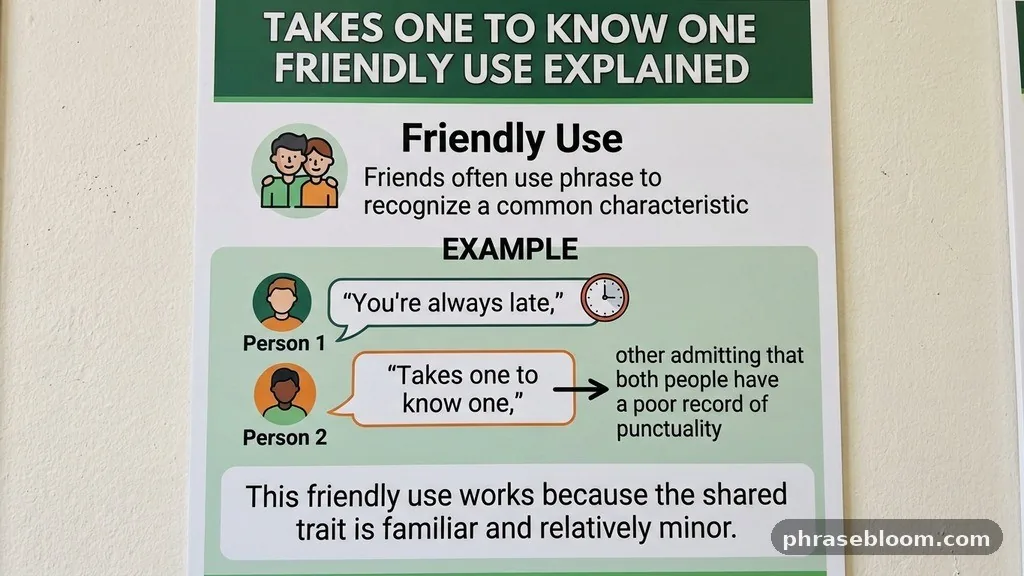
Friends often use the phrase to recognize a common characteristic. “You’re always late,” one person says. “Takes one to know one,” the other answers, admitting that both people have a poor rcord with punctuality.
Here, the phrase works because the shared trait is familiar and relatively minor. Neither speaker appears to be making a serious accusation.
Hostile use
In an argument, the same expression can imply, “You are no better than I am.” If the original criticism concerns cruelty, cheating, or dishonesty, the comeback carries a heavier negative connotation.
That difference matters in professional and public communication. A phrase that sounds witty among close friends may appear evasive or unprofessional in an email, meeting, or online discussion.
“Takes One to Know One” as a Comeback Phrase
As a comeback phrase, “takes one to know one” follows a familiar pattern found in many idioms. The speaker does not analyze the accusation; instead, they question the accuser’s ability to make it.
It is especially common after labels such as “liar,” “cheat,” “gossip,” “bully,” “show-off,” or “troublemaker.” These labels describe personal conduct, so the response suggests that the speaker recognizes the conduct through personal experience.
Consider this short exchange:
“You’re a gossip.”
“Takes one to know one.”
The second speaker may mean, “You know how gossip works because you gossip too.” The reply does not establish whether either person has actually spread rumors, which is why it is rhetorically effective but logically limited.
Another example is more playful:
“You’re obsessed with winning.”
“Takes one to know one.”
In that version, the comeback may signal mutual competitiveness. The speakers could be teasing one another rather than making a serious charge.
People also use shorter variations such as “It takes one to know one” or simply “Takes one to know one.” The longer version sounds slightly more complete, while the shortened form is common in quick conversation.
The phrase can be useful in fiction and dialogue because it reveals character quickly. A defensive character may use it to avoid answering a difficult question, while a humorous character may use it to admit an embarrassing similarity.
How Tone Changes the Meaning
The phrase’s dictionary-style meaning is only part of its practical meaning. In real conversations, listeners interpret facial expression, timing, relationship, subject matter, and emotional intensity along with the words.
A relaxed “Takes one to know one” after mild teasing can sound affectionate. The same phrase after an allegation of misconduct may sound like a serious counter-accusation.
Written messages create extra uncertainty. A text message containing only “takes one to know one” may be read as funny, irritated, dismissive, or aggressive because the reader cannot hear the speaker’s voice.
| Situation | Likely interpretation | Safer response if clarity matters |
|---|---|---|
| Close friends joking | Playful admission of a shared trait | Use the phrase with a light tone |
| Family teasing | Humorous recognition of similar behavior | Add a laugh or explain the shared habit |
| Workplace disagreement | Personal counterattack | Address the specific issue directly |
| Online argument | Sarcasm or escalation | State the evidence or concern plainly |
| Serious accusation | Denial without proof | Give a factual correction instead |
If you want to preserve the humor while reducing hostility, you can expand the response. “Maybe, but you’re not exactly innocent either” is still pointed, yet it makes the intended comparison clearer.
If you need to resolve a dispute, avoid relying on the idiom alone. A direct sentence such as “That claim is inaccurate because the report shows…” is more useful than a sarcastic response.
Examples in Everyday Conversation
Example sentences make the phrase easier to understand because its force changes according to the accusation and relationship between speakers. The following examples show several common uses.
Playful recognition
“You reorganized the entire kitchen again.”
“Takes one to know one. You color-code your bookshelves.”
This exchange treats both speakers as unusually organized. The phrase points to a shared trait, and the second sentence explains the joke.
Responding to a personal accusation
“You’re always trying to control the conversation.”
“Takes one to know one.”
Here, the response suggests that the accuser also tries to control discussions. The exact meaning depends on whether the speakers are teasing or genuinely angry.
Responding to a claim of dishonesty
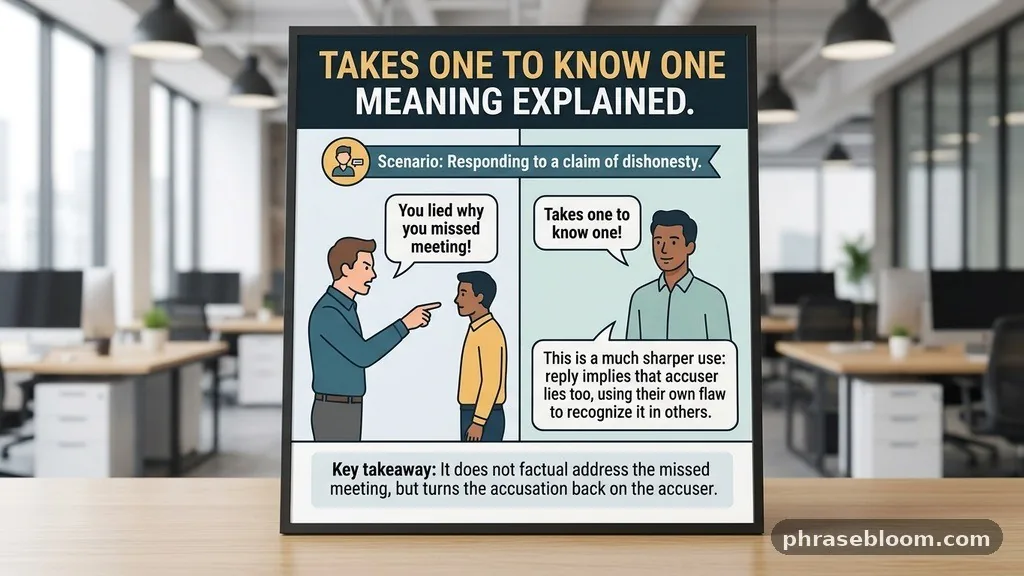
“You lied about why you missed the meeting.”
“Takes one to know one.”
This is a much sharper use. The reply implies that the accuser lies too, but it does not answer the factual question about the missed meeting.
Family conversation
“You inherited your grandfather’s stubbornness.”
“Takes one to know one.”
The phrase works here as a humorous observation about a shared family characteristic. It need not imply serious hypocrisy.
Workplace communication
“You’re being unnecessarily competitive about this presentation.”
“I may be competitive, but let’s compare the project requirements rather than trade insults.”
This second response avoids the idiom because professional communication often benefits from separating behavior from personal identity. The speaker could use “takes one to know one,” but doing so might make the disagreement more personal.
These examples show that the expression is flexible, but not universally suitable. Its usage is strongest in informal speech and dialogue, especially where the participants understand the intended tone.
Idiom Origin and Related Expressions
The exact idiom origin of “takes one to know one” is not always given as a single, universally accepted event. It belongs to a broader family of sayings built around the idea that recognition reveals familiarity.
The expression became established as a compact way to answer criticism with criticism. Its structure resembles older proverbial patterns in which people claim that only someone with a certain experience can identify it accurately.
That does not mean the phrase is logically true in every case. A person can identify dishonesty without being dishonest, recognize arrogance without being arrogant, or notice manipulation without using manipulation themselves.
Its power comes from rhetoric, not proof. The phrase makes the listener reconsider the speaker’s motives, credibility, or possible hypocrisy.
Similar idioms include “the pot calling the kettle black,” which criticizes someone for condemning a trait they also possess. “Look who’s talking” has a related function, especially when the speaker believes the critic is guilty of the same conduct.
- “The pot calling the kettle black”: focuses on hypocrisy and double standards.
- “Look who’s talking”: points out that the speaker lacks credibility on the subject.
- “Practice what you preach”: demands consistency between advice and behavior.
- “You’re one to talk”: dismisses criticism by highlighting the critic’s similar fault.
- “Birds of a feather flock together”: suggests that similar people associate with one another.
These expressions overlap, but they are not interchangeable in every context. “Takes one to know one” emphasizes recognizing a trait, while “the pot calling the kettle black” more directly emphasizes hypocrisy.
For a reliable reference on the phrase’s general sense and usage, consult this dictionary entry for “takes one to know one”.
When the Phrase Becomes Weak or Misleading
“Takes one to know one” can be rhetorically satisfying, but it may be weak as an argument. It assumes that recognition requires possession of the same trait, and that assumption is often false.
A teacher can identify plagiarism without plagiarizing. A supervisor can recognize repeated lateness without being late. A friend can notice that someone is angry without feeling angry at the same moment.
This is why the expression is sometimes described as a form of counter-accusation. It changes the subject from “Did I do this?” to “What about your behavior?” That shift may expose hypocrisy, but it can also avoid responsibility.
In a serious disagreement, ask whether the original claim needs an answer. If it does, a comeback may provide emotional satisfaction without resolving the issue.
When it is harmless
The idiom is usually harmless when the subject is trivial, the relationship is friendly, and both people understand the joke. Teasing about competitiveness, neatness, lateness, or a shared preference rarely carries major consequences.
When it causes trouble
The phrase becomes risky when it responds to allegations involving safety, harassment, discrimination, fraud, abuse, or professional misconduct. In those settings, a sarcastic response can seem evasive or retaliatory.
It can also be misleading when the two behaviors are not genuinely comparable. Calling someone out for a minor mistake is not equivalent to accusing them of a serious ethical violation.
Good communication requires proportion. A familiar idiom should not replace facts when the situation calls for facts.
Using the Phrase in Professional and Formal Writing
In professional writing, “takes one to know one” should be used sparingly. It is an informal idiomatic expression, so it may fit a transcript, fictional dialogue, informal team chat, or light internal exchange, but it rarely belongs in a formal report or official response.
Business emails can easily make the phrase sound hostile. If a colleague writes, “You’re making this project more complicated than it needs to be,” replying “takes one to know one” may invite a personal argument instead of solving the project problem.
A clearer response would identify the work issue. For example, “The extra review step was requested by compliance, so I’d like to confirm the requirement before removing it.”
Academic writing generally avoids the expression unless the writer is analyzing dialogue, rhetoric, popular speech, or figurative language. Formal prose usually states the underlying idea directly.
Instead of writing, “The critic says the author is biased, but takes one to know one,” an academic writer might write, “The criticism may reflect a similar bias in the reviewer’s own interpretation.”
There are still professional settings where the phrase can appear naturally. A company newsletter may quote an employee’s humorous remark, and a marketing campaign may use conversational language to create personality. The surrounding context should make the tone unmistakable.
- Use it freely in informal conversation when the relationship supports teasing.
- Use it carefully in workplace chats, where written tone can be misread.
- Explain or replace it in reports, policies, and formal correspondence.
- Avoid it as the only response to a serious accusation.
- Keep it in quotation marks when discussing the phrase as an expression.
How to Explain the Phrase Clearly
If you are defining “takes one to know one” for English learners, begin with the central idea: someone claims that the person who recognized a negative trait must share that trait.
Then provide a simple example. If Person A says, “You’re a liar,” and Person B says, “Takes one to know one,” Person B implies that Person A is also a liar or has enough experience with lying to recognize it.
It helps to explain that the phrase is often sarcastic. Sarcasm allows a speaker to say something whose intended force is different from the literal wording, usually by creating contrast between the surface statement and the implied criticism.
Next, explain that context matters. A person may use the idiom as a playful admission, a defensive reaction, or an aggressive counterattack.
Readers should also know that the phrase does not prove the shared trait exists. It is an accusation about the accuser, not independent evidence about the original accusation.
A concise explanation could read: “Takes one to know one” is an informal comeback meaning that a person recognizes a quality in someone else because they have that quality themselves. It often suggests hypocrisy or shared behavior, but its tone may be playful or hostile.
Common Mistakes in Usage
One common mistake is treating the expression as a factual rule. People can recognize behavior through observation, training, experience, or ordinary reasoning, so the idiom should not be read as a literal law about human knowledge.
Another mistake is using it to answer every criticism. Repeating the phrase whenever someone raises a concern can make the speaker appear unwilling to accept responsibility.
A third mistake is ignoring the difference between a shared trait and a shared situation. If two people both missed a deadline, that does not necessarily mean they share the same motives or level of responsibility.
Writers sometimes also confuse the phrase’s figurative meaning with a personal diagnosis. Saying “takes one to know one” does not establish that the other person has a psychological condition, fixed character flaw, or permanent identity.
| Common mistake | Why it causes trouble | Better approach |
|---|---|---|
| Using it during a serious allegation | It may sound evasive or retaliatory | Answer the specific claim with facts |
| Assuming it proves hypocrisy | The phrase is a suggestion, not evidence | Distinguish suspicion from proof |
| Using it with strangers | They may miss the intended humor | Choose a direct, neutral reply |
| Ignoring tone in writing | Short sarcasm can appear hostile | Add context or rewrite the sentence |
Another frequent problem is using the idiom without knowing whether the criticism is true. The response may feel clever, but it leaves the central issue unanswered.
In a conversation that matters, use the phrase only if the social purpose is clear. If you want to make a joke, make the joke obvious; if you want to resolve a dispute, explain your position.
Alternatives to “Takes One to Know One”
Several alternatives express related ideas with different levels of directness. The best choice depends on whether you want humor, confrontation, or calm clarification.
“Look who’s talking” is concise and familiar. It challenges the speaker’s credibility but does not specifically suggest that recognition requires shared behavior.
“You’re one to talk” is often sharper. It directly points out that the critic has a similar fault, so it can sound more confrontational.
“That sounds familiar” is softer and more indirect. It can suggest recognition of a shared habit without making the accusation explicit.
“We may have that in common” turns the exchange toward mutual acknowledgment. This version can reduce tension when the speaker wants to admit some similarity.
“Let’s focus on the issue rather than labeling each other” is the clearest professional alternative. It rejects the personal accusation and redirects attention to the subject under discussion.
- For friendly teasing, try “We may have that in common.”
- For mild sarcasm, try “Look who’s talking.”
- For a calm workplace reply, say “Let’s discuss the specific behavior.”
- For formal writing, describe the possible double standard directly.
- For conflict resolution, answer the claim instead of returning the insult.
Rewriting is often better than searching for a clever idiom. A sentence such as “You criticize my impatience, but you interrupted me three times” gives the listener something concrete to consider.
FAQ About “Takes One to Know One”
What does “takes one to know one” mean?
It means that a person can recognize a particular trait because they share it or have personal familiarity with it. The phrase is commonly used as a sarcastic comeback to criticism.
Is “takes one to know one” always an insult?
No. Friends and family may use it playfully to acknowledge a shared habit, such as competitiveness or stubbornness. During a serious argument, however, it can sound like a hostile counter-accusation.
Does the phrase prove that the accuser has the same trait?
No. It is a rhetorical response, not evidence. Someone can recognize dishonesty, arrogance, or manipulation without personally bhaving that way.
Is “takes one to know one” appropriate at work?
It can appear in informal workplace banter when the relationship and tone are clear, but it is risky in formal emails, reports, performance discussions, and conflict resolution. A factual and neutral response is usually safer.
What are good alternatives to the phrase?
“Look who’s talking,” “You’re one to talk,” and “We may have that in common” are related alternatives. In a serious conversation, “Let’s focus on the specific issue” is clearer and less confrontational.
Final Takeaway
“Takes one to know one” is an informal idiom meaning that recognition suggests a shared trait. It can be a playful joke, a sarcastic response, or an accusation of hypocrisy, and its effect depends heavily on tone, relationship, and subject matter.
Use it casually when the humor is clear, but choose direct language in professional or serious situations. Once you understand the phrase’s figurative meaning and limits, you can recognize whether a speaker is admitting similarity, challenging an accusation, or simply turning criticism back on its source.
You may also like: Cord vs Chord: Meaning, Origin and Usage · Having vs Having Had: Meaning and Usage
3 thoughts on “Takes One to Know One: Meaning, Origin & Usage”