
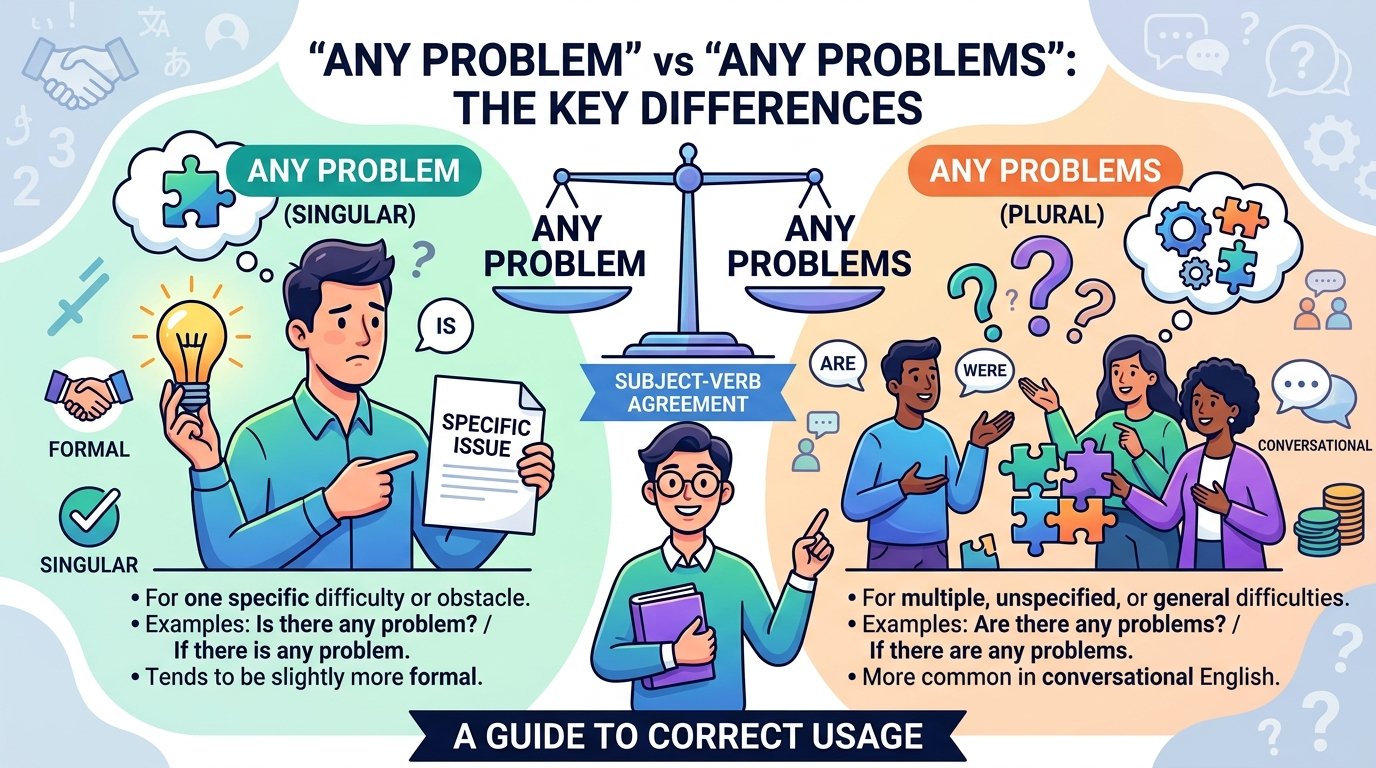
Choosing between any problem and any problems can feel confusing, especially because both expressions are grammatically correct. The difference is not simply about singular versus plural grammar. It also depends on context, meaning, formality, and what you expect the listener to understand.
In everyday English, you will often hear people ask, “Are there any problems?” However, in formal writing or when referring to one particular issue, “Is there any problem?” may be more suitable.
So, which one should you use?
The short answer is that both are correct. The better choice depends on whether you are referring to one possible issue or several possible issues and whether your situation is formal or conversational.
Any Problem or Any Problems: Why Does the Confusion Exist?
The confusion mainly comes from the word “any.” Unlike words that clearly indicate quantity, such as “one” or “several,” any can work with both singular and plural countable nouns.
For example:
- Is there any problem with the order?
- Are there any problems with the order?
Both sentences are grammatically possible, but they create slightly different impressions.
The singular version focuses on one possible issue. The plural version opens the discussion to several possible concerns.
English speakers also tend to prefer different forms depending on the situation. In casual conversation, “any problems” often sounds more natural. In formal writing, “any problem” can sound more precise, particularly when a specific issue is being considered.
Why It Matters in Professional Settings
Correct subject-verb agreement becomes especially important in professional communication.
Consider these examples:
Is there any problem with the software?
Here, “problem” is singular, so “is” agrees with it.
Now compare:
Are there any problems with the software?
Because “problems” is plural, “are” is required.
A common grammatical error is:
Is there any problems with the software?
This combines a singular verb with a plural noun. Native speakers immediately notice the mismatch.
Professional emails, reports, customer service messages, and workplace communication benefit from choosing the correct structure because small grammar mistakes can make otherwise clear writing look careless.
See Also: “A Hilarious or An Hilarious”: Understanding the Difference
Any Problem or Any Problems: Which One Is Correct?
Both any problem and any problems are correct English.
The important question is what you want to communicate.
Use any problem when your attention is directed toward one particular issue or when the wording has a formal, precise tone.
For example:
Please contact us if you encounter any problem with the installation.
Here, the writer is treating a problem as one possible obstacle.
Use any problems when you are asking about issues generally or when several difficulties could potentially exist.
For example:
Please let us know if you experience any problems during installation.
This version sounds more open-ended and conversational.
Therefore, the difference between any problem and any problems is mainly connected to number, emphasis, and context rather than basic correctness.
You can remember the general pattern this way:
Singular: any problem → is / was
Plural: any problems → are / were
What Does “Any Problem” Mean? Definition and Usage
Definition of Any Problem
Any problem refers to one possible difficulty, obstacle, fault, or concern.
The noun “problem” is a countable noun, so it has both singular and plural forms. When you use the singular form after “any,” the sentence normally focuses on an individual possible issue.
For example:
Is there any problem with your account?
The speaker is checking whether a problem exists.
Another example is:
Let me know if you have any problem with the deadline.
The sentence focuses on a possible specific difficulty.
The singular form can therefore communicate precision. It is particularly useful when the conversation already has one specific task, object, or situation in mind.
See Also: Soft Guy Era Drizzle Drizzle Meaning: Understanding the Difference
Origins of the Word “Problem”
The English word “problem” ultimately comes from the Greek word problema, which referred to something put forward as a question, task, or challenge. It entered English through French and Latin influences.
Today, “problem” has a broad meaning. It can describe anything from a minor inconvenience to a serious difficulty.
For example, people can talk about a technical problem, financial problem, personal problem, mathematical problem, or workplace problem.
Its meaning changes according to context, but its grammatical behavior remains straightforward: “problem” is singular, while “problems” is plural.
Why “Any Problem” Is Used in Formal English
Formal English often values concise and precise wording. As a result, any problem can work particularly well when the writer has one specific matter in mind.
For example:
Please notify the administrator if there is any problem with your application.
This sentence sounds professional because it identifies a possible issue without suggesting that many separate problems are expected.
Still, formal writing does not require the singular form every time. If multiple issues are genuinely possible, any problems is perfectly acceptable.
Exploring “Any Problems” in Everyday English
Any problems is extremely common in conversational English.
When someone asks:
Did you have any problems?
They are usually not asking you to identify one specific difficulty. Instead, they are asking whether you experienced difficulties of any kind.
That makes the plural form useful for general questions.
You might hear:
Did you have any problems finding the hotel?
Or:
Are you having any problems with your computer?
The plural form feels natural because the speaker does not know what type or number of difficulties might have occurred.
In modern conversational English, this open-ended meaning makes “any problems” especially common.
Any Problem vs Any Problems: Side-by-Side Comparison
| Feature | Any Problem | Any Problems |
|---|---|---|
| Number | Singular | Plural |
| Noun | Problem | Problems |
| Typical verb | Is / was | Are / were |
| Main focus | One possible issue | Multiple or unspecified issues |
| Tone | More precise or formal | More conversational |
| Common setting | Professional writing | Everyday conversation |
| Example | Is there any problem? | Are there any problems? |
| Meaning | One possible difficulty | One or more possible difficulties |
This table shows why neither form should automatically be labeled “wrong.”
Instead, think about the intended meaning and context.
Common Mistakes with Any Problem and Any Problems
One of the biggest mistakes involves using the wrong verb with the noun.
Incorrect:
Is there any problems?
Correct:
Are there any problems?
The reason is simple. “Problems” is plural, so it requires the plural verb “are.”
Another common mistake involves the contraction “there’s.”
Incorrect:
If there’s any problems, tell me.
“There’s” means “there is,” which normally introduces a singular noun in this structure.
A clearer version is:
If there are any problems, tell me.
However, you may also see “there’s” used informally before plural nouns in speech. That usage occurs in real-world English, but it is best avoided in careful formal writing.
Another mistake is choosing “any problem” when the context clearly involves multiple possible difficulties.
For example:
Did you face any problem during your three-day journey?
Although understandable, the plural form usually sounds more natural:
Did you face any problems during your three-day journey?
The longer and more open-ended the situation, the more naturally the plural form may fit.
When to Use Any Problem vs Any Problems
Use any problem when the situation points toward one specific issue.
For example:
Let me know if there is any problem with the payment.
This can work well when the payment itself is the specific matter under discussion.
On the other hand, use any problems when you are inviting someone to mention difficulties generally.
For example:
Let me know if there are any problems with the payment process.
This version allows the person to report one issue, several issues, or different types of concerns.
The distinction is therefore not absolute. Any can refer to one or more, depending on the noun and context.
That is why both forms can be grammatically sound.
Everyday Examples of Any Problem and Any Problems
Here are natural examples across different situations.
Professional email:
Please contact our support team if you encounter any problem with the software installation.
The singular form gives the message a precise, formal tone.
Everyday conversation:
Did you have any problems finding the restaurant?
The plural form sounds natural because the speaker is asking generally about the person’s experience.
Customer service:
Please tell us if there are any problems with your purchase.
The company is inviting the customer to report any concerns.
Workplace communication:
Let me know if there is any problem with the deadline.
The discussion focuses on one specific deadline.
Text message:
Everything okay? Any problems?
This short question is casual and open-ended, so the plural form feels natural.
“How to Spell Any Problem or Any Problems” and Remember the Correct Form
If you are searching for how to spell “any problem or any problems”, the spelling itself is simple:
- any problem — singular
- any problems — plural
The real challenge is not spelling. It is choosing the appropriate grammatical form.
Remember that “problem” needs no extra ending when it is singular. When you are talking about more than one problem, add -s to form “problems.”
More importantly, match the verb to the noun:
Is there any problem?
Are there any problems?
This simple connection can prevent many common grammar mistakes.
Practice Sentences
Try completing these sentences with problem or problems.
A. Is there any ______ with the printer?
B. Are there any ______ with the new system?
C. Please tell me if there is any ______ with my application.
D. Did you have any ______ during your trip?
E. If there are any ______, contact customer service.
Answers: A: problem, B: problems, C: problem, D: problems, E: problems.
Quick Grammar Challenge
Now choose the more natural option in each situation.
1. Your friend asks whether your journey was difficult.
“Did you have any problem?”
“Did you have any problems?”
The second option is more natural because the question is general.
2. Your manager is discussing one particular deadline.
“Is there any problem with the deadline?”
“Are there any problems with the deadline?”
The first option can work especially well when the focus is one specific concern.
3. A customer wants to report difficulties with an order.
“Are there any problems with your order?”
The plural form is a natural, open invitation to discuss concerns.
This kind of exercise helps you understand the grammar through context instead of memorizing a rigid rule.
Literature and Media Mentions: Correct Usage of Any Problem and Any Problems
In books, articles, television dialogue, and online communication, both forms appear.
Formal characters or professional situations may use singular constructions such as:
Is there any problem with the plan?
Meanwhile, casual dialogue commonly favors:
Are there any problems?
The difference reflects how people naturally adjust language to their audience.
Modern English is flexible, so frequency and naturalness matter alongside traditional grammar rules. A phrase can be grammatically possible while another phrase is more idiomatic in everyday speech.
That distinction is valuable for English learners. Learning grammar is not only about identifying what is technically correct. It is also about understanding what sounds natural in a particular situation.
Frequently Asked Questions About Any Problem or Any Problems
Is “any problem” grammatically correct?
Yes. “Any problem” is grammatically correct when referring to one possible issue, especially in specific or formal contexts.
Is “any problems” grammatically correct?
Yes. “Any problems” is grammatically correct and commonly used when discussing multiple possible issues or asking general questions.
Why does “any problems” sound more natural?
“Any problems” often sounds more natural because everyday questions usually invite people to mention one or more possible difficulties.
Is “if there’s any problems” correct?
In careful standard English, use “if there are any problems.” “There’s” means “there is” and does not agree with plural “problems.”
How do I know which one to use?
Consider context. Choose “any problem” for one specific issue and “any problems” for general questions or multiple possible concerns.
Conclusion: Any Problem or Any Problems Made Simple
Both any problem and any problems are correct, but they serve slightly different purposes. The singular form usually highlights one possible issue and can sound precise or formal. The plural form commonly refers to multiple or unspecified difficulties and often sounds more natural in everyday conversation.
The key is to consider context rather than memorize one rigid rule. Remember the connection between the noun and verb: any problem pairs with “is” or “was,” while any problems pairs with “are” or “were.” With regular practice, you can recognize which form sounds appropriate quickly. Once you understand how any, singular and plural nouns, and subject-verb agreement work together, choosing between the two becomes much easier.
Related reading: IONK Meaning in Text, ILY Meaning in Text, NMMS Meaning in Text.
9 thoughts on “Any Problem or Any Problems: Understanding the Difference”