
Of Course vs Ofcourse: Which Is Correct?
The correct spelling is of course, written as two separate words. “Ofcourse” is a common misspelling, although readers may recognize what it means. In the Of Course vs Ofcourse question, the answer is simple for standard English grammar: use “of course” in professional, academic, and everyday writing.
“Of course” is usually an adverbial phrase that means “certainly,” “naturally,” or “as expected.” It can also introduce a reply, show agreement, or add polite emphasis. The examples below explain its punctuation, tone, and position in a sentence so you can use the phrase confidently rather than relying only on autocorrect or a spell-checker.
Of Course or Ofcourse: The Direct Answer
Of course is the correct spelling. It is a two-word phrase, not a single compound word, so formal writing should not combine it into “ofcourse.”
| Form | Correct? | Meaning | Typical use |
|---|---|---|---|
| of course | Yes | Certainly, naturally, or as expected | Standard English usage in all kinds of writing |
| ofcourse | No | Intended to mean “of course” | Common misspelling or typing error |
| Of Course | Sometimes | The same phrase, with capitalization | At the beginning of a sentence or in a title |
The phrase remains two words even when it functions as an adverbial phrase. An adverbial phrase is a group of words that gives information about a verb, adjective, another adverb, or the whole sentence.
For example, “She will of course attend the meeting” means that her attendance is expected. In “Of course, she will attend the meeting,” the phrase comments on the entire statement and is usually followed by a comma.
The basic rule is easy to remember: write “of course,” never “ofcourse,” unless you are deliberately discussing the misspelling itself. This rule applies to business emails, reports, essays, websites, text messages, and ordinary conversation written down.
What “Of Course” Means
“Of course” has several closely related meanings, but its central idea is certainty or natural expectation. A person may use it to say “certainly,” to confirm that something is acceptable, or to suggest that an answer should be obvious from the context.
- Agreement: “Of course I can send the revised file.”
- Permission: “Of course, you may use the conference room.”
- Expected information: “The deadline is, of course, listed in the project brief.”
- Natural result: “Of course, the results changed after the sample size increased.”
- Polite reassurance: “Of course we can discuss the proposal again.”
In each example, “of course” modifies the surrounding statement rather than naming a person, object, or action. That is why treating it as a noun or a compound word creates grammatical confusion.
The phrase can sound warm and cooperative, but tone depends heavily on placement and context. “Of course, I’ll help” often sounds friendly, while “You knew that, of course” can sound impatient or sarcastic if the speaker stresses the phrase.
Meaning also changes slightly with punctuation. A comma can make “of course” sound like a separate comment, while a sentence without a comma can make it feel more closely connected to the verb.
Why “Ofcourse” Is Not the Correct Spelling
“Ofcourse” appears because English contains many closed compounds, such as “without,” “already,” and “maybe.” Writers sometimes assume that two frequently used words will eventually merge into one, but frequency alone does not determine standard spelling.
“Of course” has remained an established two-word phrase in modern English. Major dictionaries, including Merriam-Webster, Cambridge Dictionary, and the Oxford English Dictionary, record it in that form rather than as “ofcourse.”
The mistake often happens during fast typing. The words are pronounced closely together in natural speech, and a writer may reproduce that sound as one unit. Autocorrect can also introduce problems if a device learns an unusual spelling from repeated informal messages.
In formal writing, “ofcourse” signals a proofreading problem. It may not prevent readers from understanding the sentence, but it can reduce confidence in a report, application, client email, or academic assignment.
Consider these corrections:
| Incorrect | Correct | Reason |
|---|---|---|
| Ofcourse, the invoice was paid. | Of course, the invoice was paid. | The phrase is written as two words. |
| We can ofcourse revise the schedule. | We can of course revise the schedule. | The adverbial phrase remains separate after the verb. |
| She understood the instructions ofcourse. | She understood the instructions, of course. | A closing comment is set off with a comma. |
A spell-checker will catch “ofcourse” in many applications, but software is not a substitute for knowing the correct spelling. Some programs may overlook the error if a custom dictionary contains it, and informal platforms do not always check grammar accurately.
Grammar and Position in a Sentence
“Of course” is commonly an adverbial phrase. It can appear at the beginning, middle, or end of a sentence, although punctuation and tone may change with its position.
At the beginning
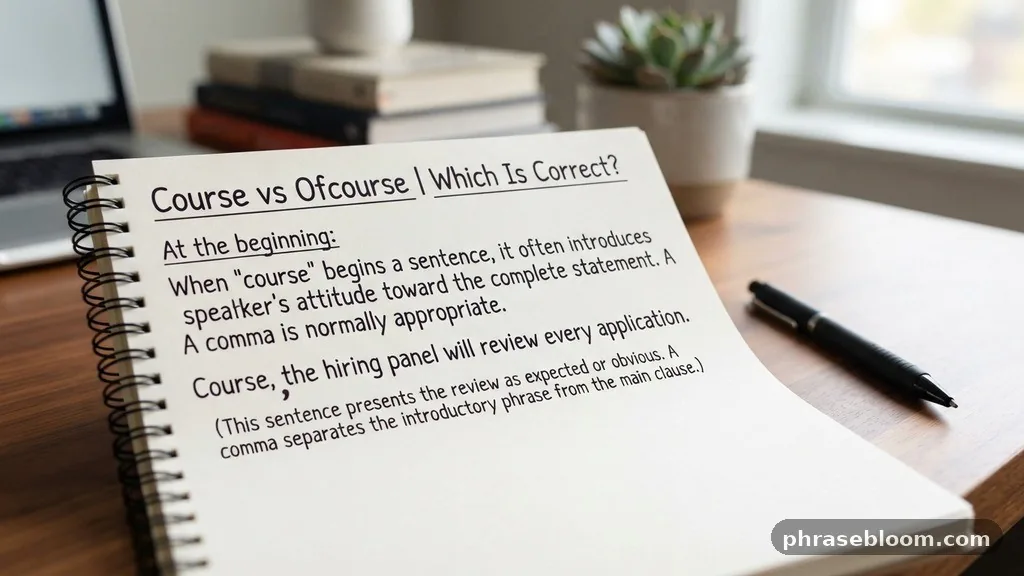
When “of course” begins a sentence, it often introduces the speaker’s attitude toward the complete statement. A comma is normally appropriate.
Of course, the hiring panel will review every application.
This sentence presents the review as expected or obvious. The comma separates the introductory phrase from the main clause, making the sentence easier to read.
In the middle
In the middle of a sentence, “of course” may be enclosed by commas when it acts as an aside.
The hiring panel will, of course, review every application.
The sentence still works without the phrase: “The hiring panel will review every application.” That test shows that “of course” is supplementary information rather than an essential part of the grammar.
Sometimes the phrase is closely connected to the verb and does not need two commas, especially in a less formal sentence. For example, “You can of course contact the support team” is understandable and common, but “You can, of course, contact the support team” gives the phrase clearer separation.
At the end
At the end of a sentence, “of course” often adds emphasis or a reminder.
The updated contract must be signed by Friday, of course.
This placement can sound conversational. In business writing, it may be better to state the deadline directly if the phrase adds attitude without useful information.
The phrase is not a noun. You should not write “an of course” or use “of course” as the name of a thing. It is also not normally converted into an invented adverb such as “ofcourse-ly” or “ofcoursely.”
Punctuation and Tone in Professional Writing
Correct spelling is only part of effective English usage. Punctuation helps readers understand whether “of course” is central to the sentence or an added comment.
Use a comma after an introductory “of course” in most standard prose:
- Of course, the finance team needs the receipts.
- Of course, employees may request a private meeting.
- Of course, the final figures depend on the audit.
When the phrase appears inside a sentence as an interruption, use commas around it:
- The finance team will, of course, need the receipts.
- Employees may, of course, request a private meeting.
- The final figures are, of course, subject to the audit.
However, punctuation should reflect meaning rather than operate as a mechanical rule. If “of course” is integrated closely into the sentence, some writers omit the commas, particularly in informal writing.
Compare the following sentences:
You can of course submit the form tomorrow.
You can, of course, submit the form tomorrow.
Both are understandable and grammatically defensible. The second version gives “of course” more vocal emphasis and is often preferable in careful formal writing, while the first is lighter and more conversational.
In workplace communication, consider whether the phrase improves the message. “Of course” can soften a response, but it can also imply that a question was unnecessary. “Of course you may apply” sounds welcoming; “That is of course incorrect” may sound dismissive.
For sensitive employee announcements, direct wording is usually safer. “Employees may request an accommodation through Human Resources” is clearer and less open to an unintended tone than “Employees can, of course, request an accommodation.”
Of Course in Formal and Informal Writing
The phrase is acceptable in nearly every register of English. Register means the level of formality or style appropriate to a situation. You may use “of course” in casual conversation, formal reports, academic writing, customer service messages, and public communication.
The main difference is not whether the phrase is allowed, but whether it is necessary and how it sounds. In a friendly email, it can create warmth. In a legal agreement, it may be unnecessary because legal drafting usually favors precise statements over conversational reassurance.
| Context | Natural example | Style consideration |
|---|---|---|
| Business email | Of course, I can send the revised figures this afternoon. | Polite and cooperative |
| Academic writing | The result is, of course, limited by the available data. | Acceptable, but remove it if it adds no analytical value |
| Policy document | Employees must complete the course before accessing the system. | Direct wording is often better than adding “of course” |
| Customer support | Of course, we can help you update the billing address. | Reassuring and service-oriented |
| Conversation transcript | “Of course,” Maya said. “I’ll join the call.” | Natural dialogue and punctuation |
In academic writing, the phrase may be useful when marking an assumption or acknowledging an obvious limitation. Still, repeated use can make an argument sound casual or overly certain. A writer should decide whether “of course” contributes meaning or merely fills space.
In formal writing, avoid using it to pressure the reader into agreement. Statements such as “Of course, the proposal is the only reasonable option” present an opinion as if disagreement were foolish. A more objective sentence would identify the evidence supporting the proposal.
Professional tone comes from the whole sentence, not from spelling alone. Writing “of course” correctly does not make an unclear or overly forceful message clear.
Sentence Examples You Can Copy and Adapt
The following examples show how “of course” works in common situations. Each sentence uses the correct two-word spelling and reflects natural workplace or everyday English.
Business emails
Of course, I can review the draft before Thursday.
This opening gives a positive answer and makes the response sound cooperative. If the message is highly formal, “I can review the draft before Thursday” is more direct.
Company policies
The policy applies to contractors, of course, as well as full-time employees.
Here, the phrase emphasizes an additional point. If the policy must be exact, state the coverage directly and remove the aside.
Training and onboarding
New hires can, of course, ask questions during the safety training.
The sentence reassures employees that questions are welcome. In an official training instruction, “New hires may ask questions during the safety training” may be more concise.
Internal communications
Of course, the office will remain open during the system upgrade.
The introductory phrase signals that the information should reassure employees. The main clause provides the actual operational detail.
Reports
The comparison is, of course, based on data from the first quarter only.
This wording highlights a limitation. A more neutral report might say, “The comparison is based on first-quarter data only,” which presents the fact without commentary.
Organizational changes
Managers will, of course, receive additional guidance before the new structure takes effect.
The sentence suggests that guidance is expected as part of the change. If that guidance is mandatory, “Managers will receive additional guidance” is stronger and clearer.
Marketing and public communication
Of course, customers may contact our support team before placing an order.
This line sounds approachable and removes hesitation. Marketing writers should still check whether the phrase matches the brand’s tone and does not sound patronizing.
Technology rollouts
The new software will, of course, require employees to reset their passwords.
The phrase presents the password reset as an expected security step. A technical notice may omit it and give the deadline and instructions instead.
Meetings and benefits announcements
Of course, the benefits team will explain the enrollment deadline during Friday’s meeting.
This example reassures employees that they will receive an explanation. It works well in an announcement, but the deadline itself should also be stated clearly.
Common Mistakes and Better Corrections
Most errors involving this phrase are simple spelling or punctuation problems. A few others involve tone, grammar, or unnecessary repetition.
| Common mistake | Better version | Explanation |
|---|---|---|
| Ofcourse, we approved the request. | Of course, we approved the request. | Use two words. |
| We will ofcourse respond soon. | We will, of course, respond soon. | Keep the phrase separate and punctuate the aside clearly. |
| She explained the process ofcourse. | She explained the process, of course. | A closing comment may need a comma. |
| The manager was an of course. | The manager agreed, of course. | “Of course” is not a noun. |
| We ofcourse-ly followed the rule. | We followed the rule, of course. | Do not invent an adverb from the phrase. |
| Of course, obviously, the file was late. | Obviously, the file was late. | Remove overlapping expressions. |
Another mistake is confusing “of course” with “course.” The noun “course” can mean a class, route, direction, or part of a meal. In “She enrolled in a course,” it has a completely different function from the phrase “Of course, she enrolled.”
Writers sometimes capitalize the phrase unnecessarily in the middle of a sentence. Use “Of Course” at the beginning of a sentence or in a title, but normally write “of course” elsewhere.
Consistency also matters. A document that contains “of course” in one paragraph and “ofcourse” in another looks unedited, even if the intended meaning is obvious. Run a search for “ofcourse” during proofreading, then check whether punctuation supports the intended tone.
How Dictionaries and Reference Tools Help
Dictionaries are useful because they show established spelling, pronunciation, part of speech, definitions, and sentence patterns. Searching for “of course” in a reputable reference work confirms that the standard form contains a space.
The Merriam-Webster entry for “of course” is a useful reference when you want to verify its definition and usage. Dictionary entries can settle the spelling question, but they cannot decide whether the phrase belongs in every sentence.
Style guides answer a different question. They help writers choose punctuation and tone for a particular setting, such as journalism, academic work, government communication, or corporate writing.
Autocorrect and spell-checker tools are helpful for catching “ofcourse,” especially in long documents. Still, a tool may not identify a tone problem, unnecessary repetition, or a comma that changes the rhythm of a sentence.
- Use a dictionary to verify the correct spelling and meaning.
- Use a style guide to check punctuation and formality.
- Use a spell-checker to catch repeated typing errors.
- Read the sentence aloud to test tone and emphasis.
- Search the finished document for “ofcourse” before publishing.
These steps are especially useful for professional writing because small errors can distract from an otherwise strong message. A final human review remains valuable, even when software reports that the document contains no spelling errors.
When to Rewrite Instead of Using “Of Course”
Correct usage does not mean every sentence needs the phrase. Sometimes “of course” adds a helpful attitude, but sometimes it makes a statement weaker, less precise, or more sarcastic than intended.
Compare these pairs:
- Of course, employees must submit the form.
Better for a reassuring explanation: Employees must submit the form by Friday. - The results are, of course, preliminary.
More neutral: The results are preliminary. - Of course, customers can request a refund.
More precise: Customers can request a refund within 30 days. - You can, of course, contact the manager.
More direct: You can contact the manager with any questions.
The revised versions remove attitude and add direct information. That can be preferable in policies, legal documents, instructions, and reports where readers need an exact rule rather than reassurance.
Keep “of course” when it contributes a genuine conversational purpose. It can acknowledge an expected result, welcome a request, soften a reply, or connect a new point to shared knowledge.
Remove it when it merely repeats information, sounds patronizing, or implies that disagreement is unreasonable. Clear professional writing does not need to sound forceful to sound confident.
Of Course in Conversation, Dialogue, and Punctuation
In dialogue, “of course” is often a complete response. It can stand alone when the context already makes the subject and action clear.
“Could you send me the address?”
“Of course.”
Here, the phrase means “certainly” or “yes.” It is not necessary to repeat the entire sentence because the question supplies the missing information.
It can also appear before a direct statement:
“Of course I remember the client,” Jordan said.
There is no automatic comma between “course” and “I” in this version because the phrase is closely connected to the following clause. If the speaker is using it as an introductory aside, the punctuation may change:
“Of course, I remember the client,” Jordan said.
Both versions can be correct, but they have slightly different rhythms. The comma makes “of course” sound more detached, while the version without the comma makes the certainty more closely connected to “remember.”
In fiction and transcripts, punctuation should help represent the speaker’s intended pause. In business writing, punctuation should make the sentence easy to process on the first reading.
Frequently Asked Questions
Is “of course” or “ofcourse” correct?
Of course is correct. It is written as two words, while “ofcourse” is a common misspelling.
Is “of course” formal?
It can be used in formal writing, but it is not automatically formal. Its tone depends on context, punctuation, and whether the phrase adds useful meaning.
Should “of course” have a comma?
Usually use a comma after an introductory “Of course” and commas around a clear mid-sentence aside. When the phrase is closely connected to the verb, punctuation may be lighter.
Can “of course” stand alone?
Yes. In conversation or dialogue, “Of course” can be a complete answer meaning “certainly” or “yes.”
Why do people write “ofcourse”?
It is usually a typing error caused by fast speech, fast writing, or autocorrect behavior. Standard dictionaries and English usage treat “of course” as the correct two-word form.
Conclusion
The Of Course vs Ofcourse question has a clear answer: write of course as two words. It is an adverbial phrase meaning “certainly,” “naturally,” or “as expected,” and it works in casual conversation, workplace communication, academic writing, and formal documents.
Before publishing, check the spelling, review the commas, and decide whether the phrase adds useful tone or information. If a sentence sounds dismissive or vague, rewrite it more directly. A quick search for “ofcourse” and a careful read aloud will prevent the most common errors.
Related: Any Problem or Any Problems · Run Like the Wind · How to Use “My Question Is” Correctly
Explore more on PhraseBloom.