
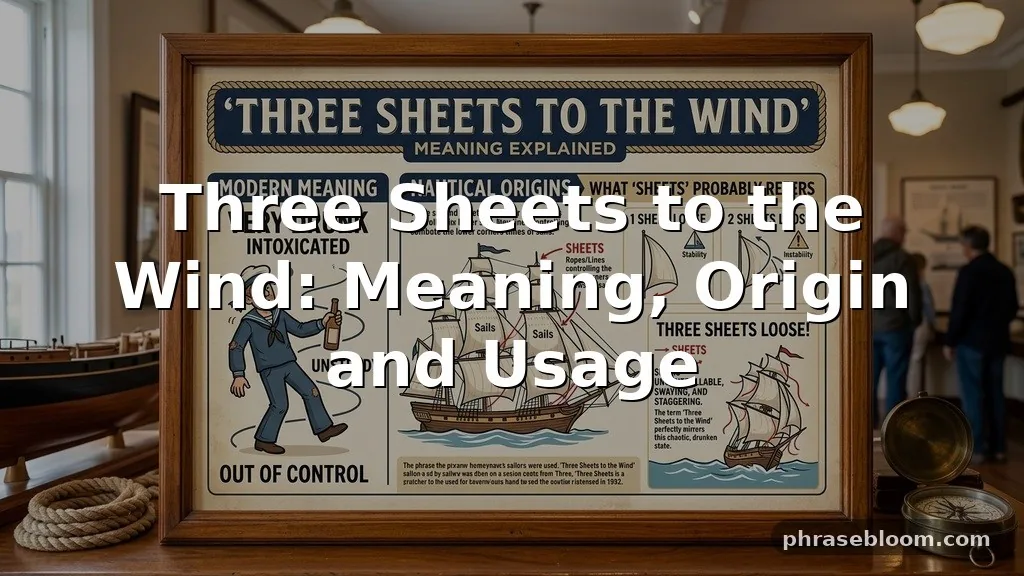
Three Sheets to the Wind: Meaning, Origin and Usage
The expression Three Sheets to the Wind means noticeably drunk or heavily intoxicated. It usually describes someone whose balance, speech, or judgment has been affected by alcohol, often in a humorous or informal way. The phrase comes from nautical terminology, although its exact maritime origin remains uncertain.
You’ll see this alcohol-related expression in novels, films, historical writing, and conversational English. This article explains the idiom meaning, examines the sailing connection, compares related synonyms, and shows how to use “three sheets to the wind” without making the sentence sound forced or outdated.
What “Three Sheets to the Wind” Means
When someone is described as three sheets to the wind, the speaker means that the person is drunk or seriously affected by alcohol. The phrase can suggest more than mild drinking. It often paints a picture of someone unsteady, loud, confused, or unable to behave normally.
For example, “By midnight, he was three sheets to the wind” means that he was visibly intoxicated by midnight. The statement does not necessarily describe alcohol poisoning or a medical emergency, but it does indicate a substantial level of drunkenness.
The idiom is generally informal. It can sound playful in a story about friends, but it may seem inappropriate in a medical report, workplace document, police statement, or other setting where precision matters.
| Expression | Basic meaning | Tone | Typical use |
|---|---|---|---|
| Three sheets to the wind | Very drunk or heavily intoxicated | Informal, colorful | Conversation, fiction, humorous description |
| Tipsy | Slightly affected by alcohol | Light, mild | Casual conversation |
| Intoxicated | Affected by alcohol or another substance | Neutral or formal | Reports, policies, professional writing |
| Inebriated | Drunk | Formal or literary | Formal prose, legal or historical contexts |
| Wasted | Extremely drunk or high | Slang | Very informal speech |
The phrase normally refers to alcohol, but the surrounding context can affect its force. A comic character may be called three sheets to the wind after several drinks, while a serious account might use “heavily intoxicated” to avoid the idiom’s humorous edge.
For a concise reference definition, the Merriam-Webster entry for “three sheets to the wind” is a useful starting point. Dictionary definitions confirm the central point: this is an idiom for drunkenness, not a literal description of a ship’s sails.
Why the Phrase Uses Nautical Language
The words “sheets,” “wind,” and “sail” belong to the language of sailing. In nautical usage, a sheet is a rope or line used to control the lower corner of a sail. It does not mean a piece of bedding.
A sheet rope helps a sailor adjust the position of a sail in relation to the wind. If the line is loose, the sail may flap, hang badly, or fail to help the ship move efficiently. That image provides the foundation for the idiom’s meaning.
A vessel with poorly controlled sails might move erratically. It could veer, stagger, or drift instead of traveling in a steady direction. The comparison with a drunken person is easy to recognize: both may appear unstable, disorganized, and difficult to control.
The phrase’s maritime imagery also explains why “wind” appears in the expression. Wind fills a sail and affects a ship’s movement, while alcohol affects a person’s balance and judgment. The idiom joins those two ideas in a memorable picture.
Not every explanation of the phrase agrees on exactly how three loose sails produced the expression. Some accounts imagine a ship with several sheets trailing in the wind.
Others connect “three sheets” with increasing degrees of drunkenness. The broad sailing comparison is well established, but the precise route from nautical image to alcohol-related expression is less certain.
- Sheet: a rope used to control a sail.
- Wind: the force that fills and moves a sail.
- Loose sails: a visual image of disorder or instability.
- Unsteady ship: the comparison that supports the idiom’s connection with drunkenness.
That uncertainty is common with old idioms. Their imagery can survive for centuries even when speakers no longer know the original technical setting. Today, many people use “three sheets to the wind” without knowing anything about sailing.
The Maritime Origin and Historical Development
The phrase is commonly explained through maritime origin, but a careful account should distinguish a plausible explanation from a proven one. Historical dictionaries and language references connect the expression with the behavior of sails or sheets in strong wind, yet the exact first use and earliest intended image are not always presented identically.
Some explanations describe a ship with three sheets loose, leaving its sails uncontrolled. Others suggest that the phrase developed from earlier expressions in which one, two, or three sheets represented different levels of disorder. These interpretations share the same basic metaphor, even if they do not establish a single certain invention story.
The phrase belongs to a family of expressions that use ships and sailing to describe human behavior. English has long borrowed nautical terminology for ordinary life because ships provided vivid examples of direction, control, danger, and instability.
“Three sheets to the wind” probably became more understandable to a wider audience as the technical origin faded. A modern listener may not know how to rig a sail, but the idea of something being blown about by the wind remains clear. The phrase therefore retains its expressive force even outside maritime communities.
It is also important not to confuse this idiom with a claim that sailors invented every form of drinking slang. Historical language changes through repetition, humor, regional use, and reinterpretation. A phrase can acquire a new meaning after speakers begin using an older image in a different context.
The spelling and wording have also appeared in slightly different forms. “Three sheets to the wind” is now the familiar version, but historical language often varies in articles, verb forms, and related expressions. Such variation does not change the central meaning.
What “sheets” probably refers to
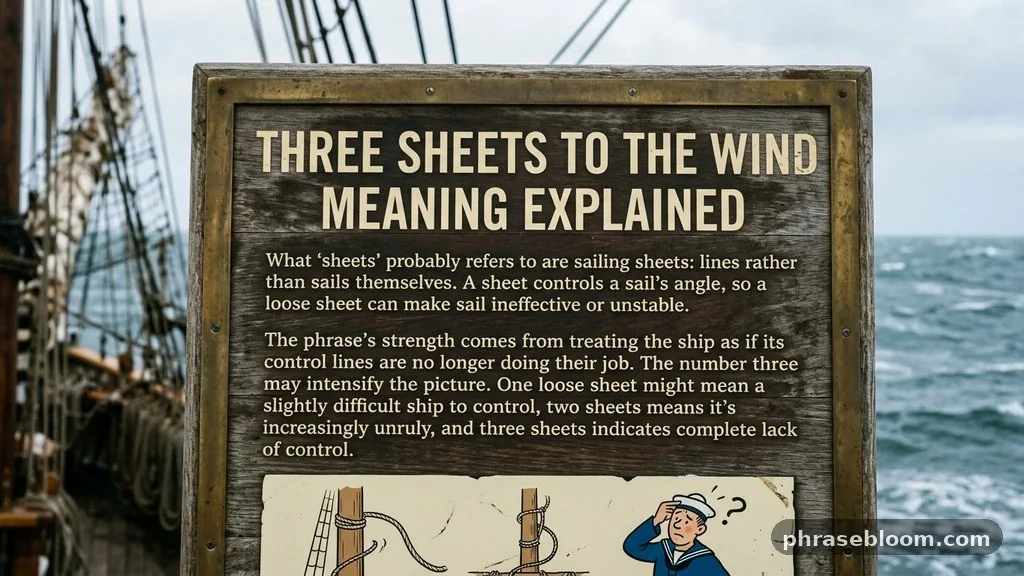
In sailing, sheets are lines rather than sails themselves. A sheet controls a sail’s angle, so a loose sheet can make the sail ineffective or unstable. The phrase’s strength comes from treating the ship as if its control lines are no longer doing their job.
The number three may intensify the picture. One loose sheet might create a problem, while several loose sheets suggest a vessel in considerable disorder. Whether that numerical progression was the original mechanism or a later interpretation remains difficult to establish with complete confidence.
Why the exact origin is debated
Idioms are rarely recorded at the instant they are created. By the time a phrase appears in print, people may already have used it orally for years. That makes it difficult to prove which sailor, writer, or community first gave the expression its alcohol-related meaning.
A responsible explanation therefore says that “three sheets to the wind” has a nautical image associated with loose or uncontrolled sails, while acknowledging that the detailed origin story is not perfectly settled.
How to Use the Idiom in a Sentence
“Three sheets to the wind” usually functions as a descriptive phrase after a linking verb or as part of a clause describing someone’s condition. The person does not literally become a ship. The expression works through comparison.
Here are natural example sentences:
- By the end of the wedding reception, Martin was three sheets to the wind.
- The novel opens with a sailor returning to port three sheets to the wind.
- She was too three sheets to the wind to remember where she had left her keys.
- The bartender refused to serve the customer, who was already three sheets to the wind.
- After the office celebration, one guest became three sheets to the wind and left early.
- The comedy depends on the captain being three sheets to the wind during the storm.
The expression normally describes a person, group, or character. It can occasionally describe a crew, crowd, or party, but the subject should be something capable of being intoxicated or behaving as though intoxicated.
It is usually written without quotation marks when used as an ordinary idiom. Quotation marks may be appropriate if a writer is discussing the phrase itself rather than using it in a sentence.
For example, compare these two sentences:
- The actor played a sailor who was three sheets to the wind.
- The phrase “three sheets to the wind” has a nautical image.
The first sentence uses the idiom. The second sentence treats the idiom as a subject of discussion.
Verb tense and sentence patterns
The expression can appear with several verb tenses. “He was three sheets to the wind” describes a past condition, while “They are three sheets to the wind” describes a present one. “She had been three sheets to the wind” places the drunkenness before another past event.
Some writers use “get” or “become” with the phrase. “He got three sheets to the wind” is understandable but less natural than “He got drunk” or “He became three sheets to the wind.” The idiom sounds most comfortable with “was,” “were,” or another verb that presents a condition.
The phrase can also follow a noun directly in a descriptive clause. “The three-sheets-to-the-wind passenger caused a delay” is possible in highly informal or creative writing, but the stacked hyphens make it visually heavy. Rewriting the sentence is often better: “The passenger, who was three sheets to the wind, caused a delay.”
How Strong Is the Expression?
The idiom generally suggests more than being slightly tipsy. Someone who is “three sheets to the wind” is usually imagined as clearly drunk, unsteady, or unable to make sensible decisions. The exact severity depends on the speaker and the situation.
“Tipsy” is milder. It may describe a person who has consumed enough alcohol to feel relaxed or slightly unbalanced but is still functioning normally. “Three sheets to the wind” creates a much more dramatic picture.
“Intoxicated” is broader and more neutral. It can refer to alcohol or drugs, while the sailing idiom conventionally points to alcohol. A workplace policy should usually use “intoxicated,” “under the influence,” or similarly precise language instead of a colorful expression.
“Inebriated” is close in meaning but has a more formal or literary tone. A historian might write that a nineteenth-century sailor was inebriated, while a novelist might describe the same character as three sheets to the wind.
“Wasted,” “hammered,” “sloshed,” and “plastered” are stronger slang alternatives in some varieties of English. They can sound crude, regional, or deliberately casual. Writers should consider the audience before choosing them.
| Term | Approximate force | Register | Best setting |
|---|---|---|---|
| Tipsy | Mildly affected | Informal | Casual conversation |
| Drunk | General term | Everyday | Most ordinary contexts |
| Three sheets to the wind | Clearly or heavily drunk | Informal, idiomatic | Stories and conversation |
| Intoxicated | Potentially serious impairment | Neutral, formal | Policies, reports, professional writing |
| Heavily intoxicated | Severe impairment | Formal | Medical, legal, safety-related contexts |
Because the phrase can sound humorous, it may soften a serious issue. That is useful in fiction or light conversation, but it can be misleading in a safety report. Choose a direct term if the reader needs an exact account of a person’s condition.
Three Sheets to the Wind in British and American English
The expression appears in both British English and American English. It is not a phrase that belongs exclusively to one side of the Atlantic, although readers may encounter it more often in certain genres, historical settings, or regional conversations.
British English has preserved many nautical and maritime expressions because of the language’s long connection with seafaring, naval history, and coastal communities. American English also uses the phrase, especially in fiction, humor, and descriptions of old-fashioned or rough drinking culture.
That does not mean every British speaker uses it regularly, or that every American reader will recognize it immediately. Age, region, occupation, and reading habits influence familiarity more than a simple national boundary.
The tone can also shift by audience. In a British historical novel, the phrase may fit naturally into a sailor’s dialogue. In contemporary American business writing, it would usually be too informal and too indirect to describe an employee’s condition.
Neither American English nor British English owns the expression. Writers should avoid claiming that one national variety always uses “three sheets to the wind” while the other rejects it. It is better understood as an established idiom available in both varieties, with frequency and tone depending on context.
Spelling and punctuation
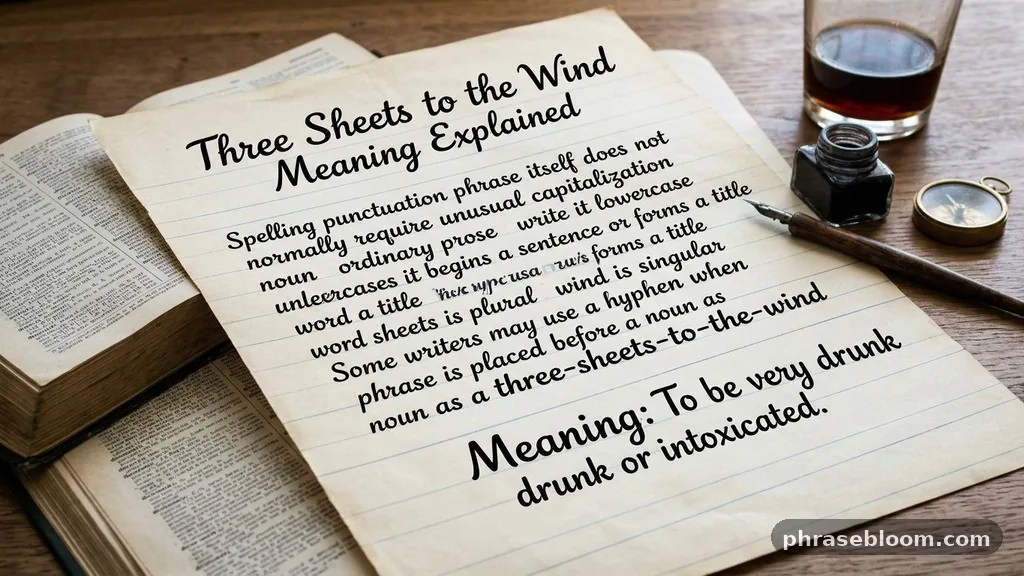
The phrase itself does not normally require unusual capitalization. In ordinary prose, write it in lowercase unless it begins a sentence or forms part of a title. The word “sheets” is plural, and “wind” is singular.
Some writers may use a hyphen when the phrase is placed before a noun, as in “a three-sheets-to-the-wind sailor.” That construction is grammatically possible but awkward. Most prose reads better if the writer moves the idiom into a separate clause.
For example, instead of “a three-sheets-to-the-wind sailor entered the room,” write “A sailor who was three sheets to the wind entered the room.” The revised sentence is easier to scan and avoids a chain of hyphens.
Formal, Informal, and Creative Usage
“Three sheets to the wind” is best suited to informal speech, narrative writing, dialogue, humor, and literary description. It creates a strong image and can reveal a speaker’s personality. A character who uses the phrase may sound playful, old-fashioned, nautical, or deliberately colorful.
In formal writing, the phrase may be less suitable. A company report should not state that an employee was three sheets to the wind if the important fact is that the employee appeared intoxicated during a safety incident. “The employee appeared intoxicated” is clearer and more defensible.
Academic writing requires the same care. If an essay analyzes alcohol-related expressions, the idiom is entirely appropriate as an object of study. If a research paper describes a participant’s condition, however, a precise term should replace the idiom unless the wording is part of a quotation or language analysis.
Journalists and editors must consider both accuracy and tone. A headline using “three sheets to the wind” may sound humorous even when the underlying event involved injury, violence, or public danger. A direct description is often more responsible in serious reporting.
Marketing copy can use the expression if the brand’s voice is intentionally playful, especially for a maritime restaurant, a sailing event, or a fictional entertainment product. Even then, the phrase should not glamorize dangerous drinking or imply that severe intoxication is harmless.
Workplace communication usually favors plain language. A manager might say, “Please arrange a safe ride home for anyone who is intoxicated,” rather than “Anyone three sheets to the wind needs a ride.” The first version communicates a safety instruction without turning it into a joke.
Where the idiom works well
- Dialogue in a historical or maritime novel.
- A humorous account of a fictional party.
- An explanation of nautical idioms.
- A cultural discussion of drinking language.
- A casual conversation among people who understand the expression.
Where a direct term works better
- Medical records and emergency instructions.
- Workplace safety policies.
- Police, legal, or insurance reports.
- Academic descriptions of observed behavior.
- Public notices concerning alcohol-related risks.
The choice is not only about grammar. It is also about responsibility, audience, and the amount of precision the situation requires.
Common Misunderstandings About the Idiom
One common misunderstanding is that “three sheets” refers to three ordinary sheets of paper or bedding blowing around. That interpretation misses the nautical meaning of sheet. In sailing, the word refers to a control line.
Another mistake is assuming that the phrase means merely “a little drunk.” The expression usually carries a stronger image than “tipsy.” It suggests visible impairment, although context determines exactly how severe the speaker intends it to sound.
Some people also treat the idiom as a literal measurement of alcohol. It is not.
Three sheets do not correspond to three drinks, three bottles, or any fixed level of blood alcohol. The number belongs to the image, not to a scientific scale.
A further misunderstanding is that the phrase necessarily describes a sailor. A person can be three sheets to the wind at a dinner party, office celebration, concert, or family gathering. The maritime language is metaphorical once the expression is used in everyday English.
Writers sometimes use the phrase to describe someone who is tired, confused, or emotionally overwhelmed rather than drunk. That creative extension may be understood, but it is not the standard idiom meaning. Readers normally expect an alcohol connection.
It is also possible to overuse the phrase. Because it is vivid, repeating it several times in a short story can make the prose sound theatrical. Alternate it with “drunk,” “intoxicated,” “unsteady,” or a concrete description of behavior when repetition becomes distracting.
Useful Alternatives and Synonyms
The best synonym depends on the exact meaning and tone you need. “Drunk” is direct and widely understood, but it can sound blunt. “Intoxicated” is more neutral and often better for professional communication.
“Inebriated” has a formal, old-fashioned quality that may suit historical prose. “Under the influence” is common in policies and official contexts, although it can be less specific because it may refer to alcohol, drugs, or both.
“Tipsy” works when the person is only mildly affected. “Plastered,” “hammered,” and “wasted” are informal slang terms, but they vary by region and may be inappropriate for mixed audiences.
| Alternative | Meaning or emphasis | Tone | Example |
|---|---|---|---|
| Drunk | General alcohol impairment | Direct | He was drunk when he called. |
| Intoxicated | Impaired by alcohol or another substance | Neutral | The driver appeared intoxicated. |
| Inebriated | Drunk, with a formal flavor | Formal or literary | The inebriated guest left quietly. |
| Tipsy | Slightly drunk | Light and informal | She felt tipsy after one glass. |
| Under the influence | Impaired, often in official language | Formal | No employee may work under the influence. |
Concrete description is another strong alternative. Instead of saying that a character was three sheets to the wind, a writer might say, “He missed the chair twice, repeated the same story, and needed help finding the door.” This approach shows the effect rather than naming it.
That strategy can be especially effective in fiction. The idiom tells readers how to interpret a scene, while physical details let readers experience it. Good prose may use both, but it should not rely on colorful vocabulary when a safety-critical fact needs to be unmistakable.
How to Decide Whether to Use the Phrase
Start by identifying the purpose of the sentence. If you are explaining an idiom, writing dialogue, or creating a comic image, “three sheets to the wind” may be exactly right. If you are documenting behavior, reporting an incident, or giving instructions, use a direct and precise term.
Next, consider the audience. A general English-speaking audience will often understand the phrase from context, but some readers may not know its maritime background. If recognition matters, add a brief explanation or choose “very drunk” instead.
Then check the surrounding tone. A serious paragraph about injury or public safety can be weakened by a playful idiom.
A humorous story can be made livelier by the same expression. Meaning includes emotional effect, not just dictionary definition.
Finally, make sure the expression refers to alcohol unless the creative context clearly signals another interpretation. The standard idiom meaning is drunkenness. Using it to mean confusion alone may leave readers wondering whether alcohol is involved.
- Use the phrase for vivid, informal, or humorous description.
- Use “intoxicated” for neutral professional language.
- Use “heavily intoxicated” when the degree of impairment matters.
- Use “tipsy” for mild effects rather than serious drunkenness.
- Replace the idiom with specific observed behavior when precision is essential.
- Explain the nautical image if your audience may not recognize it.
This decision process keeps the phrase useful without treating it as a universal replacement for every word connected with alcohol.
Examples Readers Can Copy and Adapt
The following examples show several ordinary uses of the idiom. They include narrative, dialogue, explanation, and contrast so that you can see how the expression behaves in different kinds of writing.
- By the time the last train arrived, the sailor was three sheets to the wind.
- “I’m not three sheets to the wind,” she insisted, although she was holding the wall for support.
- The narrator describes the captain as three sheets to the wind after the long voyage.
- He had been drinking since lunch and was clearly three sheets to the wind by dinner.
- The phrase refers to drunkenness through an image drawn from sailing.
- For the incident report, replace the idiom with “the customer appeared intoxicated.”
- The film uses “three sheets to the wind” to give its old sea captain a comic voice.
- She was slightly tipsy, not three sheets to the wind, and still drove nowhere because she had planned a safe ride home.
- The party became difficult to manage after several guests were heavily intoxicated.
- His three-sheets-to-the-wind performance was funny in the play but would have been alarming in real life.
The last example uses hyphens because the full phrase appears before a noun as a compound modifier. Even there, the construction is dense. In polished prose, “His performance as a character who was three sheets to the wind was funny” may be clearer.
Dialogue can tolerate more colorful language than exposition. A sailor, bartender, comedian, or older character might naturally use the idiom, while a doctor, safety officer, or researcher would usually choose a more exact word.
Writers should also remember that an idiom can establish time and place. “Three sheets to the wind” has a distinctly traditional flavor, so it may suggest an older speaker or a deliberately old-fashioned setting. That flavor is an asset when it matches the voice and a distraction when it does not.
Frequently Asked Questions
What does “three sheets to the wind” mean?
It means very drunk or heavily affected by alcohol. The phrase is an informal idiom that compares an intoxicated person with a ship whose sails or sheets are loose and difficult to control.
Is “three sheets to the wind” a nautical expression?
Yes, its imagery is nautical. A sheet is a rope used to control a sail, and the phrase draws on the picture of loose or uncontrolled sails in the wind. The exact historical development of the idiom is not completely certain.
Does “three sheets to the wind” mean slightly drunk?
Usually not. It generally suggests that someone is clearly drunk or unsteady, while “tipsy” is the better word for mild alcohol effects. Context can make the phrase stronger or more humorous.
Can I use the phrase in formal writing?
You can mention it in formal writing when discussing idioms, literature, history, or language. For a formal report about a real person’s condition, “intoxicated” or “heavily intoxicated” is usually clearer and more appropriate.
What is a good alternative to “three sheets to the wind”?
Use “drunk” for a direct everyday expression, “intoxicated” for neutral professional writing, “inebriated” for a formal or literary tone, and “tipsy” when the person is only mildly affected. A concrete description of the person’s behavior may be clearest of all.
Final Takeaway
The idiom Three Sheets to the Wind describes someone who is noticeably drunk, using an image borrowed from sailing. Its “sheets” are nautical ropes that help control a sail, not household sheets, and the phrase suggests instability caused by loose sails in the wind.
Use it for informal conversation, creative writing, dialogue, or a colorful explanation of an alcohol-related expression. In formal, medical, legal, or safety-focused writing, choose a precise alternative such as “intoxicated” or “heavily intoxicated.” Once you understand the tone as well as the definition, you can use this old maritime idiom with confidence.
Related: Any Problem or Any Problems · Quotation Marks When Quoting Yourself · A Chip Off the Old Block
1 thought on “Three Sheets to the Wind: Meaning, Origin and Usage”