
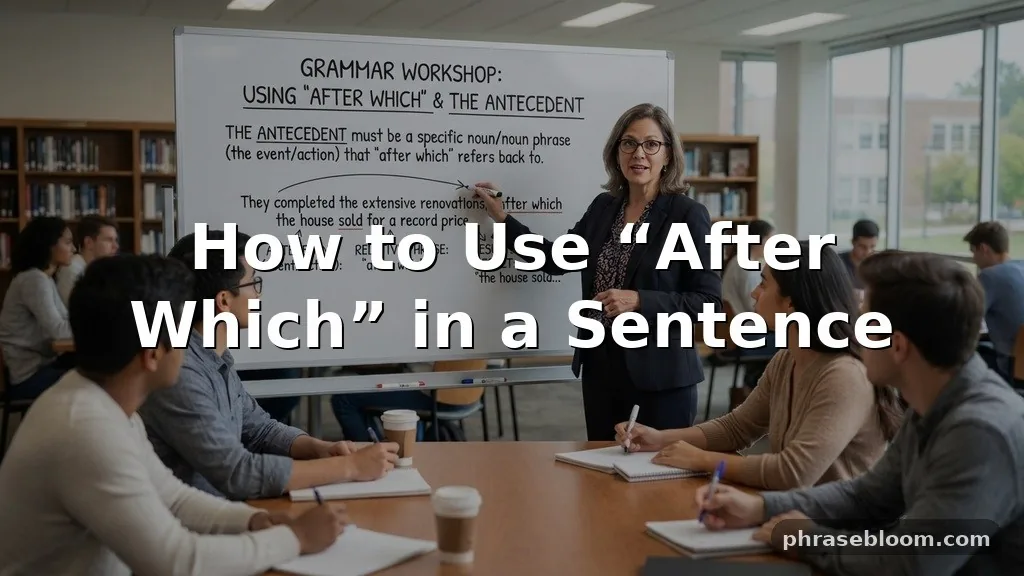
Using “after which” in a sentence helps show that one event follows another, usually in a clear time sequence. The phrase often appears in formal writing because it connects an earlier event with a later result without repeating the same time expression.
“After which” normally introduces a relative clause, and it usually refers back to a noun or an entire event in the preceding clause. By the end of this article, you’ll know how to place the phrase, when to use a comma, how it differs from “after that,” and how to make your sentence sound natural rather than overly formal.
What “After Which” Means
“After which” means after that event, action, or time. The word “which” points backward to something already mentioned, while “after” establishes the order in which events happen.
For example, in the sentence “The committee reviewed the proposal, after which it issued a recommendation,” the phrase “after which” refers to the committee’s review. The recommendation came later.
The phrase can refer to a specific noun, such as “the meeting,” or to the complete action described in the first part of a sentence. That flexibility makes it useful in reports, instructions, formal emails, academic prose, and business writing.
| Expression | Basic meaning | Typical role | Example |
|---|---|---|---|
| after which | after that event or action | relative clause connector | The interview ended, after which the panel met privately. |
| after that | after that event or time | independent clause or transition | The interview ended. After that, the panel met privately. |
| then | next or afterward | adverb | The interview ended, and then the panel met privately. |
| following which | after which | formal relative connector | The vote was completed, following which the result was announced. |
“After which” is not normally a complete sentence by itself. It needs a clause before it to provide the antecedent, which is the word or idea that “which” refers to, and it usually needs a clause after it to explain what happened next.
- The first clause describes an event, action, or time.
- “After which” points back to that event or action.
- The following clause states what happened afterward.
For instance, “The company completed the audit, after which it revised its procedures” contains two connected actions. The audit happened first, and the revision followed.
How “After Which” Works Grammatically
In most sentences, “after which” introduces a relative clause. A relative clause is a group of words that gives more information about a noun or an event, and it often begins with a word such as “which,” “that,” “who,” “where,” or “when.”
In “The training ended, after which employees completed a survey,” the clause “after which employees completed a survey” tells us what happened after the training ended. The word “which” does not describe the survey. It refers to the earlier event, the ending of the training.
The phrase can also be understood as a prepositional phrase combined with a relative pronoun. “After” supplies the time relationship, while “which” connects the phrase to an earlier antecedent.
The role of the antecedent

An antecedent is the word or idea that a pronoun refers to. In “The company held a briefing, after which the software rollout began,” the antecedent of “which” is the briefing, or more precisely the event of holding the briefing.
Sometimes the antecedent is a whole clause rather than one noun. Consider this example: “The board rejected the proposal, after which the director resigned.” Here, “which” refers to the board’s rejection, not simply to the proposal.
That distinction matters because unclear antecedents can make a sentence confusing. If several events appear before “after which,” readers may not know which one came first in the time sequence.
A dependent clause after “after which”
The clause beginning with “after which” is generally dependent. It cannot stand alone as a complete sentence because “after which” signals a relationship to information that came before it.
“After which the team left” is not a complete sentence in ordinary formal writing. The reader needs the earlier event: “The meeting ended, after which the team left.”
The clause after “after which” can contain its own subject and verb. In “The inspection was completed, after which the building reopened,” “the building” is the subject and “reopened” is the verb.
Comma Placement and Punctuation
A comma commonly appears before “after which” when the phrase follows an independent clause. An independent clause contains a subject and a verb and can stand as a complete sentence on its own.
Correct: “The manager approved the request, after which the finance team released the funds.” The comma separates the completed first event from the dependent clause that explains what happened next.
The comma also helps readers see the sentence structure immediately. Without it, the words may still be understandable, but the transition between the two clauses can look crowded.
When the comma is expected
Use a comma before “after which” when it follows a complete statement and adds a later action. This is especially helpful in formal writing, where long sentences often contain several pieces of information.
- “The witness gave evidence, after which the court adjourned.”
- “The system was tested, after which the update was released.”
- “The contract was signed, after which both parties received a copy.”
Each sentence has a clear first event followed by a later event. The comma signals that the second clause is connected to, but not part of, the first clause.
Comma placement inside a larger sentence
When “after which” appears in the middle of a longer sentence, punctuation depends on the structure around it. A pair of commas may be appropriate if the clause is nonrestrictive, meaning it adds extra information rather than identifying a necessary part of the sentence.
For example: “The annual review, after which several employees received new responsibilities, took place in June.” The inserted clause gives additional information about the review, so it is set off with commas.
By contrast, a restrictive clause is essential to the meaning and is not normally separated with commas. The exact structure may vary, but the main question remains the same: does the clause identify something necessary, or does it simply add background information?
For a detailed reference on clause punctuation and sentence structure, consult the Purdue Online Writing Lab punctuation guide.
Examples of “After Which” in Professional Writing
Professional writers use “after which” to connect workplace events without starting a new sentence each time. The phrase is especially natural when the first event is a meeting, review, approval, announcement, or operational step.
Policies and company announcements
“The revised company policy was approved by the executive team, after which it was distributed to all employees.” This sentence makes the approval the first event and the distribution the second.
“The company announced the restructuring plan, after which department leaders met with their teams.” The structure works because the announcement clearly precedes the internal meetings.
“The benefits policy was updated, after which employees received instructions for enrolling in the new plan.” This is a useful pattern for HR announcements because it presents the policy change and the communication that followed.
Training and workplace communication
“Employees completed the safety training, after which they signed an acknowledgment form.” The phrase creates a direct connection between completion and the required administrative step.
“The instructor demonstrated the new procedure, after which participants practiced it in small groups.” This example fits training materials because the demonstration naturally comes before practice.
“The team received the workplace email, after which supervisors scheduled individual meetings.” The wording is formal but still clear for internal communication.
Reports and organizational changes
“The company completed its market analysis, after which it adjusted its expansion plans.” This works well in a business report because the analysis provides the basis for the later decision.
“The organization merged two departments, after which several reporting lines changed.” The second clause describes a consequence that followed the organizational change.
“The audit identified weaknesses in the process, after which management introduced additional controls.” Here, “after which” presents the response to a finding without claiming that the response was immediate unless the surrounding context supports that interpretation.
Technology rollouts and meetings
“The new software was installed on company devices, after which employees received access to the updated dashboard.” The phrase shows the order of technical steps.
“The project meeting ended, after which the design team circulated the revised schedule.” This sounds natural in meeting minutes and project reports.
“The technology rollout was completed, after which the support team monitored login issues.” The construction allows a report writer to describe an operational sequence precisely.
“After Which” Before a Noun and After a Verb
Many readers first encounter “after which” before a clause rather than directly before a noun. The important point is that the phrase can connect an earlier event to a later clause, but it does not function like an ordinary adjective placed before a noun.
For example, “The company held a company-wide meeting, after which the chief executive answered questions” is correct. The phrase “after which” introduces the later action, “the chief executive answered questions.”
It would be incorrect to treat “after which” as though it were a normal noun modifier in a phrase such as “the after which meeting.” That construction does not express the intended time relationship.
Predicate use
“After which” can appear after a verb when the verb is part of the first clause. In “The policy was approved, after which it took effect,” the phrase comes after the verb “was approved” because the complete first clause comes before it.
Do not confuse this use with the sentence “The policy is after which,” which is not grammatical. “After which” needs an earlier event or noun to provide its reference.
The expression can also appear after a linking verb in a sentence that contains a separate clause. For example, “The final stage is the review, after which the project closes.” Here, “after which” follows the first clause and introduces the next stage.
Adverbial use
An adverbial expression gives information about time, place, manner, or reason. “After which” has an adverbial meaning because it tells readers when the next action happens, but it is usually attached to a relative clause rather than operating as a single-word adverb.
Compare “The meeting ended, after which everyone left” with “The meeting ended. Everyone left afterward.” Both describe the same sequence, but the first uses a relative clause and the second uses a separate sentence with an adverb.
This is why grammatical function and placement matter. A phrase that follows a completed clause may need different punctuation from a phrase placed at the beginning of a new sentence.
“After Which” Versus “After That”
“After which” and “after that” usually express the same basic time relationship, but they fit into different sentence structures. “After which” normally connects to something already stated, while “after that” often begins a new independent clause or functions as a transition phrase.
Compare these examples:
- “The manager approved the budget, after which the team began hiring.”
- “The manager approved the budget. After that, the team began hiring.”
- “The manager approved the budget, and then the team began hiring.”
The first sentence is compact and formal. The second is often easier to read in everyday business communication because each event receives its own sentence.
“After that” can sound more conversational, while “after which” is common in reports, minutes, academic writing, legal documents, and formal correspondence. Neither expression is automatically better.
Choosing the clearer option
Use “after which” when the relationship between the two events is close and the sentence remains easy to follow. Use “after that” when the first sentence is long, contains several nouns, or would otherwise make the antecedent unclear.
For example, “The committee reviewed the proposal, discussed the financial risks, and requested additional data, after which it postponed the vote” is grammatically possible but heavy. A clearer version is “The committee reviewed the proposal, discussed the financial risks, and requested additional data. After that, it postponed the vote.”
Shorter sentences are not less professional. In many workplace emails and internal communications, they improve clarity and reduce the chance that readers will miss the time sequence.
Formal and Everyday Uses
“After which” is associated with formal writing, but it is not limited to academic or legal language. It can appear in everyday speech, although many speakers would choose “and then,” “after that,” or “later” in conversation.
A project report might say, “The supplier confirmed delivery, after which the warehouse prepared the receiving area.” In a casual conversation, someone might say, “The supplier confirmed delivery, and then the warehouse got ready.”
The difference is one of tone and sentence design, not correctness. Formal writing often benefits from precise connectors, while everyday communication often favors shorter and more familiar expressions.
Business emails
In a business email, “after which” is suitable when the message describes a clear sequence. “Please complete the registration form, after which you’ll receive an access code” is concise and professional.
Still, “Once you complete the registration form, you’ll receive an access code” may sound more direct. The best choice depends on whether the writer wants to emphasize sequence, condition, or simple instruction.
Academic and legal writing
Academic writers often use “after which” to describe procedures: “The samples were heated for ten minutes, after which they were placed in a cooling chamber.” The phrase helps show that the second step followed the first.
Legal and policy documents may use it to describe formal actions: “The notice was delivered, after which the recipient had thirty days to respond.” In such writing, the exact surrounding wording should make clear whether “after which” means immediately afterward or simply at a later point.
Related Expressions and Better Alternatives
Several alternatives can replace “after which,” but they do not always have exactly the same tone or scope. Choosing among them can make a sentence more natural and prevent a formal expression from sounding unnecessarily stiff.
| Alternative | Best use | Example |
|---|---|---|
| after that | everyday or direct sequencing | The meeting ended. After that, we sent the report. |
| afterward | short reference to a later time | The team discussed the issue and left afterward. |
| then | simple chronological order | We checked the figures and then submitted them. |
| following this | formal reports and notices | Following this, the agency issued new guidance. |
| once | condition or completed prerequisite | Once the review ends, the report will be published. |
| subsequently | formal description of a later action | The error was identified and subsequently corrected. |
“After which” is especially useful when the earlier event is already the focus of the sentence. “Following this” can be more vague if several actions have just been mentioned, while “subsequently” may sound too formal for an ordinary email.
Using “which” and “that” correctly
“After which” should not normally be replaced with “after that” inside the same relative-clause structure. The expressions behave differently: “which” connects back to an antecedent, while “that” often introduces a restrictive clause or acts as a demonstrative pronoun.
For example, “The team completed the test, after which it submitted the results” is natural. “The team completed the test, after that it submitted the results” is not the standard structure because “after that” does not normally connect two independent clauses with only a comma.
You could write “The team completed the test, and after that it submitted the results,” or split the sentence into two sentences. This change fixes both the connector and the punctuation.
Common Mistakes with “After Which”
Most errors involving “after which” come from unclear reference, punctuation, or an incomplete clause. The phrase itself is not difficult, but it must be attached to a logical earlier event.
Using it without an antecedent
Incorrect: “After which, the company released the report.” The reader has no earlier event to explain what “which” refers to.
Correct: “The review was completed, after which the company released the report.” The first clause supplies the missing antecedent.
Using a comma splice
Incorrect: “The meeting ended, after that the employees left.” The comma joins two independent clauses without a suitable coordinating conjunction or correct sentence break.
Correct: “The meeting ended, after which the employees left.” Another correct option is “The meeting ended. After that, the employees left.”
Creating an awkward or unclear sequence
Weak: “The director signed the document after which the assistant filed it.” The sentence may be understood, but the missing comma makes the structure harder to scan.
Better: “The director signed the document, after which the assistant filed it.” The comma clearly separates the first event from the event that followed.
Using “after which” for a condition
“After which” describes sequence, not usually a condition. If the meaning is “as soon as” or “provided that,” use “once” instead: “Once the manager approves the request, finance will process it.”
“After which the request will be processed” can work when the approval is already presented as an event, but “once” is often clearer when approval is a requirement that must occur first.
Making the sentence too formal
“After which” is correct, but it may not be the best choice for a short message to coworkers. “The call ended, and we sent the file” may be more direct than “The call ended, after which we sent the file.”
Good grammatical usage is not only about correctness. It is also about matching the expression to the audience, purpose, and level of formality.
How to Decide Whether to Use It
Before using “after which,” identify the first event and the later event. If the order is clear and the two actions belong naturally in one sentence, the phrase may be a good fit.
- Find the event that happens first.
- Check that “which” has a clear antecedent.
- Write the later action after “after which.”
- Add a comma when the phrase follows a complete clause.
- Read the sentence aloud to test its rhythm and clarity.
For example, begin with two simple sentences: “The team completed the inspection. The facility reopened.” Combining them gives “The team completed the inspection, after which the facility reopened.”
If the combined sentence becomes long or confusing, keep the sentences separate. “After which” is a useful connector, not a requirement to combine every pair of related statements.
When “after which” is a strong choice
- The first event is clearly stated.
- The second event follows in a straightforward time sequence.
- The writing is formal, technical, academic, or report-based.
- The sentence is short enough to remain easy to process.
- The writer wants to avoid repeating “after that” in several nearby sentences.
It is particularly effective in procedures, meeting minutes, research descriptions, and official notices. Readers can quickly identify what happened first and what followed.
When another expression is better
Choose “after that” when you want an accessible conversational tone. Choose “once” when the first event is a condition, and choose “then” when the sequence is simple and informal.
Use “following which” sparingly. It is grammatical and common in formal documents, but it can sound more bureaucratic than “after which.” A plain alternative often gives the same meaning with less weight.
Copyable Sentence Examples
The following examples show how “after which” works in different settings. Each one contains a complete first clause and a later action connected by the phrase.
- “The policy was approved, after which it became effective immediately.”
- “The employee completed orientation, after which she received system access.”
- “The company issued an announcement, after which managers answered questions from staff.”
- “The software update was installed, after which users were asked to restart their devices.”
- “The report was reviewed by the legal team, after which it was sent to the client.”
- “The meeting concluded, after which the participants received a copy of the minutes.”
- “The training session ended, after which employees completed a short assessment.”
- “The board approved the merger, after which the organizations began integrating their operations.”
These examples work because each “which” has an identifiable antecedent. The phrase also appears after a comma because it follows a complete first clause.
Here are versions using alternatives:
- “The meeting ended. After that, the team returned to work.”
- “Once the meeting ended, the team returned to work.”
- “The meeting ended, and then the team returned to work.”
All three sentences express a related sequence, but their structures differ. The first uses a transition between two sentences, the second emphasizes a condition or point in time, and the third uses a coordinating conjunction.
Frequently Asked Questions
What does “after which” mean?
“After which” means “after that event” or “after the thing just mentioned.” It connects an earlier event with a later action and usually introduces a relative clause.
Is “after which” formal?
It is more common in formal writing than in casual conversation, but it is not excessively formal or unusual. In everyday speech, “after that,” “then,” or “afterward” may sound more natural.
Do I need a comma before “after which”?
Usually, yes, when “after which” follows a complete independent clause. For example: “The review ended, after which the report was issued.” The comma helps separate the first event from the dependent clause that follows.
Can “after which” begin a sentence?
It can begin a sentence only when it has a clear antecedent from the preceding sentence or context, but this use is less common and may sound incomplete. “The review ended. After which, the report was issued” is generally less polished than “The review ended, after which the report was issued” or “The review ended. After that, the report was issued.”
What is a good alternative to “after which”?
Use “after that,” “afterward,” “then,” “once,” or “following this,” depending on the meaning and tone. “After that” is usually the easiest everyday alternative, while “once” is better when the first event is a condition.
Final Guidance on Using “After Which” in a Sentence
Using “after which” in a sentence is a clear way to show that one event followed another. Place it after a complete first clause, make sure “which” points to a clear antecedent, and usually add a comma before the phrase.
Choose it when the sentence benefits from a formal, compact connection. If the wording feels heavy, rewrite with “after that,” “then,” or “once.” The strongest sentence is the one that makes the time sequence obvious while matching the tone of the communication.
Related reading: Deem Fit, What Are Staccato Sentences? Meaning, Examples, and How to Use Them, It Is How It Is.