
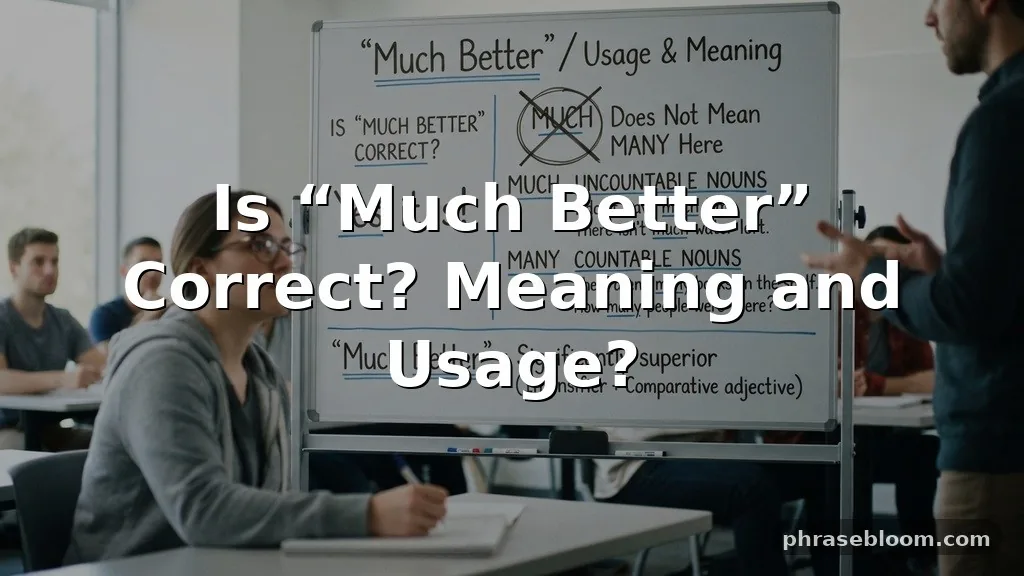
Is “Much Better” Correct? Meaning and Usage
“Much better” is correct English and means noticeably, considerably, or greatly better than something else. It is a common comparative expression used to show a clear improvement in quality, condition, performance, health, or suitability.
The phrase works in both formal English and informal English, although the best alternative can depend on context. Understanding the difference between “much better,” “far better,” “a lot better,” and simply “better” will help you choose a natural expression and avoid common usage mistakes.
What “Much Better” Means
The basic “much better” meaning is “considerably better.” The word “better” is the comparative form of “good,” while “much” strengthens the comparison by showing that the difference is significant.
For example, if one proposal is only slightly stronger than another, you might say, “This proposal is better.” If the improvement is obvious, you can say, “This proposal is much better.”
| Expression | Meaning | Typical force | Example |
|---|---|---|---|
| better | Higher in quality or suitability | General comparison | This option is better. |
| much better | Clearly or considerably better | Strong comparison | This option is much better. |
| far better | Significantly better | Strong, often formal comparison | This option is far better. |
| a little better | Slightly better | Weak comparison | This option is a little better. |
| the best | Better than all others in the relevant group | Superlative judgment | This is the best option. |
“Much better” normally compares two conditions, choices, experiences, or states. The second part of the comparison may be stated directly, as in “The revised version is much better than the original,” or left understood, as in “The revised version is much better.”
In everyday speech, the phrase can describe improvement over time: “I’m feeling much better today.” It can also express a preference: “The blue design is much better for this audience.”
The expression does not necessarily mean perfect or excellent. It only says that one thing has a noticeably higher degree of quality than another relevant thing.
Why “Much Better” Is Grammatically Correct
“Better” is a comparative adjective. A comparative adjective compares one person, object, situation, or idea with another. The underlying pattern is part of the familiar good-better-best sequence: “good” is the positive form, “better” is the comparative form, and “best” is the superlative form.
“Much” is an intensifier in this construction. An intensifier is a word that increases the strength of another word without changing its basic meaning. In “much better,” it tells us that the difference is large rather than minor.
- Good: The service is good.
- Better: The service is better than before.
- Much better: The service is much better than before.
- Best: This is the best service available.
The phrase follows standard grammar rules because “much” can modify a comparative adjective. Other degree adverbs that can work with comparatives include “far,” “considerably,” “significantly,” and “slightly,” although each creates a different tone or level of emphasis.
For example, “slightly better” suggests a small improvement, while “considerably better” sounds more formal and measured. “Much better” is flexible enough for a casual conversation, a workplace email, or a polished report.
“Much” Does Not Mean “Many” Here
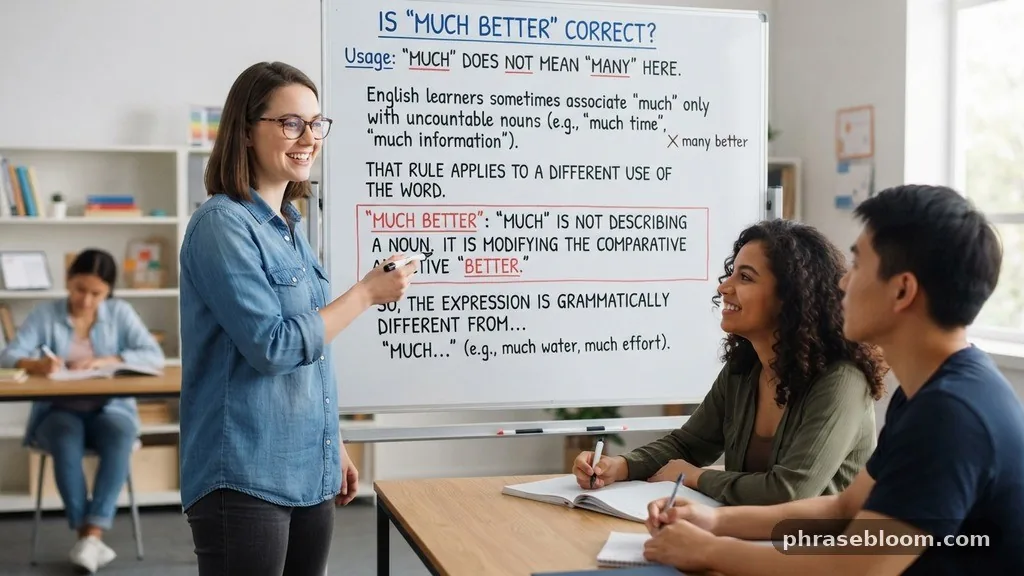
English learners sometimes associate “much” only with uncountable nouns, as in “much time” or “much information.” That rule applies to a different use of the word.
In “much better,” “much” is not describing a noun. It is modifying the comparative adjective “better,” so the expression is grammatically different from “much information.”
The same pattern appears in sentences such as “The new process is much faster,” “The updated figures are much clearer,” and “The patient feels much healthier.”
How “Much Better” Works in a Sentence
“Much better” most often appears after a linking verb such as “be,” “feel,” “look,” “seem,” or “sound.” These verbs connect the subject to a description rather than showing a direct physical action.
- The revised contract is much better.
- The new layout looks much better.
- Her presentation sounded much better after the edits.
- The customer feels much better about the proposed solution.
In these examples, “much better” functions as a description of the subject. The phrase tells us about the contract, layout, presentation, or customer’s state.
It can also appear before a noun in a comparative modifier. For example, “a much better solution” means a solution that is considerably better than another solution under discussion.
- We need a much better explanation for new employees.
- The second draft offers a much better structure.
- They found a much better location for the event.
Here, “much” modifies “better,” and the combined phrase modifies the noun that follows. The usual word order is “much better” before the noun, not “better much.”
Direct Comparisons With “Than”
A sentence can include “than” when the writer wants to identify the thing being compared. “The new software is much better than the old software” makes the comparison explicit.
However, “than” is not required if the comparison is already clear. If a team has just reviewed two versions, someone can say, “The second version is much better,” and listeners will understand the implied comparison.
Use “than” when leaving out the comparison could make the sentence unclear. In formal writing, a complete comparison can also help readers understand exactly what the writer is evaluating.
“Much Better” as an Adjective and Related Uses
In many sentences, “better” acts as an adjective because it describes a noun or subject. This is the most common grammatical role in sentences such as “The new policy is much better” and “We developed a much better process.”
The adjective vs adverb distinction becomes important when “better” describes an action. In “She works better under pressure,” “better” describes how she works, so it has an adverbial function. The same word can serve as an adjective or adverb depending on the sentence.
| Sentence | Role of “better” | What it describes |
|---|---|---|
| The revised plan is much better. | Adjective | The plan |
| We need a much better plan. | Adjective | The noun “plan” |
| The team performed much better. | Adverbial | How the team performed |
| She communicates much better now. | Adverbial | How she communicates |
In standard English, “much better” can therefore describe either a state or an action, depending on its position and the verb it relates to. The phrase remains correct in both uses.
Adjective Use
As an adjective, “much better” may follow a linking verb or appear before a noun. “The customer experience is much better” describes the experience, while “a much better customer experience” places the phrase directly before the noun.
The phrase can describe measurable qualities without requiring a number. “The new battery lasts much better” would be less natural because “lasts” usually needs an adverbial description, but “The new battery performs much better” is natural.
Adverbial Use
As an adverbial expression, “much better” describes the degree or quality of an action. “The team collaborated much better after the training” means the team collaborated more effectively than before.
In these sentences, “much” still intensifies “better.” The difference is that “better” describes the action rather than a noun or subject.
“Much Better” Versus “Far Better” and “A Lot Better”
“Much better,” “far better,” and “a lot better” share the same central meaning, but they do not always create the same tone. Choosing among them is partly a matter of register, which means the level of formality associated with the wording.
| Phrase | Typical tone | Example |
|---|---|---|
| much better | Neutral and widely usable | The revised process is much better. |
| far better | Formal, emphatic, or evaluative | The revised process is far better for large teams. |
| a lot better | Conversational and informal | The revised process is a lot better now. |
| considerably better | Formal and precise | The revised process is considerably better. |
| significantly better | Formal, often analytical | The revised process produced significantly better results. |
“Much vs far” is not a question of correctness. Both words can intensify a comparative adjective, but “far better” often sounds more forceful or formal than “much better.”
“Much vs a lot” involves register more clearly. “A lot better” is normal in conversation and friendly emails, while “much better” is usually safer in formal reports, academic writing, policy documents, and customer-facing communication.
For example, a colleague might write, “The new dashboard is a lot better.” A formal report might say, “The redesigned dashboard is much better suited to monthly reporting.”
When “Better Than” Is Enough
Writers sometimes add “much” when they only mean that one thing is preferable. That can overstate the difference. If the improvement is modest or has not been measured, plain “better” may be more accurate.
Compare “The revised forecast is better than the previous forecast” with “The revised forecast is much better than the previous forecast.” The second sentence claims a noticeably larger improvement, so it should match the evidence or the writer’s clear judgment.
In formal writing, “significantly better” may imply a meaningful difference, and in some academic contexts it can suggest statistical significance. Do not use that phrase casually if the evidence does not support it.
Real-Sentence Examples of “Much Better” Usage
The following examples show how “much better” works in professional, academic, and everyday contexts. Each sentence uses the phrase naturally, but the surrounding wording determines whether the tone is casual, neutral, or formal.
Workplace and Business Examples
- “The updated employee handbook is much better organized than the previous edition.”
- “This version gives customers a much better explanation of the return process.”
- “The revised budget is much better aligned with our hiring plan.”
- “The new meeting format works much better for remote employees.”
These examples use “much better” to compare documents, explanations, plans, and processes. The phrase can appear before a noun, after a linking verb, or after an action verb without changing its basic meaning.
Academic and Analytical Examples
- “The second method produced much better results across the three test groups.”
- “Students gave much better answers after reviewing the worked examples.”
- “The revised argument is much better supported by the available evidence.”
- “This model predicts demand much better during seasonal changes.”
Academic writing often benefits from specifying what improved. “Much better supported” is more informative than simply saying “much better,” because it identifies the relevant quality.
Personal and Everyday Examples
- “I’m feeling much better after getting some rest.”
- “The soup tastes much better with fresh herbs.”
- “This chair is much better for long work sessions.”
- “The weather looks much better than it did this morning.”
These sentences show why “much better” is not limited to business English. It can describe health, taste, comfort, appearance, and many other forms of comparison.
Negative and Question Forms
- “The new plan isn’t much better than the old one.”
- “Is the revised schedule much better for the team?”
- “Would a shorter introduction be much better?”
- “The replacement product was not much better in practice.”
In negative sentences, “not much better” often means that the improvement is small or disappointing. It does not usually mean that the new option is worse.
Common Mistakes With “Much Better”
Most mistakes involving “much better” concern comparison, word choice, or unnecessary intensification. The phrase itself is not a difficult or unusual construction, but small changes can affect accuracy and naturalness.
Using “More Better”
“More better” is not standard English because “better” already expresses the comparative form of “good.” Use “better” or “much better,” not “more better.”
Incorrect: “The new design is more better than the old one.” Correct: “The new design is much better than the old one.”
Using “Most Better”
“Most better” is also incorrect in standard English. The superlative form is “best,” so the correct sentence is “This is the best option,” not “This is the most better option.”
“Much better” is comparative, which means it normally relates to two options or conditions. “Best” is superlative, which means it identifies the highest level within a group.
Adding “Than” Without a Clear Comparison
“Much better than” should be followed by a sensible comparison. A sentence such as “The new system is much better than” is incomplete because the reader is waiting to learn what the system is better than.
Correct examples include “The new system is much better than the previous version” and “The new system performs much better than expected.” The second example compares actual performance with an expectation rather than with another object.
Confusing “Much Better” With “Much Best”
“Much best” is not a standard phrase because “best” is already the superlative form. You can say “much better,” “by far the best,” or “easily the best,” but not “much best” in ordinary formal or informal English.
Using “Much Better” Without Enough Context
Sometimes a sentence is grammatically correct but too vague. “The proposal is much better” leaves readers to guess whether the improvement concerns cost, clarity, timing, risk, or another factor.
A stronger version might say, “The proposal is much better suited to small businesses because it lowers the setup time.” The comparison becomes more useful once the writer identifies the relevant quality.
Formal English, Informal English, and Professional Style
“Much better” is acceptable in formal writing, but the surrounding sentence should remain precise. In a business report, “The revised procedure is much better” may be appropriate if the comparison has already been explained.
If the audience needs evidence, use a more specific construction: “The revised procedure reduces processing time and is much better suited to high-volume requests.” This approach combines the natural comparative phrase with a concrete reason.
| Context | Natural wording | Style note |
|---|---|---|
| Business email | The updated file is much better organized. | Neutral and clear |
| Formal report | The revised method produced considerably better results. | More analytical |
| Academic paper | The second method performed significantly better under these conditions. | Use “significantly” only when justified |
| Conversation | This version is a lot better. | Informal and natural |
| Customer communication | The new design provides a much better user experience. | Professional and accessible |
For many professional situations, “much better” is the safest general choice because it sounds natural without being overly casual. “A lot better” is fine in conversation, but it may sound too relaxed in a formal report or legal document.
Editors should also consider whether the claim is subjective or supported by evidence. “Much better” is a judgment, so a report may need to explain the basis for that judgment through results, comparisons, or specific criteria.
Using a Dictionary for Confirmation
Reference works can help confirm the comparative form and examples of standard usage. For an authoritative reference, consult the Cambridge Dictionary when checking meanings, grammatical labels, and example sentences.
Dictionaries can show that “better” has several meanings, including higher quality, greater suitability, improved health, and more effective performance. Context determines which meaning applies in a particular sentence.
How “Much Better” Differs From Similar Expressions
Several expressions overlap with “much better,” but they are not identical in tone or emphasis. Choosing the right one can make a sentence sound more accurate and less repetitive.
“Much Better Than”
“Much better than” gives a direct comparison. It is useful when the reader may not know what standard or alternative you have in mind.
Example: “The updated onboarding process is much better than the previous process.” For a more concise version, write, “The updated onboarding process is much better,” if the earlier context already identifies the comparison.
“Better Suited”
“Better suited” focuses on suitability rather than overall quality. A product may not be universally better, but it may be better suited to a particular audience or purpose.
Example: “The shorter form is better suited to mobile users.” You can strengthen it by writing, “The shorter form is much better suited to mobile users.”
“Improved”
“Improved” describes positive change without directly comparing two things. It can be useful when the earlier version is understood but does not need to be named.
Example: “The improved process requires fewer approvals.” This may sound more objective than “The process is much better,” especially in a formal report.
“Considerably More Effective”
“Considerably more effective” is a formal alternative when the relevant quality is effectiveness. It is more specific than “much better,” but it can also sound heavier.
Example: “The revised training method was considerably more effective for new hires.” Use this form when the writing needs a clear analytical focus.
Choosing the Right Form in Different Contexts
The best expression depends on your audience, purpose, and evidence. There is no grammar rule requiring every writer to replace “much better” with a more formal alternative.
- Use “much better” for a neutral, strong comparison in most situations.
- Use “a lot better” in casual speech, personal messages, and friendly workplace conversations.
- Use “far better” when you want an emphatic or somewhat formal comparison.
- Use “considerably better” in formal reports when the difference is substantial.
- Use “significantly better” when the evidence supports a meaningful or measured difference.
- Use “better suited” when the main issue is fit for a purpose or audience.
- Use “improved” when you want to emphasize positive change without making a strong direct comparison.
In business emails, “The new schedule works much better for the sales team” is clear and professional. In an employee handbook, “The revised procedure provides a much better explanation of leave requests” is also appropriate.
In academic writing, avoid using “much better” as a vague substitute for evidence. Explain what improved and, where relevant, identify the conditions under which the difference occurred.
In marketing, the phrase can be persuasive but may need support. “A much better way to manage invoices” makes a broad claim, while “A faster way to review invoices with fewer manual steps” gives the reader a more concrete reason to believe the claim.
Sentence Patterns You Can Copy and Adapt
The following patterns can be adapted for workplace communication, reports, presentations, and everyday writing. Replace the bracketed words with details that fit your situation.
- “The revised [document/process/design] is much better than the previous version.”
- “This approach is much better suited to [audience/use case].”
- “The team performed much better after [training/support/change].”
- “The new system provides a much better way to [task].”
- “The results were much better than we expected.”
- “The updated explanation makes the policy much better understood.”
- “The shorter version is much better for [context or audience].”
- “I’m feeling much better after [specific change or action].”
Notice that each pattern identifies either the comparison, the purpose, or the result. That extra detail prevents “much better” from sounding like an unsupported or empty judgment.
Workplace Email Model
“The revised schedule is much better for the regional teams because it gives each office a full day to review the figures.”
This sentence is effective because it states the judgment and gives a reason. A shorter version, “The revised schedule is much better,” would work only if the reason had already been discussed.
Report Model
“The updated intake process performed much better than the previous process during the first month of testing.”
This wording gives the comparison and the period being evaluated. If the report includes data, the writer can follow it with specific measurements rather than relying on the phrase alone.
Announcement Model
“The new employee portal offers a much better way to update contact details and review benefits information.”
This example uses “a much better way” before a noun phrase. It is natural in an internal announcement because it highlights practical benefits without sounding excessively technical.
Frequently Asked Questions About “Much Better”
Is “much better” correct English?
Yes. “Much better” is a standard comparative expression meaning considerably better or noticeably improved. It works in both formal and informal English.
Is “much better” more formal than “a lot better”?
Usually, yes. Both are correct, but “much better” is more neutral and is generally safer for reports, professional emails, academic writing, and formal communication.
Can I say “much better than”?
Yes. Use “much better than” when you want to identify the thing, situation, or standard being compared. For example, “The revised plan is much better than the original plan.”
Is “much better” an adjective or an adverb?
It depends on the sentence. In “The plan is much better,” “better” functions as an adjective, while in “The team worked much better,” it has an adverbial function describing how the team worked.
What is the best alternative to “much better”?
There is no single best alternative. Use “far better” for emphasis, “considerably better” for formal writing, “a lot better” for casual speech, or “better suited” when you mean more appropriate for a particular purpose.
Final Rule for “Much Better” Usage
“Much better” is correct whenever you need to say that one thing is noticeably better than another. It is the comparative form “better” strengthened by the intensifier “much,” and it can describe a noun, a state, or the way an action is performed.
For a neutral choice, use “much better.” Choose “a lot better” for informal conversation, “far better” or “considerably better” for stronger formal emphasis, and a more specific phrase when the comparison concerns suitability, effectiveness, cost, or performance. The answer to “Is ‘Much Better’ Correct? Meaning and Usage” is straightforward: yes, and clear context makes the phrase even stronger.
Explore more on PhraseBloom.