
Let One’s Hair Down: Meaning, Origin and Examples
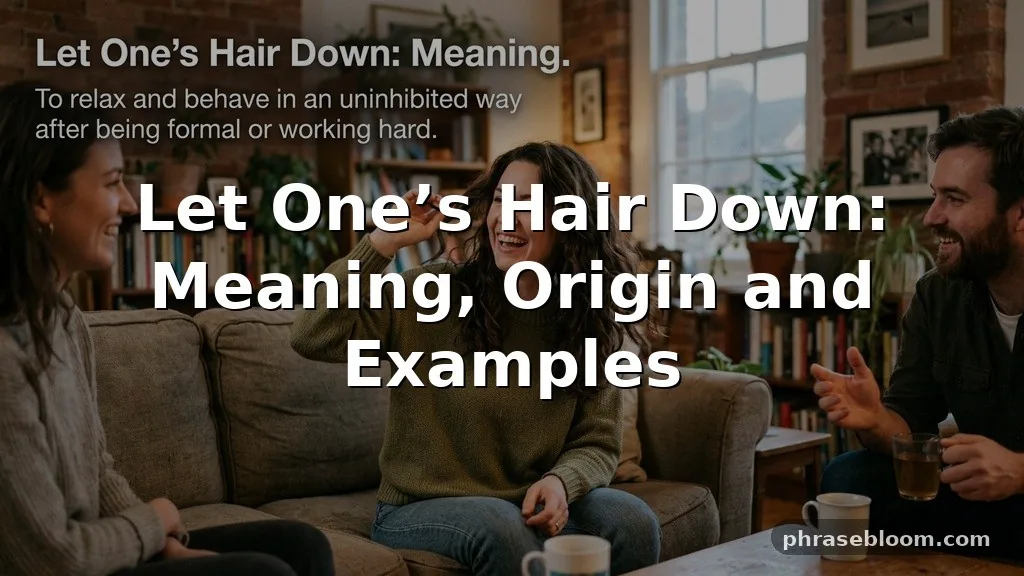
The phrase let one’s hair down means to relax, loosen up, and behave more informally than usual. Someone who lets their hair down stops being so serious or controlled for a while, often in a comfortable social setting with friends, family, or trusted colleagues.
The expression is useful because it describes more than simple rest. It suggests releasing stress, having fun, and allowing yourself to be less formal. The examples below explain the idiom definition, its likely history, sentence usage, related expressions, and the social context that makes the phrase sound natural.
Let One’s Hair Down Meaning
The central let one’s hair down meaning is “to relax and act freely.” The phrase can describe a person who stops worrying about appearances, rules, schedules, or professional behavior for a short time.
For example, if someone says, “Maya finally let her hair down at the weekend party,” they mean Maya became more relaxed and informal than she normally is. She may have danced, joked, talked openly, or simply enjoyed herself without carefully managing every word and movement.
The expression is an idiomatic expression, so its meaning is not usually literal. A listener should not assume that someone physically loosened their hairstyle. Instead, the image communicates a change in mood and behavior.
The phrase can apply to small moments or major breaks from routine. A manager might let her hair down after a demanding presentation, while a parent might do so during an unplanned evening with old friends.
- Relax: reduce tension after work, travel, study, or responsibility.
- Unwind: move away from pressure and return to a calmer state.
- Have fun: enjoy an activity without treating it as a task or performance.
- Loosen up: become less stiff, cautious, or formal.
- Be oneself: behave naturally rather than presenting a carefully controlled image.
“Let your hair down” is the version speakers often use when addressing another person directly. “Let his hair down,” “let her hair down,” and “let their hair down” are adjusted forms that match the subject of the sentence.
How the Idiom Works in a Sentence
In grammar, let is followed by an object and a base-form verb. The basic pattern is “let + person or pronoun + hair down,” as in “She let her hair down” or “We let our hair down.”
The possessive word changes with the subject. You say “I let my hair down,” “you let your hair down,” “he let his hair down,” “she let her hair down,” and “they let their hair down.” The verb “let” does not change in the present tense, which makes the structure fairly straightforward.
The phrase is commonly used in the past tense because people often describe a relaxing event after it happened. “The team let their hair down after the project ended” presents the informal behavior as a completed experience.
| Subject | Natural form | Example |
|---|---|---|
| I | let my hair down | I let my hair down after the exam. |
| You | let your hair down | You should let your hair down tonight. |
| He | let his hair down | He let his hair down at the reunion. |
| She | let her hair down | She let her hair down with close friends. |
| We | let our hair down | We let our hair down on vacation. |
| They | let their hair down | They let their hair down after the ceremony. |
The expression normally appears with a human subject, although a group can be treated as a collective subject. A sentence such as “The office let its hair down at the annual picnic” is possible, but it gives the workplace a playful human quality.
Writers should also remember that the phrase is informal. It works well in personal messages, lifestyle writing, dialogue, and friendly workplace communication, but a formal report may need a more direct phrase such as “reduce stress” or “participate in informal activities.”
Let Your Hair Down in Everyday Conversation
People use “let your hair down” most naturally when encouraging someone to relax. The phrase can sound warm and friendly, especially when the person being addressed has been working hard or behaving in a particularly serious way.
“You’ve been preparing for this conference for months. Let your hair down tonight” is an invitation to stop focusing on work.
It does not necessarily suggest reckless behavior, drinking, or breaking rules. The exact meaning depends on the activity and the relationship between the speakers.
In everyday conversation, the phrase often follows a reference to pressure. Someone may say, “After the deadline, I’m going to let my hair down,” which means they intend to enjoy free time once an obligation has finished.
Natural conversational examples
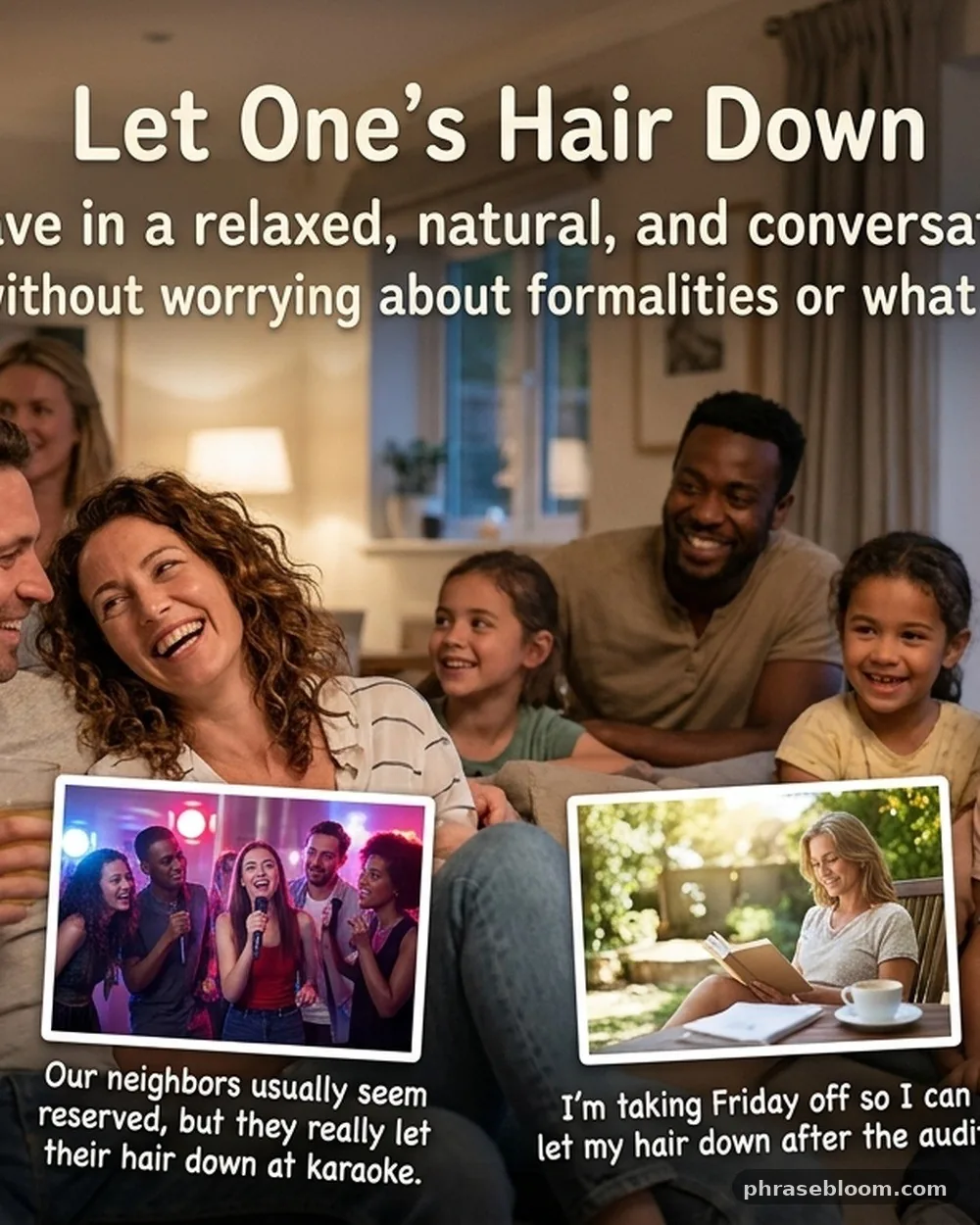
- “You don’t have to give a speech tonight. Just let your hair down and enjoy the dinner.”
- “Our neighbors usually seem reserved, but they really let their hair down at karaoke.”
- “I’m taking Friday off so I can let my hair down after the audit.”
- “The children let their hair down as soon as the formal ceremony ended.”
- “He finds it difficult to let his hair down around people he has just met.”
- “Let your hair down for an hour. The emails can wait.”
The phrase can also appear in a question. “When do you get to let your hair down?” asks about a person’s opportunities to relax, not about their hairstyle.
It can be used humorously as well. A friend might say, “I let my hair down by ordering dessert,” even if the activity is modest. The humor comes from applying a dramatic idiom to an ordinary pleasure.
For learners of English, the safest approach is to use the phrase in a clearly informal setting. It is especially natural in conversations about parties, vacations, hobbies, weekends, reunions, celebrations, and time with close friends.
Let One’s Hair Down: Examples by Social Context
The social context determines whether the expression sounds appropriate. A person may behave professionally in one setting and let their hair down in another without being inconsistent. The idiom focuses on a temporary change in formality.
Workplace communication
“The department let its hair down during the retirement celebration” suggests that employees moved beyond their usual workplace roles. They may have shared stories, joked with one another, or participated in activities that would not fit a routine staff meeting.
A manager could write, “After we submit the proposal, let’s let our hair down over dinner.” This is friendly workplace language, but it may be too casual for a formal memo or communication to an unfamiliar client.
Family and friendship
“Nora is usually the responsible one, but she let her hair down during the family camping trip” contrasts her ordinary role with a more playful version of her personality. The sentence suggests comfort, trust, and a temporary release from responsibility.
Friends often use the idiom to reassure one another. “You can let your hair down with us” tells someone that they do not need to impress the group or carefully monitor their behavior.
Public and creative writing

Travel writers, magazine authors, and advertisers may use the phrase to describe a destination or activity designed for relaxation. A resort might invite visitors to “let their hair down by the pool,” although this is promotional language rather than a literal instruction.
Fiction writers can use the idiom to reveal character. A tightly controlled character who finally lets her hair down may be showing trust, relief, or a new willingness to take a social risk.
Online posts and messages
In a social media caption, “Finally letting my hair down after a long week” can accompany a photograph from a concert, restaurant, game night, or quiet evening at home. The wording signals a mood of release without requiring a detailed explanation.
Because the phrase is familiar, it can also make a short message sound more expressive. “Weekend mode: letting our hair down” communicates relaxation in a compact, conversational way.
Hair-Down Idiom Origin and Literal Image
The hair-down idiom origin is commonly connected with older social conventions surrounding women’s hairstyles. In formal public settings, women often wore their hair arranged, pinned, or covered. Letting the hair fall freely could therefore suggest privacy, informality, or a move away from public presentation.
The image is easy to understand even for people who do not know the historical background. Carefully arranged hair can symbolize preparation and self-control, while loose hair can suggest comfort and freedom from ceremony.
That historical image should not be treated as a precise documented event that created the phrase on one specific date. Idioms often develop gradually through repeated figurative use, and the exact point at which this expression entered common speech is not always certain.
Modern speakers generally use the phrase without thinking about its gendered history. The subject can be anyone, and the meaning now concerns emotional relaxation rather than a particular hairstyle or social rule.
The expression also belongs to a larger group of idioms that describe changes in physical posture as changes in mental state. “Take a load off,” “kick back,” and “loosen up” similarly connect bodily ease with reduced pressure.
For a concise dictionary reference, the Cambridge Dictionary entry for “let your hair down” provides a standard definition and example usage. Such references are useful when you need to confirm the phrase’s general meaning rather than infer it from a single conversation.
Synonyms and Antonyms for Let One’s Hair Down
The best synonym depends on what aspect of the idiom matters most. If the focus is physical rest, “unwind” may fit. If the focus is social behavior, “loosen up” or “be oneself” may be more precise.
| Expression | Close meaning | Best use |
|---|---|---|
| Unwind | Release tension gradually | After work, travel, or study |
| Relax | Become less tense | General situations |
| Loosen up | Become less formal or rigid | Social interaction |
| Kick back | Rest in a casual way | Very informal conversation |
| Be oneself | Act naturally | Trust and personal comfort |
| Take it easy | Avoid strain or pressure | Advice about rest |
| Remain formal | Maintain controlled behavior | Opposite social condition |
“Relax” is broader than “let one’s hair down.” A person can relax while reading alone, whereas letting one’s hair down often carries a social or emotional suggestion of acting more freely.
“Have fun” is also related but less specific. Someone can have fun while remaining formal, while the idiom usually implies that the person has temporarily dropped some restraint.
Useful antonyms include “stay serious,” “remain reserved,” “keep one’s composure,” “maintain a formal manner,” and “stay on guard.” These expressions describe control rather than release.
The opposite does not always mean that someone is unhappy. A person may choose to remain formal because the setting requires it, even while enjoying the event. Meaning depends on whether the sentence contrasts restraint with freedom or simply describes a person’s normal personality.
Formal and Informal Use
“Let one’s hair down” is generally an informal idiom. It is acceptable in everyday conversation, personal essays, interviews, speeches with a relaxed tone, and marketing copy aimed at a general audience.
Formal writing often benefits from replacing the idiom with a direct description. Instead of writing “The committee let its hair down after the hearing,” a report might say, “The committee held an informal reception after the hearing.”
That does not make the idiom incorrect in formal writing. A feature article, literary analysis, or quoted statement may use it effectively. The question is whether the tone matches the purpose and audience.
Suitable professional examples
“The leadership team had an opportunity to let its hair down during the annual retreat” can work in an employee newsletter. It presents the retreat as a place for connection rather than formal decision-making.
“Employees were encouraged to relax and socialize after the training session” is more suitable for a policy, event notice, or official report. It communicates the same general idea without the idiomatic tone.
“The campaign invites customers to let their hair down and enjoy the summer” may fit an advertisement. The phrase creates an emotional image, but a legal notice or financial statement would normally avoid it.
Academic writers should use the expression only when analyzing language, quoting a speaker, discussing popular culture, or writing in a deliberately accessible style. In an analytical argument, “reduce social restraint” or “adopt a more informal manner” may be clearer.
Business English often sits between conversation and formal prose. A message to colleagues can use the idiom naturally, while a document intended for regulators, investors, or contract interpretation should usually choose literal wording.
Common Mistakes with the Expression
One common mistake is treating the phrase as a literal instruction. “She let her hair down at the reunion” usually says nothing about whether her hair was styled, tied, or physically released.
Another mistake is using the expression in a situation that requires caution or seriousness. A sentence such as “The emergency team let its hair down during the evacuation” creates an unintended suggestion that the team stopped behaving responsibly.
Frequent errors and better choices
- Incorrect interpretation: assuming the phrase always refers to hairstyle. Better approach: read it as figurative language about relaxation or informality.
- Unnatural subject: using the idiom for an object that cannot behave socially. Better approach: reserve it for people or groups treated as people.
- Wrong possessive: writing “She let their hair down.” Correction: write “She let her hair down.”
- Mixed grammar: writing “He lets his hair down yesterday.” Correction: use “He let his hair down yesterday.”
- Excessive formality: placing the idiom in a technical finding or legal requirement. Better approach: use “relax,” “socialize,” or “participate informally.”
- Overstatement: suggesting that relaxation means irresponsible behavior. Better approach: describe the specific activity if the distinction matters.
Writers sometimes assume that “let one’s hair down” means “become reckless.” That interpretation is possible in a particular context, but it is not part of the basic idiom definition.
For example, “The students let their hair down after exams” normally suggests celebration or relief. It does not automatically imply rule-breaking, dangerous conduct, or poor judgment.
Another issue is register. “Let your hair down” can sound encouraging among friends, but it may sound overly familiar if a supervisor says it to a new employee without an established relationship.
How to Choose the Right Expression
Start by asking what you actually want to communicate. If you mean physical rest, use “rest” or “relax.” If you mean becoming more socially open, “let your hair down” may be the stronger choice.
Next, consider the setting. A text message, birthday speech, travel caption, or friendly email can use the idiom comfortably. A safety procedure, academic finding, or official announcement may need a literal alternative.
Think about the audience as well. Intermediate English learners may understand the phrase from context, but a global audience may benefit from wording such as “relax and enjoy the evening.” Clear language is often better than an idiom when misunderstanding could matter.
| Question to ask | If the answer is yes | Recommended choice |
|---|---|---|
| Is the setting casual? | The phrase can sound natural. | Use “let one’s hair down.” |
| Does the sentence describe social freedom? | The idiom captures that extra meaning. | Use the idiom or “loosen up.” |
| Does the sentence belong in a formal record? | Direct wording is usually safer. | Use “relax,” “socialize,” or “reduce stress.” |
| Could the audience misunderstand an idiom? | Literal language will be clearer. | State the activity directly. |
| Are you writing dialogue? | Natural speech may matter more than formality. | Use the idiom if it fits the speaker. |
Pronoun choice is another practical decision. Use the form that matches the subject, and remember that “one’s” is mainly a dictionary or explanatory form rather than the version used in ordinary conversation.
In real speech, people usually say “let your hair down,” “let her hair down,” or “let my hair down.” “Let one’s hair down” is useful when discussing the expression generally, as in a language lesson or reference article.
Finally, read the sentence aloud. If the idiom sounds too playful for the setting, replace it with a direct phrase. If the sentence is a personal story or friendly invitation, the expression may give it warmth and personality.
Examples Readers Can Copy and Adapt
These examples show how the phrase works across common situations. Each sentence uses the idiom figuratively and keeps the surrounding language natural.
- After three intense weeks of negotiations, the lawyers let their hair down at a quiet dinner.
- Our team rarely has free evenings, so we’re planning a weekend to let our hair down.
- She is highly organized at work, but she lets her hair down when she plays live music.
- Once the guests left, the hosts finally let their hair down.
- You’ve handled the difficult part of the presentation; now let your hair down and enjoy the reception.
- The reunion gave former classmates a chance to let their hair down together.
- He finds it easier to let his hair down when the conversation moves away from business.
- The company picnic was designed to help employees relax and let their hair down.
- I don’t often let my hair down on weeknights, but tonight is an exception.
- The normally reserved speaker let her hair down during the question-and-answer session.
The phrase can appear with time expressions such as “after work,” “for the weekend,” “during the holidays,” and “once the project ended.” These details explain what pressure has been removed or what opportunity has made relaxation possible.
It can also appear with “finally,” which emphasizes delayed relief. “The volunteers finally let their hair down after the fundraiser closed” suggests that they stayed focused until their responsibility was complete.
For a more neutral variation, write “The volunteers relaxed after the fundraiser.” For a more vivid and conversational version, write “The volunteers finally let their hair down after the fundraiser.”
FAQ About Let One’s Hair Down
What does let one’s hair down mean?
It means to relax, have fun, and behave less formally or seriously than usual. The phrase is figurative and usually describes a temporary release from pressure or self-control.
Is “let your hair down” informal?
Yes. It is common in everyday conversation, friendly messages, personal writing, and informal workplace communication. In highly formal documents, a phrase such as “relax,” “socialize,” or “reduce stress” may be more appropriate.
Can I say “let her hair down” about someone who has short hair?
Yes. The expression does not depend on the person’s actual hairstyle. It describes a change in behavior, so it can apply to anyone regardless of hair length or appearance.
What is a good synonym for let one’s hair down?
Depending on the context, useful alternatives include “relax,” “unwind,” “loosen up,” “kick back,” “have fun,” and “be oneself.” None matches every shade of meaning, so choose based on whether the focus is rest, social openness, or informality.
Can let one’s hair down describe a group?
Yes. You can write “The team let its hair down” or “The friends let their hair down.” The group is being described as a collection of people who became more relaxed together.
Conclusion
The phrase let one’s hair down means to relax, loosen up, and act more freely in a comfortable setting. It is an informal idiom that can describe a party, a quiet evening, a workplace celebration, or any moment when pressure gives way to enjoyment.
Use “let your hair down” in natural conversation when you want warmth and personality. Choose “relax,” “unwind,” or “socialize” for formal documents or audiences that may not know the idiom. If you have a memorable example of letting your hair down, share it in your own words.
Related: Is Summer Capitalized? Grammar Rules Explained? · A Chip Off the Old Block · Quotation Marks When Quoting Yourself
Explore more on PhraseBloom.