
“Summer” is usually written with a lowercase s because it names a season, not a proper noun. You capitalize it at the beginning of a sentence, in a title or heading when title-case rules call for it, or when it forms part of an official name.
That is the short answer to the question behind “Is Summer Capitalized? Grammar Rules Explained,” but context determines the final choice.
Season names often appear in vacation plans, school calendars, reports, headlines, and formal documents, so a small capitalization decision can affect the polish of your writing. The examples below show when to use summer, when Summer is justified, and how major style systems handle seasons of the year.
Is Summer Capitalized? The Short Answer
In ordinary English sentences, summer is not capitalized. The names of the four calendar seasons, including spring, summer, autumn or fall, and winter, are generally common nouns rather than proper nouns.
Write “We usually travel in summer” and “The summer months are often busy.” The lowercase form is also correct in “summer vacation,” “summer weather,” “summer training,” and “the beginning of summer.”
There are three common situations in which Summer begins with a capital letter:
- It appears at the beginning of a sentence: “Summer starts in June.”
- It appears in a title or heading where the chosen capitalization system capitalizes that word: “Planning for Summer Travel.”
- It belongs to an official name, event title, course title, publication title, or branded phrase: “Summer Olympics” or “Summer Session 2026,” when that is the institution’s official styling.
Capitalization may also depend on the style guide used by a school, publisher, employer, or website. The safest general rule is simple: use lowercase for the season in normal prose, then capitalize it only because another rule requires a capital letter.
The same principle applies to the other seasons. “The course begins in fall” follows standard sentence-style capitalization, while “Fall Semester Orientation” may use capitals because it is a formal program name or a heading written in title case.
Why Seasons Are Usually Lowercase
The word summer describes a recurring period of the year. It does not identify one unique person, place, institution, or event, so it normally functions as a common noun.
Proper nouns receive capital letters because they name particular entities, such as “Canada,” “Tuesday,” or “Lake Michigan.” Common nouns identify general categories, including “country,” “day,” “lake,” and “season.” Summer belongs to that second group.
This distinction explains why writers usually produce sentences such as “Our summer schedule starts next week” and “She taught during the winter term.” The season is meaningful, but it is not automatically a proper noun.
Some writers capitalize seasons because they resemble named periods such as months or holidays. That comparison can be misleading. January, Monday, and Christmas are conventionally treated as proper names, while summer, winter, and spring are generally lowercase.
Seasons Compared With Months
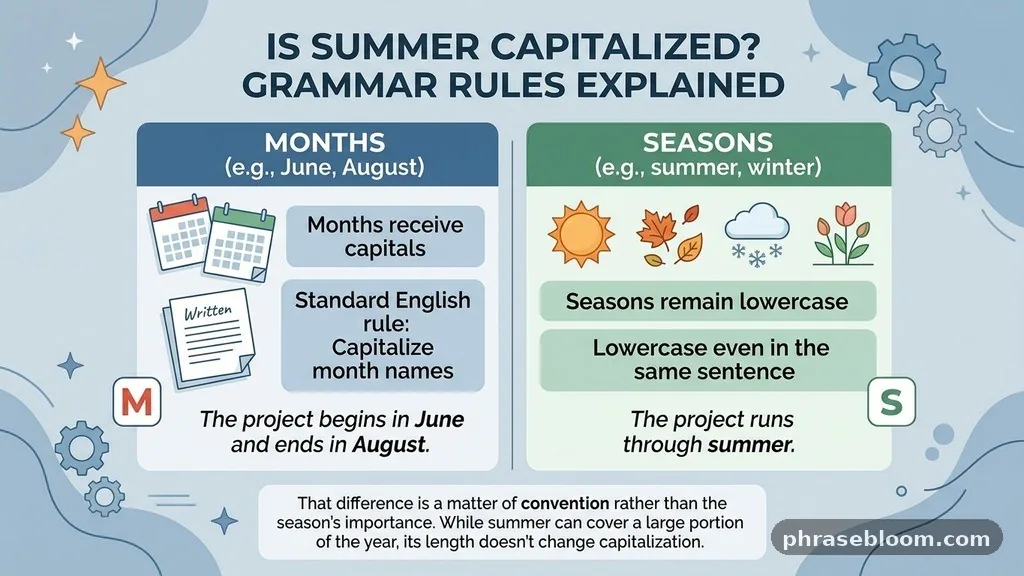
Months receive capitals in standard English: “The project begins in June and ends in August.” A season in the same sentence remains lowercase: “The project runs through the summer.”
That difference is a matter of convention rather than the season’s importance. Summer can cover a large part of the year, but length and cultural importance do not turn a common noun into a proper noun.
Capitalization rules also apply consistently in related expressions. Use “summer break,” “spring semester,” “fall enrollment,” and “winter conditions” unless one of those phrases belongs to an official name or appears in a position that requires capitalization.
The dictionary definition of summer reflects its ordinary status as a season and common noun. A dictionary can clarify meaning and usage, but an organization’s style guide may still determine how the word appears in headings, labels, or branded material.
When Summer Must Be Capitalized
The first and most obvious exception occurs at the start of a sentence. Because English capitalizes the first word of a sentence, write “Summer is my favorite season,” even though the word would be lowercase in the middle of a sentence.
This is a rule about sentence beginnings, not a special rule about summer. The same pattern appears in “Winter arrived early” and “Spring brought heavy rain.”
Official Names and Proper Nouns
Capitalize summer when it forms part of a recognized proper noun or official title. For example, an organization might formally name its annual event “Summer Leadership Institute,” while a university may call a course “Summer Session Writing Workshop.”
The capital letters in those examples come from the name itself. If you are referring to the event generically, lowercase may be appropriate: “The institute offers a summer leadership program.”
Names connected with major international events can also use capitals when the event’s official name does so. “Summer Olympics” may appear in a formal name, while “Olympic events held during the summer” uses lowercase because summer is descriptive rather than part of a title.
Titles, Headings, and Labels
Titles create a separate issue because publishers use different systems. In title case, important words are capitalized, so “How to Prepare for Summer Travel” normally gives Summer a capital letter.
In sentence case, only the first word and proper nouns are capitalized, so the same heading may appear as “How to prepare for summer travel.” Neither format is automatically wrong; the publication’s headline style controls the result.
A calendar or software interface may use “Summer 2026” as a label. That capital letter may reflect the design system or the name of a program period rather than a universal rule that all season names require capitals.
Summer Capitalization in Titles and Headings
Titles deserve special attention because title case and sentence case produce visibly different results. Writers often see “Summer” capitalized in books, articles, course catalogs, and marketing campaigns, then assume the word must always be capitalized.
In title case, nouns, verbs, adjectives, adverbs, pronouns, and other major words usually receive capitals. A heading such as “Summer Safety Tips for Families” therefore capitalizes Summer because it is a noun and a major title word.
In sentence case, the heading follows ordinary sentence capitalization. The same heading becomes “Summer safety tips for families,” with Summer capitalized only because it is the first word.
Headline Style Is Not Ordinary Prose
Compare these examples:
- Heading in title case: “Summer Travel Checklist”
- Heading in sentence case: “Summer travel checklist”
- Sentence in body copy: “Use this summer travel checklist before your trip.”
- Official program name: “The Summer Travel Fellowship opens in May.”
The body sentence uses lowercase because summer is a common noun in the middle of ordinary prose. The first two versions depend on the publication’s heading style, while the fourth treats the phrase as an official name.
Marketing materials sometimes capitalize season names for visual emphasis, even when the wording is not a formal title. A brand may write “Make This Summer Count,” but promotional styling should not be mistaken for a general grammar requirement.
The AP Stylebook, Chicago Manual of Style, MLA style, and APA Style all place strong emphasis on consistency and context, although the details of heading capitalization and title formatting differ. If you are preparing academic writing, follow the style system assigned by your instructor, journal, or institution rather than mixing conventions from several systems.
Examples of Summer in Real Sentences
Seeing the word in practical contexts makes the rule easier to apply. In the following examples, lowercase summer is the normal choice because the word is a general noun or modifier.
| Context | Correct example | Why the form works |
|---|---|---|
| Ordinary statement | We visit the coast every summer. | Summer is a common noun in the middle of a sentence. |
| Compound phrase | The summer schedule is posted online. | Summer modifies schedule and remains lowercase. |
| Sentence beginning | Summer brings longer evenings. | The capital letter is required at the beginning. |
| Title case heading | Preparing for Summer Travel | Summer is a major word in the heading. |
| Sentence case heading | Preparing for summer travel | Only the first word is capitalized. |
| Official name | She enrolled in the Summer Scholars Program. | Summer is part of a formal program name. |
Consider the workplace sentence “The company will publish its summer hiring plan in April.” Here, summer describes the kind of hiring plan, so lowercase is appropriate.
Now compare “Summer Hiring Plan 2026,” which might be the official name of a document. If the organization consistently treats that phrase as a formal document title, capitals can be justified.
The same distinction applies to “summer vacation” and “Summer Vacation,” “summer reading” and “Summer Reading,” or “summer camp” and “Summer Camp.” The capitalized versions may appear in a title, a named program, or a brand, but the generic versions normally stay lowercase.
Academic and Formal Writing Rules
Academic writing should normally use lowercase season names in running text. A research paper might state, “The survey was conducted during the summer of 2024,” or “Participants were recruited in the winter months.”
Do not capitalize summer simply because the paper is formal. Formal writing requires precision and consistency, not extra capital letters.
Dates, Terms, and Academic Sessions
Universities and schools often capitalize labels such as “Summer 2026,” “Fall Term,” or “Spring Semester.” These may be administrative names used in catalogs, registration systems, and official notices.
In a sentence, however, the generic wording may be lowercase: “Students may register for summer courses beginning in March.” If “Summer Session” is the institution’s formal name for a division or enrollment period, its official capitalization can remain.
Academic style systems also affect titles, headings, references, and captions. A paper formatted in APA Style may use a different heading system from a paper following MLA style, while Chicago style may provide another approach to titles and capitalization.
Research and Historical Writing
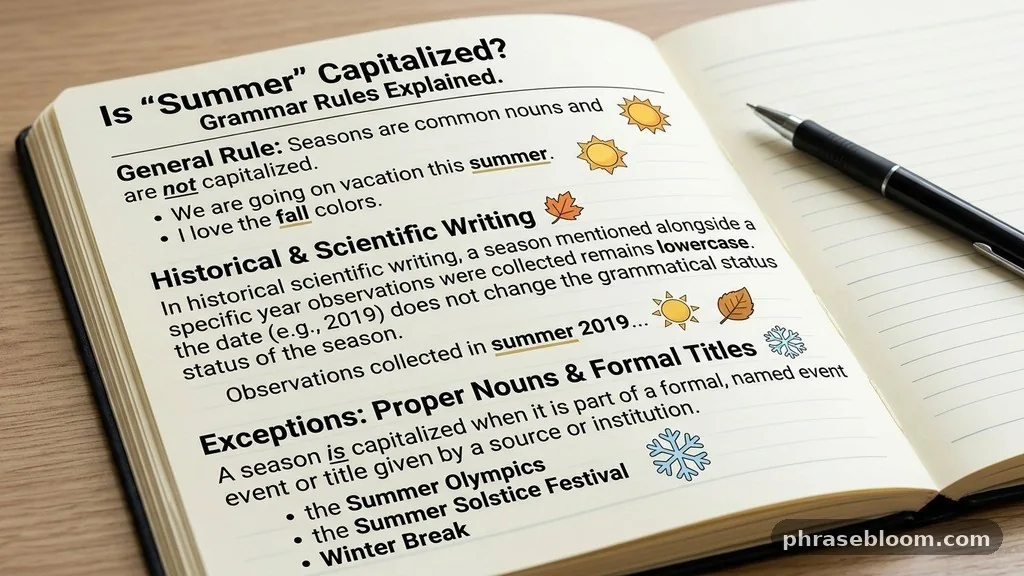
Historical and scientific writing sometimes includes a season alongside a year: “The observations were collected in summer 2019.” The season remains lowercase because the date does not change its grammatical status.
A named historical event may be different. If a source or institution gives an event a formal title containing Summer, preserve that title’s established capitalization when referring to it as a name.
Editors should also distinguish a quotation from the surrounding prose. If a source writes “Summer Initiative” as an official title, reproduce it accurately when the title matters, but do not generalize that capitalization to every use of summer in your own sentences.
American English, British English, and Style Guides
American English and British English generally agree that ordinary season names are lowercase. It would be misleading to claim that company, school, or publication style can be predicted solely from national variety.
Both American and British writers use lowercase in phrases such as “during the summer,” “summer holidays,” and “the summer months.” Both also capitalize the word at the beginning of a sentence and in many titles.
Differences can arise from editorial preferences, especially in headings, event names, and institutional labels. One British publication may use sentence case for all headings, while an American organization may use title case; the visible capitalization will differ even though the underlying grammar is not fundamentally different.
Why Style Guides Matter
A style guide establishes decisions that might otherwise vary from page to page. It can specify title case, sentence case, treatment of official names, capitalization in headings, and how to handle branded terms.
The AP Stylebook is widely used in journalism and public-facing communications. The Chicago Manual of Style is common in book publishing and many formal editorial settings, while MLA style and APA Style are frequently used in academic contexts.
These systems should not be treated as interchangeable. If a professor requires APA Style, follow that requirement; if a newspaper has an internal headline policy, follow the publication’s policy.
Neither American English nor British English makes every capitalization decision for you. The practical priority is to identify the governing style, check the organization’s examples, and apply the same rule throughout the document.
Common Mistakes With Summer Capitalization
Most errors come from treating one visible example as a universal rule. A writer sees “Summer Reading Program” on a poster and then capitalizes summer in every sentence, including “Children enjoy Summer reading during school breaks.”
The second sentence should normally read “Children enjoy summer reading during school breaks,” unless Summer Reading is the official name of a specific program.
Capitalizing Every Season
Another common mistake is writing “Spring, Summer, Fall, and Winter” in ordinary prose. The standard form is “spring, summer, fall, and winter.” Capitalize the first word only when the list begins a sentence.
Using Title Case in Body Text
Headings may use title case, but body paragraphs usually do not. “Summer Health Guidelines” may be a heading, while the paragraph below should say, “These summer health guidelines apply to all employees.”
Confusing Branding With Grammar
Companies often capitalize words for brand identity. A business may call its seasonal campaign “Summer Strong,” even though the normal phrase “summer campaign” remains lowercase.
Brand styling should be copied when you are referring to the brand, but it should not control unrelated sentences. Official names are exceptions to ordinary capitalization, not evidence that the ordinary rule has changed.
Changing Style Midway Through a Document
Inconsistent capitalization can make a report look unfinished. If the first heading says “Summer Training Schedule,” do not switch later to “summer training schedule” unless the document intentionally changes from title case to sentence case.
Create a simple internal rule before editing. For example, use sentence case for headings, lowercase season names in prose, and official capitalization only for registered or formally named programs.
How to Choose the Correct Form
When you are unsure about summer capitalization, ask what role the word plays in the sentence. This quick process usually produces the right answer without requiring a complicated grammar analysis.
- Check the position. If summer begins the sentence, capitalize it.
- Check the function. If it is a general season or modifier, lowercase it.
- Check the name. If it belongs to an official title, preserve the title’s capitalization.
- Check the format. If the text is a heading, identify whether the document uses title case or sentence case.
- Check the style guide. Follow the applicable academic, editorial, or organizational rules.
- Check consistency. Apply the same decision to comparable uses of spring, fall, and winter.
For example, suppose you are writing an employee notice. In the sentence “The summer schedule begins June 1,” use lowercase. If the notice is titled “Summer Schedule Changes,” the title may use a capital because the heading uses title case.
If your sentence feels awkward, rewriting can help. Instead of “Summer enrollment begins soon,” you could write “Enrollment for the summer term begins soon,” but rewriting is not necessary merely to avoid a capital letter.
For international audiences, plain sentence-style capitalization is often the easiest approach. It keeps ordinary prose predictable and leaves capitals for sentence beginnings, proper nouns, formal names, and clearly defined headings.
Professional Writing and Workplace Usage
Business emails usually use lowercase summer in ordinary sentences: “We will review the summer staffing plan on Friday.” A subject line such as “Summer Staffing Plan” may use title case if that matches the company’s email convention.
Employee handbooks should distinguish generic descriptions from formal policy titles. Write “The summer schedule may change according to staffing needs,” but capitalize a named document if the organization formally calls it the “Summer Scheduling Policy.”
Legal and policy documents benefit from consistency more than decorative capitalization. If a policy defines “Summer Period” as a special term, the document may capitalize it after defining the term, but that is a drafting choice that should be applied consistently and explained clearly.
Business reports often use sentence case for headings because it is readable and easy to maintain. A report might contain the heading “Summer sales results” and the sentence “Summer sales increased in several regions.”
Websites and software interfaces may follow a design system. Navigation labels such as “Summer Programs” can use title case, while explanatory text uses lowercase. The same organization can use both forms correctly if each follows a clear interface or editorial rule.
Marketing copy is more flexible, but flexibility does not remove the need for intention. “Make summer memorable” uses ordinary sentence styling, while “Make Summer Memorable” may be a campaign headline.
Quick Comparison of Summer Capitalization
The table below separates ordinary usage from contexts that create a legitimate capital letter. It is not a list of different meanings. In most cases, the word still refers to the same season.
| Form | Example | Typical context | Recommendation |
|---|---|---|---|
| summer | We work during the summer. | Ordinary body text | Use as the default form. |
| Summer | Summer begins in June. | Beginning of a sentence | Capitalize because of sentence position. |
| Summer | Summer Leadership Institute | Official name or formal title | Follow the established name. |
| Summer | Preparing for Summer Travel | Title-case heading | Follow the publication’s heading style. |
| summer | Preparing for summer travel | Sentence-case heading | Use lowercase unless another rule applies. |
A useful distinction is that capitalization does not necessarily signal a change in meaning. “Summer travel” and “Summer Travel” may refer to the same subject, with the second version capitalized because it is a title or label.
Writers should therefore avoid asking only, “Is summer a capitalized word?” The better question is, “Why is this particular use appearing here?” Its position, title status, and naming function provide the answer.
Examples You Can Copy and Adapt
These examples show how the rule works across everyday, academic, workplace, and public communication. They are written as complete sentences so you can compare the capitalization in context.
- “The summer training schedule will be available on Monday.”
- “Summer begins on June 20 this year.”
- “Please submit your summer vacation request by May 1.”
- “The department introduced a Summer Internship Program for university students.”
- “Our summer newsletter includes updates from every regional office.”
- “The report compares energy use during summer and winter.”
- “Summer Orientation begins with a welcome session for new students.”
- “The museum’s summer exhibition opens next week.”
- “The course is listed under the university’s Summer Session catalog.”
- “We will review the summer hiring plan at the next meeting.”
In the first, third, fifth, sixth, and eighth examples, summer is a general descriptive word. In the fourth, seventh, and ninth, capitalization may be appropriate because the phrase is presented as the name of a program, event, or institutional division.
The surrounding document matters. If “Summer Internship Program” is only a descriptive phrase rather than the organization’s official title, lowercase may be more appropriate: “The company offers a summer internship program.”
For a public webpage, choose one heading format and use it throughout. A page with “Summer Programs,” “Summer Events,” and “Summer Resources” in title case should not unexpectedly switch to “Fall events” unless the style has changed deliberately.
Frequently Asked Questions
Is summer capitalized in a sentence?
Usually, no. Write summer in lowercase when it refers to the season in ordinary prose, but capitalize it at the beginning of a sentence, in a title that requires it, or as part of an official name.
Is “summer” a proper noun?
Normally, summer is a common noun, like winter, spring, and fall. It becomes capitalized only when another rule applies, such as a sentence beginning, a formal title, or a proper name.
Should summer be capitalized in a title?
It depends on the title style. Title case usually capitalizes Summer because it is a major word, while sentence case normally capitalizes it only if it begins the title. Follow the style used by the publication, school, or organization.
Is “Summer Session” always capitalized?
No. Capitalize it when it is the official name of an academic division, term, or program. Use lowercase in a generic phrase such as “students can take courses during the summer session.”
Does American or British English use a different rule?
Both varieties generally use lowercase for ordinary references to the season. Differences usually come from house style, heading conventions, or official names rather than a strict American-versus-British rule.
Final Rule for Summer Capitalization
The normal form is summer in lowercase: “We plan to move in the summer.” Use Summer when the word begins a sentence, appears in a title or heading that requires title case, or belongs to an official name such as a formally named program.
That is the practical answer to “Is Summer Capitalized? Grammar Rules Explained.” When in doubt, check the document’s style guide, identify whether the phrase is generic or official, and keep comparable uses consistent. Apply the same care to spring, fall, and winter, and your seasonal references will look natural in both everyday and formal writing.
Explore more on PhraseBloom.
1 thought on “Is Summer Capitalized? Grammar Rules Explained?”