
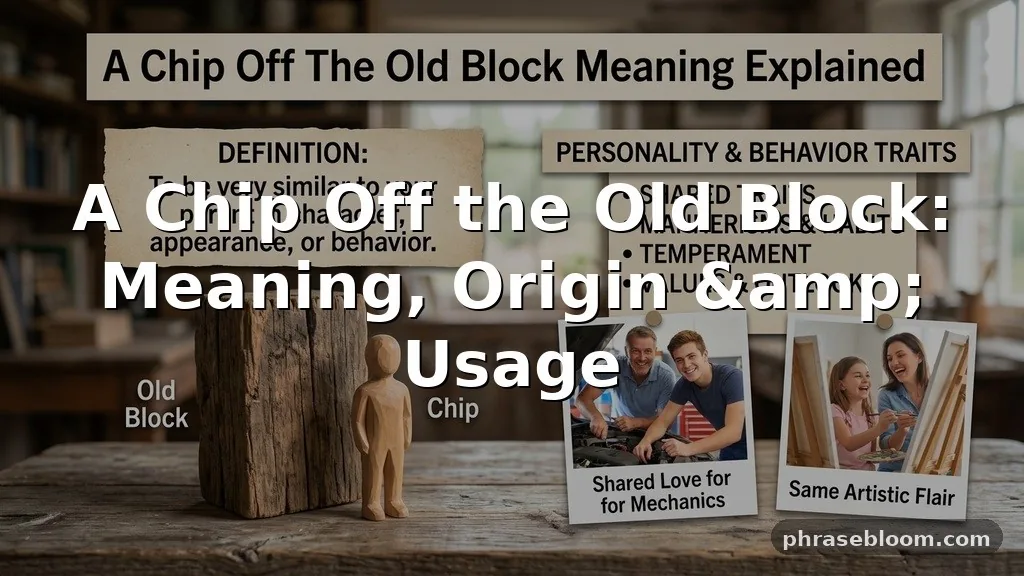
The expression “a chip off the old block” describes someone who strongly resembles a parent, usually in personality, behavior, talents, or appearance. If a daughter has her father’s sharp wit or a son has his mother’s patience and musical ability, someone might call that child a chip off the old block.
This English idiom is usually affectionate, though its tone depends on context. You’ll learn the idiom meaning, expression origin, modern usage, related phrases, and practical examples so you can recognize and use it naturally in conversation and writing.
What “A Chip Off the Old Block” Means
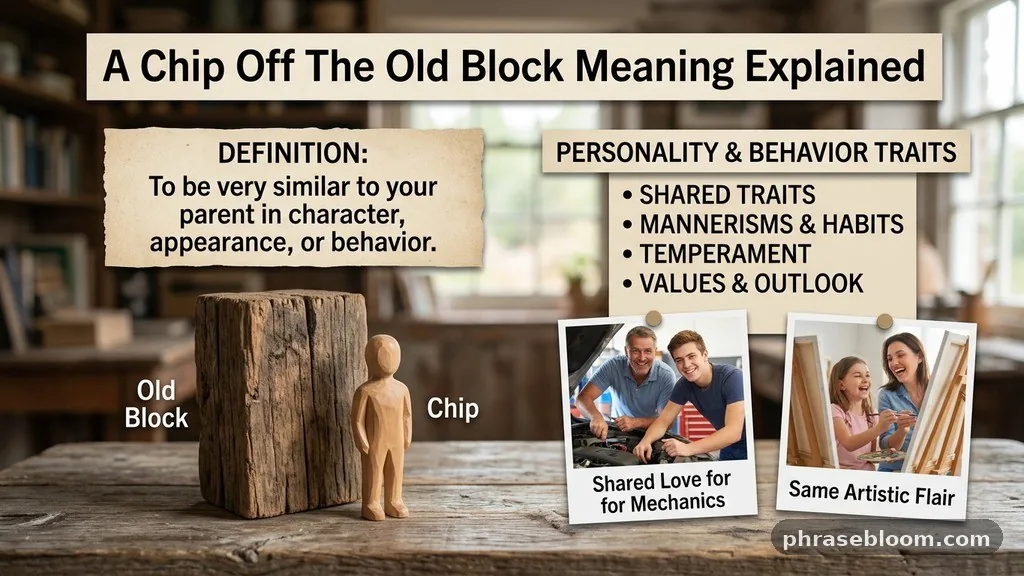
“A chip off the old block” means a person resembles one of their parents in a noticeable way. The resemblance may involve physical appearance, personality traits, behavior, talents, skills, values, or even familiar habits.
The phrase is figurative language. It does not suggest that a child was literally cut from a piece of wood. Instead, it creates an image of a small piece, or “chip,” broken from a larger block and therefore made of the same material.
In ordinary use, the “old block” represents the parent, while the “chip” represents the child. The expression often highlights family resemblance, but it can also point to a shared family legacy or a recognizable way of doing things.
For example, if Marcus repairs every broken appliance in his house just as his father did, a friend might say, “Marcus is a chip off the old block.” The comment may refer to practical skills rather than physical appearance.
The phrase is commonly used about children and parents, but the comparison does not have to be limited to a biological relationship. A person may resemble a mentor, grandparent, guardian, or other influential adult in a similar way, although the traditional expression most often involves parent-child resemblance.
Its meaning is generally positive or warmly humorous. A speaker may use it to praise a child for inheriting a parent’s courage, generosity, creativity, discipline, or professional ability.
- Physical resemblance: “She has the same smile as her mother.”
- Personality: “He is just as patient as his father.”
- Behavior: “Like his grandfather, he always arrives early.”
- Talents: “She inherited her father’s gift for storytelling.”
- Values: “He takes community service as seriously as his parents do.”
The phrase can also be mildly teasing. If someone repeats a parent’s stubborn habits, questionable jokes, or dramatic reactions, relatives may call that person a chip off the old block without intending it as a serious compliment.
The Idiom’s Origin and Wooden Image
The expression’s central image comes from woodworking. A block is a larger piece of wood, while a chip is a smaller piece that comes from it. Because the chip has the same material and often the same grain or color, it naturally suggests something that resembles its source.
That image makes the idiom easy to understand even for someone hearing it for the first time. The child is not identical to the parent, just as a chip is not the whole block, but the two share an obvious connection.
The exact moment when the phrase entered everyday English is difficult to identify with complete certainty. Expressions often develop through speech before writers record them, and similar ideas have appeared in several languages and cultural traditions.
English speakers have used the phrase for centuries to describe a person who takes after a parent. Its continued survival comes partly from its strong visual metaphor. A listener can picture the relationship without needing a technical explanation of heredity.
The wording also reflects an older style of expression in which family identity was described through materials, crafts, and lineage. Woodworking was familiar to many communities, so the comparison would have felt concrete rather than abstract.
For a deeper reference on the phrase’s definition and established usage, consult this dictionary entry for “chip off the old block”. A dictionary can confirm the conventional meaning, while context determines whether the expression sounds affectionate, humorous, or critical.
The idiom’s origin does not mean that it makes a scientific claim about inherited traits. A child may resemble a parent because of genetics, learned behavior, shared surroundings, or simple coincidence. The expression compresses all of those possibilities into a colorful social observation.
It also does not imply that children are exact copies. The “chip” remains a separate piece. That distinction matters because the phrase can acknowledge similarity while leaving room for an individual identity.
Why the Expression Is Usually Positive
People often use “a chip off the old block” when a child demonstrates a quality the family admires. A parent may feel proud if a child shows the same commitment to teaching, craftsmanship, public service, athletics, or music.
Consider a family-owned bakery. If a daughter learns the family’s recipes, manages the morning production, and greets customers with the same warmth as her mother, customers may describe her as a chip off the old block.
The compliment is not limited to inherited talent. It can refer to values that a child has absorbed through years of observation and participation. Honesty, patience, resilience, generosity, and loyalty are all qualities that can produce a family resemblance in behavior.
Sometimes the phrase praises a parent indirectly. Calling a child a chip off the old block suggests that the parent possesses a quality worth recognizing. If the child is brave, skilled, or dependable, the parent may receive some reflected credit.
Still, the expression is not always entirely complimentary. A person might say, “He’s a chip off the old block,” after a child makes the same impulsive decision that a parent is known for making.
Tone does most of the work. A smile, warm voice, or approving context usually makes the phrase positive, while a sarcastic tone can turn it into gentle criticism.
Writers should therefore consider the surrounding details. If the sentence describes a child’s admirable achievement, readers will likely interpret the idiom as praise. If the sentence follows a foolish or harmful act, the same words may sound ironic.
The phrase can also be used affectionately even when the shared trait is ordinary. A father who always loses his keys may laugh when his daughter begins doing the same thing and say, “You’re a chip off the old block.”
Family Resemblance Beyond Physical Appearance
Many people first associate the idiom with facial features. A child may have a parent’s eyes, posture, voice, hair, or distinctive smile, making the family connection immediately visible.
Physical appearance is only one kind of resemblance, however. The phrase often refers to less visible qualities that emerge through behavior and repeated choices.
Personality and Behavior
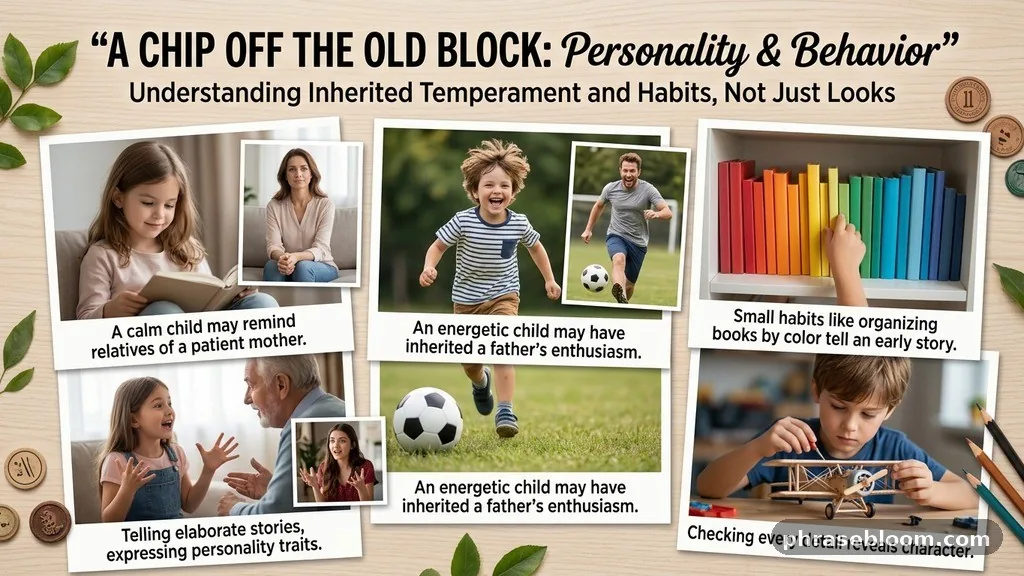
A calm child may remind relatives of a patient mother. An energetic child may seem to have inherited a father’s enthusiasm. These comparisons concern temperament, not facial features.
Family members may also notice small habits. A child who organizes books by color, tells elaborate stories, or checks every detail before leaving home may imitate a parent without realizing it.
Talents and Skills
Shared talents make the idiom especially natural. A young musician who learns an instrument quickly may be called a chip off the old block if a parent is also an accomplished musician.
The same applies to cooking, carpentry, coding, public speaking, negotiation, athletics, writing, or mechanical work. The expression points to a recognizable connection, not necessarily to a talent that was directly taught.
Values and Worldview
Shared values can create a strong family resemblance even when no physical similarity exists. A child who volunteers regularly, protects younger siblings, or treats customers with unusual respect may reflect a parent’s example.
This broader use shows why the idiom remains useful. It describes the way families pass along habits and standards through both inherited tendencies and daily influence.
The phrase can also describe a family legacy. A lawyer’s child who enters law, a farmer’s child who continues the farm, or a teacher’s child who chooses education may be called a chip off the old block, especially when the child adopts a similar approach to the work.
How to Use the Idiom in a Sentence
“A chip off the old block” is a noun phrase. It usually follows a linking verb such as “is,” “looks,” or “seems,” or appears after a verb such as “call” or “prove.”
Here are natural usage examples:
- “Nina is a chip off the old block; she has her father’s patience with difficult customers.”
- “After watching Leo repair the bicycle, his uncle laughed and called him a chip off the old block.”
- “The young chef is a chip off the old block, using the same careful techniques as her mother.”
- “He may look different from his grandfather, but his dry sense of humor makes him a chip off the old block.”
- “When Priya organized the neighborhood fundraiser, everyone saw that she was a chip off the old block.”
The expression normally takes the article “a.” Saying “She is chip off the old block” is incorrect because the singular countable noun “chip” needs a determiner in this construction.
The phrase can appear at the beginning, middle, or end of a sentence. Its position does not substantially change its meaning, although the surrounding sentence controls what kind of resemblance the reader understands.
At the beginning, it can introduce a comparison: “A chip off the old block, Daniel handled the negotiation with the same calm confidence as his mother.” This form is grammatical but slightly more literary than the everyday version.
In conversation, speakers often use a shorter form such as “He’s a chip off the old block.” The missing explanation is supplied by the situation, a visible family resemblance, or the trait just mentioned.
Use the phrase with “like father, like son” or “like mother, like daughter” only when the context supports it. Those related expressions emphasize a specific parent-child similarity, while “a chip off the old block” can refer to either parent and often sounds more flexible.
Related Expressions and Their Differences
English has several expressions for family resemblance, but they do not all carry exactly the same emphasis. Choosing among them depends on whether you want to stress appearance, behavior, gender, inheritance, or learned influence.
“Like Father, Like Son”
“Like father, like son” specifically compares a father and son. It can refer to appearance, conduct, interests, or life choices, but its wording excludes daughters and other parent-child combinations.
“Like Mother, Like Daughter”
“Like mother, like daughter” is the corresponding expression for a mother and daughter. It is useful when that exact relationship matters, but it can sound less inclusive than the gender-neutral “a chip off the old block.”
“Runs in the Family”
“Runs in the family” suggests that a trait appears among several relatives rather than in only one parent and one child. It may describe height, musical ability, a profession, a medical condition, or a particular sense of humor.
“Takes After”
“Takes after” is a direct and versatile alternative. “Maya takes after her grandfather” can describe physical appearance, personality, voice, interests, or habits without the metaphorical tone of the idiom.
“The Apple Doesn’t Fall Far from the Tree”
This familiar expression has a meaning close to “a chip off the old block.” It suggests that a child’s character or behavior is not far removed from a parent’s. Depending on context, it can sound admiring, humorous, or critical.
These alternatives help writers vary their language. They also allow you to be more precise when the relationship or type of similarity needs to be clear.
| Expression | Main emphasis | Typical tone | Example |
|---|---|---|---|
| A chip off the old block | General resemblance to a parent | Affectionate or humorous | “She’s a chip off the old block.” |
| Like father, like son | Father and son similarity | Warm, admiring, or teasing | “Like father, like son, they both love sailing.” |
| Runs in the family | A trait shared by several relatives | Neutral or conversational | “A talent for music runs in the family.” |
| Takes after | Directly resembles a relative | Neutral and flexible | “She takes after her aunt.” |
| The apple doesn’t fall far from the tree | A child reflects a parent’s character | Warm, witty, or critical | “The apple doesn’t fall far from the tree.” |
When the Phrase Can Be Sensitive
Although the idiom is usually friendly, it can oversimplify a person. Children are influenced by parents, but they also develop through friendships, education, culture, personal choices, and experiences outside the family.
Calling someone a chip off the old block may sound unfair if it suggests that the person has no separate identity. This is especially true when the comparison concerns a parent’s negative behavior, public reputation, or controversial decisions.
Context matters in professional and public writing. A journalist describing a child’s career may use the expression lightly, but the phrase could seem dismissive if it reduces the child’s achievements to family inheritance.
Writers should also avoid assuming that resemblance comes only from biology. Adopted children, stepchildren, foster children, and students may share values or habits with the adults who raised or mentored them.
The expression can be used respectfully by naming the specific quality involved. “She’s a chip off the old block, with her mother’s gift for patient coaching” is clearer and kinder than using the idiom without explanation.
Be careful with comparisons involving health, disability, trauma, addiction, or other sensitive subjects. A phrase intended as a joke may appear to assign blame or predict a child’s future based on a parent’s circumstances.
In fiction and dialogue, the idiom can reveal a speaker’s attitude. A proud grandparent may use it lovingly, while a skeptical character may use it to suggest that a younger person is repeating an older generation’s mistakes.
That flexibility makes the phrase expressive, but it also means that readers rely on context. Add a brief explanation when the intended tone could be misunderstood.
Common Mistakes and Better Choices
One common mistake is treating the phrase as a literal description. The expression is figurative, so it should be used to discuss resemblance, influence, or inherited qualities rather than an actual piece of wood.
Another mistake is leaving out the article. Write “He is a chip off the old block,” not “He is chip off the old block.” The article is part of the standard expression.
Writers sometimes use the idiom when they mean only that two people look alike. In that situation, “She looks just like her father” may be clearer because it identifies physical appearance directly.
The reverse problem also occurs. If the point involves shared ambition, humor, or work ethic, “They look alike” is too narrow. “A chip off the old block” gives the reader room to understand a broader family resemblance.
Do not assume that the phrase proves a trait was genetically inherited. A child may learn a parent’s habits by observing them for years. The idiom is about perceived similarity, not a scientific explanation.
Another error is using the expression in a way that ignores the family relationship. If a person resembles a colleague or friend who is not a parent or parental figure, “cut from the same cloth” may be more appropriate.
Finally, avoid repeating the idiom so often that it becomes predictable. Once you have established the family connection, use specific language such as “She has her father’s dry humor” or “He learned his mother’s careful approach to design.”
Examples for Conversation, Writing, and Storytelling
In everyday conversation, the expression often appears after someone notices a familiar habit. “You brought three notebooks to a short meeting? You’re a chip off the old block,” a parent might say to a child who shares the parent’s preparation habits.
In a workplace profile, the idiom can connect generations without sounding overly formal. “As the third generation to join the workshop, Elena is a chip off the old block, combining her grandfather’s precision with her own interest in modern design.”
In a school setting, a teacher might write, “Sam is a chip off the old block, showing the same curiosity and patience that his mother displayed during last year’s science fair.” The sentence identifies the specific qualities rather than leaving the meaning vague.
In a family story, the phrase can add warmth: “Grandpa watched Theo tune the old piano and smiled. ‘A chip off the old block,’ he said, remembering Theo’s great-grandmother.”
In marketing or public communication, use the idiom only if the audience will understand its informal tone. A family business may use it effectively in a campaign, while a highly technical corporate report would probably benefit from more direct wording.
Here are additional examples that show different shades of meaning:
- “Her quick laugh and generous spirit make her a chip off the old block.”
- “The young engineer solved the design problem with the same inventive approach as his father.”
- “He isn’t a chip off the old block in appearance, but his mother’s determination is unmistakable.”
- “The twins both inherited their grandmother’s talent for turning ordinary stories into entertaining ones.”
- “After the team watched her negotiate, they joked that she was a chip off the old block.”
- “The phrase fits, but her achievements are also distinctly her own.”
Notice that the idiom works best when the reader can identify the shared quality. A bare statement may be understandable, but a concrete detail makes the comparison more vivid and less clichéd.
How the Idiom Works in Modern English
“A chip off the old block” remains common because it is short, memorable, and adaptable. It can fit a family conversation, a novel, a newspaper feature, a speech, or a personal essay.
Its grammar is stable, but its reference can be broad. The “old block” may mean a parent’s character, profession, habits, appearance, reputation, or approach to life. The sentence around it tells the reader which interpretation is intended.
The phrase is also relatively informal. It is suitable for most general writing, but a formal report may call for a direct statement such as “The daughter demonstrates the same leadership style as her mother.”
That does not make the idiom incorrect in formal writing. It simply means that tone and purpose should guide the choice. An editorial column may welcome the phrase, while a legal document usually benefits from literal precision.
The expression can describe adults as well as children. Someone in their forties may still be called a chip off the old block if their career, temperament, or manner strongly recalls a parent.
It can also be used retrospectively. A person may say, “I didn’t realize it when I was young, but I’m a chip off the old block,” after noticing that they have adopted a parent’s routines or priorities.
Modern speakers may use the phrase with humor because family resemblance is often revealed through small, familiar details. A shared catchphrase, cooking method, dance move, or reaction to bad weather can be enough.
At the same time, contemporary writing often pairs the idiom with a statement of individuality. “She’s a chip off the old block, but she has built a career in a field her family never entered” recognizes both connection and independence.
Frequently Asked Questions
What is the idiom meaning of “a chip off the old block”?
It means that someone resembles a parent or another influential older relative in appearance, personality, behavior, talents, skills, or values. The phrase is usually affectionate or humorous.
Is “a chip off the old block” always positive?
No. It is commonly a compliment, but tone and context can make it teasing or critical. The expression may refer to an admirable family trait or to an unwanted habit that a child has repeated.
Does the phrase refer only to physical resemblance?
No. It may describe physical appearance, but it often refers to personality traits, behavior, talents, work habits, values, or a shared family legacy.
What is a good alternative to “a chip off the old block”?
Depending on your meaning, you can use “takes after,” “runs in the family,” “like father, like son,” “like mother, like daughter,” or “the apple doesn’t fall far from the tree.” A direct sentence such as “She has her father’s patience” may be clearest.
Can the phrase be used for someone who is not a biological child?
Yes. The idiom can describe a child who resembles an adoptive parent, guardian, mentor, or other influential adult in behavior or values. The key idea is a strong perceived resemblance, not a biological test.
Final Takeaway
“A chip off the old block” is a flexible English idiom for a person who strongly resembles a parent or parental figure. Its image comes from a small piece of wood sharing the character of the larger block, while its modern use covers appearance, behavior, talents, skills, and values.
Use it when the tone is warm, conversational, or lightly humorous, and name the shared quality if clarity matters. Remember that a child can be a chip off the old block without being a copy, because family resemblance and individual identity can exist together.
Related reading: Takes One to Know One, Minuet vs Minute, Too Many Irons in the Fire.
Explore more on PhraseBloom.