
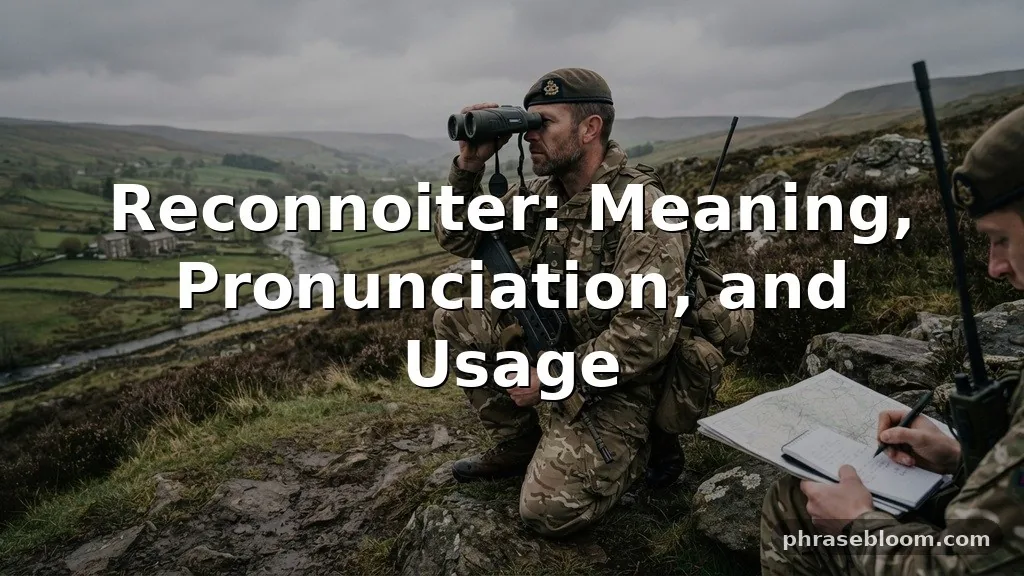
The verb reconnoiter means to inspect, survey, or explore an area in order to gather information before making a decision or taking action. It often appears in military contexts, but writers also use it for scouting a route, examining a site, or studying a situation carefully.
The word can look more difficult than it is. Its pronunciation, British spelling, military connection, and difference from simpler words such as “look” or “explore” all affect how it works in a sentence. This article explains the reconnoiter meaning, origin, pronunciation, synonyms, and practical usage in clear modern English.
Reconnoiter Definition and Basic Meaning
To reconnoiter means to examine a place or situation in advance so that you can understand it better. The activity usually has a practical purpose: someone wants information about roads, terrain, conditions, risks, resources, or possible movements.
A simple reconnoiter definition is “to scout or survey an area.” The word suggests a deliberate inspection rather than a casual glance. If a hiking group reconnoiters a mountain pass, for example, the group is checking the pass before deciding whether and how to cross it.
Military reconnaissance provides the clearest traditional example. Soldiers may reconnoiter a road, bridge, shoreline, or hill to learn about its condition and identify possible dangers. The action can involve observation from a distance, physical inspection, mapping, photography, or other forms of information gathering.
The word does not necessarily imply secrecy, danger, or military action. A construction team may reconnoiter a proposed building site, and a journalist may reconnoiter a neighborhood before reporting there. In both cases, the central idea is preparation through direct observation.
In ordinary language, reconnoiter can often be replaced by “inspect,” “survey,” “scout,” or “look over.” However, it has a more focused meaning than the general verb “look.” It usually implies that the person is gathering useful information for a later plan, decision, or operation.
- Military use: Soldiers reconnoiter terrain before an operation.
- Travel use: Travelers reconnoiter a route before beginning a difficult journey.
- Business use: A company may reconnoiter a market before opening a new location.
- Practical use: A team can reconnoiter a venue before holding a large event.
The verb is usually transitive, which means it can take a direct object. You can reconnoiter a valley, a neighborhood, a site, a route, or the surrounding terrain. It can also appear without an object when the context already makes the location clear: “The patrol went ahead to reconnoiter.”
How to Pronounce Reconnoiter
The standard American pronunciation of reconnoiter is commonly represented as /ˌrɛkəˈnɔɪtər/. In a simple pronunciation guide, it sounds roughly like rek-uh-NOY-ter, with the main stress on the “noy” syllable.
The first part resembles “reck-uh,” while the middle sounds like “noy,” as in “noise” without the final “z” sound. The last part is usually pronounced “ter” in American English. The word has four syllables in careful speech: rek, uh, noy, ter.
For a reliable audio model and dictionary entry, consult the Merriam-Webster entry for reconnoiter. Dictionary audio can be especially useful because stress matters more than perfect individual sounds. A misplaced stress may make the word harder for listeners to recognize.
Reconnoiter pronunciation in British English
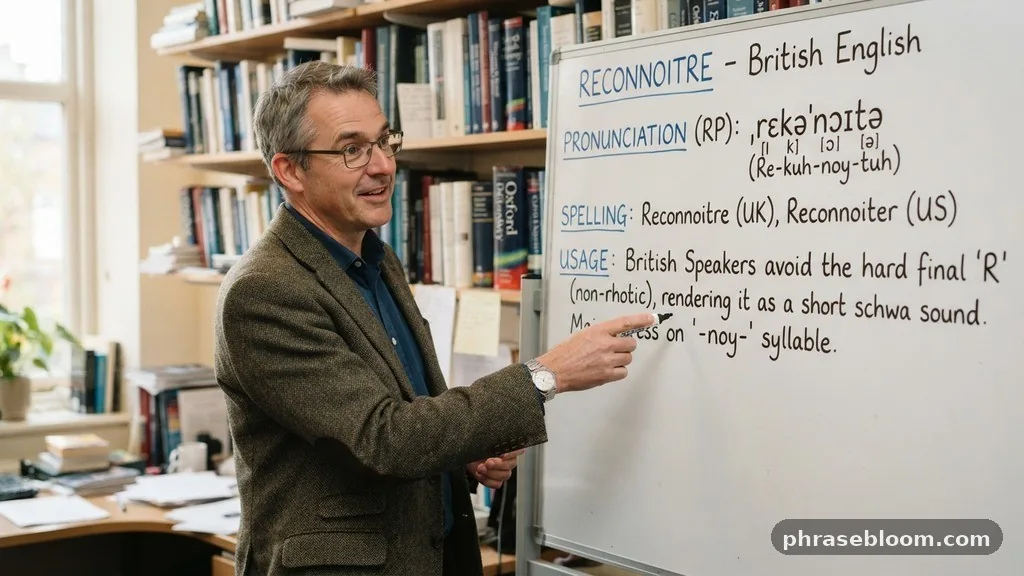
British speakers use the related spelling reconnoitre, and the final sound may be shorter because many British accents do not pronounce the final “r” in the same way as most American accents. A broad pronunciation guide for the British form is approximately /ˌrɛkəˈnɔɪtə/.
The main stress remains on the “noy” sound. Whether a speaker says “rek-uh-NOY-ter” or “rek-uh-NOY-tuh,” listeners will usually understand the word from context.
When learning how to pronounce reconnoiter, focus on three features: the four-part rhythm, the “noy” sound, and the stress on the third syllable. Avoid stressing the first syllable too strongly, since “REK-uh-noy-ter” does not reflect the most common pronunciation.
Reconnoiter Meaning in Context
The reconnoiter meaning becomes clearer when you compare it with nearby verbs. “Explore” can mean traveling through a place to learn about it, often with an open-ended or curious purpose. “Reconnoiter” usually suggests a more specific objective and a later action based on what the observer discovers.
“Inspect” focuses on close examination, often to check quality, safety, or condition. A building inspector inspects a structure for defects. A project manager might reconnoiter the same structure before deciding where to place equipment or how to organize the work.
“Survey” can mean collecting information systematically, measuring land, or asking people for opinions. Reconnoitering is often more immediate and observational. A team may survey a region over several weeks, while a scout reconnoiters a route during a short preliminary visit.
“Scout” is probably the closest everyday synonym. A scout looks for useful information, opportunities, or dangers. Reconnoiter sounds more formal and is more likely to appear in military reports, historical writing, adventure narratives, and serious descriptions of preliminary investigation.
| Word | Main idea | Typical purpose | Style and context |
|---|---|---|---|
| Reconnoiter | Examine an area before acting | Gather information for a plan | Formal, military, strategic |
| Scout | Search or look around | Find routes, opportunities, or risks | Everyday and professional |
| Inspect | Examine closely | Check condition, quality, or compliance | Technical and practical |
| Survey | Study or measure systematically | Collect broad or organized information | Technical, academic, and business |
| Explore | Investigate or travel through | Learn about something new | General and flexible |
The choice depends on the intended emphasis. “The engineers inspected the bridge” suggests a condition check, while “The engineers reconnoitered the bridge” suggests that they gathered information before planning a crossing, repair, or operation.
That distinction prevents overuse. Reconnoiter is a useful word when advance information matters, but “looked at” or “visited” may be clearer if no strategic purpose exists.
Reconnoiter Etymology and Word Origin
The reconnoiter etymology leads back to French. The English verb developed from French reconnoître, an older spelling related to modern French reconnaître, meaning “to recognize” or “to know again.” English adopted the word in a specialized sense connected with examining land or positions.
The deeper reconnoiter origin is linked to the Latin verb recognoscere, meaning to recognize, examine, or investigate. That history helps explain why the modern word combines observation with knowledge. Someone who reconnoiters is not simply moving through a place; the person is trying to understand what is there.
The military sense became especially established because commanders have long needed information about terrain, roads, rivers, fortifications, and enemy positions. Before maps, aerial photography, and digital mapping tools, scouts often supplied essential information through direct observation.
English spelling developed two established forms. American English generally uses reconnoiter, while British English commonly uses reconnoitre. These are spelling variants of the same verb, not different actions.
The spelling with “-er” follows a pattern familiar in American English, while “-re” reflects the French-influenced spelling retained in British usage. The difference resembles other British and American pairs, although the exact history of each word can vary.
Reconnaissance is the related noun. It refers to the act or process of gathering information through observation, especially before a military or strategic operation. For example, “The unit conducted reconnaissance of the valley” describes the activity, while “The unit reconnoitered the valley” uses the verb.
Reconnoiter in a Sentence: Natural Examples
Strong reconnoiter examples usually show a preliminary action followed by a decision, movement, or operation. The word sounds most natural when the sentence makes that connection visible.
Military and outdoor examples
“The patrol reconnoitered the ridge before the main unit moved forward.” This sentence works because the patrol gathers information first, and another movement follows.
“The climbers spent the afternoon reconnoitering the lower route.” Here, the word describes a careful examination of a route before a difficult ascent. The context does not require combat or danger.
“An officer was sent to reconnoiter the river crossing.” The direct object “the river crossing” identifies exactly what was examined.
Business and workplace examples
“Before signing the lease, the retail team reconnoitered the surrounding neighborhood.” This example uses the word figuratively but naturally. The team is studying traffic, access, competing businesses, and the suitability of the location.
“The production manager reconnoitered the warehouse before proposing a new layout.” The verb suggests an on-site review intended to support a later plan.
“Our consultants reconnoitered the client’s operations before recommending software changes.” In business writing, “assessed” or “reviewed” may sound plainer, but reconnoiter adds the idea of preliminary field observation.
Journalism and public communication
“The reporter reconnoitered the area before interviewing residents.” This wording indicates that the reporter familiarized herself with the setting before beginning formal interviews.
“The documentary crew reconnoitered several locations before choosing a filming site.” The word fits because the crew compared practical conditions before making a selection.
“Emergency officials reconnoitered the damaged roads before reopening the route.” This sentence connects direct inspection with a public safety decision.
In each case, reconnoiter functions as a verb and describes purposeful preliminary investigation. If the intended meaning is simply “visited,” the sentence may sound unnecessarily formal. Good usage depends on the reason for the visit, not just the physical movement.
Reconnoiter Usage and Grammar
Reconnoiter is an action verb. Its common forms are reconnoiter, reconnoitered, and reconnoitering. The past tense is regular, so “reconnoitered” takes the standard “-ed” ending.
In American English, you might write, “The team reconnoitered the site.” In British English, the equivalent is usually “The team reconnoitred the site.” The pronunciation remains broadly similar even though the spelling changes.
The verb often takes a place as its object:
- “The scouts reconnoitered the eastern approach.”
- “The survey crew reconnoitered the proposed road corridor.”
- “The rescue team reconnoitered the flooded district.”
- “The expedition reconnoitered several possible campsites.”
It can also appear in an infinitive phrase after another verb. “The captain ordered two soldiers to reconnoiter the trail” uses the infinitive “to reconnoiter.” The structure is direct and conventional.
The verb may be used without naming the location when the surrounding context supplies it. “They moved ahead to reconnoiter” is grammatically complete, although a more specific object may help readers understand the scene.
Because reconnoiter is formal, it can sound unusual in casual conversation. A friend might say, “Let’s check out the restaurant first,” rather than, “Let’s reconnoiter the restaurant.” In a report, historical account, or strategic plan, the formal verb may be exactly right.
Do not create the invented adverb reconnoiterly or use “reconnoiter” as a noun in ordinary standard writing. Use “reconnaissance,” “scouting,” “inspection,” or “survey” when a noun is needed.
Reconnoiter Synonyms and Choosing the Right Alternative
The best reconnoiter synonym depends on what the writer wants to emphasize. No synonym matches every shade of meaning, so replacing the word mechanically can make a sentence less precise.
Scout
“Scout” is the most accessible alternative. It works well in sentences such as “The team scouted several venues before selecting one.” It can refer to people, locations, talent, opportunities, or possible problems.
Survey
“Survey” is useful when the activity is broad, systematic, or connected with measurement. “Engineers surveyed the land” may suggest mapping or technical assessment, while “Engineers reconnoitered the land” emphasizes preliminary observation before a project.
Inspect
“Inspect” is the right choice when the goal is to check condition, compliance, safety, or quality. A safety officer inspects a factory floor. A military unit may reconnoiter the floor before entering the building.
Examine
“Examine” is a broad formal verb that works for both physical objects and abstract questions. It does not necessarily imply movement through an area or preparation for a later operation.
Explore
“Explore” suggests discovery and investigation. It is often more natural for travel, research, ideas, and new possibilities. Reconnoiter is more focused, preliminary, and strategic.
Other useful alternatives include “assess,” “review,” “investigate,” “check,” “look over,” and “conduct a preliminary survey.” The most concise alternative is not always the most accurate one.
Compare these sentences:
- “The company explored the possibility of entering the market.” This emphasizes considering an opportunity.
- “The company surveyed the market.” This emphasizes organized information gathering.
- “The company reconnoitered the market before opening its first store.” This emphasizes preliminary research tied to a future action.
For general audiences, a plain phrase may be preferable. “The team inspected the site before construction began” is immediately clear. “The team reconnoitered the site” is appropriate when the writer wants a more formal or strategic tone.
Reconnoiter in Formal, Academic, and Professional Writing
Reconnoiter appears most naturally in formal writing that describes fieldwork, strategic preparation, military activity, travel, logistics, or site assessment. It can strengthen a sentence when the writer needs to express purposeful advance inspection in one word.
In a business report, “The operations group reconnoitered three distribution sites before recommending a location” sounds precise. The sentence tells readers that the group physically or directly examined the sites as part of a decision process.
In academic writing, the word should match the discipline and audience. A history paper about military campaigns may use reconnoiter regularly. A public health paper may prefer “conducted a preliminary site assessment” if the process involved formal research methods.
Legal and policy documents require special care. Reconnoiter is not wrong, but plain language may be better when every reader must understand the instruction. “Inspect the premises before beginning work” is usually clearer than “Reconnoiter the premises before beginning work.”
Professional writers should also consider whether the word implies more than the evidence supports. If a manager merely drove past a property, “reconnoitered” may overstate the depth or purpose of the visit. If the manager gathered detailed information before making a proposal, the word may fit well.
In technical reports, define the activity if readers may interpret it differently. For example: “The field team reconnoitered the route by checking road width, bridge conditions, and access points.” The explanation makes the action concrete.
Useful formal patterns include:
- “Before the survey began, the team reconnoitered the proposed study area.”
- “The logistics officers reconnoitered available routes and identified two access problems.”
- “Researchers reconnoitered the site before selecting locations for sampling.”
- “The production crew reconnoitered the venue to assess lighting, entrances, and equipment access.”
These examples work because they pair the formal verb with a clear object and a practical purpose. The surrounding details prevent the word from sounding decorative or vague.
Common Mistakes with Reconnoiter
The most common mistake is confusing reconnoiter with reconnaissance. Reconnoiter is primarily a verb: “The scouts reconnoitered the area.” Reconnaissance is a noun: “The scouts conducted reconnaissance of the area.”
Another mistake is using “reconnoiter” when the sentence only means “visit.” The sentence “I reconnoitered the museum” sounds unusual unless the speaker visited it to gather information for a later purpose. “I visited the museum” is better for a normal sightseeing trip.
Writers sometimes use “reconnoiter” as though it meant “recognize.” The shared historical origin does not make the modern meanings interchangeable. “She recognized the landmark” means she identified something familiar, while “she reconnoitered the landmark” means she examined it for information.
Spelling errors also occur because the word contains repeated vowels and an unusual ending. American writers should normally use “reconnoiter,” while British writers often use “reconnoitre.” Both forms are established, but mixing them within one document can look careless.
| Common problem | Better version | Why it works |
|---|---|---|
| “The team did a reconnoiter.” | “The team conducted reconnaissance.” | Reconnaissance is the standard noun for the activity. |
| “We reconnoitered the restaurant for dinner.” | “We checked out the restaurant before dinner.” | The simpler wording fits a casual visit. |
| “The officer reconnoitered that the road was blocked.” | “The officer reconnoitered the road and found it blocked.” | Reconnoiter normally takes a place or area as its object. |
| “The hikers reconnoiterly studied the pass.” | “The hikers carefully reconnoitered the pass.” | Reconnoiter does not form a standard adverb as “reconnoiterly.” |
| “The team reconnoitered the situation.” | “The team assessed the situation.” | Assess is usually more natural for an abstract situation. |
A further issue is tone. Because the word is formal, it can make a simple sentence sound theatrical.
That is not a grammatical error, but it can reduce clarity. Strong writing chooses reconnoiter when its specific sense adds value, not merely because the word sounds sophisticated.
How to Decide Whether to Use Reconnoiter
Start by asking what happened. Did someone inspect a place before a planned action?
If yes, reconnoiter may be accurate. If the person simply visited, noticed, or recognized something, another verb will probably communicate the idea better.
Next, identify the object. Reconnoiter usually works best with a physical area, route, site, position, or terrain. It can extend to a market or operational environment, but abstract objects such as “an opinion” or “a feeling” usually need different verbs.
Then consider your readers. Military historians, field researchers, outdoor professionals, and strategic planners will understand reconnoiter easily. General readers may appreciate a simpler synonym or a short explanation on first use.
Use this practical decision process:
- Decide whether the action involved advance information gathering.
- Choose reconnoiter if the action focused on a place, route, site, or operational environment.
- Choose scout, inspect, survey, assess, or explore if one of those verbs expresses the purpose more clearly.
- Check whether the surrounding sentence explains what was observed or why.
- Keep the spelling consistent with the variety of English used in the document.
In a workplace email, “I inspected the proposed venue” may be more approachable than “I reconnoitered the proposed venue.” In a field report, “The team reconnoitered the venue before equipment delivery” may be concise and exact.
For websites and public communication, clarity usually comes first. A sentence such as “Staff checked the site before reopening” reaches more readers than “Staff reconnoitered the site before reopening,” unless the publication has a specialized audience.
For academic or historical writing, reconnoiter can be valuable because it distinguishes preliminary observation from later action. Define it through context rather than adding a distracting dictionary explanation.
Reconnoiter in a Sentence: Copyable Examples
The following sentences show several grammatical patterns that readers can adapt directly.
“The survey team reconnoitered the proposed trail before beginning detailed measurements.” The verb takes “the proposed trail” as its object and establishes a clear sequence of preliminary and later work.
“Before the event, the coordinator reconnoitered the venue’s entrances, loading area, and emergency exits.” This sentence uses reconnoiter for practical preparation and lists the specific features examined.
“The researchers reconnoitered the shoreline to identify safe locations for water sampling.” The phrase “to identify” explains the purpose of the inspection.
“The disaster-response team reconnoitered the neighborhood before sending in heavy equipment.” This is a natural formal use because safety and access information must come first.
“The producer spent two days reconnoitering possible filming locations.” The -ing form follows “spent,” and the plural object indicates several locations.
“The captain ordered a small unit to reconnoiter the road ahead.” The infinitive construction clearly shows who performed the action and what area they examined.
“After reconnoitering the site, the engineers changed the delivery schedule.” The opening phrase connects the inspection with a later business decision.
“The company explored the market but did not yet choose a location.” This alternative is better when the activity involved broad consideration rather than direct site inspection.
“The facilities manager inspected the roof before approving repairs.” Inspect is better here because the central purpose is checking condition, not scouting a location for future movement.
These examples show why context matters. Reconnoiter can serve military, commercial, scientific, emergency, and creative work, but the sentence should reveal an information-gathering purpose.
Frequently Asked Questions About Reconnoiter
What does reconnoiter mean?
Reconnoiter means to inspect, scout, or survey a place in advance to gather information. It often implies preparation for a later action or decision.
How do you pronounce reconnoiter?
In common American pronunciation, reconnoiter sounds approximately like “rek-uh-NOY-ter,” with the main stress on “NOY.” A broad IPA representation is /ˌrɛkəˈnɔɪtər/.
What is the British spelling of reconnoiter?
The common British spelling is reconnoitre. It has the same basic meaning and is a spelling variant rather than a different verb.
What is a good reconnoiter synonym?
“Scout” is the closest everyday synonym. Depending on the context, “survey,” “inspect,” “explore,” “assess,” or “examine” may be more natural and precise.
Is reconnoiter too formal for ordinary writing?
It can be. Use it when purposeful preliminary inspection is important. In casual writing, “check out,” “look over,” or “inspect” may sound clearer.
Conclusion
Reconnoiter means to examine a place or situation before acting, usually to gather information for a practical decision. Its strongest uses involve routes, terrain, sites, markets, venues, and other settings that someone must understand in advance. The American spelling is reconnoiter, while British English commonly uses reconnoitre.
Use the word when its strategic sense adds precision, and choose scout, inspect, survey, or explore when a simpler verb fits better. Understanding Reconnoiter’s pronunciation, origin, synonyms, and grammar will help you use it confidently without making a straightforward idea sound unnecessarily complicated.
Related reading: Tear vs Tare, Worn vs Warn, IONK Meaning in Text.