
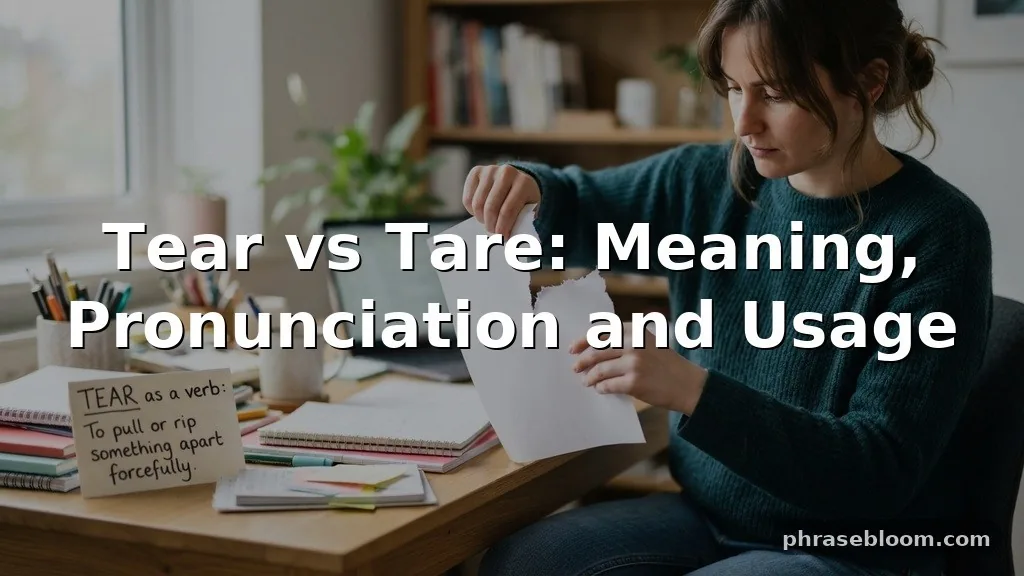
The difference between tear and tare depends on meaning, pronunciation, and context. Tear can mean to pull something apart, a rip in material, or a drop produced by the eye. Tare usually refers to packaging weight, or to the act of adjusting a scale to account for that packaging. In one pronunciation, tear and tare are homophones, but they are not interchangeable in writing.
Knowing the tear definition and tare definition helps you choose the right word in a report, instruction, message, or shipping document. The quickest rule is simple: use tear for ripping or crying, and use tare for weighing and packaging. The examples below also explain why the words sound different in some sentences.
Tear vs Tare: The Basic Difference
Tear has several common meanings. As a verb, it can mean to pull, rip, or separate something by force, as in “Please do not tear the label.” As a noun, it can mean either a rip or hole in fabric or paper, or a drop of liquid from the eye.
Tare belongs mainly to the language of weighing, shipping, cooking, manufacturing, and measurement. Its most familiar noun meaning is the weight of a container or other packaging, while its verb meaning involves setting a scale to disregard that container’s weight.
| Word | Main meaning | Typical pronunciation | Example |
|---|---|---|---|
| tear | Rip, pull apart, or liquid from the eye | /tɛr/ for rip; /tɪr/ for eye liquid | “Be careful not to tear the paper.” |
| tare | Packaging weight or scale adjustment | /tɛr/ | “The tare weight is printed on the label.” |
The spelling difference matters because a reader may understand “tare” as a measurement term and “tear” as an action or physical mark. A single letter changes the written meaning even when the pronunciation is identical.
In everyday writing, confusion is most likely in sentences about equipment, shipping, food preparation, or damaged materials. A warehouse worker may tare a weighing scale, while a customer may report a tear in a bag. The surrounding words usually make the intended meaning clear, but correct spelling removes avoidable uncertainty.
Tear Definition, Meaning, and Pronunciation
The word tear has two major pronunciation patterns. In “tear the envelope,” it is pronounced like “tair,” rhyming approximately with “care.” In “a tear rolled down her cheek,” it is pronounced like “teer,” rhyming approximately with “near.”
This makes tear an example of a word whose pronunciation changes according to meaning. The spelling stays the same, but the grammatical and semantic context tells the reader which form is intended.
Tear as a verb

Tear as a verb means to pull something apart, damage it by ripping, or move through something with force. It can take a direct object, as in “The machine tore the cardboard,” or appear in a phrase such as “The fabric began to tear.”
- “Do not tear the warranty card from the booklet.”
- “The child tore the wrapping paper before opening the box.”
- “A sharp edge could tear the protective sleeve.”
- “The runner tore through the final section of the course.”
The verb also appears in the phrase tear apart. That phrase may describe physically separating an object, such as tearing apart a sheet of cardboard, or emotionally damaging a relationship or group.
Tear as a noun
Tear as a noun has two common meanings. A tear may be a drop of fluid from the eye, or it may be a rip, split, or damaged opening in a material such as fabric, paper, plastic, or a sail.
The sentence “There was a tear in the curtain” uses the /tɛr/ pronunciation. The sentence “A tear formed in his eye” uses the /tɪr/ pronunciation. Context does the work that pronunciation alone cannot do in writing.
In a repair report, “tear in fabric” is the relevant phrase. In a personal narrative, “a tear in her eye” is more likely. Neither meaning uses tare, because tare relates to measurement rather than ripping or emotion.
Tare Definition, Meaning, and Pronunciation
The tare definition is closely connected to weighing. Tare weight is the weight of an empty container, wrapper, pallet, vehicle, or other material included with the item being weighed. It is not the weight of the product itself.
For example, suppose a sealed box and its contents weigh 12 pounds. If the empty box weighs 2 pounds, the product’s net weight is 10 pounds. The 2-pound container weight is the tare weight, and the 12-pound total is the gross weight.
| Measurement | What it includes | Example |
|---|---|---|
| Tare weight | Packaging or container weight | 2 pounds for an empty box |
| Net weight | Product weight without packaging | 10 pounds of product |
| Gross weight | Product plus packaging | 12 pounds total |
The tare pronunciation is usually the same as the “rip” pronunciation of tear. Both sound like “tair.” They remain different words because they have different spellings, histories, and meanings.
Tare as a verb
Tare as a verb means to set a weighing device so that the scale excludes the weight of an empty container. If you place a bowl on a kitchen scale and press the tare button, the display returns to zero while the bowl remains on the platform.
The instruction “Tare the scale before adding the ingredients” means “zero the scale with the container already in place.” A similar instruction might appear in a laboratory procedure, warehouse checklist, or manufacturing standard operating procedure.
For technical terminology and official measurement guidance, writers can consult the National Institute of Standards and Technology’s Office of Weights and Measures. The surrounding industry may use additional requirements for labeling, calibration, and records.
How to Use Tear and Tare in Real Sentences
Correct usage becomes easier when you connect each word to its typical setting. Tear belongs with paper, clothing, labels, eyes, and physical separation. Tare belongs with scales, containers, product quantities, shipping records, and net weight.
Examples with tear
“Please do not tear the inspection sticker when removing the outer packaging.” Here, tear is a verb describing damage to the sticker.
“The technician found a small tear in the protective fabric.” In this sentence, tear is a noun meaning a rip or split.
“The witness wiped away a tear before continuing.” This use refers to liquid from the eye, and it has the different /tɪr/ pronunciation.
“The storm could tear loose sections of the temporary covering.” The word again functions as a verb, but the sentence describes forceful separation rather than an existing hole.
Examples with tare
“Record the tare weight before filling the container.” The empty container must be weighed first so that the product quantity can be calculated accurately.
“The operator tared the balance scale before measuring the powder.” In this sentence, tared is the past tense of the verb tare.
“The shipping label lists the gross weight and the tare weight.” Both terms are measurement categories, so tare is the correct spelling.
“Place the empty tray on the weighing scale, then press Tare.” This instruction uses Tare as the name of a scale function or button.
One useful test is to replace the word with a more explicit phrase. If “rip,” “split,” or “drop from the eye” fits, choose tear. If “container weight,” “packaging weight,” or “adjust the scale to zero” fits, choose tare.
Why Tear and Tare Are Often Confused
The main source of confusion is sound. The pronunciation of tare is the same as the pronunciation of tear when tear means “rip.” Words with the same pronunciation but different spellings and meanings are called homophones.
Homophones create problems because speech does not reveal spelling. Someone may hear “the box has a tare” and need the surrounding context to determine whether the speaker means a measurement term, a tear in the box, or an imprecise statement.
Writing removes that ambiguity when the correct spelling is chosen. A warehouse report should say “a tear in the box” if the box is damaged, but “the box’s tare weight” if the report concerns the empty box’s mass.
| Intended idea | Correct wording | Why |
|---|---|---|
| Damage to cardboard | “There is a tear in the box.” | Tear means a rip or split. |
| Empty box weight | “The box has a tare weight of two kilograms.” | Tare means packaging weight. |
| Adjusting a scale | “Tare the scale before weighing the sample.” | Tare is the measurement-related verb. |
| Pulling paper apart | “Do not tear the paper.” | Tear is the action of ripping. |
The word tear also has an internal pronunciation issue that makes it especially challenging for English learners. The spelling represents both “tair” and “teer,” while tare normally has only the “tair” sound.
Grammar: Tear as a Verb and Noun
Grammar helps explain how tear behaves in a sentence. As a transitive verb, it can act on an object: “The blade tore the plastic.” As an intransitive verb, it can describe something that rips without naming an object: “The seam tore during testing.”
The past tense can cause a separate pronunciation and spelling issue. The past tense of “tear” meaning rip is usually tore, as in “The packaging tore along the seam.” The past participle is torn, as in “The label was torn.” These forms should not be confused with the verb tare, whose past tense is tared.
- Present: “The paper may tear.”
- Past: “The paper tore.”
- Past participle: “The paper was torn.”
- Measurement verb: “The technician tared the scale.”
As a noun, tear can be countable when it means a rip: “The jacket has two tears.” It can also refer to the liquid from the eye, as in “A tear fell onto the page.”
The phrase tear apart is a phrasal verb. “The reviewers tore apart the proposal” uses the phrase figuratively to mean severe criticism, while “The machine tore apart the scrap material” uses it literally.
These grammatical patterns make tear versatile, but they also make it harder to identify by sound alone. The noun or verb surrounding it usually provides the necessary clue.
Grammar: Tare, Tare Weight, and Net Weight
The word tare has a narrower grammatical range than tear. It is commonly a noun in phrases such as tare weight, and it is also a verb in instructions involving scales and measurement equipment.
In “The tare is listed on the shipping document,” tare is a noun referring to the packaging weight. In “Tare the container before filling it,” the word is a verb giving an instruction.
Measurement language often uses three related terms. Gross weight is the total weight of the product and its packaging. Tare weight is the packaging weight, and net weight is the product weight after the tare is removed from the gross weight.
The basic relationship can be written as:
Net weight = gross weight minus tare weight
For example, a filled drum may have a gross weight of 80 kilograms, while the empty drum weighs 12 kilograms. The net contents weigh 68 kilograms. In a record, the writer might state, “Gross weight: 80 kg; tare weight: 12 kg; net weight: 68 kg.”
A weighing scale may perform the subtraction automatically after the operator uses the tare function. The calculation still matters because the user must know whether the displayed value represents gross weight, net weight, or net weight after the container has been removed.
This is why “tare” should not be used as a general spelling for “tear.” A torn bag has physical damage; a tared scale has been adjusted for packaging weight.
Common Mistakes and How to Correct Them
Many errors occur because the words sound alike in ordinary speech. The best correction depends on the intended meaning, not on the pronunciation.
Using tare for physical damage
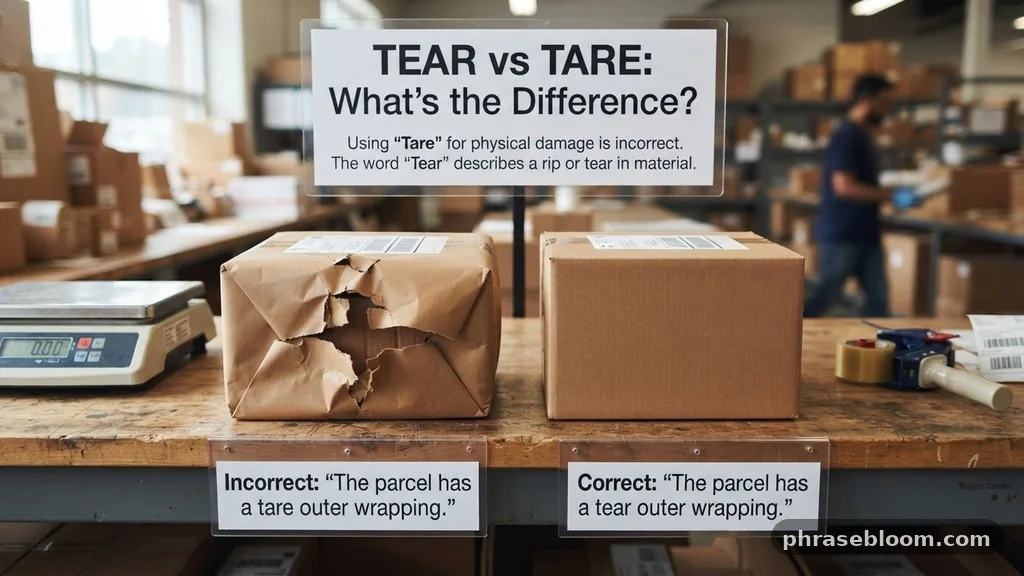
Incorrect: “The parcel has a tare in the outer wrapping.” Correct: “The parcel has a tear in the outer wrapping.” The sentence describes a rip, so the word must be tear.
Using tear for packaging weight
Incorrect: “Enter the tear weight of the container.” Correct: “Enter the tare weight of the container.” The relevant concept is the empty container’s weight.
Confusing tore with tared
Incorrect: “The operator tore the scale before weighing the sample.” Correct: “The operator tared the scale before weighing the sample.” Tore is the past tense of tear, while tared is the past tense of the measurement verb.
Writing a vague technical instruction
A sentence such as “Put the box on the scale and adjust it” may be understandable, but “Place the empty box on the scale and press Tare” is more precise. Clear instructions identify both the container and the scale function.
Assuming sound determines spelling
English spelling often preserves distinctions that speech does not. Since “tear” and “tare” may sound identical, writers should decide from meaning before typing the word.
- Can you replace the word with “rip” or “split”? Use tear.
- Can you replace it with “packaging weight”? Use tare.
- Does it refer to a scale button or adjustment? Use tare.
- Does it refer to eye fluid? Use tear, pronounced “teer.”
Practical Usage in Workplace and Technical Writing
In workplace communication, precision matters most in documents involving inventory, shipping, food production, laboratories, retail packaging, or manufacturing. A wrong spelling can make a sentence look careless and, in a technical context, obscure the intended measurement.
A warehouse instruction might read, “Verify the tare weight of every reusable container before loading the product.” This tells employees to identify the packaging weight, not to inspect the container for a rip.
A quality-control report might say, “A tear was found in the inner liner.” Here, the report concerns packaging damage. The two words could appear in the same document without any contradiction: “The tare weight was recorded, and a tear was later found in the liner.”
Examples for business documents
“The shipping team must record gross weight, tare weight, and net weight on the dispatch form.” This sentence uses standard measurement vocabulary.
“A tear in the carton made the barcode difficult to scan.” This sentence describes a physical defect.
“Please tare the balance scale before adding the sample.” This is a direct operating instruction.
“The customer reported a tear in the delivery bag, although the contents were undamaged.” The word tear functions as a noun and identifies the problem clearly.
“The packaging specification includes the maximum tare weight for each container size.” The noun tare modifies “weight” in a standard technical phrase.
In formal writing, avoid relying on a reader to infer the intended word from a vague sentence. If the distinction is central to a process, define the terms in a glossary or procedure and use them consistently throughout the document.
Quick Decision Guide for Tear or Tare
When you hesitate between the two spellings, pause before considering pronunciation. Meaning is the more reliable test.
| Question to ask | Choose | Example |
|---|---|---|
| Does it mean to rip or pull apart? | tear | “The tape may tear the paper.” |
| Does it mean a rip or split? | tear | “There is a tear in the fabric.” |
| Does it mean liquid from the eye? | tear | “A tear ran down her cheek.” |
| Does it mean packaging weight? | tare | “Calculate the tare weight.” |
| Does it mean adjust a scale to zero? | tare | “Tare the scale before measuring.” |
Next, check the grammar. If the word names a defect, action, or eye drop, tear is likely correct. If it appears beside “weight,” “scale,” “container,” “gross,” or “net,” tare is likely correct.
Finally, read the complete sentence aloud and inspect it visually. Reading aloud may reveal whether the sentence concerns ripping or weighing, while visual review confirms that the spelling matches the intended meaning.
FAQ: Tear vs Tare
What is the difference between tear and tare?
Tear can mean to rip something, a rip in a material, or liquid from the eye. Tare relates to weighing, especially the weight of packaging or the process of adjusting a scale to exclude that packaging.
Are tear and tare pronounced the same?
Tare is normally pronounced like “tair.” Tear is pronounced the same way when it means “rip,” but tear meaning liquid from the eye is pronounced like “teer.”
What does tare weight mean?
Tare weight is the weight of an empty container or other packaging. It is subtracted from gross weight to determine net weight.
Is “tear” a noun or a verb?
It can be both. As a verb, it means to rip or pull apart. As a noun, it can mean a rip in material or a drop of liquid from the eye.
What does it mean to tare a scale?
To tare a scale means to set it to zero while a container is on the platform, so the displayed measurement represents the contents rather than the container.
Conclusion: Choosing the Right Word
The practical distinction in Tear vs Tare is straightforward once you focus on meaning rather than sound. Use tear for ripping, a rip in material, or liquid from the eye. Use tare for packaging weight, net and gross weight calculations, or adjusting a weighing scale.
In professional writing, check the surrounding terms before choosing the spelling. If the sentence mentions a box, scale, container, or measurement, tare is probably right; if it describes paper, fabric, damage, or emotion, tear is likely correct. Keep the distinction consistent in reports and instructions, and share this explanation with anyone who regularly works with weighing or packaging terminology.
Related reading: Reconnoiter, Worn vs Warn, Unselect vs Deselect.
Explore more on PhraseBloom.