

Some of Whom vs Some of Who: Which Is Correct?
Some of whom vs some of who is mainly a question of grammatical case. In formal English, some of whom is normally the correct expression because “whom” is the object of the preposition “of.” The phrase refers to part of a group of people, as in “We interviewed several applicants, some of whom had worked abroad.”
“Some of who” appears in informal writing and speech, but it is generally avoided in edited prose. The choice becomes easier once you identify the pronoun’s role in the relative clause, check whether “of” governs it, and distinguish “some of whom” from the separate construction “some who.”
The direct answer: some of whom is usually correct
Use some of whom when you mean “some members of that group” and the group consists of people. The word “whom” follows “of” because it is the object of that preposition.
For example, consider this sentence: “The committee consulted twelve researchers, some of whom had studied the issue for years.” The antecedent is “researchers,” and “some of whom” means “some of the researchers.”
The phrase can appear in many sentence positions, but it commonly follows a comma after a noun referring to people. It introduces a relative clause that adds information about only part of the larger group.
- “The company hired eight designers, some of whom specialize in accessibility.”
- “She has three brothers, some of whom live overseas.”
- “The conference attracted hundreds of guests, some of whom arrived early.”
- “We contacted several witnesses, some of whom agreed to speak on the record.”
In each example, the phrase identifies a subset of people already mentioned. The relative pronoun “whom” is connected to the noun before it through the preposition “of.”
That does not mean “whom” is always required whenever people are mentioned. The correct pronoun depends on grammatical function, not simply on whether the antecedent is human.
What “some of whom” means
Some of whom means “some of the people previously mentioned.” The expression has a partitive meaning: it divides a larger group into a smaller, unspecified portion.
In “The museum displayed works by twenty artists, some of whom were local,” the phrase means “some of the twenty artists.” The word “some” identifies the portion, while “whom” connects that portion to the human antecedent “artists.”
The expression usually begins a nonrestrictive relative clause. That means the clause provides extra information rather than identifying which people the sentence means.
Compare these two sentences:
- “The manager spoke with five employees, some of whom requested schedule changes.”
- “The employees who requested schedule changes met with the manager.”
The first sentence says that some members of an already identified group made requests. The second identifies a particular group of employees by describing which employees requested changes.
The comma matters in the first example because “some of whom requested schedule changes” is additional information. It is not normally treated as an essential part of the noun phrase “five employees.”
“Some of whom” can also appear after a preposition in a longer structure. For instance, “The board selected six applicants, three of whom had previously worked for the organization.” Here, “three of whom” works in the same way as “some of whom.”
Why “whom” follows “of”
The difference between “who” and “whom” reflects grammatical case. “Who” is traditionally the subjective case, used for the subject of a verb, while “whom” is the objective case, used for an object of a verb or preposition.
In the phrase some of whom, “whom” is the object of the preposition “of.” You can test the structure by expanding it:
“Some of whom” means “some of the people.” The word “people” follows “of,” so the relative pronoun replacing “people” takes the objective form “whom.”
The same pattern appears in other expressions:
- “Several of whom were invited” means “several of the people were invited.”
- “None of whom replied” means “none of the people replied.”
- “Both of whom work here” means “both of the people work here.”
- “One of whom I recognized” means “one of the people I recognized.”
The grammar can feel confusing because “whom” may seem to be the subject of the verb that follows. In “some of whom were present,” however, the preposition “of” governs “whom,” while the larger phrase “some of whom” functions as the subject of “were present.”
That distinction explains why formal grammar traditionally accepts “some of whom were present.” The phrase as a whole is the subject, but “whom” remains the object of “of” inside that phrase.
For a concise reference on the broader distinction, see Merriam-Webster’s explanation of who versus whom.
Is “some of who” ever correct?
In standard formal English, some of who is generally not the preferred construction. Because “of” is a preposition, traditional grammar calls for its object form, “whom,” rather than the subject form, “who.”
For example, this sentence is generally edited as follows:
“The organization supports many volunteers, some of whom work remotely.”
“The organization supports many volunteers, some of who work remotely” is commonly understood, but it is likely to be marked as incorrect in formal writing. It may appear in casual speech because English speakers increasingly use “who” in places where older grammar would use “whom.”
There is an important difference between some of who and some who. The second expression can be completely correct because it does not contain the preposition “of.”
- Correct: “Some who attended the meeting submitted questions.”
- Formal standard: “The attendees, some of whom submitted questions, stayed afterward.”
- Generally avoided in formal prose: “The attendees, some of who submitted questions, stayed afterward.”
In the first sentence, “who” is the subject of “attended.” In the second, “whom” follows “of.” These are different grammatical structures, even though they refer to people from the same broad group.
If you are writing an academic paper, formal report, application, policy, or public-facing business document, use “some of whom.” It is clear, established, and unlikely to distract readers who expect traditional pronoun agreement.
Some of whom vs some who
The expressions some of whom and some who should not be treated as interchangeable. Both can introduce information about people, but they organize the sentence differently.
Use “some who” when “some” directly refers to people who perform the action in the relative clause. For example, “Some who attended the workshop stayed for the question period.” Here, “who” is the subject of “attended.”
Use “some of whom” when the phrase means “some of the people” and “of” connects the subset to an established group. For example, “The workshop had forty attendees, some of whom stayed for the question period.”
| Expression | Meaning | Grammatical role | Example |
|---|---|---|---|
| some who | Some people who | “Who” is the subject of a verb | Some who applied were selected. |
| some of whom | Some of the people previously mentioned | “Whom” is the object of “of” | The applicants, some of whom were experienced, impressed the panel. |
| some of who | Usually intended to mean “some of the people” | Uses subject-form “who” after “of” | Generally revise to “some of whom” in formal writing. |
Try removing the relative clause and reading the underlying phrase. “Some who applied” becomes “some people applied.” By contrast, “some of whom applied” becomes “some of the applicants applied.”
That substitution test often reveals the answer quickly. If “of the people” is part of the intended meaning, “some of whom” is usually the appropriate choice.
Examples in professional and academic writing
Formal writing often uses “some of whom” to describe a group without repeating the noun. The construction is especially useful in reports, research summaries, biographies, business communications, and meeting records.
Business reports

“The survey included responses from 240 customers, some of whom had used the service for more than a decade.” The phrase identifies a portion of the respondents without suggesting that every respondent had the same experience.
“The audit team reviewed six departments, some of whom had already changed their procedures” would not be correct because departments are not people. The sentence should say “some of which” or be rewritten as “some departments had already changed their procedures.”
Workplace communication
“The training was attended by thirty employees, some of whom requested additional materials.” This sentence works because employees are people and “whom” follows “of.”
“We invited several managers, some of whom will lead the next phase of the project.” The relative clause adds useful information about only part of the managers.
Academic writing
“The study examines twelve communities, some of which experienced rapid population growth.” Here, “which” is correct because communities are treated as things or places, not people.
“The interviews involved fifteen participants, some of whom reported similar concerns.” In this sentence, “whom” refers to human participants.
Academic writing tends to favor the traditional distinction because pronoun case contributes to a formal, carefully edited tone. It also helps readers see the structure of complex sentences.
Public and personal writing

“The festival welcomed local musicians, some of whom performed original songs.” The phrase sounds natural in a website announcement, brochure, or newsletter.
“I have several neighbors, some of whom volunteer at the food bank.” This is also appropriate in ordinary personal writing, although everyday conversation might use a shorter construction such as “Several of my neighbors volunteer at the food bank.”
How “whom” works after other prepositions
The same grammatical principle applies when “whom” follows prepositions other than “of.” Examples include “to whom,” “with whom,” “for whom,” and “by whom.”
- “The consultant, with whom we worked closely, prepared the report.”
- “The client to whom the letter was addressed had moved.”
- “The employee for whom the award was created attended the ceremony.”
- “The committee identified several witnesses, one of whom had recorded the conversation.”
In each example, the preposition creates an object position. The relative pronoun refers to a human antecedent, so formal English uses “whom.”
Modern English often moves a preposition to the end of a clause, especially in speech. “Who did you speak with?” is common and widely accepted in informal English, while “With whom did you speak?” sounds more formal.
That variation does not make “some of who” the safest choice. The phrase “of who” is still less established than “of whom,” and the formal form avoids unnecessary doubt.
In some sentences, you can avoid the issue entirely by restructuring the clause. Instead of “The applicants, some of whom we interviewed, received an email,” write “We interviewed some applicants, who later received an email.” The meaning may shift slightly, so revise only when the new wording accurately reflects the intended relationship.
Common mistakes and how to fix them
Many errors involving “some of whom” arise from confusing a subject pronoun with an object pronoun. Others come from overlooking the antecedent or using a relative clause that does not logically match the noun it describes.
Using “some of who” in formal prose
Original: “The panel heard from several witnesses, some of who had been present.”
Revision: “The panel heard from several witnesses, some of whom had been present.” The preposition “of” takes “whom” in the traditional objective case.
Dropping “of” unnecessarily
Original: “The panel heard from several witnesses, some whom had been present.”
Revision: “The panel heard from several witnesses, some of whom had been present.” The word “of” is not optional in this construction because it creates the relationship between the subset and the larger group.
Using “whom” when “who” is the subject
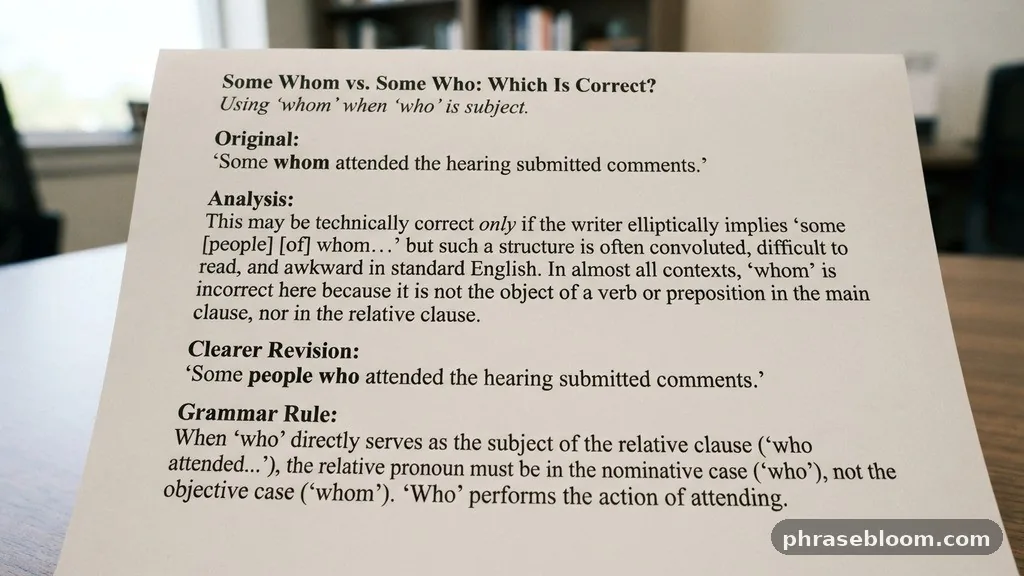
Original: “Some of whom attended the hearing submitted comments.” This may be correct if the writer means “some of the people who attended,” but the structure can be difficult to read.
Clearer revision: “Some of the people who attended the hearing submitted comments.” When “who” directly serves as the subject of “attended,” it is the natural subject pronoun.
Using “whom” for nonhuman antecedents
Original: “The software tools, some of whom were outdated, caused delays.”
Revision: “The software tools, some of which were outdated, caused delays.” Use “which” for things, animals in many contexts, organizations treated as entities, and other nonhuman antecedents.
Creating an unclear antecedent
Original: “The director spoke with the assistants about the interns, some of whom were frustrated.” The reader may not know whether “whom” refers to the assistants or the interns.
Clearer revision: “The director spoke with the assistants about the interns, several of the interns being frustrated.” Better still: “The director spoke with the assistants about the interns. Several interns were frustrated.” A short rewrite can remove an ambiguous reference.
How to choose the right form
A practical decision process can resolve most questions about “some of whom vs some of who.” Start by identifying the human antecedent, then examine the words immediately before the pronoun.
- Find the noun that the phrase refers to.
- Ask whether the noun refers to people or things.
- Check whether the phrase is “some of the people” or simply “some people who.”
- If “of” is part of the expression, choose “whom” for formal writing.
- Read the entire sentence aloud and check whether the reference is clear.
For example, “The agency contacted thirty residents, some of whom had filed complaints.” The antecedent is “residents,” the meaning is “some of the residents,” and “whom” follows “of.”
Now consider “Some who filed complaints received a response.” There is no “of.” The word “who” is the subject of “filed,” so “some who” is correct.
Another useful test is to replace the phrase with a personal pronoun. If you would say “of them,” choose “whom.” If you would say “they,” choose “who.”
- “Some of whom” corresponds to “some of them.”
- “Some who complained” corresponds to “some people who complained.”
- “Some of whom we interviewed” corresponds to “we interviewed some of them.”
This test is not a substitute for understanding the sentence, but it is a reliable practical shortcut in most formal contexts.
Formal English, informal English, and changing usage
The distinction between “who” and “whom” is less rigid in ordinary conversation than it is in edited writing. Many speakers use “who” in object positions, especially when it sounds more natural or when a preposition appears at the end of a clause.
For example, “Who did you invite?” is common in everyday English, while “Whom did you invite?” is more formal. Both are understood, but they create different impressions of tone and style.
“Some of who” is less secure than “who” in a question such as “Who did you call?” The phrase contains the fixed relationship “of the people,” so “some of whom” remains the standard choice for professional and academic writing.
Usage can change over time, and not every speaker follows traditional grammatical case distinctions. That does not make every variant equally suitable for every audience.
If you are writing a formal report, legal document, thesis, business proposal, or official announcement, use the established form “some of whom.” If you are speaking casually, a different construction may sound more natural, such as “Some of the people we met had already left.”
The goal is not to make every sentence sound ceremonial. It is to match the grammar and tone to the setting while keeping the intended meaning clear.
Alternatives that avoid the question
Sometimes the best revision is not choosing between “who” and “whom.” A sentence can often be rewritten to sound simpler and more direct without losing its meaning.
- “Several of the employees requested flexible hours.”
- “Some employees requested flexible hours.”
- “The employees who requested flexible hours met with human resources.”
- “Among the applicants were several people with engineering experience.”
- “A few members of the committee supported the proposal.”
These alternatives are useful when a sentence contains several clauses or when the antecedent could be ambiguous. They can also make business writing more direct for readers who are learning English.
Compare “The department consulted twenty clients, some of whom had used the service before.” The sentence is correct, but “The department consulted twenty clients, including several long-term users” may be more concise if that is the intended meaning.
Do not rewrite merely to avoid “whom” if the original sentence is clear and appropriately formal. “Some of whom” is a normal, useful construction, not a problem that must always be removed.
Sentence examples you can copy and adapt
The following examples show how the phrase works in different settings. Each one refers to a human antecedent and uses “some of whom” as part of a relative clause.
- “The company promoted nine employees, some of whom had joined as interns.”
- “We received applications from experienced nurses, some of whom were available to start immediately.”
- “The speaker answered questions from several audience members, some of whom had traveled a long distance.”
- “The board reviewed three proposals, two of which included a revised budget.”
- “The school invited former students, some of whom now work in public service.”
- “The report names several witnesses, none of whom were available for a second interview.”
- “The project team includes designers, some of whom specialize in accessible interfaces.”
- “The organization funds local programs, many of which serve rural communities.”
The fifth example uses “some of whom” because “students” refers to people. The eighth uses “many of which” because “programs” are nonhuman things or activities.
For a sentence using “some who,” write the phrase without “of”:
“Some who attended the orientation later volunteered to mentor new employees.” Here, “who” is the subject of “attended,” and the sentence does not mean “some of the attendees” as a separate noun phrase.
For a sentence that needs “whom” after another preposition, try this pattern: “The analysts, with whom we shared the preliminary data, provided useful feedback.” The phrase is formal but grammatically clear.
FAQ: some of whom vs some of who
Is “some of whom” correct?
Yes. “Some of whom” is the standard formal construction when the phrase refers to some people from a previously mentioned group. “Whom” is the object of the preposition “of.”
Is “some of who” correct?
It is encountered in informal speech and writing, but it is generally avoided in formal English. In edited prose, use “some of whom” when the intended meaning is “some of the people.”
Should I use “some of whom” before a verb?
Yes. Sentences such as “The delegates, some of whom were lawyers, attended the session” are grammatical. The whole phrase “some of whom” functions as the subject of “were,” while “whom” remains the object of “of.”
Is “some who” ever correct?
Yes. Use “some who” when “who” is the subject of the following verb, as in “Some who applied were invited to interview.” This is different from “some of whom,” which means “some of the people.”
Can I avoid the issue by rewriting the sentence?
Often. You can write “Several of the participants agreed” instead of “Several of whom agreed,” depending on the sentence. Rewriting is useful when it makes the antecedent or the intended meaning clearer.
Final takeaway on some of whom vs some of who
The safest formal choice in Some of Whom vs Some of Who is usually some of whom. Use it when you mean “some of the people” and the phrase follows the preposition “of.” Use “some who” when “who” is directly the subject of the following verb.
Before submitting a report, essay, email, or public announcement, check the antecedent and apply the “of them” test. If the sentence means “some of them,” choose “some of whom”; if a rewrite is clearer, use it. The point is accurate grammar and readable prose, not formality for its own sake.
Related: Team That, Team Who, or Team Which · Who to Contact or Whom to Contact · For Who or For Whom
Explore more on PhraseBloom.