
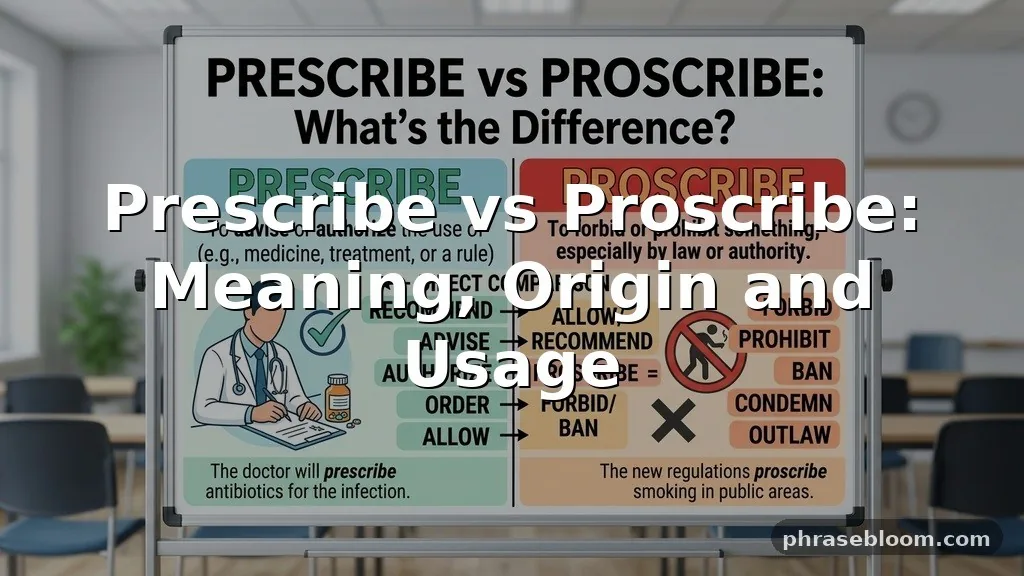
Prescribe vs proscribe is a classic vocabulary mix-up because the two verbs look and sound similar, yet their meanings point in opposite directions. To prescribe is to recommend, order, or authorize something, especially a medical treatment or a required course of action. To proscribe is to forbid, ban, or officially declare something unacceptable.
The difference matters in medical writing, legal documents, workplace policies, academic essays, and everyday communication. A doctor prescribes medicine, while a government may proscribe an activity. Once you connect prescribe with a prescription and proscribe with a prohibition, the distinction becomes much easier to remember and apply.
Prescribe vs Proscribe: The Direct Answer
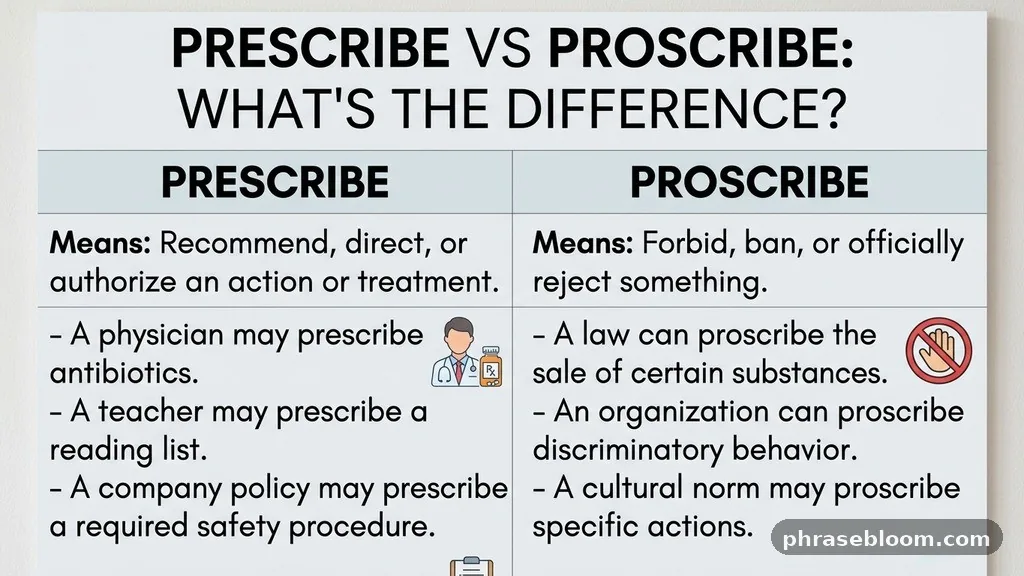
Prescribe means to recommend, direct, or authorize an action or treatment. A physician may prescribe antibiotics, a teacher may prescribe a reading list, and a policy may prescribe a required procedure.
Proscribe means to forbid, ban, or officially reject something. A law can proscribe the sale of a substance, and an organization can proscribe conduct that violates its rules.
| Word | Core meaning | Typical object | Example |
|---|---|---|---|
| Prescribe | Recommend, order, or authorize | Treatment, procedure, conduct | The doctor prescribed a new medication. |
| Proscribe | Forbid, ban, or condemn | Activity, practice, item, behavior | The rules proscribe unauthorized disclosure. |
The words are not interchangeable. Saying that a regulation “prescribes” bribery would normally suggest that the regulation requires or authorizes bribery, which is probably the opposite of the intended meaning. If the regulation forbids bribery, proscribes is the more precise verb, although “prohibits” will usually be clearer to a general audience.
A useful memory device is simple: a medical prescription tells you what to use or do, while a prohibition tells you what not to do. The first syllable supplies the clue, but the context should confirm your choice.
Prescribe Definition and Meaning
The basic prescribe definition is “to set down as a rule, direction, or requirement.” In modern English, the verb is especially common in medicine, where a qualified professional prescribes a drug, therapy, dosage, or treatment plan for a patient.
Medical use is only one part of the word’s meaning. A contract may prescribe how payments must be made, a building code may prescribe safety standards, and a project plan may prescribe the steps employees must follow. In each case, prescribe introduces guidance or an imposed requirement.
- A doctor prescribes medication for a diagnosed condition.
- A supervisor prescribes a procedure for handling customer complaints.
- A statute prescribes the requirements for obtaining a permit.
- A style guide prescribes a preferred form of citation.
- A coach prescribes a training schedule for the team.
The word can therefore range from a strong command to a formal recommendation. “The policy prescribes quarterly reviews” suggests that quarterly reviews are required or officially established. “The adviser prescribed more rest” may sound more like professional advice, although it can still carry an authoritative tone.
The noun prescription has the same broad connection. In a clinic, it is a written or electronic order for medicine. In a broader context, “a prescription for success” is a figurative recommendation or formula, not a legal prohibition.
Writers should pay attention to the object that follows the verb. You prescribe a treatment, procedure, remedy, method, or course of action. You do not normally prescribe something when your intended meaning is simply that you have banned it.
Proscribe Definition and Meaning
The proscribe definition is “to forbid or condemn as prohibited.” It is a formal verb that commonly appears in legal, political, academic, and institutional writing. If an authority proscribes an activity, that authority declares the activity unacceptable or forbidden.
For example, a workplace policy may proscribe harassment, a court order may proscribe contact with a protected person, and a government may proscribe an organization or practice under a particular law. The object of proscribe is something that must be avoided, not something that should be followed.
“The code proscribes discrimination in hiring” means that the code forbids discrimination. “The code prescribes nondiscriminatory hiring procedures” means that it sets out what employers must do. Both verbs can appear in the same document, but they perform different jobs.
Because proscribe is relatively formal, “ban,” “forbid,” or “prohibit” may be more natural in everyday writing. A public notice might say, “The park prohibits open fires,” rather than “The park proscribes open fires.” The formal verb is accurate, but clarity and audience should guide the final choice.
Proscribe can also describe public condemnation, particularly in historical or political contexts. An authority might proscribe a book, belief, group, or practice by declaring it unacceptable. The central idea remains exclusion through prohibition.
Do not treat the prefix pro- as meaning “in favor of” here. That shortcut does not work. The word’s history is older and more specialized, which is why its modern meaning must be learned as a whole.
The Etymology and Latin Roots
The difference between the words becomes clearer through their Latin roots. Both contain a form of scribere, meaning “to write,” which also appears in words such as describe, inscribe, and subscribe. Their prefixes, however, developed in different directions.
Prescribe comes from Latin praescribere, meaning to write beforehand or set down in advance. That historical idea fits its modern uses: a doctor writes an order for treatment, and a rule sets out what people are expected to do.
Proscribe comes from Latin proscribere, which involved making something publicly known or officially declaring it. Over time, the word became associated with public condemnation, exclusion, and prohibition. Its present meaning is therefore connected to officially marking something as forbidden.
The shared -scribe ending explains why the words look related, but it does not make them synonyms. Their Latin roots are useful as a memory aid, not as a substitute for understanding the modern definitions.
Pronunciation creates another source of confusion. In common American English pronunciation, prescribe begins with a short “prih” sound, while proscribe begins with a sound closer to “proh.” Both usually carry primary stress on the final syllable: pre-SCRIBE and pro-SCRIBE.
They are not exact homophones, but in fast speech the distinction can be easy to miss. That is one reason the error appears more often in writing than in careful conversation. If you remember the Latin connection but forget the modern meaning, check the sentence’s direction: is it requiring something or banning it?
For a concise reference, the Merriam-Webster entry for prescribe is useful, especially because it shows the medical and broader rule-setting senses together. A full dictionary comparison can also help reveal how each verb behaves with different objects.
How the Words Work in Real Sentences
The fastest way to understand prescribe vs proscribe is to compare them in realistic sentences. Consider a hospital policy: “The protocol prescribes a second review before discharge.” The protocol establishes an action that staff must take.
Now change the verb: “The protocol proscribes the disclosure of patient information.” The protocol forbids a particular action. The two words can sit in neighboring sentences, but their meanings move in opposite directions.
Examples with prescribe
- The physician prescribed a lower dosage after reviewing the patient’s test results.
- The employee handbook prescribes a written response to formal complaints.
- The project charter prescribes monthly reporting to the executive committee.
- The instructor prescribed three chapters for the next seminar.
- The safety plan prescribes protective equipment in the laboratory.
Each example tells someone what treatment, reading, process, or standard to follow. The prescribed item may be medical, administrative, educational, or technical, but it has been set out as guidance or a requirement.
Examples with proscribe
- The ethics policy proscribes gifts that could influence procurement decisions.
- The court order proscribed contact with the protected witness.
- The association’s rules proscribe the use of confidential member data.
- The regulation proscribes dumping waste into the river.
- The school code proscribes threats and targeted harassment.
These examples identify conduct that is not allowed. “Proscribes” works especially well when the prohibition comes from a formal authority, although “forbids” and “prohibits” may be better for plain-language communication.
Prescribe in Medical, Legal, and Everyday Writing
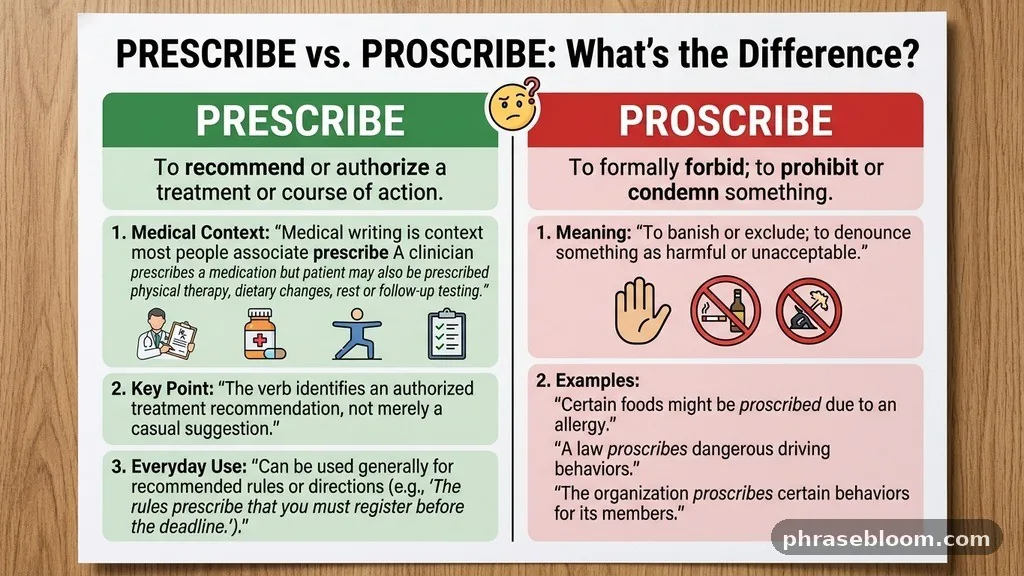
Medical writing is the context most people associate with prescribe. A clinician prescribes a medication, but the patient may also be prescribed physical therapy, dietary changes, rest, or follow-up testing. The verb identifies an authorized treatment recommendation, not merely a casual suggestion.
There is a practical distinction between “recommend” and “prescribe.” A friend can recommend an over-the-counter product, but only an appropriately authorized professional can prescribe a medical prescription. In professional documents, avoid using prescribe if you mean that someone offered an informal opinion.
Legal and administrative writing uses the verb in a broader rule-setting sense. A contract might prescribe the notice period for termination, while a regulation prescribes the information that an application must contain. Here, the word means “sets out as required,” not “provides medicine.”
Everyday English also permits figurative uses. Someone may say, “The best remedy is patience,” or “The manager prescribed a short break after the difficult meeting.” The figurative form works because the speaker is presenting a remedy or course of action.
In business communication, the verb can sound formal and authoritative. “The new procedure prescribes weekly checks” is suitable for a policy manual. In an informal email, “The new procedure requires weekly checks” may be more direct and easier for employees to understand.
Use prescribe when the sentence answers the question “What action, treatment, or method has been set out?” If the answer is a required or recommended course, the verb is probably correct.
Proscribe in Law, Policy, and Public Communication
Proscribe is most useful when a rule, authority, or institution identifies conduct that must not occur. A legal prohibition may proscribe bribery, unauthorized disclosure, obstruction, or access to a restricted location.
Policy writers should choose the word with care because it may be unfamiliar to some readers. “The policy proscribes retaliation” is precise, but “The policy prohibits retaliation” is often more immediately understood. Neither choice changes the underlying rule.
In academic writing, proscribe can help describe formal restrictions without repeating “ban” or “forbid.” For example, a historian might write that a government proscribed a political organization. A legal scholar might explain that a statute proscribes a certain form of conduct.
Public-facing communication usually benefits from plain language. A sign that says “Photography is prohibited” is clearer to most visitors than one that says “Photography is proscribed.” The less familiar verb may be justified in a specialized analysis, but it should not be used merely to sound sophisticated.
Proscribe also differs from “discourage.” If a company discourages employees from using personal devices for sensitive work, it is expressing a preference. If the policy proscribes that use, the policy presents it as forbidden. The strength of the verb matters.
Ask whether the subject is imposing a restriction. If it is, proscribe may fit. If the reader needs a quick and unmistakable instruction, however, “prohibit,” “forbid,” or “do not” may be the stronger editorial choice.
Common Errors and Reliable Memory Aids
The most common mistake is using prescribe when the sentence means “ban.” Writers may say that a law “prescribes” unsafe conduct when they intend to say that the law forbids it. Replace the verb with “requires” and “prohibits” during editing to test the intended meaning.
Another mistake is assuming that the two words differ only in spelling. They are related historically, but their modern definitions are distinct. A prescription gives direction, while a proscription creates a restriction.
- Prescribe: think “prescription” and “put forward a treatment or rule.”
- Proscribe: think “prohibition” and “prevent or ban.”
- Prescribe a course of action: tell someone what to do.
- Proscribe an activity: tell someone what must not be done.
- Recommend is usually closer to prescribe than to proscribe.
- Forbid and ban are usually closer to proscribe than to prescribe.
Do not confuse proscribe with proscribe as a synonym for “describe.” The spelling is close to several other verbs ending in -scribe, but the prefix changes the word’s meaning. Reading the whole sentence aloud may expose an unintended meaning, especially in legal or policy prose.
Finally, do not assume that a formal word is automatically a better word. Precision includes choosing language your audience will understand. In many public documents, “prohibit” communicates the restriction more efficiently than “proscribe.”
Prescribe vs Proscribe in Formal and Professional Writing
Professional writing requires more than selecting a technically correct word. You also need to consider audience, tone, field, and the practical consequences of ambiguity. A medical record, a contract, a research paper, and a customer email may all describe rules, but they do not need the same vocabulary.
In a medical record, “The physician prescribed oral medication” is standard and specific. In an employee handbook, “The policy prohibits retaliation” is usually clearer than “The policy proscribes retaliation,” unless the organization has an established legal drafting style that favors the latter.
Academic writing can use both terms effectively. A paper might explain that a professional code prescribes disclosure procedures while proscribing conflicts of interest. The contrast is valuable because it shows both what the code requires and what it forbids.
Business writers should also consider whether the verb describes a mandatory rule or a recommendation. “The framework prescribes a five-stage review” signals a defined process. “The framework recommends a five-stage review” leaves room for discretion.
Before finalizing a document, ask these questions:
- Does the subject tell people what to do, or does it ban an action?
- Would “requires” or “recommends” clarify the intended meaning?
- Would “prohibits,” “forbids,” or “bans” be clearer than proscribes?
- Does the document use formal legal terminology consistently?
- Could a reader misunderstand the sentence if the verb is unfamiliar?
A style guide may encourage plain language, while a specialized legal or academic publication may accept more formal diction. The strongest choice is the one that preserves the intended force and remains clear to the intended reader.
Alternatives That Make the Meaning Clear
Sometimes the best way to avoid confusion is to rewrite the sentence. Instead of “The policy proscribes personal data sharing,” write “The policy prohibits employees from sharing personal data.” The revised version is longer, but its meaning is immediately visible.
For prescribe, useful alternatives include “require,” “specify,” “set out,” “recommend,” “direct,” and “authorize.” They are not exact substitutes in every context. “Authorize” grants permission, while “prescribe” may impose a requirement, so the surrounding sentence still matters.
For proscribe, alternatives include “prohibit,” “forbid,” “ban,” “rule out,” and “disallow.” “Ban” can sound more forceful or public, while “prohibit” is common in formal policies. “Discourage” is weaker and should not replace a true prohibition.
Compare the following revisions:
| Original idea | Formal wording | Plain-language alternative |
|---|---|---|
| Set a required process | The rules prescribe a review process. | The rules require a review process. |
| Ban an action | The rules proscribe unauthorized access. | The rules prohibit unauthorized access. |
| Offer advice | The guidance prescribes regular backups. | The guidance recommends regular backups. |
| Reject an option | The policy proscribes that arrangement. | The policy does not allow that arrangement. |
Rewriting is especially useful for international audiences and readers working in a second language. It also helps prevent a stylistic concern from becoming a substantive misunderstanding.
Quick Guide to Choosing the Correct Word
Use this short decision process whenever you hesitate over prescribe vs proscribe. First, identify the direction of the sentence. Is an authority setting out a treatment, rule, or course of action, or is it placing something outside the permitted boundaries?
If the sentence points toward an action, choose prescribe. If it points away from an action, choose proscribe. Then test the sentence with a simpler replacement.
- Replace the verb with “recommend,” “require,” or “specify.” If the meaning still works, prescribe is likely correct.
- Replace the verb with “prohibit,” “forbid,” or “ban.” If that captures the meaning, proscribe is likely correct.
- Check the object. Treatments, methods, procedures, and requirements are often prescribed; prohibited conduct and restricted practices are often proscribed.
- Consider the audience. Use a plainer alternative if the formal verb might slow comprehension.
- Read the final sentence in context. A single word can change whether a policy appears to require or forbid an action.
For example, “The regulation prescribes the disposal of chemical waste” may mean that it sets out the required disposal method. “The regulation proscribes the disposal of chemical waste in the river” means that river disposal is forbidden. The object and the added detail determine the practical meaning.
This method works in editing, proofreading, and timed writing because it relies on function rather than memorizing isolated definitions. The key question remains: does the word establish a course, or does it exclude one?
Frequently Asked Questions
What is the difference between prescribe and proscribe?
Prescribe means to recommend, require, or authorize something. Proscribe means to forbid, ban, or officially condemn something.
Does prescribe mean the same as recommend?
They overlap, but prescribe often sounds more authoritative. A doctor may prescribe treatment, while an adviser may simply recommend an option.
Does proscribe mean the same as prohibit?
Usually, yes. Proscribe is a formal term for forbidding or banning something, while prohibit is generally more familiar and direct.
What is the easiest way to remember the difference?
Connect prescribe with a prescription, which tells you what to use or do. Connect proscribe with a prohibition, which tells you what not to do.
Are prescribe and proscribe homophones?
No. They are similar in spelling and pronunciation, but their first vowel sounds differ in standard pronunciation. In fast speech, however, the contrast can be easy to miss.
Final Takeaway on Prescribe vs Proscribe
The practical distinction in Prescribe vs Proscribe is straightforward: prescribe sets out a treatment, recommendation, or required course of action, while proscribe forbids or condemns an action. A doctor prescribes medicine; a law proscribes conduct that it does not permit.
When editing, test the sentence with “require” or “prohibit,” then choose the verb that matches the intended direction. If your audience may not know proscribe, use “prohibit” or “forbid” instead. Precision is useful, but clear communication is the final goal.
Related reading: Kafkaesque Meaning, Three Sheets to the Wind, “Same Difference”.